Showing posts with label Comma Johanneum. Show all posts

Friday, November 07, 2025

Peter Martyr Vermigli on 1 John 5:7

1

I was just doing some reading in Peter Martyr Vermigli’s Commonplaces tonight and came across his treatment of 1 John 5:7–8. Vermigli (1499–1562) was a major Italian Reformer who seems to be gaining renewed appreciation today. 

In his section defending the divinity of the Holy Spirit, he brings up 1 John 5:7. What caught my attention is that he does not think he needs the Comma to prove the Trinity since he finds everything he needs theologically in the part of the text that is not in question. What’s interesting about this is that this same trinitarian interpretation of the three (earthly) witnesses is the most likely cause the the clause about the three heavenly witnesses. In other words, because Vermigli follows the early interpretation of 1 John 5:7–8, he does not need to follow the later text of it to prove his point. Had later theologians followed his lead, the debate about these verses might have been far less extended and acrimonious.

Here’s his discussion. The full source is here.

Wednesday, August 17, 2022

The Comma Johanneum in the Earliest English Bibles

6

Last week I published a list of historic English Bibles to complement Pete Head’s list. Today, I want to illustrate one way to use it. In this case, I am interested in how the earliest printed English Bibles handle the famous variant in 1 John 5:7–8. (My interest was originally sparked by Hixson’s post.)

One thing you learn from studying these Bibles is that their translators often used whatever other major editions or translations they could to produce their Bibles. As one example, Coverdale used five “sundry translations” for his 1535 Bible and these probably included Luther, the Zurich Bible, Pagninus’s Latin, the Vulgate, and Erasmus (per David Norton). It’s worth looking at how these early English Bibles navigated the lack of uniformity on the Comma among their sources. So, here is a whistle-stop tour of the main English Bibles up to the King James.

1. Tyndale (1526)


2. Tyndale (1534)


I can’t find the so-called “GH” edition of Tyndale (1534/35) online but I assume it also had the Comma in brackets since it was the basis for the Matthew Bible (see below).

3. Coverdale (1535)


4. Matthew Bible (1537)


Monday, December 20, 2021

CSNTM at Houston Baptist University

2
A couple weeks ago I was in Houston with a few others from CSNTM. We have some brand new equipment that we were using at the Dunham Bible Museum at Houston Baptist University. The museum's director, Dr. Diana Severance, graciously allowed us to come photograph some of the early printed editions of the Greek New Testament in their collection.

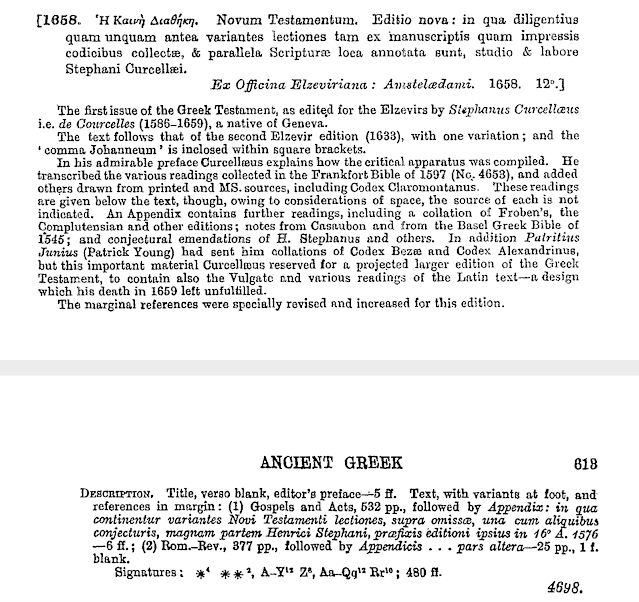
One interesting edition that caught my attention is a 1658 Elzevir edition edited by Étienne de Courcelles in which the Comma Johanneum was placed in brackets, indicating doubts to its authenticity. Here is a photo of that page—thankfully the images we took with our digitization equipment are of much better quality. Keep an eye out for images at CSNTM in the coming weeks.
1658 Elzevir text, edited by Étienne de Courcelles

Darlow and Moule's description of this edition is as follows:


Wednesday, December 01, 2021

On the Comma Johanneum in printed editions, “Which TR?” and working from inaccurate data

46

A long-ish post, but only because I care about data and getting it right.

One of the criticisms of Textus Receptus (henceforth, TR) advocacy is the question, “Which Textus Receptus?” (See the article by Mark Ward here). Instead of dealing with that question seriously, some TR defenders seem to brush it off as irrelevant.

For example, one TR advocate recently claimed that even though there are ‘minor’ differences between editions of the TR, all of them have the Pericope Adulterae (John 7:53–8:11), all of them have the Longer Ending of Mark (Mark 16:9–20), all of them have the doxology on the Lord’s Prayer (Matthew 6:13), all of them have the Comma Johanneum (1 John 5:7–8), and all of them have the Ethiopian’s confession at Acts 8:37.

Unfortunately, that statement is simply not true. Familiarity with the editions of the Textus Receptus themselves demonstrates as much.

I have seen I think at least one TR advocate respond with the No True Scotsman argument, redefining “Textus Receptus” to include only the editions that do have these passages (thus excluding Erasmus’ first two editions). That objection doesn’t work for three reasons:

1. Martin Luther himself used Erasmus’ second edition for his German translation of the New Testament, which lacked the Comma Johanneum. Even though later Lutherans added it after his death, Luther himself still rejected it. Additionally, the 1537 Matthew’s Bible places it in brackets in smaller type, which does indicate textual uncertainty.

Source: my own copy of the 1537 Matthew's Bible facsimile.

2. By my count there are not two but (at least) six editions of the TR that lack the Comma Johanneum (and if you argue that ‘canon’ extends to the very form of the text, an argument could be made for more editions that have a form of the Comma Johanneum but with a number of variations from the form of the Comma Johanneum in Scrivener’s TR as republished by the Trinitarian Bible Society, which seems to be the standard TR now).

Wednesday, October 13, 2021

Codex Ravianus and 5 lost manuscripts, now found

1

after Unknown artist,
line engraving, 1645
NPG D29240
© National Portrait Gallery, CC
In addition to the manuscripts I described here, a lot of (especially older or KJV-preferred) works will refer to another manuscript with the Comma Johanneum: one Codex Ravianus (named for it's former owner, Christian Ravis). E.F. Hills is honest enough to qualify his mention of Codex Ravianus: "The Johannine comma is also found in Codex Ravianus, in the margin of 88, and in 629. The evidence of these three manuscripts, however, is not regarded as very weighty, since the first two are thought to have taken this disputed reading from early printed Greek texts and the latter (like 61) from the Vulgate" (The King James Version Defended [1973 ed.]), pp. 204–205).

Still, it's worth looking into. Given how little Greek manuscript support there is for the Comma Johanneum, we might as well try to track down what we can.

A quick Google of Codex Ravianus reveals that it was once numbered 110 by Wettstein (not to be confused with GA 110), but it was later excluded from the list of Greek NT manuscripts because it is considered to be a copy of the Complutensian Polyglot. A part of me wants to poke at that a bit more, but on this, Tregelles writes:

The Codex Ravianus at Berlin certainly contains this passage; but the MS. itself is nothing whatever but a modern transcript taken almost entirely from the Complutensian Polyglott with a few readings introduced from the text of Erasmus. The very handwriting is an imitation of the Complutensian Greek types. The real character of this MS., which some in the last century were so incautious as to quote as though it possessed authority, was very fully shown by Griesbach and Pappelbaum. This MS. is now preserved at Berlin simply as a literary forgery, and not as the precious monument of the sacred text which it was once described as being. It is uncertain who formed this MS., and whether Rav[is] himself took a part in the fraud, or whether he was himself the dupe of others. A learned man who had not made MSS. his study might be thus misled. 
(Horne, Introduction to the Critical Study and Knowledge of the Holy Scriptures [10th ed.], vol. 4: Introduction to the Textual Criticism of the New Testament; "the critical part re-written and the remainder revised and edited" by Tregelles, p. 218)

That last sentence is relevant for more than just Codex Ravianus; let the reader understand. Still, Codex Ravianus doesn't turn up easily in a quick search. What can we know about it?

As Wikipedia can be a decent place to start (if never a good place to finish), I checked the Wikipedia page for Codex Ravianus.  According to it, the manuscript is (was!) in Berlin (Berlin, Staatsbibliothek Gr. fol. 1, 2). It is a 2-volume manuscript.

Friday, January 15, 2021

A claim that Jesus was a woman(!) and other things I’ve read about recently

4

Now that I’ve got your attention with my shamelessly clickbaity title, I mention below some observations from my recent reading. But the titular claim is not the only thing I could have used as clickbait! Below are discussions on a manuscript that contains the Comma Johanneum, facsimiles of the Chester Beatty papyri, and even a romance novel inspired by a manuscript!

1. Andrew J. Brown on Codex 61

Part of my job at CSNTM has been purchasing books for our physical library. One group of books that I have been eager to acquire is the four volumes of Andrew J. Brown’s edition of Erasmus’ text in the Amsterdam series, Opera Omnia Desiderii Erasmi Roterodami (ASD VI-1 through ASD VI-4). ASD VI-1 has not been published yet, but I was especially excited to get ASD VI-4 for CSNTM. This volume covers Erasmus’ editions of 1 Timothy–Hebrew, the Catholic Epistles, and Revelation. Brown’s editions are really remarkable. Take ASD VI-4, for example: Opening the 698-page book at random, you’ll see on average about 1/4 of the two-page opening given to Erasmus’ Greek and Latin texts and 3/4 to Brown’s notes. These notes cover textual variations among Erasmus’s editions, textual variants in the manuscripts he would have had access to and even Brown’s own text-critical observations. I even updated my post about textual commentaries to include Brown’s editions there.

Tuesday, January 07, 2020

The Greek Manuscripts of the Comma Johanneum (1 John 5:7–8)

55
Warning: long post because there’s a lot of detail here.

Although it is one of the easiest text-critical decisions, a lot of attention often goes to the Comma Johanneum (henceforth, CJ), the addition at 1 John 5:7–8 (addition in italics): “For there are three that bear record in heaven, the Father, the Word, and the Holy Ghost: and these three are one. And there are three that bear witness in earth, the Spirit, and the water, and the blood: and these three agree in one. (1 John 5:7-8 KJV).” A lot of people who take a textus receptus position vigorously defend the CJ because of its theological value. This was actually one of my first tastes of the implications of textual criticism—I was doing evangelism with my John MacArthur NKJV Study Bible back when I was much younger and found this amazing verse that ‘proves’ the Trinity, until my friend told me I couldn’t use it because it wasn’t original to 1 John but not to worry because there was ample proof of the Trinity elsewhere in Scripture. As it turns out, a mere appeal to 1 John 5:7–8 without also having a Trinitarian interpretation of the passage does not automatically ‘prove’ the Trinity, because Oneness Pentecostals (=a branch of Pentecostalism that denies the Trinity) who use the KJV also appeal to this passage as a proof of their anti-Trinitarian doctrine—they claim that the phrase “and these three are one” teaches their “oneness” doctrine (a great example here).

The Tyndale House Greek New Testament gives special treatment to the CJ by breaking its normal pattern of citing very few witnesses, and in the last few days, I decided to examine each of the Greek manuscripts that contain some form of the CJ to learn a bit more about each of them. The following are some of my findings. There are 10 Greek manuscripts that have the CJ, but only three of them have it in the same form as in Stephanus’ 1550 edition and Scrivener’s edition reprinted by the TBS—these three are 221marg, 2318 and 2473. All ten of these manuscripts are indexed for 1 John 5:7–8 at the INTF’s VMR, so you are free to verify them yourself. Regarding scribes and manuscript acquisition histories/provenance, I got all of that information from a combination of catalogues of manuscripts in those libraries (see the short bibliography at the end of this post) and shelfmarks/information given at the online Liste.

Before I get there, I want to mention that sometimes an eleventh Greek manuscript is cited. GA 635 is sometimes cited as having the CJ in the margin, but it does not.

GA 635 
I can’t make out all the words, but I’m seeing το πν(ευμ)α το αγιο(ν) και ο π(ατ)ηρ (και)...the rest is more difficult. αιματος? It’s probably an obvious solution, and I’m happy to update the post if someone has a better image or can make more sense of it. There are a number of notes like this in the margins of 635, and there isn’t room for the whole CJ here anyway, so I didn’t want to spend too much time on it.

Wednesday, August 07, 2019

More on Erasmus and Codex Montfortianus

15
Matthew in Montfortianus (per Wikipedia)
Last week I posted about the myth that Codex Montfortianus (GA 61) was made-to-order in response to a challenge by Erasmus to include it if even a single Greek manuscript could be found that had it. However, our excellent ETC commenters noted that, while it is true that Erasmus did not throw down such a gauntlet, it may still be true the Codex Montfortianus was made in response to his omission of the Comma Johanneum in his first two editions. Others, such as Tregelles, have indeed thought so.

In response, I quoted the opinion of Grantley McDonald, whose recent book on the Comma is extremely well executed (see my review).
Given the incomplete evidence, it is impossible to know why the scribe of Montfortianus altered his Greek text in so many places to conform to the Latin Vulgate. At several points throughout the manuscript, this scribe added variant readings from Erasmus’ 1516 New Testament in the margins. These variant readings are written in a slightly different ink and with different pens from that used for the body text, which may suggest that they were added later, perhaps days, perhaps years. It is clear that the scribe had access to Erasmus’ 1516 edition before relinquishing possession of the manuscript. It is less certain whether he copied it in direct reaction to Erasmus’ work. (pp. 32–33)
He goes on to cite Tregelles’s opinion. But McDonald thinks Tregelles is too confident since we might expect more readings in it that support Lee’s criticisms of Erasmus’ edition if it really was made to order.

Yesterday, however, I realized that in the thesis version of McDonald’s work, he seems a little more confident than in the published version that it was made for Erasmus. Here is what he says there, at the beginning of a detailed section on Montfortianius that is not included in the published book:
Further evidence allows us to date the manuscript quite firmly to the early sixteenth century. An examination of the textual variants in Codex Montfortianus has revealed that it was copied largely from manuscripts written in the second half of the fifteenth century, most of which were only gathered in one place after 1502; these data provide a terminus post quem for the copying of Montfortianus. It seems that Montfortianus also contains readings taken from Erasmus’ 1516 New Testament. The notion that Montfortianus was copied specifically to strong-arm Erasmus into including the comma—a suspicion hitherto based on nothing more than circumstantial evidence—thus becomes more plausible. (p. 315)
In the published version, he is less confident, but still open to the suggestion, writing, in a section not in his thesis:
Until the manuscript can be dated more precisely than the current estimate (c. 1500–1520), it is difficult to know for certain whether the scribe intended to influence Erasmus’ editorial choices. But that a recent Greek manuscript containing the comma—one of only two in the world—should have appeared in the homeland of Erasmus’ critic Lee, and should have been presented to Erasmus at the moment when it might make a difference, can certainly be described as a remarkable coincidence. (p. 33)
For my take, it still seems like a bit much to copy an entire NT manuscript just to influence Erasmus on one verse. But I certainly can’t say that this couldn’t have been part of the motivation. We may never know, but I thought I should give a bit more of McDonald’s own view given his expertise.

As a final note, any aspiring PhDs out there should note not only the quality of the content of McDonald’s thesis but also its typography and formatting. Something to aspire to.

Wednesday, July 31, 2019

Putting to Rest an Old Canard about Erasmus

29
Among text critics, it’s fairly well known that no Greek manuscript was ever produced to order for Erasmus that included the long form of 1 John 5.7. But given that the story is still found in the standard textbook and that it works as such a great illustration, it continues to be perpetuated among students of the New Testament. Here is the text of Metzger-Ehrman (p. 146):
In an unguarded moment, Erasmus may have promised that he would insert the Comma Johanneum, as it is called, in future editions if a single Greek manuscript could be found that contained the passage. At length, such a copy was found—or was made to order! As it now appears, the Greek manuscript had probably been written in Oxford about 1520 by a Franciscan friar named Froy (or Roy), who took the disputed words from the Latin Vulgate. 
Thankfully, Metzger and Ehrman do cite the work of Henk J. de Jonge who found no such promise from Erasmus but did find a text that seems to have been misread as such. The story of the Comma from the time of the printing press is now told in a remarkably detailed account by one of de Jonge’s students. It’s worth thinking about why this particular canard appeals to us so much. Why are we so easily taken by it? In any case, here is a letter from de Jonge to Michael Maynard on the matter:
From Michael Maynard, A History of the Debate over 1 John 5,7–8: A Tracing of the Longevity of the Comma Johanneum, with Evalutations of Arguments Against Its Authenticity. Tempe, AZ: Comma Publications, 1995.