Now that I’ve got your attention with my shamelessly clickbaity title, I mention below some observations from my recent reading. But the titular claim is not the only thing I could have used as clickbait! Below are discussions on a manuscript that contains the Comma Johanneum, facsimiles of the Chester Beatty papyri, and even a romance novel inspired by a manuscript!
Showing posts with label Chester Beatty Biblical Papyri. Show all posts
Friday, January 15, 2021
Wednesday, September 05, 2018
Rahlfs 967 of the Kölner Papyri of the Institute of Ancient History at the University of Cologne
![]() |
| Ra 967, p. 197 |
What I didn’t know previously is that the pages of this MS are divided between five different collections. The Verzeichnis (2004; pp. 98–103) lists the following (hyperlinks are to the images online of which I’m aware):
1. Chester Beatty IX + X: pp. 10–17 (upper half); 71–83 (upper half); 102–109 (upper half) (images of the pages from Dublin can be viewed at the CSNTM).For my purpose, I wanted to see how Esther began and ended in this MS; that is, I was interested to learn about its paratextual features. Unfortunately, there are no visible paratextual features (e.g. title or inscription) except the page number (p. 197) at the beginning, and the end of Esther is not extant in the MS.
2. Princeton, Univ. Libr., P. Scheide 3: pp. 20 + 22, 23–28, 30–32, 34–37, 40–45 (upper half).
3. Kӧln, IfA, P. Colon. theol. 3–40: pp. 10–17, 20, 22, 71–77, 79–83 (lower half); 90, 92–101 (upper half); pp. 18–19, 21, 29, 53–70, 84–89 (whole) (see images at Kölner Papyri of the Institute of Ancient History at the University of Cologne).
4. Madrid, CSIC (Fonds Photiaded), P. Matr. bibl. 1: pp. 10, 33, 38–39, 46–52.
5. Montserrat, SBO, P.Monts./II Inv. 42. 43: p. 78 (lower half), p. 91 (upper half)
![]() |
| Ra 967, p. 196 |
Of some interest is the placement of Esther after Susanna (p. 196), which contains a subscription: Daniel: [pe]ace to the one who wro[te] and to those who re[ad] amen. In other MSS, the order is Sus–Dan–Bel et Draco, but in this MS, Sus is placed at the end of the book and may have been intended to be joined to Esther, another virtuous woman. Who knows? No other Greek MS has this order. The order Sus–Esth is attested in Syriac MSS.
Both of these images are from the Kölner Papyri collection, and I’m grateful to curator Prof. Dr. Charikleia Armoni for answering my query and directing me to the digitized images and also being willing to send me higher resolution images upon request.
Friday, October 10, 2014
Nongbri on the Chester Beatty Biblical Papyri (Michigan Portion)
In the recent issue of Archiv für Papyrusforschung 60/1 (2014), Brent Nongbri has published an article on "The Acquisition of the University of Michigan's Portion of the Chester Beatty Biblical Papyri and a New Suggested Provenance."The title perhaps sounds too optimistic in regard to provenance—to cite the conclusion:
The goal of this paper was two-fold – to clarify the history of acquisitions of Beatty biblical papyri and to reassess what we know of the provenance of the find. I am reasonably satisfied with the results of the first task. As to the reassessment of provenance, I think dissatisfaction is the order of the day.Brent has kindly made his article available here.
Tuesday, November 12, 2013
The Chester Beatty Library Expedition: Guestpost by Peter Malik
The following is a report by Peter Malik, who was invited to join the CSNTM expedition to photograph the Chester Beatty papyri – photos which have just been published on-line (see previous post). A nice videoclip from the expedition in which Peter appears has also been published by the CSNTM.
* * *
At the end of July 2013, I was privileged to join the CSNTM team led by Dan Wallace and spend a couple of days (July 29–31) at Chester Beatty Library, studying P47, the earliest extensive manuscript of the book of Revelation. The invitation to join was due to friendly supportive efforts of one of the ETC’s Blogmeisters, Dr. Tommy Wasserman, who—without my prior knowledge of his cunning plans (!)—essentially set everything up, so I could come to CBL and study the MS while Dan and his team would be shooting it.
Besides simply being interested in the NT MSS in general and in the early papyri in particular, the main reason why I went to CBL to inspect P47 is that this MS is the main subject of my doctoral thesis, supervised by Dr. Peter M. Head (the other Blogmeister). Quite surprisingly, very little has been written on P47. Royse (Scribal Habits, 359) tells us that “[t]here have been remarkably few studies devoted to P47, and most of the attention given to it has concentrated on its textual relationships,” and Parker (Introduction, 234) further observes “[t]here seems to be no thorough palaeographical study of this codex.” Hence, I decided to take this challenge (at this partially) and take a closer look to see if more could be said about this MS, its scribe, and its text.
During my brief stay, I tried to check the discrepancies I found (having studied the images at VMR) especially in the editio princeps, Comfort & Barrett, and Royse. From the high-resolution images and, moreover, from the autopsy it soon became clear that much more can be seen in the MS than from Kenyon’s great, but dated edition.
Besides having fun with simply seeing the real thing in its own right, main highlights of the trip included several unspotted corrections (mostly of one letter), being able to observe much more transparent signs of scribal re-inking (at times virtually untraceable in the editio princeps, though now quite clearly visible in the images), and Dan’s kind offer to make microscopic and UV photographs of the more problematical spots. All I can say now is that I’ve got a lot of material to work with, and I know already that I’ll have to come to CBL again! I also can’t forget to mention that the new images produced by the CSNTM folks (finally on both white and black backgrounds) are of much superior quality to those made previously, so there’s a lot to be excited about in that regard as well.
Overall, it was all great fun. Among others, I owe my gratitude to those above mentioned folks, who made this trip possible, including my supervisor, who encouraged me to pursue this project as well as to see the MS. I also thank my college (Peterhouse) for providing all the necessary funding.
* * *
At the end of July 2013, I was privileged to join the CSNTM team led by Dan Wallace and spend a couple of days (July 29–31) at Chester Beatty Library, studying P47, the earliest extensive manuscript of the book of Revelation. The invitation to join was due to friendly supportive efforts of one of the ETC’s Blogmeisters, Dr. Tommy Wasserman, who—without my prior knowledge of his cunning plans (!)—essentially set everything up, so I could come to CBL and study the MS while Dan and his team would be shooting it.
Besides simply being interested in the NT MSS in general and in the early papyri in particular, the main reason why I went to CBL to inspect P47 is that this MS is the main subject of my doctoral thesis, supervised by Dr. Peter M. Head (the other Blogmeister). Quite surprisingly, very little has been written on P47. Royse (Scribal Habits, 359) tells us that “[t]here have been remarkably few studies devoted to P47, and most of the attention given to it has concentrated on its textual relationships,” and Parker (Introduction, 234) further observes “[t]here seems to be no thorough palaeographical study of this codex.” Hence, I decided to take this challenge (at this partially) and take a closer look to see if more could be said about this MS, its scribe, and its text.
During my brief stay, I tried to check the discrepancies I found (having studied the images at VMR) especially in the editio princeps, Comfort & Barrett, and Royse. From the high-resolution images and, moreover, from the autopsy it soon became clear that much more can be seen in the MS than from Kenyon’s great, but dated edition.
Besides having fun with simply seeing the real thing in its own right, main highlights of the trip included several unspotted corrections (mostly of one letter), being able to observe much more transparent signs of scribal re-inking (at times virtually untraceable in the editio princeps, though now quite clearly visible in the images), and Dan’s kind offer to make microscopic and UV photographs of the more problematical spots. All I can say now is that I’ve got a lot of material to work with, and I know already that I’ll have to come to CBL again! I also can’t forget to mention that the new images produced by the CSNTM folks (finally on both white and black backgrounds) are of much superior quality to those made previously, so there’s a lot to be excited about in that regard as well.
Overall, it was all great fun. Among others, I owe my gratitude to those above mentioned folks, who made this trip possible, including my supervisor, who encouraged me to pursue this project as well as to see the MS. I also thank my college (Peterhouse) for providing all the necessary funding.
Wednesday, September 18, 2013
The Chester Beatty Papyri Photographed by CSNTM

Press Release from the Center for the Study of New Testament Manuscripts (CSNTM):
17 September 2013
The Chester Beatty papyri, published in the 1930s and 1950s, are some of the oldest and most important biblical manuscripts known to exist. Housed at the Chester Beatty Library (CBL) in Dublin, they have attracted countless visitors every year. It is safe to say that the only Greek biblical manuscripts that might receive more visitors are Codex Sinaiticus and Codex Alexandrinus, both on display at the British Library.Perhaps it is needless to say that this very prestigious enterprise will be important for the CSNTM and its professional reputation. Hopefully this success can open up many doors in the future so that the scholarly community and everyone interested in New Testament manuscripts can have access to state-of-the-art images of these ancient Christian artefacts and the text they carry.
The Center for the Study of New Testament Manuscripts (CSNTM) is pleased to announce that a six-person team, in a four-week expedition during July–August 2013, digitized all the Greek biblical papyri at the Chester Beatty Library.The CBL has granted permission to CSNTM to post the images on their website (www.csntm.org), which will happen before the end of the year. The New Testament papyri at the CBL include the oldest manuscript of Paul’s letters (dated c. AD 200), the oldest manuscript of Mark’s Gospel and portions of the other Gospels and Acts (third century), and the oldest manuscript of Revelation (third century). One or two of the Old Testament papyri are as old as the second century AD.
Using state-of-the-art digital equipment, CSNTM photographed each manuscript against white and black backgrounds. The result was stunning. Each image is over 120 megabytes. The photographs reveal some text that has not been seen before. Besides the papyri, CSNTM also digitized all of the Greek New Testament manuscripts at the CBL as well as several others, including some early apocryphal texts. The total number of images came to more than 5100.
CSNTM is grateful to the CBL for the privilege of digitizing these priceless treasures. Their staff were extremely competent and a joy to work with. Kudos to Dr. Fionnuala Croke, Director of CBL, for such a superb staff! This kind of collaboration is needed both for the preservation of biblical manuscripts and their accessibility by scholars.
Since I happened to know about this expedition beforehand, I managed with short notice to organize for a student to go along on the expedition for a few days in the summer and study one of the papyri on site for his thesis work. He will do a guest blogpost about his wonderful experiences in the Chester Beatty Library – stay tuned.
Tuesday, January 05, 2010
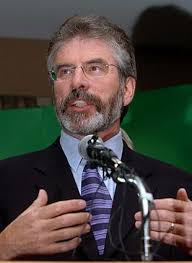
Sinn Fein Leader Gerry Adams in Search for Jesus and Papyrus 45
In a statement Channel 4 says that Mr Adams, "as a former supporter of political violence" would also examine the "contradiction between Jesus' teachings and the involvement of Christians, and followers of other faiths, in conflict the world over. Further, Ralph Lee of Channel 4 says the programme will "offer an insight into how a man so strongly associated first with conflict and then with peace in Northern Ireland, has reconciled his religion with the decisions he has taken in his life".
Read the whole story at BBC News here.
The Daily Mail, on the other hand, reports on the outrage it has caused as "Channel 4 invites Gerry Adams to preach... on forgiveness." Apparently, the former Tory minister Lord Tebbit, who was injured in an IRA bombing in 1984, burst out laughing when he heard about Gerry Adams's programme, and said: 'I wish him well. And I hope he also comes across the doctrine of hell and the consuming of pernicious unrepentant murderers and sinners in general by the fires of hell for all eternity."
It has come to my knowledge that the English film crew that produces this particular episode has recently visited the Chester Beatty Library in Dublin to shoot the significant Gospel MS Chester Beatty Biblical 1 (P45). (Note that the proper designation is Chester Beatty Biblical 1, or I, not Chester Beatty 1; the latter is in fact another manuscript, an ancient Egyptian Love Poem, published in the 1920's.)
See image and brief description of P45 here.
See also the on-line exhibition of Chester Beatty Biblical 2 (P46), "In the Footsteps of Saint Paul" including manuscript images.
Subscribe to:
Posts
(
Atom
)