Showing posts with label textus receptus. Show all posts

Wednesday, March 13, 2024

Guest Post by Timothy Decker: A Critical Apparatus of the Textus Receptus Tradition

29

The following is a guest post by Timothy L. Decker. He received his Ph.D. from Capital Seminary and Graduate School in 2021. He is a professor of Biblical Languages and New Testament at Covenant Baptist Theological Seminary and an adjunct professor of New Testament with International Reformed Baptist Seminary. He is also one of the pastors of Trinity Reformed Baptist Church near Roanoke, VA. His most recent publication is A Revolutionary Reading of Romans 13.

His edition of the Sermon on the Mount (which provides the data behind this post) is available here.

Wednesday, February 08, 2023

Martin Heide on Erasmus

15

Some of our readers may know that Martin Heide, one of our blog members, has written on Erasmus. His book Der einzig wahre Bibeltext? Erasmus von Rotterdam und die Frage nach dem Urtext (The Only True Bible Text? Erasmus of Rotterdam and the Quest for the Original Text) is now in its fifth edition. Martin has worked extensively in the languages over the years, contributing to and producing numerous critical editions of the versions. 

For those who don’t read German, you can sample his work on Erasmus in his new article at the Text & Canon Institute website: “Erasmus and the Search for the Original Text of the New Testament.” Here’s a taste:

The Novum Instrumentum was the only printed and published Greek text available at the onset of the Reformation and it has done the church a great service. The success and deep impact of the Reformation and its aftermath would be unthinkable without this new spiritual and intellectual basis of the New Testament text. Moreover, no cardinal doctrine is jeopardized by its obvious shortcomings. However, the Greek of the Novum Instrumentum, or the “Received Text,” as it was later called, “soon became, as it were, stereotyped in men’s minds; so that the readings originally edited on most insufficient manuscript authority, were supposed to possess some prescriptive right, just as if … an apostle had been the compositor” (Tregelles).

Monday, October 24, 2022

About that Dan Wallace quote

44

The quote

A line from Dan Wallace's foreword to Myths and Mistakes has been making the rounds on the internet, usually in the context of people who want to discredit textual criticism. If you've not seen it, here is what usually gets shared (Update: Thanks to Jeff Riddle, who caught my typos, which I think came from accidentally hitting cmd+x instead of cmd+c when copying the phrase to search on other sites; it has been corrected, as have the mis-phrasing in the first sentence, which I am not sure how I got wrong.):

“We do not have now – in our critical Greek texts or any translations – exactly what the authors of the New Testament wrote. Even if we did, we would not know it. There are many, many places in which the text of the New Testament is uncertain.” —Daniel B. Wallace, "Foreword" to Myths and Mistakes in New Testament Textual Criticism, edited by Elijah Hixson and Peter J. Gurry (Downers Grove: IVP Academic, 2019)
One website has it this way:
The quote according to one website (below a picture of Bozo the Clown).
UPDATE: A coworker of mine found this site down, so here is the site as of July 5th 2021.

In a recent book about the textus receptus, This quote shows up more than once, quoted by contributors Dane Johannsson (p. 112), Pooyan Mehrshahi (p. 174), and Christopher Sheffield (p. 212). In each of the three instances, the contributor gives the Wallace quote [update: "substantially exactly", by which I mean without the context; Johannsson and Mehrshahi add the word "thereof", which is not in the original quote] exactly as I quoted above (Update: the words are as I typed, not in all-caps as the screenshot has them).

This quote—again, exactly as I quoted above—is the very first one given in this list of "quotes that everybody should copy and paste" to try to discredit textual criticism. In fact, when I search that site for the phrase "Even if we did, we would not know it," I get 72 hits.

The quote even gets its very own page all to itself, here (with an interesting URL, I might add). I'm sure there are other examples as well. [Update: the URL has been corrected to give the quote in context.]

If this is all you've heard, it wouldn't be surprising—perhaps you would even be justified—if your reaction was something like this:
A normal Christian, new to textual criticism, hears the scary Dan Wallace quote out of context and reacts understandably.

The context

That sounds scary, but it's rare (if it ever happens) that it gets quoted in context. Here it is; I highlighted in yellow the sentences that you typically don't see when people share the quote—what Wallace says immediately before and after the words that usually get repeated:


Notice Wallace's point: "we also do not need to be overly skeptical." Wallace explicitly rejects "radical skepticism". What exactly, then, is Wallace describing? We can shed some light on that by looking at things he has said elsewhere. When we do, we see that in the spectrum between radical skepticism and absolute certainty, what Wallace is describing is much closer to the certainty end than to the skepticism end (which is near where E.F. Hills lands in the spectrum—like Wallace, Hills also rejects absolute certainty in every place).

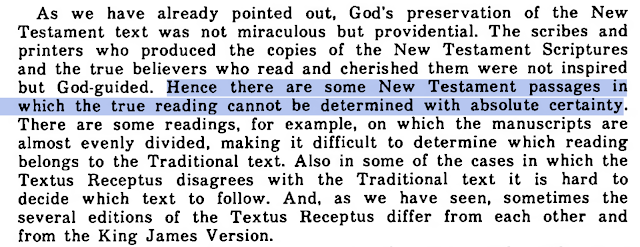
E.F. Hills rejects absolute certainty of the text of the New Testament
(Believing Bible Study, 2nd ed. [1977], p. 217)
Hills continues with a statement that I can agree with: "In other words, God does not reveal every truth with equal clearness. Hence in New Testament textual criticism, as in every other department of knowledge, there are some details in regard to which we must be content to remain uncertain. But this circumstance does not in the least affect the fundamental certainty which we obtain from our confidence in Gods special, providential preservation of the holy Scriptures. Through this believing approach to the New Testament text we gain maximum certainty, all the certainty that any mere man can obtain, all the certainty that we need."

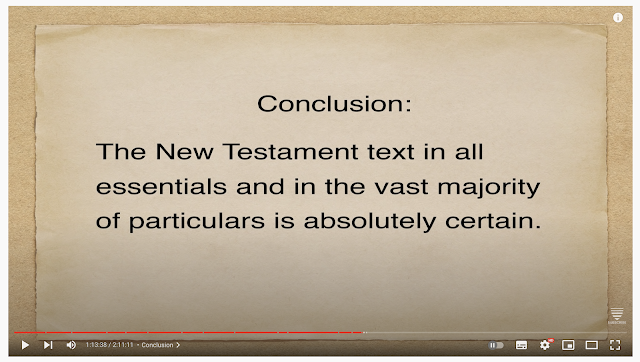
To take Wallace in his own words, here he is saying "The New Testament Text in all essentials and in the vast majority of particulars is absolutely certain."
Dan Wallace, saying something that doesn't look like radical skepticism to me.

What about the "many, many places in which the text of the New Testament is uncertain"? That might sound like it is a free-for-all in those places, where anything goes and anything is possible. Is that accurate though? [To be clear, I don't know if anybody made that inference from the quote, but in case they did:]

Here is a recent interview Wallace gave in which he says something that I have tried to point out to people when they ask me about it, and I think Wallace frames it helpfully. Here, he is talking about those places of uncertainty. Wallace says (screenshot and link below):

There's a few passages I could talk about, but understand that scholars have known what is in the original Greek New Testament for well over 150 years, because we have it above the line or below the line. It's not ... like um if you have a multiple choice it's either Text A, Text B, or Text C—it's never Text D—"none of the above." Never.

Wallace appearing on Preston Sprinkle's Theology in the Raw podcast.

I do think it would be helpful if we were more clear about these places of uncertainty—it's never "we have no idea what the original text is." Instead, it's "we are confident that in this place, it's one of these two [or rarely, three] options, but we're not completely sure which one. It can often be as simple as "Did Luke use one word for 'and' or a different word for 'and' here?"

Technical paragraph with examples of such 'uncertainty':
[9 of the 155 split line readings in ECM Acts is the 'uncertainty' between whether δέ or τέ is correct—at Acts 3:10, 12:17, 13:11, 13:52, 14:11, 15:6, 21:18, 22:23, and 24:27, and many others make about the same amount of difference as δέ/τέ. Similarly, 11 of the split line readings in the ECM Mark are transpositions involving all the same words: Mark 2:10, 3:27, 4:41, 5:19, 6:2, 6:38, 13:29, 13:30, 14:5, 15:29, and 15:34. That is to say, if we follow ECM Mark, there are 11 places where we can be sure which words belong in the text though we can't be sure if they should be in one order or a different order. Admittedly, not all of them are this inconsequential, but it would be inaccurate to say that none of them are.]

The problem

Now admittedly, one need not agree with Wallace to represent his own views fairly. One may genuinely think that modern textual criticism leads to radical skepticism in which we can't have any confidence in the NT text (though how many of its actual practitioners think so is perhaps a different discussion). One may not be able to distinguish between 0.1% uncertainty involving a choice between two knowns and 100% uncertainty in which anything is possible. And one might even think that having to choose between two readings where editions of the Textus Receptus differ is somehow categorically different from having to choose between two readings at an ECM split line.

That being said, is it really accurate to represent Wallace's words to mean something he explicitly rejects? What is hard for me to understand is how so many people can fail to mention what Wallace explicitly said, both immediately before and immediately after the section that gets quoted. The problem does seem to be quite pervasive.

When I go back to the website that had 72 hits for the phrase "Even if we did, we would not know it," I get zero hits when I search the words immediately prior ("must be avoided when we examine the New Testament Text"). The same is true of the words immediately following ("But we also do not need to be overly skeptical")—zero hits. Clearly, quoting Wallace in context doesn't seem to matter there.

Not one of the three quotations in the TR book gives the Wallace quote in the context of his rejection of radical skepticism. One even does the opposite: Christopher Sheffield (pp. 211–212) writes:

Daniel Wallace is one of the most prominent proponents of the modern Critical Text. In a foreword to the book Myths and Mistakes in New Testament Textual Criticism, he declares:

We do not have now – in our critical Greek texts or any translations – exactly what the authors of the New Testament wrote. Even if we did, we would not know it. There are many, many places in which the text of the New Testament is uncertain" (xii) [sic]

There you have it. We do not have the whole Word of God and even if we did, we wouldn’t know it. Listen carefully to what he is saying, “There are many, many places in which the text of the New Testament is uncertain.” (emphasis mine). Could there be anything more harmful to the child of God than to have some scholar take a proverbial Sharpie and write a giant question mark over every page of his Bible? That is what the modern Critical Text method does, and it can bear no good fruit in the child of God or in the church of Christ. Such a mindset does not provide patience, comfort, and hope (cf. Romans 15:4), but rather exasperation, anxiety, and despair. It will not produce stable believers with a growing confidence in their Bibles and willingness to labor and suffer for its proclamation, but only the opposite.
[I added the bold for my own emphasis. The italics are Sheffield's.]

Here, Sheffield's remarks seem to be in stark contradiction to what Wallace affirms both in his foreword to Myths and Mistakes and also in his interview that I posted. Admittedly, the interview was more recent than the publication of this book, but in a way that underscores my point—this confidence in the text was Wallace's position back when Sheffield was saying it wasn't. It seems to me that in most cases, the Wallace quote is given to 'prove' that Wallace (and by extension, modern textual criticism) is hopelessly uncertain with an implication that any verse is up for grabs—even though this type of uncertainty is explicitly what Wallace rejects.

In conclusion

1. Dan Wallace gets quoted out of context.
2. Quoting out of context is bad, so we should be extra careful to avoid it.


Final note:
No, Wallace did not ask me to write this. Yes, I do work for him, and I would have liked to get a response from him directly, but he wouldn't, as he typically doesn't respond to things like this. He did read a draft of this post though and agreed with how I represented him.

Thursday, October 06, 2022

Erasmus’ Letter to Maarten van Dorp (1515)

7
I’ve been reading Erasmus lately.
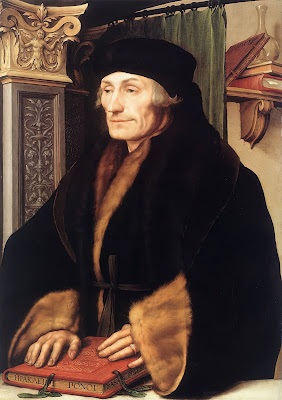
Erasmus, according to Wikipedia
In 1514, Erasmus’ friend Maarten van Dorp in Leuven had written a public letter to Erasmus (published as Ep. 304 in the Collected Works of Erasmus, vol. 3) which touched on In Praise of Folly, Erasmus’ edition of Jerome, and his work on the New Testament. Erasmus responded with a public letter back to Dorp (Ep. 337), which he wrote from Antwerp in 1515. I wanted to quote some of the parts of their correspondence about Erasmus’ New Testament here, but bear in mind that at this point, it was still a work in progress. Still, word gets around, and Dorp had some concerns.

Dorp suggests that it might be dangerous for Erasmus to presume to mess with the received text of the Vulgate:

DORP: “For it is not reasonable that the whole church, which has always used this edition and still both approves and uses it, should for all these centuries have been wrong. Nor is it probable that all those holy Fathers should have been deceived, and all those saintly men who relied on this version when deciding the most difficult questions in general councils, defending and expounding the faith, and publishing canons to which even kings submitted their civil power.” (CWE 3, p. 21)

It interested me as well to see that Dorp touched on the idea of certainty when it came to Erasmus’ work:

DORP: “And how can you be sure you have lighted on correct copies, assuming that in fact you have found several, however readily I may grant that the Greeks may possess some copies which are correct?” (CWE 3, p. 21, emphasis mine)

Looking back, we can see that Erasmus was not deterred by these questions; he would go on to publish his New Testament in five editions.

Erasmus also distinguishes between what is Scripture ontologically and what are the copies of Scripture that we receive, even ‘we’ on a broad scale (i.e. the church):

ERASMUS: “You think it wrong to weaken in any way the hold of something accepted by the agreement of so many centuries and so many synods. ... For no one asserts that there is any falsehood in Holy Scripture (which you also suggested), nor has the whole question on which Jerome came to grips with Augustine anything at all to do with the matter. But one thing the facts cry out, and it can be clear, as they say, even to a blind man, that often through the translator’s clumsiness or inattention the Greek has been wrongly rendered; often the true and genuine reading has been corrupted by ignorant scribes, which we see happen every day, or altered by scribes who are half-taught and half-asleep. Which man encourages falsehood more, he who corrects and restores these passages, or he who would rather see an error added than removed?” (CWE 3, pp. 133, 134, emphasis mine)

Erasmus then talks about his critics. He doesn’t name names, but he does poke at what he thinks are likely motives for some of the criticism of his work on the New Testament text:

ERASMUS: “These are the men who do not like to see a text corrected, for it may look as though there were something they did not know. It is they who try to stop me with the authority of imaginary synods; they who build up this great threat to the Christian faith; they who cry ‘the Church is in danger’ (and no doubt support her with their own shoulders, which would be better employed in propping a dung-cart) and spread suchlike rumours among the ignorant and superstitious mob; for the said mob takes them for great divines, and they wish to lose none of this reputation. ... St Augustine, that very great man and a bishop as well, had no objection to learning from a year-old child. But the kind of people we are dealing with would rather produce utter confusion than risk appearing to be ignorant of any detail that forms part of perfect knowledge, though I see nothing here that much affects the genuineness of our Christian faith. If it were essential to the faith, that would be all the more reason for working hard at it.” (CWE 3, p. 136)

Erasmus goes on, but I will stop here. He’s worth reading if you have the time and want to know more about the history of the New Testament text.

[Note: I wrote this post on Sept. 30th but scheduled it to post on Oct. 6th in order to space out the content here.]

Tuesday, August 23, 2022

Pierpont: Dean Burgon and the Received Text

13

Pierpont sent the first page of this short essay to Maurice Robinson on June 8th, 1990. The first page appears to have been written originally on April 14th, 1990. Later, on July 13th, Pierpont sent Robinson the second page. He writes: "The part page goes with and follows what I sent previously on "Dean Burgon and the TR". It is part of a further section, but Wilbur [Pickering] rightly suggested it be added here." I have added in links to the transcription to make checking the quotes easier.



DEAN BURGON AND THE RECEIVED TEXT

[By William G. Pierpont, 14 April–13 July 1990]

Dean Burgon has all too often been (deliberately?) misinterpreted by both friend and foe. This is still true today a century later. For example, "The Dean Burgon Society" consistently denies that Burgon would allow changes to the Textus Receptus until all MSS, Versions and Patristic evidence is in hand. Let us allow Burgon to speak for himself. (TT = "The Traditional Text of the Holy Gospels", CC = "The Causes of Corruption of the Traditional Text of the Holy Gospels", RR = "The Revision Revised")

First of all we must observe that he carefully distinguished between the Traditional Text and the Textus Receptus. He defended the former, not the latter, although he said that they do not greatly differ.

"Once for all, we request it may be clearly understood that we do not, by any means, claim perfection for the Received Text. We entertain no extravagant notions on this subject. Again and again we shall have occasion to point out (e.g. at page 107) that the Textus Receptus needs correction." RR-21 note 2.

"Yielding to no one in my desire to see the Greek of the New Testament judi­ciously revised...” (whereupon he goes on to say that it would be far better to let the TR stand than to go to the kind of text advocated and published by Westcott and Hort in 1881 -- though without naming them). CC-10,11.

His co-worker and editor reaffirms this: (Edward Miller)
"First, be it understood, that we do not advocate perfection in the Textus Receptus. We allow that here and there it requires revision. In the Text left behind by Dean Burgon, about 150 corrections have been suggested by him in St. Matthew’s Gospel alone. What we maintain is the TRADITIONAL TEXT." "I have kept before me a copy of Dr. Scrivener’s Cambridge Greek Testament, A.D. 1887, in which the disputed passages are printed in black type, although the Text there presented is the Textus Receptus from which the Traditional Text as revised by Dean Burgon and hereafter to be published differs in many passages." TT-5 and TT-95. (Only Burgon’s notes for changes recommended for Mt. Chapters 1-14 were published: in "A Textual Commentary upon the Holy Gospels, Part I. St. Matthew; Division I: i.-xiv." Edward Miller. 1899.)

"The Traditional Text must be found, not in a mere transcript, but in a laborious revision of the Received Text... which has been generally received during the last two and a half centuries." CC-1

There are many places in these volumes of Burgon which spell out the needed changes in certain passages, as well as further remarks similar to the above.

What is the problem? -- It is the radically revised-- almost rewritten "new" text which "the revisers" have thrust upon the world of Christianity in 1881. So unacceptable is it in every respect that to show it up for what it is takes preference over the much lesser task of revising the commonly Received Text.

As for the Received Text by comparison, "We do but insist, (1) That it is an incomparably better text than that which either Lachmann, or Tischendorf, or Tregelles has produced; infinitely preferable to the 'New Greek Text' of the Revisionists. And (2) That to be improved, the Textus Receptus will have to be revised on entirely different 'principles' from those which are just now in fashion. Men must begin by unlearning the German prejudices of the last fifty years; and address themselves, instead, to the stern logic of facts." RR-21 note 2. "...for, in not a few particulars, the 'Textus Receptus' does call for Revision certainly..." RR-107.

Specifically Dean Burgon called for correction, a revision of the Received Text, and he himself had done so for the Gospels, though most of it has been lost. He does not want to be misunderstood by friend or opponent: the Received Text must be revised. That is precisely what the Majority Text attempts to do.

[p. 2]

The question some have asked is whether the materials at hand to Burgon were adequate to make this necessary revision of the Received Text. Burgon answers this in 1864: "...the accumulated evidence of the last two centuries has enabled us to correct it with confidence in hundreds of places..." and "it is not to be supposed, (I humbly think, ) that we shall ever know much more about the sacred text than we know at present. But it is unquestionably to be believed that as the years roll on, and calm, judicious, conscientious criticism, (represented by such men as Mr. Scrivener,) extends its investigati[on] over the mighty field which lies before it, we shall attain to a greater and ye[t] greater amount of certainty as to the true readings of Scripture; approach nearer and yet nearer to the inspired autographs of the Evangelists and Apostle[s] of CHRIST." ("A Treatise on the Pastoral Office" pp. 69, 72, italics his.)

From what Burgon has said and done it is clear that he intended that correction. should be made now (in his lifetime) to the Received Text, based upon the plen[ty] of solid evidence, and further, that as more and more evidence is gathered and studiously and honestly examined some further changes must be made. It is ob­vious that he envisioned what every true textual critic aims for: a current edi[tion] of the Traditional Textform which is as accurate as the evidence in hand permi[ts]. Burgon had himself provided that first stage of correction in the notes he had developed himself and firmly intended should be published at that time.

He envisioned a progressively improved published text which conformed to the consensus of the multitude of MSS, and had provided the first step in that direction. But unfortunately it was never published in its entirity [sic], and the portion which was published (as noted above) seems almost unknown today.


Friday, June 17, 2022

“Guest Post” from the Grave: William G. Pierpont on E.F. Hills

14

With the permission of Maurice Robinson, I am making available one of Pierpont’s unpublished papers, an evaluation of E.F. Hills’ defense of the textus receptus. Some formatting may have changed a bit, but I include here both text (to make it searchable) and images of the paper itself (for transparency).

Edward F. Hills’ Views on the N.T. Text

[by William G. Pierpont]

Dr. Hills’ agenda is openly and clearly expressed in the title of the four editions of his book “THE KING JAMES VERSION DEFENDED,” of which this reviewer used the first (1956) and the second (1973), together with several items of personal correspondence (the last dated 10 June 1981, shortly before his death). During this period his basic premises and conclusions remained resolutely unaltered, although expressed in somewhat different ways.

His reverence, sincerity, integrity and scholarship are unquestioned. His presentation of facts is balanced, fair and precise, and often interestingly made. It is his interpretation and use of the facts, as well as certain presuppositions which we must examine.

Starting from the confidence that God is the God of truth, he lays out his two primary principles as:

a) the autographs of the NT were Divinely inspired, and therefore in­fallible, and that
b) because of this God must see that they were providentially preser­ved. (The logic for this step rests on Mt. 5:17+, 24:35, etc.)

Therefore, textual criticism of the Scriptures is different from that of other books. Its principles must be drawn from Scripture itself—and from creeds and other Church writings which are in agreement with Scripture—and used in constructing theories for criticism itself.

Providential Preservation (PP) forms the center about which his further presentation revolves. Summarizing his "axioms", he declares that:-

1) The purpose of PP is to preserve the infallibility of the autograph­ic text, and that God must have done so in a public way, i.e., so that all may know where and what it is-- not hidden somewhere among the MSS and requiring to be searched out.
2) It is the Greek text which is thus preserved, not a translated ver­sion of it. (God never promised that a translation would be kept free of errors, great or small.) Further, there may not be competing authorities.
3) During the long centuries of hand copying, PP operated through the Greek-speaking Christian community, who understood and used the language.
4) PP operated through the testimony of the Holy Spirit: only through Bible-believing universal Christian preiesthood [sic], those who have taken a supernatural view of the text, applying to it standards of judgment di­rected by the Holy Spirit, and were thus enabled to distinguish the true from the false. This was not only through the Spirit’s testimony to the individual’s soul, but also in the collective priesthood of believers through the ages (continuing onward into the Protestant period). Thus errors entering were weeded out by Divine Providence and guidance.
5) From the very first, PP supplied a multitude of trustworthy copies which were read and recopied, while faulty and untrustworthy ones fell out of use and passed into oblivion. Thus the genuine text was kept safe in the vast majority of MSS.
6) Thus the consensus agreement of this vast majority of copies forms the Traditional Text (TT), which accurately represents the originals and is the Standard Text.

This vast majority of MSS thus contains an essentially uniform text, al­though hardly any two MSS agree exactly throughout by reason of little individual variations and errors. Their differences are often hard to detect, being rare and small. This verifies that each descended indepen­dently from its own ancient ancestor, and therefore the text itself is ancient and not medieval in origin.

Wednesday, December 01, 2021

On the Comma Johanneum in printed editions, “Which TR?” and working from inaccurate data

46

A long-ish post, but only because I care about data and getting it right.

One of the criticisms of Textus Receptus (henceforth, TR) advocacy is the question, “Which Textus Receptus?” (See the article by Mark Ward here). Instead of dealing with that question seriously, some TR defenders seem to brush it off as irrelevant.

For example, one TR advocate recently claimed that even though there are ‘minor’ differences between editions of the TR, all of them have the Pericope Adulterae (John 7:53–8:11), all of them have the Longer Ending of Mark (Mark 16:9–20), all of them have the doxology on the Lord’s Prayer (Matthew 6:13), all of them have the Comma Johanneum (1 John 5:7–8), and all of them have the Ethiopian’s confession at Acts 8:37.

Unfortunately, that statement is simply not true. Familiarity with the editions of the Textus Receptus themselves demonstrates as much.

I have seen I think at least one TR advocate respond with the No True Scotsman argument, redefining “Textus Receptus” to include only the editions that do have these passages (thus excluding Erasmus’ first two editions). That objection doesn’t work for three reasons:

1. Martin Luther himself used Erasmus’ second edition for his German translation of the New Testament, which lacked the Comma Johanneum. Even though later Lutherans added it after his death, Luther himself still rejected it. Additionally, the 1537 Matthew’s Bible places it in brackets in smaller type, which does indicate textual uncertainty.

Source: my own copy of the 1537 Matthew's Bible facsimile.

2. By my count there are not two but (at least) six editions of the TR that lack the Comma Johanneum (and if you argue that ‘canon’ extends to the very form of the text, an argument could be made for more editions that have a form of the Comma Johanneum but with a number of variations from the form of the Comma Johanneum in Scrivener’s TR as republished by the Trinitarian Bible Society, which seems to be the standard TR now).

Thursday, August 26, 2021

Calvin’s Conjectures

13

Warning: This is a long post in which I trace out my research method and show the steps I try to take to find answers.

Introduction

John Calvin, probably.
Several months ago, I was reading F.F. Bruce’s chapter “Textual Problems in the Epistle to the Hebrews,” published in David Alan Black, ed., “Scribes and Scripture: New Testament Essays in Honor of J. Harold Greenlee.” In Bruce’s discussion of Heb. 11:37, Bruce opts for the P46 reading, which does have some scant attestation from minuscule witnesses, and Bruce calls in Zuntz (Text of the Epistles, p. 47) for support.  Not making any judgments on Bruce’s arguments, what intrigued me was Bruce’s next sentence: “So already Erasmus and Calvin.”

Those 5 short words sent me down a long rabbit trail.

What seemed to be implied here was that Calvin followed Erasmus in adopting a reading that was—as far as either of them were concerned—completely without known manuscript support. I checked the notes in the Amsterdam Database of New Testament Conjectural Emendation and there is a note on this conjecture that “…Erasmus could have known some Greek attestation, but his opinion seems independent from it.”

Of course, that doesn't necessarily prove that Erasmus had no manuscripts, but Jan Krans and co. know their stuff, and I am happy to defer to their judgment on Erasmus. That still leaves Calvin, however. On p. 184 of Johnson’s 1963 translation of Calvin’s commentary on Hebrews and 1–2 Peter (which Calvin published in 1549, according to T.H.L. Parker’s Calvin’s New Testament Commentaries), Calvin says:


Regardless of what we may say about Erasmus, it seems here that Calvin understood that the text was corrupted at some point in the transmission process, and that Erasmus’ explanation for what happened was correct.

From there, I was interested to see if there were any other times Calvin accepted or proposed a conjectural emendation: the notion that the text he has in his day was corrupt and that he suggested a correct reading even if there was no manuscript support for it.

When we search the Amsterdam Database, we find 13 hits for John Calvin, though two of them are sort of the same one (see below). Admittedly, that’s not much. [[At this point it’s good to give a brief explanation of the Amsterdam Database: When you search for an author, you’ll see a list of every time that author is included. This list is not a list of every time they have been the first to propose an emendation, nor is it a list of emendations they adopt—the “Author” in the list is the first to propose, and then clicking on the conjecture itself will show all the subsequent authors who commented on it, and whether they accept it, reject it or simply discuss it.]] Calvin is only the first to propose 5 of these 13 conjectures, but since 13 is not a huge number, I might as well list and discuss them all here.
Calvin’s conjectures

The date in parentheses is the publication date for Calvin’s discussion as I understand it, but it’s a little tricky. The translations I used (the series edited by D.W. and T.F. Torrance) were made from Tholuck’s edition (1834), which seems to be something of a re-print of the Amsterdam edition (1667), which is presumably made from the final editions of Calvin’s commentaries. I admit that’s a presumption on my part, and the date does matter because Calvin does seem to have shifted around 1548 from using Colinaeus’ 1534 edition as his working text to an Erasmus or Stephanus edition, as I discuss a bit more at the end of the post. In some cases I give an image of the text as additional proof that I’m not making stuff up. I haven’t been exhaustive with it though. My main purpose is to provide enough information for someone to be able to confirm what I’m saying, and at the most basic level, the Scriptural reference alone should be enough to do that.

Tuesday, July 13, 2021

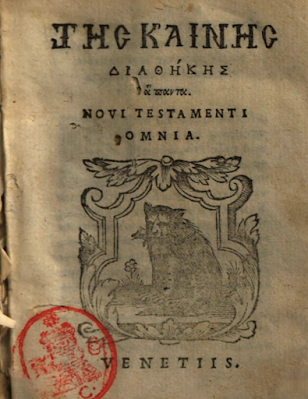
Melchior Sessa’s 1538 Greek New Testament online

1

It was once extremely rare; in 1941, Hatch knew of only 7 copies in the world.

I found one online yesterday at Google Books. Maybe this is old news to you, but it's new to me, and I was excited to find it.

According to Grantley McDonald, “The Basel printer Johannes Bebelius produced three editions (1524, 1531, 1535), based largely on Erasmus’ third edition … Bebelius’ third edition formed the basis of Johannes Valderus’ edition (Basel, 1536), which in turn served as parent for that of Melchior Sessa (Venice, 1538).” (Biblical Criticism in Early Modern Europe, pp. 56–57)

It’s also fun that this edition of the Greek NT has a cat on the title page. That should make some people happy.

Enjoy!

Thursday, March 11, 2021

Cardinal Bellarmine, Trent’s Major Apologist, on Important Variants

17

I’ve been doing some reading on the Council of Trent and its aftermath the last few weeks and would like to share some interesting finds. First, some context. Robert Bellarmine (1542–1621) was an important Roman Catholic theologian and a major apologist for Trent. More than a few leading Protestant polemicists recognized Bellarmine as their main target. As Cardinal Dulles explains:

When recalled by superiors to teach at the Roman College, Bellarmine produced his magnum opus, the Disputationes de Controversiis Fidei Catholicae adversus huius temporis haereticos, published in three large folios in 1586, 1588, and 1593. Although never translated as a whole into vernacular languages, this work remained for centuries the standard Catholic response to the Reformation.

Bellarmine
Dulles wrote that in 1994. Happily, there is now an effort to translate Bellarmine’s opus into English and put it online. It is well worth reading, not least because Bellarmine represents his positions so clearly and succinctly. He is also not afraid to criticize excesses on his own side of the debate.

One of the debates at the time was which version of the Bible was “authentic” and thus authoritative (see here). Hebrew, Greek, or Latin? The Protestants, of course, affirmed the original languages of Hebrew and Greek over against the Latin. Trent asserted the “authenticity” of the Latin, and said no one “dare, or presume to reject it under any pretext whatever.” (The role of Greek and Hebrew went unmentioned but the council did call—with varying success—for new editions of them.) It is Trent’s position that Bellarmine defends.

In the course of doing so, he comments on an argument, made by some Catholics, that the Greek New Testament had been so corrupted that the (purer) Vulgate has supreme authority. On this point, Bellarmine demurs, writing that 

there can be no doubt but that the Apostolic edition [Greek] is of supreme authority unless it be clear it has been corrupted. On this matter I judge one should think as we said above about the Hebrew editions, namely that the Greek codices are not generally corrupted; however the sources are not so very pure that necessarily whatever differs from them should be corrected, as Calvin, Major, Chemnitz, and the rest of the heretics of this age falsely think.

Disputationes (source)
He goes on to give some examples of where he thinks the Greek has been corrupted, before adding this concluding section on several variants that still get a lot of press today:

Finally it is clear that in many Greek codices there are missing many parts of the true Scripture, as the story of the adulteress John ch.8. The last chapter of Mark, the very beautiful testimony to the Trinity, I John, and others that we discussed above. It is also clear that certain things are found in all the Greek codices that are not parts of divine Scripture, as in Matthew ch.6 is added to the Lord’s prayer, “for thine is the kingdom and the power and the glory for ever.” That these words are not in the text but were added by the Greeks can be understood from two things.

First from the fact that Tertullian, Cyprian, Ambrose, Jerome, Augustine expound the Lord’s prayer and yet make no mention of these words, although all the Greeks know them well. Second from the fact that the Greeks in their liturgy recite these words indeed, but they are not continuous with the Lord’s prayer.

It’s probably no coincidence that the Reformed Scholastic Francis Turretin (1623–1687), writing a generation after Bellarmine, mentions all three of these “missing parts” in his discussion of “authenticity.” In each case, he finds the contested passage “in all the Greek copies” of his day (Institutes, vol. 1, Q.XI.X). This serves as proof, for him, against any notion that the Greek copies must cede authenticity to the Vulgate because of textual corruption.

One last observation about Bellarmine’s discussion. I notice a similarity, mutatis mutandis, between Trent’s view of the Vulgate and some present-day Protestant defenses of the TR. Both believe that usage has a key role in confirming authority. For Trent, the Vulgate’s authority is confirmed “by the lengthened usage of so many years.” For TR proponents, the TR’s authority is confirmed by the usage of such great theologians (the Reformers). Neither view convinces me, but it remains instructive to see how Bellarmine argues for his case.

Thursday, October 22, 2020

Why the Textus Receptus Cannot Be Accepted (Jan Krans)

67
Here follows a guest post from a colleague and reader of the blog, Jan Krans of the Protestantse Theologische Universiteit (PThU) in Amsterdam, author of Beyond What is Written: Erasmus and Beza as Conjectural Critics of the New Testament, NTTSD 35 (Brill, 2006).

Why the Textus Receptus cannot be accepted

In the discussion on the Textus Receptus two points of view exist that are diametrically opposed. I will first present the two views, and then demonstrate why only one of these can be sustained. 

In favour of the Textus Receptus

According to the first position the Textus Receptus has to be the one and only reliable text of the Greek New Testament. In other words it has to be the text that shows the correct reading at every single place of variation. Important historical-theological reasons are brought forward for this conclusion.

Historically speaking the Textus Receptus was the Greek New Testament text of the Reformation, during which the Bible itself took centre stage. Theologically speaking the Reformation was God-willed and God-given. Hence God himself used the Textus Receptus for his plans, condoned it, and even guided the minds and hands of its editors. In short the Textus Receptus has to be perfect.

There is even a biblical foundation for this view, for numerous Bible verses show that nothing of God’s word shall be lost: God assures that the Bible is transmitted in a pure and unaltered form. This form is the Textus Receptus.

With this position comes the conviction that the entire textual history since the establishment of the Textus Receptus has to be seen as degradation. Every textual change and every critical voice has to be suspect. For this corollary, again, historical-theological grounds can be given. The time since the Reformation, notably the Enlightenment, is marked by gradual alienation from God and detrimental human autonomy. Driven by the Enlightenment spirit, people began to undermine the Textus Receptus. Therefore all later texts and editions have to be rejected as thinly veiled attacks on God’s word.

It will be clear already at this stage that this first position can only be valid for those who share its most important presupposition, namely the special character of the Reformation, although this presupposition itself does not necessarily lead to the unconditional acceptance of the Textus Receptus.

Monday, January 13, 2020

Erasmus, the KJV, and the Order of Matt 23.13–14

16
If you are dutifully reading your Robinson-Pierpont (RP) Byzantine Greek NT alongside your Nestle-Aland or THGNT (as you should be), you will notice that they diverge at Matt 23.13–14. The Byzantine text here reads
13. Οὐαὶ δέ ὑμῖν, γραμματεῖς καὶ Φαρισαῖοι, ὑποκριταί, ὅτι κατεσθίετε τὰς οἰκίας τῶν χηρῶν, καὶ προφάσει μακρὰ προσευχόμενοι· διὰ τοῦτο λήψεσθε περισσότερον κρίμα. 14. Οὐαὶ ὑμῖν, γραμματεῖς καὶ Φαρισαῖοι, ὑποκριταί, ὅτι κλείετε τὴν βασιλείαν τῶν οὐρανῶν ἔμπροσθεν τῶν ἀνθρώπων· ὑμεῖς γὰρ οὐκ εἰσέρχεσθε, οὐδὲ τοὺς εἰσερχομένους ἀφίετε εἰσελθεῖν.

13. Woe to you, scribes and Pharisees, hypocrites! For you devour widows’ houses and for a pretense you make long prayers; therefore you will receive the greater condemnation. 14. Woe to you, scribes and Pharisees, hypocrites! For you shut the kingdom of heaven before men. For you neither enter yourselves nor allow those who would enter to go in.
Matt 23 in the 1611 KJV
The NA27 omits the first woe and numbers the second as v. 13. The KJV has both verses but inverts the order (and the versification) of the RP. (I’ll follow the RP versification rather than the KJV in the rest of this post.)

Normally, I expect the KJV to match the Byzantine textform, so what’s the deal here? It turns out the RP is indeed following the order of most manuscripts whereas the KJV is following most printed editions, editions that go back to Stephanus and before him to Erasmus. For a full list, see Abbot here). Erasmus’s first edition of 1516 has the KJV order. The Complutensian, however, has the reverse. Both orders are found in the two most important editions of Stephanus. In his beautiful 1550 edition, he has the RP order. But, in his 1551 edition, he reverses course, giving the Erasmian order and adds the versification followed by most since then.

Tuesday, January 07, 2020

The Greek Manuscripts of the Comma Johanneum (1 John 5:7–8)

55
Warning: long post because there’s a lot of detail here.

Although it is one of the easiest text-critical decisions, a lot of attention often goes to the Comma Johanneum (henceforth, CJ), the addition at 1 John 5:7–8 (addition in italics): “For there are three that bear record in heaven, the Father, the Word, and the Holy Ghost: and these three are one. And there are three that bear witness in earth, the Spirit, and the water, and the blood: and these three agree in one. (1 John 5:7-8 KJV).” A lot of people who take a textus receptus position vigorously defend the CJ because of its theological value. This was actually one of my first tastes of the implications of textual criticism—I was doing evangelism with my John MacArthur NKJV Study Bible back when I was much younger and found this amazing verse that ‘proves’ the Trinity, until my friend told me I couldn’t use it because it wasn’t original to 1 John but not to worry because there was ample proof of the Trinity elsewhere in Scripture. As it turns out, a mere appeal to 1 John 5:7–8 without also having a Trinitarian interpretation of the passage does not automatically ‘prove’ the Trinity, because Oneness Pentecostals (=a branch of Pentecostalism that denies the Trinity) who use the KJV also appeal to this passage as a proof of their anti-Trinitarian doctrine—they claim that the phrase “and these three are one” teaches their “oneness” doctrine (a great example here).

The Tyndale House Greek New Testament gives special treatment to the CJ by breaking its normal pattern of citing very few witnesses, and in the last few days, I decided to examine each of the Greek manuscripts that contain some form of the CJ to learn a bit more about each of them. The following are some of my findings. There are 10 Greek manuscripts that have the CJ, but only three of them have it in the same form as in Stephanus’ 1550 edition and Scrivener’s edition reprinted by the TBS—these three are 221marg, 2318 and 2473. All ten of these manuscripts are indexed for 1 John 5:7–8 at the INTF’s VMR, so you are free to verify them yourself. Regarding scribes and manuscript acquisition histories/provenance, I got all of that information from a combination of catalogues of manuscripts in those libraries (see the short bibliography at the end of this post) and shelfmarks/information given at the online Liste.

Before I get there, I want to mention that sometimes an eleventh Greek manuscript is cited. GA 635 is sometimes cited as having the CJ in the margin, but it does not.

GA 635 
I can’t make out all the words, but I’m seeing το πν(ευμ)α το αγιο(ν) και ο π(ατ)ηρ (και)...the rest is more difficult. αιματος? It’s probably an obvious solution, and I’m happy to update the post if someone has a better image or can make more sense of it. There are a number of notes like this in the margins of 635, and there isn’t room for the whole CJ here anyway, so I didn’t want to spend too much time on it.

Monday, December 30, 2019

Fact-checking Versional Support for the ECM and the textus receptus

18
It’s no secret that sometimes patristic citations and versions are used to make claims they don’t really support. I came across this issue the other day when I was looking at 2 Peter 3:10.

Coptic and the ECM at 2 Peter 3:10

The ECM (and the NA28 following) famously has a conjecture at 2 Peter 3:10, οὐχ εὑρεθήσεται. This reading is not found in any Greek manuscript, but the ECM claims some versional support: manuscripts of the Philoxenian Syriac, and among Coptic witnesses, the Sahidic and “Dialect V” (but V is cited videtur, so there is some potential uncertainty there). “Dialect V” is not one of the more well-attested Coptic dialects, so this citation seemed like the kind of thing I should look at more closely before citing it as supporting the conjecture. Just how many manuscripts were we talking about here?

Only one, it turns out (for this passage). P. Mich. 3520. And it’s damaged precisely at this part of 2 Peter 3:10.

The editio princeps gives the following transcription:

Source: Schenke, Hans-Martin, ed. (with Rodolphe Kasser) Papyrus Michigan 3520 und 6868(a), Ecclesiastes, Erster Johannesbrief und Zweiter Petrusbrief im fayumischen Dialekt. TUGAL 151. Berlin: De Gruyter, 2003.
And in German translation:

Source: same as above

P. Mich. inv. 3520, the bottom of p. 71r. (source)

Unless my Coptic is too rusty to be useful anymore, it looks to me like the ‘support’ for the οὐχ is coming from a reconstructed Ν in the lacuna on the last line, and my guess is that it’s a conjecture based on the Sahidic. It’s a bit speculative, but it doesn’t take much to imagine that the editors of P.Mich. 3520 thought “well since the Sahidic supports an underlying Greek οὐχ here, it’s probably the case that this lone manuscript of 2 Peter 3:10 in a different Coptic dialect does to.” Can we be this sure about a single-letter difference in a lacuna like this?

Maybe the reconstruction is correct, but maybe it isn’t. It’s not completely clear to me on the basis of P. Mich. 3520 that Dialect V should be cited as evidence of the ECM conjecture, οὐχ εὑρεθήσεται. It’s simply not extant for that part of the text.

[After I wrote all of that above, I noticed that Bart L.F. Kamphuis also addressed Dialect V’s ‘support’ for οὐχ εὑρεθήσεται in his recent monograph on conjectural emendation. Kamphuis makes the same point I make above and mentions that Christian Blumenthal makes the same point as well in his monograph on 2 Peter 3:10. I guess the moral of the story is to look things up before wasting time writing blogs about them?]

Ethiopic and the textus receptus at Rev. 16:5

The need to fact-check things like this brings to mind Rev. 16:5 in the textus receptus. Some editions of the textus receptus have ὁ ἐσόμενος there, and the KJV follows this reading, though not a single Greek manuscript (that isn’t itself a copy of a printed textus receptus) has it. This TR reading is a conjecture by Theodore Beza, plain and simple. The Amsterdam Database of New Testament Conjectural Emendation mentions that there is Ethiopic support, and I’ve seen Ethiopic support pop up in defenses of the KJV and Beza’s text as well.

That being said, the Ethiopic citation here just seems suspicious, for lack of a better word. It’s like Coptic Dialect V—the more obscure the reference, the fewer people there are who have (or even could have) looked at it more closely to verify it. How many text critics know Ethiopic and could check this? A few, I’m sure, but I certainly don’t. The Ethiopic ‘support’ at Rev. 16:5 seems to me to be exactly the sort of thing that needs to be verified by someone who knows Ethiopic before anybody puts any weight on the Ethiopic here.

I find two sources for the reference, and admittedly, I haven’t searched too hard. Hoskier cites it, but Hoskier seems to be dependent on Brian Walton’s London Polyglot, and his use of Ethiopic has not been immune from criticism. In an appendix to his dissertation that was not published in his monograph on scribal habits, James Royse wrote,
The cause of some of Hoskier’s errors is that Hoskier could not, as it appears, control the Ethiopic itself. For, as far as can be judged from his comments on P46 and his remarks in his work on Revelation, he depends on the Latin rendering of [the edition printed in Walton’s London Polyglot] and on Horner’s notes (and translation into English) in his edition of [the Sahidic]. (Royse’s dissertation, p. 718, n. 15)
Curt Niccum also has some severe criticism for Hoskier’s use of Ethiopic in his chapter, “Hoskier and his (Per)Version of the Ethiopic” in The Future of Textual Scholarship, writing that it “offers a case study for how not to mine the Ge’ez version for evidence of Greek readings” (p. 279).

If Hoskier was not the best for Ethiopic and was dependent on Walton, then that shifts everything back to Walton. Thankfully, here at Tyndale House, we have a copy of Walton’s London Polyglot in amazing condition.

The Latin translation of the Ethiopic does clearly translate the reading as et eris, which, if correct, certainly supports ὁ ἐσόμενος against ὁ ὅσιος:

Image credit: I took it myself at Tyndale House.
The Latin translation seems to have been made by Dudley Loftus. But how accurate is this translation? When I look it up, it doesn’t seem like Loftus’ translation was acclaimed for its accuracy. In 1934, James A. Montgomery wrote,
This Ethiopic text of the New Testament was republished by Brian Walton in the London Polyglot, the New Testament volume in 1657, and it is this form of the Ethiopic Testament that is generally known to scholars. The text was accompanied with a Latin translation, the first for that part of the Bible. Walton had as editors of this text Dudley Loftus of Dublin (1619-1695) and the distinguished Orientalist Edmund Castell, the latter revising the former’s work and seeing it through the press. But the new print was a degradation of the first one, and its Latin translation has been excoriated by scholars since Ludolf.
Earlier, F.H.A. Scrivener (the guy who put together the edition of the textus receptus that the Trinitarian Bible Society sells) said this about the reliability of the Ethiopic in the London Polyglot:

Source: Scrivener’s Plain Introduction, 3rd ed., p. 410 (thanks to Royse’s dissertation for pointing me to it).
Can any Ethiopic scholars shed some light on this? Does the Ethiopic in Walton’s Polyglot really support ὁ ἐσόμενος at Rev. 16:5, or is this one of those examples of “an unusually bad Latin translation” that should not be followed?

Here is the Ethiopic, according to Walton:

Image credit: Definitely not CSNTM. I mean, look at how skewed the photo is. Terrible. Still, I did the best I could do with my phone, the lighting that I had, and my desire not to damage a book that’s older than the country that issued my passport.
I should add that due to the holiday closures of libraries, I don’t currently have access to Josef Hofmann’s edition of Revelation in Ethiopic (and even if I did, I don’t know that it would help. I don’t know Ethiopic myself, or I wouldn’t be writing this post asking for help!).

In conclusion, here are my questions, if we have any readers who are competent in Ethiopic:
  1. Does the Ethiopic text printed in Walton’s London Polyglot support ὁ ἐσόμενος at Rev. 16:5 or not?
  2. Is the accompanying Latin translation correct, or is it not?
  3. Is there anything in Hofmann’s edition that could indicate that the Ethiopic could be cited in support of ὁ ἐσόμενος at Rev. 16:5?

UPDATE:
Now that the CUL is open again, I was able to check out Hofmann's edition. Below is his entry for Rev. 16:5. I'm very sorry it's awkwardly huge, but I wanted to make sure the resolution would be sufficient.

Source: Josef Hofmann, ed. Die Äthiopische Übersetzung der Johannes-Apokalypse. CSCO 281; Scriptores Aethiopici 55, pp. 116–117.


Thursday, May 09, 2019

Markan Priority, Messianic Secret, and the Textus Receptus

18
I’ve just finished reading David Parker’s essay in the new book The Future of NT Textual Scholarship (more on that here). Even though I disagree with the main thrust of Parker’s work in the Living Text of the Gospels, there are few text critics I enjoy reading more than him. He always gets me thinking about things in fresh ways or from new angles. And very often he is asking the right question even when I don’t agree with his answer.

Here is a case in point from the essay just mentioned, and I’d love to hear from people who are better versed in the history of Gospel scholarship than I am. On pages 398–399, Parker writes:
The result [of using 4th/5th c. manuscripts for critical editions] represented a huge change from the Textus Receptus. Gone were the Johannine Comma, the Pericope Adulterae, the Longer Ending of Mark. Gone too were so many harmonisations and alterations in the text of Mark that the new editions produced what by comparison with the Textus Receptus was a new version of the Gospel. A new approach to the Synoptic Problem and the influential theory of the Messianic Secret were just two developments that would never have been possible using the Textus Receptus.
Now, I would not have thought that certain views of the Synoptic problem or Wrede’s messianic secret theory weren’t possible using the TR. But that could well be due to my ignorance. Even if that’s an exaggeration, it does get me thinking about the degree to which certain prominent views in NT studies over the last 150 years wouldn’t be possible (or would be far less compelling) if we were all still using the TR. What say our readers on this question?