Showing posts with label bible translation. Show all posts

Thursday, August 08, 2024

Notable Textual Changes in the NRSVue NT

6

Produced by the National Council of Churches, the NRSV has long been the Bible of mainline Protestant denominations, those in the ecumenical movement, and the wider academy. It has never really been popular among evangelicals to my knowledge. That unpopularity goes all the way back to the controversy over its predecessor, the RSV. But that history is for another day. What we can say is that the NRSV’s reach is still in the top ten of English translations according to data from NPD Bookscan and published by the ECPA: the NRSV was the tenth bestselling English translation last month. 

Be that as it may, readers may not remember that six years ago I shared news about a planned update to the NRSV. You may also not remember that textual criticism was front and center as a justification for the need to revise, going so far as to name the CBGM itself. So, text-critical changes have been prominent in the justification for the NRSVue since the start. Besides that, the NRSVue is also noteworthy for text-critics because the general NT editor was none other than our own ETC blog member, Michael W. Holmes. (For the full list of contributors, see here.) 

So, what were the results? According to the preface, “The NRSVue presents approximately 12,000 substantive edits and 20,000 total changes, which include alterations in grammar and punctuation.” Obviously, most of these cannot be text-critical and many are in the OT. The new preface does have a pretty detailed section on textual criticism, at least as far as translation prefaces go. It says:

For the New Testament, the team based its work on three recent editions of the Greek New Testament: (1) The Greek New Testament, 5th revised edition (United Bible Societies, 2014); (2) The Greek New Testament: SBL Edition (Society of Biblical Literature and Logos Bible Software, 2010); and, (3) for Acts and the Catholic Letters, Novum Testamentum Graecum: Editio Critica Maior (Deutsche Bibelgesellschaft, 2013, 2017). Occasionally these editions differ in regard to text or punctuation; in such cases the team followed the reading best supported by a combination of both traditional and more recent approaches and considerations. As in the original NRSV, double brackets are used to enclose a few passages that are generally regarded to be later additions to the text but that have been retained because of their antiquity and importance in the textual tradition. Here and there in the notes the phrase “Other ancient authorities read” identifies alternative readings preserved by Greek manuscripts and early versions. In both Testaments, other possible translations of the text are indicated by the word “Or.” 

Textual criticism continues to evolve. Not only have additional manuscripts become available, but some of the goals and methodology have changed over the last several decades. This is more the case for reconstructing the books of the Old Testament and Apocrypha, but it is generally true for the entire enterprise. In the NRSVue, care was taken not to push too far ahead of the existing critical editions or to turn the translation itself and its notes into a critical edition. Nevertheless, a careful reader will notice in general a more generous use of the notes for alternative readings. The editors hope that this work will serve translators in the future.

In light of the emphasis on textual criticism, I wondered what changes I could find. This is just from my spot-checking, mind you. I haven’t found a list of changes anywhere yet.

  • Matt. 19.9: “And I say to you, whoever divorces his wife, except for sexual immorality, and marries another commits adultery, and he who marries a divorced woman commits adultery.” The longer reading was in the footnote before along with the reading of B and some others. I’m guessing this change is due to Holmes’s influence given his 1990 JBL article on the subject which you should all read and heed.
  • Mark 1.1: “The beginning of the good news of Jesus Christ.” To which I can only say, booooo! (The right reading is in the footnote and at least they got Mark 1.41 right.)
  • Luke 10:41-42: “But the Lord answered her, ‘Martha, Martha, you are worried and distracted by many things, but few things are needed—indeed only one.[a] Mary has chosen the better part, which will not be taken away from her.’ ” Note a gives the shorter reading that was the main text in the NRSV: “Other ancient authorities read but only one thing is needed.”
  • John 1.18: “No one has ever seen God. It is the only Son, himself God, who[f] is close to the Father’s heart, who has made him known.” Note f reads “Other ancient authorities read is the only Son who.” The former edition read “It is God the only Son, who...” with a slightly different note.
  • Acts 3.13: “The God of Abraham and Isaac and Jacob,[c] the God of our ancestors, has glorified his servant Jesus, whom you handed over and rejected in the presence of Pilate, though he had decided to release him.” Footnote c says, “Other ancient authorities read and the God of Isaac and the God of Jacob,” which is what the NRSV read before.
  • Eph. 5.22: the paragraph break is now after 5.21 instead of before with a new footnote that says there is no verb in 5.22. That’s an interesting combination of judgments, but at least can claim the support of Vaticanus.
  • 1 Pet 4.16: footnote now says, “Other ancient authorities read in this respect” (for “in this name”).
  • 2 Pet 3.10: footnote now says, “Other ancient authorities read will not be found or will be burned up.” The first part of that refers to the conjecture in NA28 which has support only of a few Coptic and Syriac witnesses.
  • Jude 5: “Now I desire to remind you, though you are fully informed, once and for all, that Jesus, who saved a people out of the land of Egypt, afterward destroyed those who did not believe.” The NRSV had “the Lord.”
For more on the process behind the NRSVue, see https://www.christiancentury.org/article/interview/even-better-bible

Wednesday, August 17, 2022

The Comma Johanneum in the Earliest English Bibles

6

Last week I published a list of historic English Bibles to complement Pete Head’s list. Today, I want to illustrate one way to use it. In this case, I am interested in how the earliest printed English Bibles handle the famous variant in 1 John 5:7–8. (My interest was originally sparked by Hixson’s post.)

One thing you learn from studying these Bibles is that their translators often used whatever other major editions or translations they could to produce their Bibles. As one example, Coverdale used five “sundry translations” for his 1535 Bible and these probably included Luther, the Zurich Bible, Pagninus’s Latin, the Vulgate, and Erasmus (per David Norton). It’s worth looking at how these early English Bibles navigated the lack of uniformity on the Comma among their sources. So, here is a whistle-stop tour of the main English Bibles up to the King James.

1. Tyndale (1526)


2. Tyndale (1534)


I can’t find the so-called “GH” edition of Tyndale (1534/35) online but I assume it also had the Comma in brackets since it was the basis for the Matthew Bible (see below).

3. Coverdale (1535)


4. Matthew Bible (1537)


Friday, August 12, 2022

Historic Editions of the English Bible Online

23
Some years ago, Peter Head put together a lovely list of historic editions of the Greek NT that are available free online. I have used that list more times than I can count. It’s wonderful to have them all in one place like that. 

Many times over the last year, I have found myself wanting a similar list but for early English Bibles. So that’s what I have given you here. It should be self-explanatory. The Bibles are listed chronologically and I have usually only included the most important edition(s) of each. If you know of better sources for some of these or see a correction needed, let me know in the comments.

Wycliffite Bible (14th c.)

First complete Bible in (middle) English.

  • Christ Church MS. 145 (14th c.): images and details; OT, NT, Apocryrpha
  • Egerton MS 617 (c. 1390-1397): images and details; Proverbs-Maccabbees; “the earliest datable copy of the complete Bible in English”
  • Egerton MS 618 (c. 1390-1397): images and details; Matthew-Revelation
  • Holy Bible, containing the Old and New Testaments with the Apocryphal books, in the earliest English version etc., ed. J. Forshall and F. Madden (1850), vol. 1, vol. 2, vol. 3, vol. 4
  • Searchable version.

Luther (1522, 1534)

Not an English Bible, but included because it was used by many of the early English translators like Tyndale.

Tyndale (1525–1536)

Coverdale (1535)

The first complete printed Bible in English; basis for the Matthew Bible where Tyndale wasn’t extant.

Matthew Bible (1537)

First complete English Bible licensed by the crown for sale in England; basis for the Great Bible and Taverner.

Great Bible (1539)

It was a BIG; basis for the Bishops’ Bible.
  • 1539: haven’t found one online
  • 1540: b/w PDF

Taverner’s Bible (1539)

Often neglected thanks, in part, to Westcott giving it short shrift.

Whittingham/Geneva (1557, 1560, etc.)

First English Bible with verse numbers, first to use italics to mark words not in the original, etc.
  • 1557 NT: 1 photo (only one I can find); Reprint
  • 1560 OT+NT: PDF (missing the note to the reader) color version on Google Books
  • 1570: A few color images
  • 1599: this has updated marginal notes which took a sharper Calvinist and anti-Catholic turn

Bishops’ (1568, 1602)

1602 was the basis for the KJV.

Douai-Rheims (1582, 1609/1610)

The first Roman Catholic translation in English, intended as a response to Protestant translations.

KJV (1611)

To quote Hixson (probably), “If it ain’t the King James, it ain’t the Bible.”

  • For the 1602 Bishops’ used by the translators, see here
  • 1611: color images; “He Bible” (thought to be the first 1611 printing); slightly larger pictures from UPenn
  • 1611: “She Bible” (thought to be the second 1611 printing)
  • 1767 Blayney: PDF – Thorough update behind most modern printings
Two other sources you may want to check, if you have access, are the English Short Title Catalogue (or STC) and Early English Books Online.

Thursday, March 03, 2022

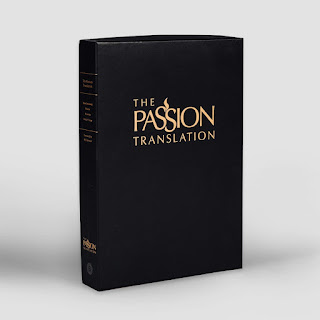
Passion Translation Removed from Bible Gateway

8

Here’s a bit of Bible translation news from last month. The very popular translation website Biblegateway.com has removed the Passion Translation from its list of available Bibles. Christianity Today has the story. What is the Passion Translation, you ask?

First released as a New Testament in 2017, The Passion Translation includes additions that do not appear in the source manuscripts, phrases meant to draw out God’s “tone” and “heart” in each passage.

Or, according to the publisher:

The Passion Translation is a modern, easy-to-read Bible translation that unlocks the passion of God’s heart and expresses his fiery love—merging emotion and life-changing truth.

Why was it pulled from Bible Gateway? Mainly, it seems, because its not a translation, but rather one man’s effort to combine his own idiosyncratic interpretations with occasional “insights” and readings from the “Aramaic” (presumably meaning the Syriac). To give you a taste, here is Eph. 6:5–8

5 Those who are employed should listen to their employers and obey their instructions with great respect and honor. Serve them with humility in your hearts as though you were working for the Master. 6 Always do what is right and not only when others are watching, so that you may please Christ as his servants by doing his will. 7 Serve  your employers wholeheartedly and with love, as though you were serving Christ and not men. 8 Be assured that anything you do that is beautiful and excellent will be repaid by our Lord, whether you are an employee or an employer. 9 And to the caretakers of the flock  I say, do what is right with your people by forgiving them when they offend you, for you know there is a Master in heaven that shows no favoritism.

Things do not get better in the footnotes. The first one, following the word “employers” (τοῖς κατὰ σάρκα κυρίοις) in v. 5, reads, “Literally ‘Servants should obey their caretakers.’” The last one, in v. 9, explains “caretakers of the flock” (οἱ κύριοι) with this:

As translated literally from the Aramaic. The “caretakers of the flock” can refer to both leadership in the church and in the workplace. The Greek text states “masters, do the same things to them, and give up threatening.”

If you can figure that out, let me know. You can still read it online at bible.com—but I don’t recommend it.

Tuesday, October 12, 2021

The New CSB Note at 2 Peter 3.10

0

Last night in class, the students and I were talking about how changes in the NA28 might affect English translations. So I pulled up 2 Peter 3.10 in the CSB as an example. I wrote about this note before and criticized it for being misleading. Lo and behold, the CSB has updated the note with what appears to be perhaps the first Bible footnote taken from an ETC blog post! I can’t be sure, of course, but the evidence looks compelling.

The old note at 2 Peter 3.10 said “Or will not be found” which read as if it was saying “some Greek mss read...” which is, of course, not the case. Now it says “Some Syriac and Coptic mss read will not be found.” That’s much better.

Here’s my ETC post.


And here’s the new CSB note.

Curiously, this change is not noted in the official list of changes in the CSB 2020 revision. But it certainly is a change from what I found in 2017.

Wednesday, September 15, 2021

GA 048 and the Text of Ephesians 5:22

23

Some years ago, I wrote a blog post on the text of Ephesians 5:22. There I suggested that the neglected longer reading (ὑποτασσέσθωσαν) seemed to me to be the more difficult reading while noting a simple transcriptional explanation for the shorter reading.

Since then, I have fleshed out my argument in much more detail and the result is a new article in NTS. (For those without access, here’s the pre-pub version.) If my textual argument is sound, the upshot is a resolution to the longstanding debate about where Paul starts his instructions to the household. Beginning with the RSV, English translations started to reflect the uncertainty by putting paragraph breaks before 5.21 or before both 5.21 and 5.22 (NEB, NIV1984, NRSV, NCV, etc.) while some still put one only before 5.22 (NKJV, NASB, ESV, NET). Commentators, of course, also disagree and the issue has become a lighting rod for debates about Paul and gender.

As part of my work on this variant, I revisited the text of 048 (Vat. Gr. 2061). 048 is a palimpsest with a fifth-century undertext from Acts and Paul. Given its early date, it’s quite important and is consistently cited in NA28. However, it is not cited at Eph 5.22. My guess is that this is because the last major collation of 048, done by Dale Heath in 1965 from photographic plates, says the text is illegible at this point. Well, I gave it a crack using the images at the VMR and some Photoshop adjustments and I’m pretty sure that this fifth-century witness has ὑποτασσέσθωσαν. Not surprisingly, it also has a new paragraph at 5.22 too. 

You can see my attempt to reconstruct the text and judge how I did. Red letters are ones I’m pretty confident about and blue are ones where I really can’t be sure about.


Because I didn’t have color images or MSI, I included 048 with “vid” in my article. So, here is my formal appeal for the Vatican to digitize this early manuscript using MSI and for someone to write a fresh dissertation on it. Even without new photos, I think there’s quite a bit more text to be deciphered than what Heath was able to if someone is willing to work at it.

Update

Christian spotted that the Vatican now has color photos that weren’t there when I worked on this last. They seem to use UV light. Posted below is a close shot of the color image with some heightened contrast. I only had a little time to spare today. Anon also alerted me to the IGNTP transcriptions that I didn’t know about. They disagree with my reconstruction so be sure to check that out too.

fol. 300r


Monday, September 13, 2021

Ozoliņš: Observations on ESV Old Testament Translation Notes

2

The following is a guest post from Kaspars Ozoliņš who has a PhD from UCLA in Indo-European linguistics and currently works as a Research Associate at Tyndale House in Cambridge.


Translation notes are a time-honoured tradition in biblical translation. Here, for example, is an excerpt from the preface “To the Reader” of the 1611 KJV:

[I]t hath pleaſed God in his divine prouidence, heere and there to ſcatter wordes and ſentences of that difficultie and doubtfulneſſe, not in doctrinall points that concerne ſaluation, (for in ſuch it hath beene uouched that the ſcriptures are plaine) but in matters of leſſe momentNow in ſuch a caſe, doth not a margine do well to admoniſh the Reader to ſeeke further, and not to conclude or dogmatize upon this or that peremptorily?They that are wiſe, had rather haue their judgements at libertie in differences of readings, then to be captiuated to one, when it may be the other.

Translation notes are in fact a very useful tool for expanding and clarifying particular words and passages, given the many complications involved in transferring the meaning of ancient texts written in languages generally unfamiliar to the reader. The NET version excels at this, containing no fewer than 60,932 translation notes. But such an abundance of information raises an important question. What are the intended audience(s) for such notes, and therefore, what kind of information ought to be included?

This question is especially germane to notes of a text-critical nature. Naturally, the academic or pastor will consult standard critical editions of the biblical text for information about variant readings for a given passage. So it would seem that text-critical notes in an English Bible are not aimed at such an individual, at least not directly. On the other hand, what purpose could be fulfilled by supplying a layperson with variant manuscript and versional readings?

Of course, the obvious answer is that some variants ultimately make a difference, especially when dealing with an inspired text. To that end, anyone engaging with the biblical text should take at least some interest in important variant readings. Text-critical notes in translated versions should be a kind of bare-bones apparatus presenting the most important variant readings which are exegetically significant and difficult to evaluate (i.e., valuable and viable).

Wednesday, April 28, 2021

Tyndale’s Use of ‘Jehovah’

11

William Tyndale (1491–1536) is known as the father of the English Bible because of the influence of his translation work. He is well known for giving to English Bible readers terms we now take for granted like anathema, godly, scapegoat, unbeliever, and zealous. He also gave us Jehovah for the divine name (spelled Iehouah or Iehoua). Tyndale was killed before he finished the OT, of course, but this translation of the divine name is found in his Pentateuch. 

What I didn’t realize until yesterday is that he does not use it in every case to translate יְהוָה. In fact, his use is quite sparing. A search of an online edition of Tyndale’s Pentateuch, turns up only seven results. Elsewhere, Tyndale treats the tetragrammaton the same way that Luther’s Bible did, by putting the first three letters in caps to mark it out. Thus, LORde akin to Luther’s HERr.

Tyndale’s 1530 Pentateuch at Gen 15.2f (source)

But if Tyndale did not use it always, how did he decide when to use it? Four of the seven cases are explainable because there is an explicit mention of יְהוָה as God’s name. The other five are all uses of הָאָדֹן יְהוָה (marked with an asterisk). He does seem to have missed Gen 15.8 though. Maybe he would have caught in revision had he lived to do so. 

  1. Genesis 15:2*
    And Abram answered: LORde Iehouah what wilt thou geue me: I goo childlesse and the cater of myne housse this Eleasar of Damasco hath a sonne.
  2. Exodus 6:3 
    and I appeared vnto Abraham, Isaac and Iacob an allmightie God: but in my name Iehouah was I not knowne vnto them.
  3. Exodus 15:3 
    The Lorde is a ma off warre, Iehouah ys his name:
  4. Exodus 17:15
    And Moses made an alter ad called the name of it Iehouah Nissi,
  5. Exodus 23:17
    Thre tymes in a yere shall all thy men childern appere before the Lorde Iehouah.
  6. Exodus 33:19 
    And he sayde: I will make all my good goo before the, and I will be called in this name Iehouah before the, ad wil shewe mercy to whom I shew mercy, and will haue compassion on whom I haue compassion.
  7. Exodus 34:23*
    Thrise in a yere shall all youre men childern appeare before the Lorde Iehouah God of Israel:
  8. Deuteronomy 3:24*
    O lorde Iehoua, thou hast begonne to shewe thy servaunte thy greatnesse and thy mightie hande for there is no God in heauen nor in erth that can do after thy workes and after thy power:
  9. Deuteronomy 9:26*
    But I made intercession vnto the Lorde and sayed: O Lorde Iehoua, destroye not thy people and thyne enheritauce which thou hast delyuered thorow thi greatnesse and which thou hast brought out of Egipte with a mightie hand.
One of the reasons I bring this up is because some recent English translations have made a big deal of using “Yahweh” in the OT for the Tetragrammaton. The 2004 HCSB did this when it came out but reversed course with the revised CSB in 2017. The in-process LSB also says it will use Yahweh. Until I checked, I had thought this was essentially a return to Tyndale’s approach. But I now see that is not the case. These modern translations really are innovating rather than returning to precedent. (Someone correct me if that’s wrong.)

Tuesday, March 09, 2021

A Myth/Mistake about the ESV

10
The ESV was not translated from the NA28, and the reading at Jude 5 is not an example of the ESV adopting the reading of the NA28.

(That’s the correct version, not the myth—just to be clear.)

I’ve seen this one several times before and was once even accused of bearing false witness against the ESV Translation Committee for saying that they did not translate the ESV from the NA28. The text-critical question is who saved the people out of Egypt? The UBS5/NA28/ECM/THGNT have “Jesus” (Ἰησοῦς), and the UBS4/NA27/Tommy Wasserman have “Lord” (κύριος). There is more to the variation unit than just that substitution, but that is the part I want to focus on here.

Before I get to why that is a myth, I’d like to acknowledge why I think I’ve seen it so much.

If you check the preface to the ESV, the “Textual Basis and Resources” section says the following:
The ESV is based on the Masoretic text of the Hebrew Bible as found in Biblia Hebraica Stuttgartensia (5th ed., 1997), and on the Greek text in the 2014 editions of the Greek New Testament (5th corrected ed.), published by the United Bible Societies (UBS), and Novum Testamentum Graece (28th ed., 2012), edited by Nestle and Aland. ... Similarly, in a few difficult cases in the New Testament, the ESV has followed a Greek text different from the text given preference in the UBS/Nestle-Aland 28th edition. Throughout, the translation team has benefited greatly from the massive textual resources that have become readily available recently, from new insights into biblical laws and culture, and from current advances in Hebrew and Greek lexicography and grammatical understanding.
That is both in the online version and in recent (at least since 2016) print versions.

Furthermore, if you check Jude 5 in the ESV, we see that it translates the reading adopted in the NA28 and the Tyndale House GNT:

Source: https://www.esv.org/Jude/

Those two things are enough to make someone think that the ESV is simply following the NA28 here.

However, there is more to the story.

I attach below images from my own copy of the 2001 ESV, which I’ve had since college. Here are pictures of the copyright page (to show that it is the 2001 edition), the “Textual Basis” section from the preface, the text of Jude 5 and the text-critical footnote for Jude 5.

ESV 2001 Copyright page

ESV 2001 Textual Basis

ESV 2001 Jude 5

ESV 2001 Jude 5 text-critical footnote

Now, assuming I’m not bearing false witness with these photos (I promise I am not, but of course, that’s exactly what someone who was bearing false witness would say, so please do find an ESV 2001 and check it yourself rather than take my word for it), here we have the reading adopted by the NA28, Ἰησοῦς (against κύριος in the NA27 and in Tommy Wasserman’s Epistle of Jude: Its Text and Transmission).

The thing to remember here is that Ἰησοῦς was adopted by the ESV Committee eleven years before the NA28 was published. The 2001 ESV was also published four years before the publication of Installment 4 of the text (2–3 John, Jude) of the ECM1 Catholic Epistles (2005), which also adopted Ἰησοῦς before the NA28 (2012) or the ECM2 of the Catholic Epistles (2013). Unless Wayne Grudem is a Time Lord, this demonstrates that the ESV did not get the Ἰησοῦς reading from the NA28. Instead, the ESV Committee broke from the NA27’s main text at Jude 5 and adopted the Ἰησοῦς reading from the NA27 apparatus—just like they said they occasionally did in the preface—and coincidentally Ἰησοῦς was also adopted (a few years later) as the main text in the ECM/NA28.

That leaves one important question though: Why does the current ESV say that it was translated from the NA28/UBS5? From here, I can only speculate. I did ask this question to someone who is on the ESV translation committee (back when I was accused of bearing false witness—I do try to check myself believe it or not, because I’ve been wrong before), and unfortunately he said he was not on the committee in the beginning when it was first translated. If I remember his answer correctly, he said the process was something like “ok we’re going to meet to translate” and everyone brought whichever editions of the original languages he used. My suspicion is that when the ESV was updated, someone simply updated the ‘editions used’ to whatever was current—which became the NA28 and the UBS5. The textual difference is not huge, and given that the ESV never stuck slavishly to the NA27/UBS4 in the first place, it probably seemed reasonable at the time. Indeed, I imagine when the committee has met since, committee members probably brought their copies of the NA28/UBS5.

Update for clarification (29 Sept. 2021): I did not, nor have I ever suggested that the translators of the ESV lied about which editions they use. Lying is intentionally saying something false. As I said above, changing the preface from NA27 to NA28 "probably seemed reasonable at the time," because I suspect the translators simply brought the editions they typically used when they met, and since they admitted that they were not bound to follow those editions at every point of variation anyway, it was sufficiently accurate for their purposes to say they used the NA edition, the most recent of which became the NA28.

As a final thought: there is something to the notion that fundamentally textual critics are not in control of what’s in people’s Bibles—translation committees are. We can rave about/rail against the CBGM all day long, but the only way it will ever change the text of a Bible translation is if a translation committee follows the textual decisions that the CBGM was used to make.

Monday, June 15, 2020

Ward: A Rising Tide Sinks All Boats: The Legacy Standard Bible and Stewarding the Church’s Trust

86

The following guest post is from Mark Ward (PhD, Bob Jones University), who serves the church as an academic editor at Lexham Press (though his opinions in this piece are solely his own). His most recent book is Authorized: The Use and Misuse of the King James Bible, and he produced a Faithlife infotainment documentary by the same title.


It’s time for someone to stand athwart American Christianity and yell “STOP!”—to anyone planning yet another “centrist” English Bible translation. By “centrist” I mean versions designed to be used by actual churches rather than for specialized study purposes.

Making a new “centrist” translation is precisely what a man I greatly respect and love, Dr. John MacArthur, is doing with his recently announced Legacy Standard Bible; and yet I must stick to my guns. Nerf guns. I am not shooting to kill or even to wound but to dissuade: faithful are the foam darts of a friend. And I don’t care to fire even these at Dr. MacArthur in particular; my words apply to all evangelical institutions who might now be planning their own centrist English Bibles. MacArthur is simply the most recent, so he has the privilege of occasioning this piece.

MacArthur has long used the 1995 New American Standard Bible in his world-famous teaching ministry. Its reputation fits his well: both are focused on a careful, literal approach to Bible interpretation. And of these things I have no complaint. But as the NASB branches into a 2020 revision (while promising to continue to print the 1995 edition), MacArthur is branching off in a different direction. One Bible translation (the NASB) is becoming three (NASB95, NASB20, and LSB) in a very short space. ETC has already announced this, but I’ve been invited to subject the LSB decision to some of my foam darts.

Different kinds of English Bible translations

I’m actually a big fan of English Bibles, plural. When someone asks me, “Which is the best Bible version?” I answer with sincerity, “All the good ones.”

I use multiple Bible translations all the time in Bible study, because the ones I use have staked out usefully different spots on the continuum between formal and functional. You’ve seen that continuum in the standard diagram:

Translation chart

The “centrist” translations are the ones that go from about the NASB on the left to the NIV on the right. These are the translations that in my unscientific experience actually get used as the main translation in doctrinally sound evangelical churches. (I could be generous and include the NLT, too.)

Any further toward the left than the NASB and you cross into translations that are designed to be Bible study tools for those who know the original languages (the NASB itself is also often used this way). My own employer’s Lexham English Bible, born as a set of interlinear glosses, is an example. I see room for more translations that are hyper-literal like the LEB, because no one sees them as competing with the centrist ones to be used in churches. They are tools for study.

Monday, May 04, 2020

News from Zondervan on the NASB 2020

17
I recently noted a second revision of the NASB being done by John MacArthur. I have discussed the first revision before and given some samples of it. Today I discovered that Zondervan has a website with some additional info about the first revision of the NASB, now called the NASB 2020.
Zondervan is honored to continue its long-standing relationship with the Lockman Foundation in publishing the New American Standard Bible. Even while the publishing world eagerly awaits an update to the NASB text, we are delighted to be able to continue to publish new, beautiful Bibles in the NASB 95 text even after the NASB 2020 is in print.

Zondervan has once again partnered with 2K/Denmark to create an exclusive Zondervan Comfort Print typeface-this time for the NASB. Both the new 95 editions as well as the forthcoming 2020 editions will be set in this new typeface. The first wave of new NASB 95 Bibles will appear in February 2020. We must wait for the translation update to be complete, but if all goes according to plan then we anticipate the first wave of Zondervan NASB 2020 editions to appear in spring 2021.
The highlighted part is what is new to me. This means that sometime in the next few years, the NASB95 will be in print right alongside the NASB20—and both of those alongside MacArthur’s LSB (Legacy Standard Bible).

I also note that the Zondervan webpage says that all the new editions of the NASB will be verse-by-verse rather than set in paragraphs. This is one of my least favorite features of the NASB so it’s sad to see this feature being maintained.

You can read more at zondervan.com/p/newamericanstandardbible/about.

Thursday, April 02, 2020

Another Revision of the NASB

46
Over the last few years, I noted that the NASB, last updated in 1995, is currently undergoing a major revision (see here and here). Today, a video came out from Pastor John MacArthur that faculty at his university and seminary have been working on yet another revision of their own.

It will be called the Legacy Standard Bible. MacArthur describes it as “the expositor’s dream Bible” and says it is bound to be the “most accurate and most consistent translation in English.” So, they are aiming for the fences.

The only changes he mentions in the video are the use of “Yahweh” for the divine name (יְהוָה) and “slave” for doulos (δοῦλος). You may remember that the original HCSB also used Yahweh, but then reversed course in the CSB. As for doulos, MacArthur has previously emphasized why he thinks this is so important (see his book on the subject). MacArthur and his church and schools are well known around the world for their emphasis on the importance of doctrine, which include being cessationist, dispensational, inerrantist, and complementarian. It will be worth seeing if these are reflected in any particular ways in the translation. (My hunch is that most of the original NASB committee shared these views as well.)

The revision committee named in the video includes Abner Chou, William Varner, Jason Beals, Iosif Zhakevich, Mark Zhakevich, and Paul Twiss. New Testament, Psalms, and Proverbs is set to be out by next March. He does not mention who will publish it but it is licensed from the Lockman Foundation which owns the rights to the NASB. You can watch the announcement in this video starting around 7:20.


My main reaction to this news is: why is this needed? Are the changes really enough to justify an entirely new translation? In any case, I will be most interested to see what they do text critically in the New Testament, especially with Varner on the committee. This may be one of the first NT translations in a long time to have three different critical editions of the Greek New Testament to work from.

Tuesday, March 26, 2019

Example Passages from the NASB Update

14
Over at the Opened Heart blog, Rob Oberto has helpfully culled a list of verses that the Lockman Foundation has been sharing on their Facebook page of the forthcoming update to the NASB translation (mentioned here). They have been posted as “NASB 2020.” Whether that date will hold as the actual publication date isn’t clear yet. In any case, here are some samples of the work in progress:

1 Thessalonians 5:14:
We urge you, brethren, admonish the unruly, encourage the fainthearted, help the weak, be patient with everyone. NASB 1995
We urge you, brothers and sisters, admonish the unruly, encourage the fainthearted, help the weak, be patient with everyone. NASB 2020
Micah 6.8:
He has told you, O man, what is good… NASB 1995
He has told you, a human, what is good... NASB 2020
Joshua 1.9
Have I not commanded you? Be strong and courageous! Do not tremble or be dismayed, for the LORD your God is with you wherever you go.” NASB 1995
Have I not commanded you? Be strong and courageous! Do not be terrified nor  dismayed, for the LORD your God is with you wherever you go.” NASB 2020
Luke 1.38
And Mary said, “Behold, the Lord’s bondslave; may it be done to me according to your word.” And the angel departed from her. NASB 1995
And Mary said, “Behold, the Lord’s slave; may it be done to me according to your word.” And the angel departed from her. NASB 2020
John 1.18
No one has seen God at any time; the only begotten God who is in the bosom of the Father, He has explained Him. NASB 1995
No one has seen God at any time; God the only Son, who is in the arms of the Father, He has explained Him. NASB 2020
Some of these are more noteworthy than others, of course. Some are quite odd, like Micah 6.8. 

Wednesday, December 05, 2018

New Book on the Revised Version by Cadwallader

0
Alan Cadwallader has been working on a major book on the Revised Version for years now. I first became aware of his work when I visited Westcott House a few years ago and found that he had preceded me and had very helpfully produced a catalogue of the materials there. Since then, I have been waiting for the fruit to appear. Now it has.

Although I have not seen the final book in hand, I was able to use some of the chapters in pre-pub form thanks to Alan’s generosity. If the rest of the book is like what I saw, then you can expect it to be finely researched, insightful, and full of spicy details. I learned a good deal from what I read. For a taste of the earlier fruit of his research, see the article I mention here.

The price is uncomfortable, but I hope to get a copy somehow at some point. If you’re interested in Bible translation, the history of New Testament scholarship, or Victorian church politics, you’ll want to take a look.

The full details are The Politics of the Revised Version: A Tale of Two New Testament Revision Companies, The Library of Hebrew Bible/Old Testament Studies (T&T Clark, 2018).

Wednesday, February 28, 2018

NASB Now Being Revised

33
More translation news today. On their Facebook page, the Lockman Foundation announces a revision of the New American Standard Bible which is underway. I’m guessing they are feeling the heat from updates to the ESV, NIV, and CSB.
Update on the NASB revision:

The whole text is being reviewed with more emphasis in the Old Testament.

The primary goal is to maintain accuracy and modernize English.

As our base texts are the Biblia Hebraica Stuttgartensia (BHS) and Biblia Hebraica Quinta (BHQ) for the books available and the NA28 for the NT. We don’t always agree with the editors of those texts and choose alternate or variant readings when we feel they are more accurate.

Our current publication goal is to have a first release in early 2019.
The NASB was last updated in 1995 and has often been promoted for its literalness and accuracy. I tried adopting it at one point but the English was just too stilted. For example: “...and she [Eve] said, ‘I have gotten a manchild (!) with the help of the Lord’” (Gen 4.1). Hopefully they can improve some of that.

This is yet another English translation that will be working from the NA28. Note, however, that they explicitly say they do not always agree with the editors’ decisions. This is important because, in conversations about the CBGM and the NA28, some people assume that English translators simply adopt the NA/UBS text ipso facto. But I don’t know of any English translations that do this. Rather, they (rightly) diverge from that text when they feel it appropriate.

Thursday, January 25, 2018

Plan to Review and Revise the New Revised Standard Version

38
News from the SBL annual report this week is that SBL is planning to oversee a review and revision of the NRSV translation. What really surprised me about this was how prominent textual criticism is in the explanation. From the report:

SBL to Provide a Review and Update to the New Revised Standard Version

At the 2017 SBL-AAR Annual Meeting, the National Council of Churches (NCC) announced an update of the New Revised Standard Version (NRSV), an English translation of the Bible owned and licensed by the NCC. This update will be managed by the Society for Biblical Literature, following a partnership approved by Council earlier in 2017. Scholars have produced a considerable amount of work in text criticism since 1989, the year the NRSV was published. The last three decades have provided significant new discoveries, including new manuscript witnesses, developments in textcritical methodology, and philological insights. A thirty-year review is not only necessary in the light of this scholarly work but will result in an English translation that is based, without exception, on the most up-to-date textual analysis. The update will focus on three areas:
  • Text-Critical and Philological Advances: The primary focus of the thirty-year review is on new text-critical and philological considerations that affect the English translation. The philological review will draw upon the fruits of historical-critical scholarship that affect expressions in English. For the Hebrew Bible/Old Testament, text-critical developments in the last thirty years have been especially significant. The publication of the Judean Desert biblical texts and fragments has revealed a number of readings that differ from the medieval Hebrew traditions in the Masoretic Text, which was the basis of the NRSV.
  • Textual Notes: SBL’s initial review of the NRSV suggested that the current text-critical footnotes are neither complete nor consistent. There are cases when the translation silently adds words not conspicuously in the sources or does not indicate when a reading is not following the sources. To address this deficiency, reviewers will be asked to identify text-critical issues that should have been documented in the notes but were not.
  • Style and Rendering: The translation philosophy of the NRSV will be maintained, including its overarching commitment to being “‘as literal as possible’ in adhering to the ancient texts and only ‘as free as necessary’ to make the meaning clear in graceful, understandable English.” That being said, when a reviewer judges a particular translation awkward, inaccurate, or difficult for general readers to understand, the reviewer may suggest a more elegant rendering.
The SBL editorial board includes Sidnie White Crawford (University of Nebraska-Lincoln), Ronald Hendel (University of California-Berkeley), Michael W. Holmes (Bethel University), Robert S. Kawashima (University of Florida), Jennifer W. Knust (Boston University), Judith H. Newman (University of Toronto), and Eugene Ulrich (University of Notre Dame). In addition to the editorial board, more than fifty scholars will contribute to the review, which will be conducted over the next three years.

Participants will draw upon new tools developed after the NRSV was published, including The SBL Greek New Testament, edited by Michael W. Holmes (2010); SBL Press’s The Hebrew Bible: A Critical Edition, edited by Ronald Hendel (2015–); and the German Bible Society’s Biblia Hebraica Quinta (2004–), The Greek New Testament, Fifth Revised Edition (2014), and twenty-eighth edition of Nestle-Aland’s Novum Testamentum Graece, as well as volumes from GBS’s Editio Critica Minor [sic] produced by the Institut für neutestamentliche Textforschung and based on recent New Testament methodological developments reflected in the INTF’s Coherence-Based Genealogical Method (see Tommy Wasserman and Peter J. Gurry, A New Approach to Textual Criticism: An Introduction to the Coherence-Based Genealogical Method [SBL Press, 2017]).

Wednesday, January 25, 2017

The New Christian Standard Bible and the NA28

65
Attendees to last year’s ETS meeting were given nicely bound copies of the new Christian Standard Bible (CSB) translation which releases in March of this year. The CSB is basically a revision of the Holman Christian Standard Bible (HCSB), now without the “H.” I have always thought of the HCSB as basically “the Southern Baptist Bible.” I think others did too and the CSB looks to be an attempt to move the translation away from that identification.

The website explains that the Holman Christian Standard Bible was updated “with the goals of increased fidelity to the original Hebrew, Greek, and Aramaic texts and increased clarity for today’s readers.” Specific changes mentioned are the non-capitalization of pronouns referring to God, the use of “tongues” rather than “languages” to translate λαλειν γλωσσα, The use of “LORD” rather than “Yahweh,” etc.

In light of our earlier discussion about what translators will do with the NA28/UBS5 changes, I should point out that the “pastoral FAQ” page says:
The textual base for the New Testament is the Nestle-Aland Novum Testamentum Graece, 28th edition, and the United Bible Societies’ Greek New Testament, 5th corrected edition.... Where there are significant differences among Hebrew, Aramaic, or Greek manuscripts, the translators follow what they believe is the original reading and indicate the main alternative(s) in footnotes.
Given this, I wondered what the translators did at 2 Peter 3.10 where the NA28 has changed quite noticeably. In particular, I wondered if they followed the NA28’s conjecture. The answer? No, they did not. The CSB text is exactly the same as it was in the HCSB (my emphasis):
But the Day of the Lord will come like a thief; on that day the heavens will pass away with a loud noise, the elements will burn and be dissolved, and the earth and the works on it will be disclosed.
So the new editors have not been bound to the NA28 text just as the website says. But this does not mean they have ignored the NA28’s change altogether. You just have to look at the footnotes to see the change. Whereas the HCSB includes a single note saying, “Other mss read will be burned up,” the new CSB adds a second footnote immediately after this which reads, “Or will not be found.” This is almost certainly a reference to the conjecture found in NA28: ουχ ευρεθησεται.

What I find unhelpful is the sequence of notes in the CSB. Since both notes are given back-to-back, I think most people will naturally read them together as “some manuscripts read ‘will be burned up’ and some manuscripts read ‘will not be found.’” This is not what the second note explicitly says, of course, but how else are people expected to read it?

The problem is that the two alternate readings are here presented to the English reader as if they are on par with one another when they really aren’t. The reading of NA28 is attested by a few Syriac and Coptic witnesses which means this note breaks the translation’s own policy that “the Christian Standard Bible uses textual footnotes to show important differences among Hebrew manuscripts and other texts such as the Septuagint and the Vulgate for the Old Testament and between various Greek manuscripts for the New Testament.”

Don’t misunderstand me. I do not expect translation footnotes to do full justice to the external evidence. They can’t; that’s what critical editions are for. But I don’t see how the CSB’s current note can do anything other than mislead its readers here. It either needs to be revised to something like “some Coptic and Syriac manuscripts read...” or be taken out altogether. As it is, it’s counterproductive.

One other new reading in the CSB was pointed out to me by Maurice Robinson. John 1.18 reads:
No one has ever seen God. The one and only Son, who is himself God and is at the Father’s side—he has revealed him.
Notice anything odd?

Friday, September 30, 2016

The ESV Reverses Course

0
After announcing last month that they were not going to make any more changes to the ESV ever, Crossway publishers has reversed their decision. The original post has been removed, but it contained some very odd language about the new text being a “permanent text edition” which would remain “unchanged forever, in perpetuity.”

So much for that.

Apparently, they got enough negative feedback (see here and here, for example) that they have reversed course. This seems like a good decision. I didn’t really see the point of the original one. I generally prefer the ESV and use it when I can.

Thursday, April 11, 2013

How Many TC Errors in This Statement?

15
We’ve played this game before. Someone submits a statement about TC from the BBC or some other news media, and we count how many errors are contained therein. But this time, it comes from a Hendrickson publication entitled, Formation of the Bible: The Story of the Church’s Canon  (Lee Martin McDonald). Extra credit points if anyone can help me understand how the statements could possibly be right,
As a result of the more recent discovery of many more ancient biblical manuscripts, all early translations, namely those produced before 1993, are essentially out of date—an unfortunate consequece of reassembling a text closer to the biblical original than was possible earlier. With the publication of the most recent editions of critical scholarly texts of the New Testament—the United Bible Society’s 5th Edition of the Greek New Testament  (2013) and the soon to be published Nestle/Aland 28th edition (2012) of the Greek Testament—we draw closer yet to the original text of the New Testament, but it would be a mistake to believe that we have reached that goal. There are some challenging and difficult passages to unravel, to which biblical scholars can offer very tenuous, possible solutions, but certainty is not yet available.
Since almost all modern translations of the New Testament depend on these two modern texts of the Greek New Testament, translations dating before these editions are not as reliable or as accurate and do not accurately reflect the latest understanding of what the biblical writers wrote....  p. 134.
JML

Thursday, April 21, 2011

The King's Version: A Contemporary Translation of the New Testament

6
Apparently, N.T. Wright has prepared a new translation of the NT, "The King’s Version: A Contemporary Translation of the New Testament" to be released in September by HarperCollins (HT: Euagelion).

Clayboy assumes that Wright has simply extracted the working translation of the New Testament he developed in his “for everyone” commentary series. I do not know whether and to what extent Wright's translation work involves any text-critical decisions.