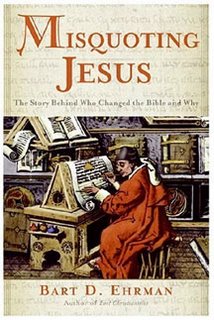
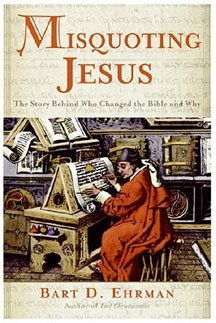
Bart Ehrman’s Misquoting Jesus seeks to fill a market niche by being a book written for people who know nothing about textual criticism. Here it is reviewed under five headings: Synopsis, Praise, Critique, Conclusion, and Appendix.1. Synopsis
Introduction (pp. 1-15). Ehrman explains why the subject of the text of the New Testament is one that has radically affected him both emotionally and intellectually. He was brought up in a 'churchgoing but not particularly religious' family (p. 1) but in teenage years felt a kind of loneliness (which he now thinks was just what all teenagers feel). After becoming involved in a Campus Life Youth for Christ club he had a 'born-again' experience aged 15 and some time after that was encouraged to attend the Moody Bible Institute in Chicago, which he did in 1973. This institution held to biblical inerrancy and that the words of the autograph were inspired, but in an early class he encountered the fact that we do not possess the autographs, only 'error-ridden copies of the autographs' (p. 5). This got him interested in trying to learn about textual criticism. By the end of his three-year diploma at Moody he wanted to become '... an evangelical "voice" in secular circles, by getting degrees that would allow me to teach in secular settings while retaining my evangelical commitments' (pp. 5-6). He went to Wheaton College, majoring in English and learning Greek, and there he experienced some doubts. After two years he went to Princeton Theological Seminary, where he studied with Bruce Metzger. He writes, 'A turning point came in my second semester' (p. 8), during a course on Mark when he had written a paper trying to justify the name 'Abiathar' in Mark 2:26 and his professor, Cullen Story, wrote thereon 'Maybe Mark just made a mistake'. Once Ehrman had concluded that he did, 'the floodgates opened' to admitting other problems in scripture (p. 9) and then to having a radical rethink of his understanding of the Bible. He now writes a book which he believes is the first of its kind: a book 'for people who know nothing about textual criticism' (p. 15).
1. The Beginnings of Christian Scripture (pp. 17-43). Judaism was a religion of the book and writing became important within Christian churches through such things as Paul's letters, pseudonymous letters, early gospels, acts, apocalypses, church orders, apologies, martyrologies, antiheretical tractates and early Christian commentaries. A canon began to form and people began to ascribe to New Testament writings the authority already ascribed to the Old Testament. In response to Marcion, the 'Orthodox' sought to delineate the canon's boundaries. Despite the importance of writings for the churches, literacy was not common and there was consequently an emphasis on reading texts out publicly.
2. The Copyists of the Early Christian Writings (pp. 45-69). All texts in the ancient world needed to be manually copied and the difficulties involved in copying are presented by considering the narratives about books in the Shepherd of Hermas 5.4 and 8.3. At the earliest stage Christian texts were not copied by professional scribes and, accordingly, references to miscopying in Origen, Irenaeus and Revelation 22:18-19 are explored. Even if scribes only occasionally changed texts, changes were permanently introduced into the manuscript tradition. If Paul sent multiple copies of the letter to the Galatians round the Galatian churches, how can we be sure that they were all the same? If you assume, for instance, that John 1:1-18 and chapter 21 were not originally in the Gospel, what would it mean to reconstruct the original text? The Pericope Adulterae (John 7:53-8:12) and the last twelve verses of Mark (16:9-20) illustrate that major secondary additions occur in the New Testament text.
3. Texts of the New Testament (pp. 71-99). As professional scribes took over from non-professionals the transmission of the New Testament became more controlled. A further stage of standardization was achieved through the invention of printing during the fifteenth century. Erasmus produced the first published Greek New Testament, but one with significant weaknesses. Subsequent editions of the Greek New Testament are considered. Mill, in 1707, based on variants from 100 manuscripts, showed some thirty thousand places of variation in the New Testament and thereby demonstrated a significant problem for those who attribute authority to the original text. The problem that Mill demonstrated, however, is relatively small when compared with our present situation when so many more variations in the New Testament are known. There are various types of change that take place in manuscripts.
4. The Quest for Origins (pp. 101-125). Over recent centuries various scholars have contributed to discussions on method in textual criticism and the theological significance of variation in manuscripts. Those treated here are Richard Simon, Richard Bentley, Johann Albrecht Bengel, Johann Jakob Wettstein, Karl Lachmann, Lobegott Friedrich Constantine von Tischendorf, Brooke Foss Westcott and Fenton John Anthony Hort.
5. Originals That Matter (pp. 127-149). Variants can be very important. Here are presented some variants that are crucial for the interpretation of a whole book. Judged by a process of weighing external and internal evidence Mark 1:41 originally said that Jesus was angry, Luke did not originally contain 22:43-44 and Hebrews 2:9 originally read χωρις θεου 'without God' rather than χαριτι θεου 'by the grace of God'. These three variants are highly significant for the picture of Jesus that emerges from these books and yet, Ehrman notes, most of our modern translations are based on the wrong text in these cases. If the wrong text is selected a quite different picture of Jesus can emerge.
6. Theologically Motivated Alterations of the Text (pp. 151-175). Scribes in the early centuries of Christianity sometimes allowed theological considerations to dictate what they wrote. The early centuries were a time of intense competition between various groups and a group we may label 'Orthodox' generally won the day. Members of this group occasionally altered the text to preclude interpretations that they viewed as heretical. For instance, the reading θεος in 1 Timothy 3:16 was anti-adoptionistic. Other changes were anti-docetic or anti-separationist.
7. The Social Worlds of the Text (pp. 177-205). Three further categories of changes introduced into the text are considered. First, Jesus and even Paul, though still adhering to certain aspects of patriarchy, had promoted the role of women. A number of later textual alterations seek to restrict women's roles. Secondly, some secondary alterations to the text were anti-Jewish. Thirdly, some secondary alterations to the text were apologetically motivated, to protect Christianity from certain criticisms brought forward by pagans.
Conclusion: Changing Scripture: Scribes, Authors, and Readers (pp. 207-218). 'The more I studied the manuscript tradition of the New Testament, the more I realized just how radically the text had been altered over the years at the hands of scribes, who were not only conserving scripture but also changing it' (p. 207). The changes in the New Testament make it impossible to believe that God inspired the original words.
My summary: the book's purposes are (a) to introduce laypeople to New Testmant textual criticism and (b) to disprove the divine inspiration of the New Testament.
2. Praise
There are a number of strong points in this book. First, we may note that the material is all basically mature. Ehrman has been publishing in this area for some while and therefore for almost every variant he discusses in this popular treatment he can refer us to a more detailed and technical treatment of his elsewhere. His treatment is not superficial and every variant is dealt with instructively.
Secondly, Ehrman shows the importance of variants and that many of these cannot be lightly dismissed. He has done everyone a service in presenting us with a strong case for many of the variants he chooses to take as earlier.
Thirdly, the book makes some important connections that are often not made. It denies the authority of scripture by arguing against verbal inspiration, thereby agreeing with evangelicals that authority requires verbal inspiration.
Fourthly, it is a good read.
Fifthly, the pictures are nice.
3. Critique
Nevertheless, this important book cannot escape criticism and this can be made for a number of reasons.
1. Lack of emphasis on manuscripts. For an introduction to textual criticism this book has a rather low emphasis on manuscripts. Though a number of manuscripts are referred to, the readers are in general kept at some distance from manuscripts, while there is much discussion of variant units.
2. Uncertain analysis of variants. It is hard to begin to discuss treatment of variants within this book without referring to Ehrman's more technical discussions of the same variants. This would involve basically reviewing much of Ehrman's scholarly work. Rather I will here raise broader issues about how one decides between variants: first, it must be remembered that for many variants Ehrman discusses he does not dispute that modern Bible translations are based on the earliest available form of the text. For all the other cases, i.e. where the text that Ehrman claims is original differs from that behind modern Bible translations, it would be possible to find a number of top textual scholars who agreed with and a number who disagreed with Ehrman's analysis. We may therefore ask how many of Ehrman's analyses need to be right for his portrait of New Testament transmission to be right. What if only 75%, or even 50% or 25% were correct? Actually, for Ehrman's overall analysis to be right he needs a very high proportion of his analyses of variants to be right. For many of the types of changes he gives but a few examples, and these are the 'best' examples. If he is wrong just a few times then a 'type of change' may be almost non-existent.
Ehrman is strangely certain about the correct explanation of the variants in almost every case. There are some positions on the overall transmission of the text that allow textual critics to be relatively certain about what is original. For instance, if one has a high view of the reliability of one particular tradition (e.g. the Alexandrian or Byzantine) or of one particular manuscript (e.g. Vaticanus) then it is intellectually consistent to reach a high degree of confidence about what is the earliest available form of the text. Similarly, one might construct a stemma showing the genealogical relationship between manuscripts, or one might have another theoretical way of reaching confidence about the earliest text. One might even have a theological reason for certainty about the text. Whatever the merits of such positions—which cannot be explored here—they can be methodologically consistent.
I would maintain, however, that, if the history of textual transmission is as Ehrman maintains it is, then it is really rather unreasonable of him to be so certain that his reconstruction of the earliest forms of the text are correct. If there were scribes who not infrequently introduced alterations into their texts, and the changes they introduced were capable of spreading across almost the entire range of manuscripts available to us, then we must be rather uncertain of what the earliest form of the text is. At one level this is what Ehrman himself maintains. And yet time and again Ehrman claims to be able to tell us what is earlier and what is later, and something of the theological convictions and motivation of those who introduced a variant in the text. The text he prefers may sometimes be in the mass of Alexandrian witnesses and may at other times be only attested in late manuscripts. At times it will be a difficult reading while at others a difficult reading is rejected. The one thing, however, that does run through most of the discussions of variants is Ehrman's historical reconstruction of what scribes thought, how they were motivated, and how they acted in an environment of theological debate. Yet, the historical reconstruction is not some datum, but something itself supposedly derived from the manuscripts. This derivative construction has been given decisive authority, just as another textual critic might give decisive authority to a manuscript. Clearly, however, the construction needs its own verification before it can be given such decisive weight.
3. Misunderstandings of Concepts of Inspiration. The book is in some ways framed as an argument against divine verbal inspiration of the scriptures (a core historic evangelical belief, as well as one found widely in churches that are not evangelical). Nevertheless, it contains a number of statements that either misunderstand or misrepresent standard expressions of inspiration. One might well ask why this is the case. It might be, of course, that those evangelicals with whom Ehrman had contact as he was working through the question of inspiration did not correctly understand or present standard positions on inspiration. Yet, whatever the reason, Ehrman is now a mature scholar and should not merely engage with the non-intellectual expressions of evangelicals he happens to have encountered, but also with the ablest exponents of verbal inspiration. He has not, and the result is often unsatisfactory as will be seen as a few passages below are discussed.
In his 'testimony' Ehrman says (p. 7):
I kept reverting to my basic question: how does it help us to say that the Bible is the inerrant word of God if in fact we don't have the words that God inerrantly inspired, but only the words copied by the scribes—sometimes correctly but sometimes (many times!) incorrectly? What good is it to say that the autographs (i.e., the originals) were inspired? We don't have the originals! We have only error-ridden copies, and the vast majority of these are centuries removed from the originals and different from them, evidently, in thousands of ways.The premise seems to be that we do not have the words that God inspired, but Ehrman has produced little evidence that this is ever the case. He has shown that there are variants in the manuscripts, but unless he is prepared to show that none of the variants in the manuscripts is correct (and he does not do this), then he has merely shown that anyone believing in the divine inspiration of scripture would also have to believe that many New Testament manuscripts have lost divinely given words and replaced them with words that were not divinely given (which is hardly going to worry anyone provided this has not occurred in the whole manuscript tradition). It might be correct to say that such and such a scribe in history 'did not have' the divinely given words, but this cannot be converted into a statement about what 'we' have. The phrases '... we don't have the words that God inerrantly inspired, but only the words copied by the scribes' introduces a rather strange dichotomy. After all, these words are generally the same. Since it is the words that are inspired, not the ink, words do not lose inspiration by being copied. As for the sentences, 'What good is it to say that the autographs (i.e., the originals) were inspired? We don't have the originals!', these are extremely strange. 'Autographs' and 'originals' as used here by Ehrman clearly mean material entities, i.e. actual manuscripts. Now, while I'm sure that many evangelicals have talked of 'inspired autographs' and the like, it has never been evangelical doctrine, or the doctrine of another group in Christendom, that any material was ever inspired. The text, which is immaterial, is inspired, and this text is recorded on a material. However, that text is neither more nor less inspired when written in the manuscript autograph or on a CD. The inspired words are therefore not lost when the originals are lost. The final sentence of this section uses the rhetorically-laden phrase 'error-ridden' (completely undefined) and observes that the majority of manuscripts are centuries removed in time from the autographs (which is irrelevant unless one attaches authority to numbers of manuscripts).
We come across the same issue on p. 60:
... it is a very complicated business talking about the 'original' text of Galatians. We don't have it. The best we can do is get back to an early stage of its transmission, and simply hope that what we reconstruct about the copies made at that stage—based on the copies that happen to survive (in increasing numbers as we move into the Middle Ages)—reasonably reflects what Paul himself actually wrote, or at least what he intended to write when he dictated the letter.In this context 'original' refers to a material entity. Ehrman conjectures that there may have been multiple copies sent to the Galatian churches and that these would have differed in text. One could equally conjecture that there was a single autograph containing only one original text. Of the 'original' text Ehrman asserts: 'we don't have it'. If he is referring to the material of the manuscript then the answer is naturally, 'so what?' If he is referring to the actual verbal sequence contained in the earliest manuscript then Ehrman has a lot more work to do to make his case. Take, for instance, the first 100 letters of Galatians as given in any Greek New Testament. There is no reason to suppose that these letters differ in any way from what the original scribe wrote. Of course one cannot 'prove' that the original scribe wrote these—one could never 'prove' anything about an original scribe. But believers in divine inspiration do not need to 'prove' their belief to be true; they only need to be able to show that it is reasonable and to be able to show grounds of some kind that warrant that belief. In fact, there is no case in Galatians where we need suppose that a single letter written by the original scribe is not preserved in one of a relatively small number of Greek witnesses.
Throughout this work, and particularly in the final chapter, Ehrman uses terms in an ill-defined way. The words 'change' and 'alter' are used in different senses and the words 'scripture', 'text' and 'Bible' are also used in more than one sense. The phrases 'mean different things' (p. 212) and 'not saying the same thing' (p. 214) are also used rather loosely.
Consider the following:
The more I studied the manuscript tradition of the New Testament, the more I realized just how radically the text had been altered over the years at the hands of scribes, who were not only conserving scripture but also changing it. (p. 207)Clearly scribes may produce a text which is altered by being different from the text that they received. They may also alter what was written in a manuscript (by an addition or erasure). But in most cases scribes doing this do not alter 'the text' if by 'the text' we mean something that we now consider 'the text' of the New Testament. Ehrman has presumably opted for the ill-defined expression 'change the text' rather than a precise expression like 'introduce a new variant reading' for rhetorical reasons.
Note the change in sense of the word 'scripture' in the following extract:
When I was a student just beginning to think about those fifteen centuries of copying and the vicissitudes of the text, I kept reverting to the fact that whatever else we may say about the Christian scribes—whether of the early centuries or of the Middle Ages—we have to admit that in addition to copying scripture, they were changing scripture. Sometimes they didn't mean to—they were simply tired, or inattentive, or, on occasion, inept. At other times, though, they did mean to make changes, as when they wanted the text to emphasize precisely what they themselves believed, for example about the nature of Christ, or about the role of women in the church, or about the wicked character of their Jewish opponents.In the first paragraph the first reference to 'scripture' refers to what the scribes held to be scripture. The second occurrence refers to 'changing scripture', which more often than not refers to the process whereby a second version of a text is produced alongside the first (which continues to be preserved in some copy). In the second paragraph 'scripture' seems to refer to 'scripture' as available to Ehrman. For Ehrman's argument against verbal inspiration to be cogent it needs to mean that scribes had changed scripture before it got to Ehrman and that he thereby no longer had access to the original text.
This conviction that scribes had changed scripture became an increasing certitude for me as I studied the text more and more. (p. 210)
On the next page he says the following:
As I realized already in graduate school, even if God had inspired the original words, we don't have the original words. So the doctrine of inspiration was in a sense irrelevant to the Bible as we have it, since the words God reputedly inspired had been changed and, in some cases, lost. (p. 211)There is very little in this book that even attempts to show that we do not have the 'original words'. To say that 'the words God reputedly inspired had been changed' must mean that the words are no longer available, which is not the case. He mentions that such words have been lost, but has not adduced evidence for this.
On the same page:
... the only reason (I came to think) for God to inspire the Bible would be so that his people would have his actual words; but if he really wanted people to have his actual words, surely he would have miraculously preserved those words, just as he had miraculously inspired them in the first place. Given the circumstance that he didn't preserve the words, the conclusion seemed inescapable to me that he hadn't gone to the trouble of inspiring them. (p. 211)
This is a fairly unnuanced argument. Must all people have all of God's word at every moment for it to be possible to believe that God 'wanted people to have his actual words'? Or will it suffice to believe that God wanted some people to have some of his words for some of the time? Just what are the conditions that Ehrman is demanding for inspiration to be logical? He does not say. Ehrman's whole emphasis here, however, is on human reception. Yet there is no need for reception of the whole of God's word by the entire human race for it to function as his word. God may speak through a single verse that someone encounters, or through a single book of the Bible that has been translated into a particular language. Similarly, for us to insist on a perfectly printed version of the Greek New Testament bound under a single cover before we can believe that the text is inspired is a rather anthropocentric condition. We would also be insisting that scripture could only be verbally inspired for us in the twenty-first century if God fulfilled for us conditions that could not possibly have been fulfilled for Christians prior to the invention of printing. It is not irrational to suppose that God has not made his word available to all people at all times and places. Yet it is possible to maintain that in our time and place the whole original text of the New Testament is available in a relatively limited number of Greek witnesses.
The final section of the book is a rather weak section on openness of interpretation: 'The reality, I came to see, is that meaning is not inherent and that texts do not speak for themselves. If texts could speak for themselves, then everyone honestly and openly reading a text would agree on what the text says' (p. 216). We are presented with an all or nothing dichotomy. Either there is complete agreement on every point of interpretation, or else basic interpretative openness. Actually interpretations can converge. Ehrman knows this, and elsewhere he seems to presuppose a more restricted view of a text's meaning. Here, however, he seems to be throwing just one more argument in favour of uncertainty to do with the New Testament.
4. Conclusion
There is much that is true and correct in this book and which should cause constructive reflection amongst those who believe in the verbal inspiration of Scripture. Many of the discussions are also highly debatable from a historical angle. The book engages in a theological subject, but often fails to make vital distinctions in treating theological positions. Consequently, although it is a book from which one will learn much, it is better treated as a repository of information than as a model of argumentation. This critique of Ehrman's has been made without disputing the various discussions of variants. Perhaps this can take place at a further stage of review.
5. Appendix A: lesser points
- A review of major textual critics in recent centuries, such as is undertaken in chapter 4, really must include a separate section on Griesbach.
- The Hebrew on the dust jacket is upside down.
- ‘Desiderus Erasmus’ should read ‘Desiderius Erasmus’ (p. 70).
- The phrase scriptio continua is twice miswritten as scriptuo continua (pp. 48, 90).
- Despite the comments on p. 91 the normal nomen sacrum for πνευμα is not πμα but πνα. This causes problems in the statement with relation to 1 Corinthians 12:13 'The word Spirit (PNEUMA) would have been abbreviated in most manuscripts as PMA, which understandably could be—and was—misread by some scribes as the Greek word for 'drink' (POMA)...' (p. 91).
- The next paragraph contains the following ironic sentence: ‘This kind of mistake is called periblepsis (an “eye-skip”) occasioned by homoeoteleuton (the “same endings”). I teach my students that they can lay claim to a university education when they can speak intelligently about periblepsis occasioned by homoeoteleuton.’ (p. 91). Twice the author means ‘parablepsis’.
- Codex Sinaiticus does not support the presence of 'and he was taken up into heaven' (Luke 24:51) despite the rather confused assertion on p. 169 that it does.
- P. 192 should refer to Acts 17:30 not 17:27.
Appendix B, 26 Jan 2006:
Further typographical confusion is pointed out in the following paragraph, quoted from a review by Marcia Ford on FaithfulReader:
'Despite all my praise for MISQUOTING JESUS, I confess I had a tough time reading past page 13, for what may seem to some readers to be an insignificant reason. But there, right on the page, Ehrman refers to the "Timothy LeHaye and Philip Jenkins series Left Behind." Do I need to point out all the errors in those few words? One, it's LaHaye, not LeHaye. Two, I'm guessing no one's called him Timothy since his baptismal certificate was signed; he's been known as Tim for at least the nearly 40 years he's been a published author. Three, Philip Jenkins? Philip Jenkins? I have to believe that a scholar of Ehrman's stature, a professor who pores over ancient manuscripts with exactitude and precision and accuracy, is not the one who made that mistake; I'm going to assume it was a well-meaning editor. Philip Jenkins is a religion professor at Penn State, and I'm sure Ehrman is well-acquainted with his work. LaHaye's co-author is Jerry Jenkins, not Philip. Oh, and "Timothy" was given the last name of LaHay on page 110, but in the index, it was back to LeHaye. Should I even mention that Hal Lindsey's name was spelled "Lindsay" in that same sentence on page 110?'
[with thanks to Jan Krans for pointing out some of my own typos in the first posting]