Showing posts with label Myths and Mistakes. Show all posts

Thursday, April 25, 2024

Two items from Erasmus on Stunica

2


I've been reading through vol. 74 of the Collected Works of Erasmus series—Erasmus' controversies with Stunica—Diego López de Zúñiga, if you prefer (not to be confused with the other Diego López de Zúñiga. Zúñiga was the main editor behind the Complutensian Polyglot and was therefore one of the more qualified of Erasmus' many critics. Still, Erasmus took issue with Zúñiga, including the way he went about his criticisms. I always enjoy reading the writings of my second-favorite Dutch textual critic who worked in Cambridge, and I found these words from his Apologia Against Zúñiga to be interesting:

Collected Works of Erasmus vol. 74, p. 245

"This man put the extracts on display once and for all in the most invidious way he could, omitting the material that softened their sharpness, and adding violent and even meaningless titles to exacerbate their effect."

Evidently, Zúñiga was circulating quotes from Erasmus' writings taken out of context—he had conveniently left out the parts where Erasmus qualified what he said to make it less severe. You can definitely get more mileage out of a quote that way, but it's simply not honest to leave out the parts that contradict the narrative you are trying to spin. As I read on, I chuckled at what Erasmus said a few pages later about Zúñiga (in the context of his responses to Erasmus' broad criticisms of abusive clergy who were not acting like Christians): "And he is an unhappy advocate if he cannot protect the honour of others except by speaking ill of me, which a pimp could do just as well."

___

To shift gears, we also see this interesting comment a few pages later: "Or is it a falsehood that I say that some passages have been added? That is incontrovertibly the case at the conclusion of the Lord’s Prayer, to say nothing of other places" (p. 258).

Zúñiga evidently (by what I infer from Erasmus' response) didn't like that Erasmus admitted that it's difficult not to come to the conclusion that there are places in the New Testament textual tradition where something has been added. Erasmus appeals to the doxology of the Lord's Prayer (Matt. 6:13). I find this interesting for two reasons:

1. Despite that he says that it is "incontrovertibly the case" that the doxology is not original, Erasmus did include it in his Greek text. However, he clearly doesn't think it's original, he says as much, and elsewhere, his Paraphrase leaves out the doxology.

2. Erasmus' appeal to the Lord's Prayer is especially clever. Zúñiga was over the Complutensian Polyglot, which leaves out the doxology to the Lord's Prayer and has a rare marginal note about how it is added in the Greek copies. While it seems that Zúñiga was not the author (or at least not the principal author) of this marginal note, it's still the case that he was in charge of an edition that left out the doxology and casts doubts on its authenticity. Jerry Bentley writes, concerning the marginal note in the Complutensian Polyglot: 

"In only one note does a peculiar observation suggest its author. This is the note to Mt. 6:13 (quoted above), which discusses the authenticity of a clause found in many Greek texts, but not in the Vulgate: "for thine is the kingdom, the power, and the glory forever. Amen." The note casts doubt on the authenticity of this clause : the author suggests that the clause crept into Greek New Testament manuscripts by way of the Greek mass, where it forms part of the liturgy. The note obviously bears the mark of the Cretan Demetrius Ducas, no doubt the only member of the Complutensian team familiar enough with the Greek liturgy to have made such precise points about it. This is not necessarily to say that Ducas prepared all the annotations, for the note to Mt. 6:13 is by no means representative of all the rest. We may be fairly sure we see Ducas' influence in this note, though we must not jump to the conclusion that he was sole author of the annotations." ("New Light on the Editing of the Complutensian New Testament," Bibliothèque d'Humanisme et Renaissance 42.1 (1980): 154–155).

The textually-missing/marginally-present doxology and beginning of the note in the Complutensian Polyglot (page 2069 here).

Friday, November 03, 2023

Peterson: A Recounting of My Accounting of the Difficulty of Counting

4

Having blogged about the discrepancy between the number of manuscripts in Myths and Mistakes and the number recently given by INTF, I asked Jacob Peterson, the author of the chapter in question, to weigh in. I’m happy to share his thoughts here. —ed.


I had several people send me the INTF blog post by Katie Leggett and Greg Paulson in the days after it was posted and now I’ve been asked to write a short addendum here about Peter’s posts (here and here). Having been out of the field essentially since my chapter in Myths and Mistakes was published, this feels a bit like I’ve been granted some lasting and undue authority as an adjudicator on the issue at hand. At best, I have some thoughts for your continued consideration.

Preliminarily, I want to reiterate an overriding theme from my chapter—as Peter did in his most recent piece—that at the level of disagreement we have between my count and INTF’s the stakes are incredibly low and inconsequential, no matter how interesting the issue might be as an intellectual exercise. As I’ll show below, we are arguing over around 100 manuscripts out of over 5000. Beyond that, I have only a couple things to contribute that I think bring my numbers and theirs much closer. And, of course, I’ll offer updated guidance at the end.

If I have an actual qualm with the blog from INTF, it is in the conclusion to use the maximal count of 5700 as the total number of manuscripts when just two sentences earlier it was stated that “you can add together all destroyed manuscripts with ones presumed missing, and subtract this number from the total number of manuscripts, which results in 5,541 manuscripts.” I spent a fair amount of space in my chapter dealing with these categories and problematising issues around lost/destroyed/missing manuscripts, especially those for which we do not have images or the images are illegible (see especially p. 58). If the question is how many manuscripts are there and not how many were there, then surely a “destroyed” manuscript ain’t there (pardon my mostly suppressed Texas grammatical heritage).

Moving forward with their 5,541 number, we also need to account for the passage of time since I wrote my chapter. I submitted the draft in December 2017 with a limited subsequent edit in April 2019 to include the famed “First Century Mark” into my various charts, especially since I had a chart on the preservation of Mark in the first four centuries. In the nearly 5 years since that edit, the last issued numbers in the Liste have changed as follows. 

Category M&M Count INTF Blog count Additions
Papyri 139 141 2
Majuscules 323 326 3
Minuscules 2940 3019 79
Lectionaries 2483 2555 72

That’s a total of 156 newly utilised numbers in the Liste, which roughly aligns with the 167 stated in the INTF blog to have been added since January 2019 (they indicate that some lectionaries were assigned to previously vacated numbers). If we subtract those 167 newly catalogued manuscripts from INTF’s 2023 number of 5541, we arrive at a count of 5,374 manuscripts. That is more than close enough to my approximation of 5300 to make me happy and justify the extrapolations I was doing.

In trying to explain the difference between my count and INTF’s, Peter points out that I got it correct for majuscules but says that “since minuscule and lectionaries turn out to have a far smaller rate of difference [from the Liste numbers due to loss], Peterson’s extrapolation undershot the total by hundreds.” I don’t contest what the Liste records as the state of things today, and certainly do not in any way malign them for an inability to perfectly reflect an ever-changing landscape of manuscripts spread around the world. Rather, as I contend in the chapter and its footnotes (especially p.68 fns. 44 and 45), minuscules and lectionaries probably do experience a rate of loss not too dissimilar to the majuscules but keeping track of them is much more difficult and the payoff is not worth the effort. 

Thus, my count relies on the Liste being, justifiably, out of sync with the real-world conditions of the much larger and harder to monitor class of minuscules and lectionaries. This is certainly a theoretical point—and a bit anecdotal from working in, visiting, and contacting dozens of monasteries—and it was made in the broader service of my point to use prudent and round numbers rather than sensational ones. 

Thus, we might say INTF and I were offering two different types of counts. My extrapolation was an approximation based on a readily ascertainable (and might I say accurate!) rate of loss within the majuscules to give a likely total of how many manuscripts there actually are, whereas INTF is offering a “state of the Liste” count that indicates how many manuscripts are currently catalogued and maybe still survive.

Whatever the case may be for this last point, I’m glad to see that my now-outdated numbers were not far off the mark. I’m similarly pleased to see that some of my comments have now been incorporated into the Liste, although doubtfully under the influence of my chapter. I have in mind here the de-listing of P99 and recognition that 0229 was not destroyed, among others. We should all be thankful for INTF’s ongoing work to maintain the Liste, not least so that I can pop in every once in a while to say a few things. 

In conclusion, with the updated catalogue and in view of my own advice about numbers, I’m happy to update my own guidance regarding how we should answer the question of how many manuscripts there are of the New Testament: 5500.

Thursday, November 02, 2023

Explaining a Discrepancy in the Number of Greek NT Manuscripts

3

In my post last week, I pointed to a blog by the folks at INTF giving the number of known Greek NT manuscripts. Their number was 5,700. But some eagle-eyed readers may remember reading in Jacob Peterson’s chapter in Myths and Mistakes that there are more like 5,100–5,300. 

Why the discrepancy?

The short answer, I believe, is that Peterson used an extrapolation that turned out not to hold true across all categories. To get his total, Peterson went through the majuscules carefully to note places where manuscripts had been counted twice or added without warrant. From the original number of 323 (the highest majuscule number assigned when he wrote his chapter), he found 41 had been stricken from the Liste (p. 58). 

He further noted cases where the actual manuscript’s whereabouts are lost or unknown and that brought the number down from 282 to 261. From there it was a simple extrapolation to the other categories (see p. 68, esp. n. 44). From a total of 5885 numbers in the Liste, the result would be 5138. Given that minuscules and lectionaries might not suffer as much from the problem of double counting, he was happy to say it might be closer to 5,300.

As it turns out from INTF’s recent work, that number is not steady and the minuscules and lectionaries have suffered far less than the majuscules from the problems of mis-cataloguing. By comparing Peterson’s numbers to INTF’s, we can see the difference clearly.

  Highest Number in Liste MSS Removed from Liste Rate of difference
Papyri 141 6 4%
Majuscule 326 43 13%
Majuscule (Peterson) 323 41 13%
Minuscule 3019 159 5%
Lectionary 2555 133 5%

As you can see from this, Peterson and INTF got the same 13% rate of difference for majuscules. But since minuscule and lectionaries turn out to have a far smaller rate of difference, Peterson’s extrapolation undershot the total by hundreds. 

So, that’s the why. What about the so what?

Two things. First, Peterson notes 21 majuscules whose whereabouts are unknown. Incorporating them would have taken him below 5,100. I don’t see that category factored into INTF’s numbers. We could have a good debate about whether those should be counted or not. But part of Peterson’s goal was to question the usefulness of trying to attain an exact number.

That leads to the second point. The reason Peterson didn’t go through the minuscule and lectionary data is because there’s no point apologetically. As he says, “Arriving at a range this precise for the thousands of minuscules and lectionaries would be a monumental task and one that, as will hopefully become clear in what follows is not worth undertaking—at least not for apologetic purposes” (p. 58). Why? Because, as he says in his conclusion, “finding one more minuscule is not going to convince someone Christianity is true” (p. 68). 

Personally, I’m happy to use INFT’s numbers going forward. Perhaps a future edition of M&M could be updated to note all this. Which brings me to the conclusion of Peter Rodgers’s very nice review of M&M in the latest Filologia Neotestamentaria, “It is clear from my last few paragraphs that a wider audience should be in view than simply apologists for this fine collection of essays by upcoming scholars in New Testament textual research. It is hoped that periodic updates in further editions will address a broader range of issues for a more diverse readership.”

Tuesday, May 30, 2023

Why We Wrote Myths & Mistakes in Two Tweets

7
Twitter is not exactly famous for nuance, but at least it reminds you from time to time of the value of writing books. Today was one such day. Here are two tweets, from different ends of the spectrum that repeat unhelpful myths about the text of the NT. 


If only someone had edited a book correcting such common myths.

Monday, October 24, 2022

About that Dan Wallace quote

44

The quote

A line from Dan Wallace's foreword to Myths and Mistakes has been making the rounds on the internet, usually in the context of people who want to discredit textual criticism. If you've not seen it, here is what usually gets shared (Update: Thanks to Jeff Riddle, who caught my typos, which I think came from accidentally hitting cmd+x instead of cmd+c when copying the phrase to search on other sites; it has been corrected, as have the mis-phrasing in the first sentence, which I am not sure how I got wrong.):

“We do not have now – in our critical Greek texts or any translations – exactly what the authors of the New Testament wrote. Even if we did, we would not know it. There are many, many places in which the text of the New Testament is uncertain.” —Daniel B. Wallace, "Foreword" to Myths and Mistakes in New Testament Textual Criticism, edited by Elijah Hixson and Peter J. Gurry (Downers Grove: IVP Academic, 2019)
One website has it this way:
The quote according to one website (below a picture of Bozo the Clown).
UPDATE: A coworker of mine found this site down, so here is the site as of July 5th 2021.

In a recent book about the textus receptus, This quote shows up more than once, quoted by contributors Dane Johannsson (p. 112), Pooyan Mehrshahi (p. 174), and Christopher Sheffield (p. 212). In each of the three instances, the contributor gives the Wallace quote [update: "substantially exactly", by which I mean without the context; Johannsson and Mehrshahi add the word "thereof", which is not in the original quote] exactly as I quoted above (Update: the words are as I typed, not in all-caps as the screenshot has them).

This quote—again, exactly as I quoted above—is the very first one given in this list of "quotes that everybody should copy and paste" to try to discredit textual criticism. In fact, when I search that site for the phrase "Even if we did, we would not know it," I get 72 hits.

The quote even gets its very own page all to itself, here (with an interesting URL, I might add). I'm sure there are other examples as well. [Update: the URL has been corrected to give the quote in context.]

If this is all you've heard, it wouldn't be surprising—perhaps you would even be justified—if your reaction was something like this:
A normal Christian, new to textual criticism, hears the scary Dan Wallace quote out of context and reacts understandably.

The context

That sounds scary, but it's rare (if it ever happens) that it gets quoted in context. Here it is; I highlighted in yellow the sentences that you typically don't see when people share the quote—what Wallace says immediately before and after the words that usually get repeated:


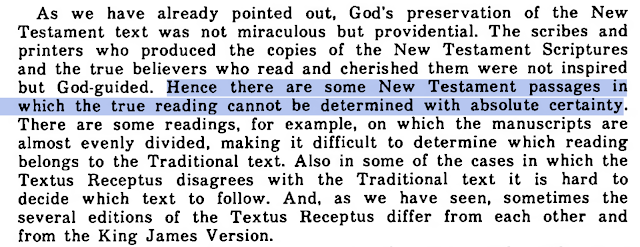
Notice Wallace's point: "we also do not need to be overly skeptical." Wallace explicitly rejects "radical skepticism". What exactly, then, is Wallace describing? We can shed some light on that by looking at things he has said elsewhere. When we do, we see that in the spectrum between radical skepticism and absolute certainty, what Wallace is describing is much closer to the certainty end than to the skepticism end (which is near where E.F. Hills lands in the spectrum—like Wallace, Hills also rejects absolute certainty in every place).

E.F. Hills rejects absolute certainty of the text of the New Testament
(Believing Bible Study, 2nd ed. [1977], p. 217)
Hills continues with a statement that I can agree with: "In other words, God does not reveal every truth with equal clearness. Hence in New Testament textual criticism, as in every other department of knowledge, there are some details in regard to which we must be content to remain uncertain. But this circumstance does not in the least affect the fundamental certainty which we obtain from our confidence in Gods special, providential preservation of the holy Scriptures. Through this believing approach to the New Testament text we gain maximum certainty, all the certainty that any mere man can obtain, all the certainty that we need."

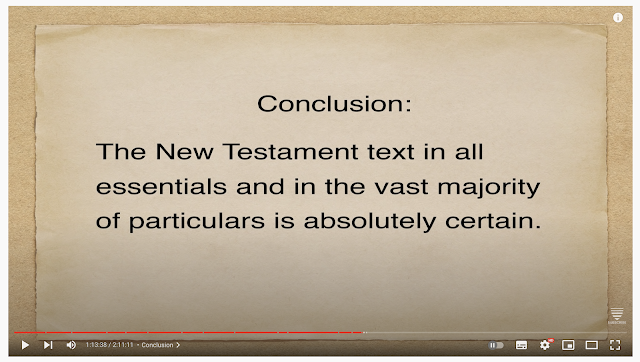
To take Wallace in his own words, here he is saying "The New Testament Text in all essentials and in the vast majority of particulars is absolutely certain."
Dan Wallace, saying something that doesn't look like radical skepticism to me.

What about the "many, many places in which the text of the New Testament is uncertain"? That might sound like it is a free-for-all in those places, where anything goes and anything is possible. Is that accurate though? [To be clear, I don't know if anybody made that inference from the quote, but in case they did:]

Here is a recent interview Wallace gave in which he says something that I have tried to point out to people when they ask me about it, and I think Wallace frames it helpfully. Here, he is talking about those places of uncertainty. Wallace says (screenshot and link below):

There's a few passages I could talk about, but understand that scholars have known what is in the original Greek New Testament for well over 150 years, because we have it above the line or below the line. It's not ... like um if you have a multiple choice it's either Text A, Text B, or Text C—it's never Text D—"none of the above." Never.

Wallace appearing on Preston Sprinkle's Theology in the Raw podcast.

I do think it would be helpful if we were more clear about these places of uncertainty—it's never "we have no idea what the original text is." Instead, it's "we are confident that in this place, it's one of these two [or rarely, three] options, but we're not completely sure which one. It can often be as simple as "Did Luke use one word for 'and' or a different word for 'and' here?"

Technical paragraph with examples of such 'uncertainty':
[9 of the 155 split line readings in ECM Acts is the 'uncertainty' between whether δέ or τέ is correct—at Acts 3:10, 12:17, 13:11, 13:52, 14:11, 15:6, 21:18, 22:23, and 24:27, and many others make about the same amount of difference as δέ/τέ. Similarly, 11 of the split line readings in the ECM Mark are transpositions involving all the same words: Mark 2:10, 3:27, 4:41, 5:19, 6:2, 6:38, 13:29, 13:30, 14:5, 15:29, and 15:34. That is to say, if we follow ECM Mark, there are 11 places where we can be sure which words belong in the text though we can't be sure if they should be in one order or a different order. Admittedly, not all of them are this inconsequential, but it would be inaccurate to say that none of them are.]

The problem

Now admittedly, one need not agree with Wallace to represent his own views fairly. One may genuinely think that modern textual criticism leads to radical skepticism in which we can't have any confidence in the NT text (though how many of its actual practitioners think so is perhaps a different discussion). One may not be able to distinguish between 0.1% uncertainty involving a choice between two knowns and 100% uncertainty in which anything is possible. And one might even think that having to choose between two readings where editions of the Textus Receptus differ is somehow categorically different from having to choose between two readings at an ECM split line.

That being said, is it really accurate to represent Wallace's words to mean something he explicitly rejects? What is hard for me to understand is how so many people can fail to mention what Wallace explicitly said, both immediately before and immediately after the section that gets quoted. The problem does seem to be quite pervasive.

When I go back to the website that had 72 hits for the phrase "Even if we did, we would not know it," I get zero hits when I search the words immediately prior ("must be avoided when we examine the New Testament Text"). The same is true of the words immediately following ("But we also do not need to be overly skeptical")—zero hits. Clearly, quoting Wallace in context doesn't seem to matter there.

Not one of the three quotations in the TR book gives the Wallace quote in the context of his rejection of radical skepticism. One even does the opposite: Christopher Sheffield (pp. 211–212) writes:

Daniel Wallace is one of the most prominent proponents of the modern Critical Text. In a foreword to the book Myths and Mistakes in New Testament Textual Criticism, he declares:

We do not have now – in our critical Greek texts or any translations – exactly what the authors of the New Testament wrote. Even if we did, we would not know it. There are many, many places in which the text of the New Testament is uncertain" (xii) [sic]

There you have it. We do not have the whole Word of God and even if we did, we wouldn’t know it. Listen carefully to what he is saying, “There are many, many places in which the text of the New Testament is uncertain.” (emphasis mine). Could there be anything more harmful to the child of God than to have some scholar take a proverbial Sharpie and write a giant question mark over every page of his Bible? That is what the modern Critical Text method does, and it can bear no good fruit in the child of God or in the church of Christ. Such a mindset does not provide patience, comfort, and hope (cf. Romans 15:4), but rather exasperation, anxiety, and despair. It will not produce stable believers with a growing confidence in their Bibles and willingness to labor and suffer for its proclamation, but only the opposite.
[I added the bold for my own emphasis. The italics are Sheffield's.]

Here, Sheffield's remarks seem to be in stark contradiction to what Wallace affirms both in his foreword to Myths and Mistakes and also in his interview that I posted. Admittedly, the interview was more recent than the publication of this book, but in a way that underscores my point—this confidence in the text was Wallace's position back when Sheffield was saying it wasn't. It seems to me that in most cases, the Wallace quote is given to 'prove' that Wallace (and by extension, modern textual criticism) is hopelessly uncertain with an implication that any verse is up for grabs—even though this type of uncertainty is explicitly what Wallace rejects.

In conclusion

1. Dan Wallace gets quoted out of context.
2. Quoting out of context is bad, so we should be extra careful to avoid it.


Final note:
No, Wallace did not ask me to write this. Yes, I do work for him, and I would have liked to get a response from him directly, but he wouldn't, as he typically doesn't respond to things like this. He did read a draft of this post though and agreed with how I represented him.

Wednesday, March 11, 2020

Interview at Ian Paul’s Blog

0
Over at his award winning blog (it’s true), Ian Paul has interviewed me about Myths & Mistakes, why skepticism sells, and whether textual criticism is the geekiest of the NT subdisciplines. Thanks to Ian for having me.


Tuesday, February 04, 2020

40% off Myths and Mistakes

11
Our Myths and Mistakes giveaway has now ended. Congrats to our winners! As a consolation prize for those who didn’t win, IVP has offered a special discount code for 40% off and free shipping (US only I assume). Just use the discount code IVP40 40IVP20 in the shopping cart. Please note that the discount does not show until you log in. Order here.


Monday, January 27, 2020

Win Myths and Mistakes in New Testament Textual Criticism!

31
Myths and Mistakes in New Testament Textual Criticism has been out for about two months now and is already in a second printing. To celebrate, we’re giving away 3 copies here on the blog! You can enter in any of the ways below. Entries will close at midnight on Wednesday (Arizona time).


a Rafflecopter giveaway

About the book

Since the unexpected popularity of Bart Ehrman’s bestselling Misquoting Jesus, textual criticism has become a staple of Christian apologetics.

Ehrman’s skepticism about recovering the original text of the New Testament does deserve a response. However, this renewed apologetic interest in textual criticism has created fresh problems for evangelicals. An unfortunate proliferation of myths, mistakes, and misinformation has arisen about this technical area of biblical studies.

In this volume Elijah Hixson and Peter Gurry, along with a team of New Testament textual critics, offer up-to-date, accurate information on the history and current state of the New Testament text that will serve apologists and Christian students even as it offers a self-corrective to evangelical excesses.

Reactions

  • Sean McDowell: “Elijah Hixson and Peter J. Gurry have provided the church with an indispensable resource with the release of their recent book Myths and Mistakes in New Testament Textual Criticism. In my opinion, every pastor, Bible teacher, speaker, and apologist needs to read this book.”
  • Justin Taylor (with excerpts from the book): “a remarkably careful and learned book that will step on some toes but serve the church and the cause of truth ... We all have a lot to learn from these rising stars of textual criticism who care about the truth and the witness of our apologetics.”
  • Andy Naselli: “Myths and Mistakes in New Testament Textual Criticism is kind of like Carson’s Exegetical Fallacies for text crit. (I’m sure I’m not the only NT prof who was relieved to not get quoted and refuted!) Impressive book. The authors know their stuff.”
  • Peter Head: “Peter Gurry is my favorite American.”*


*This quote may have been inferred.

Tuesday, December 10, 2019

Myths and Mistakes on Sale

10
Elijah and I were pleased to hear last week that, not only was Myths and Mistakes the publisher’s bestselling book at both conferences in San Diego this year, but the first print run has already sold out. One seller that has not run out is Westminster Seminary Bookstore (now out too; see ChristianBook.com for 28% off), which is running a special on the book for $23.38 (42% off). That’s the cheapest I’ve seen it.

Here are some recent reactions and reviews from readers:
  • Sean McDowell: “Elijah Hixson and Peter J. Gurry have provided the church with an indispensable resource with the release of their recent book Myths and Mistakes in New Testament Textual Criticism. In my opinion, every pastor, Bible teacher, speaker, and apologist needs to read this book.”
  • James Snapp: “In general, each chapter of Myths and Mistakes in New Testament Textual Criticism has something worthwhile to offer to the reader. This book does not address all the text-critical myths that need to be addressed.  Truckloads of misinformation in KJV-Onlyist materials have been avoided. ... But one has to start somewhere. Myths and Mistakes is a good start.”
  • Justin Taylor (with excerpts from the book): “a remarkably careful and learned book that will step on some toes but serve the church and the cause of truth ... We all have a lot to learn from these rising stars of textual criticism who care about the truth and the witness of our apologetics.”
  • Andy Naselli: “Myths and Mistakes in New Testament Textual Criticism is kind of like Carson’s Exegetical Fallacies for text crit. (I’m sure I’m not the only NT prof who was relieved to not get quoted and refuted!) Impressive book. The authors know their stuff.”