Showing posts with label scribal practices. Show all posts

Wednesday, March 12, 2025

Correcting a Dead Sea Scroll

5
Correcting a digital text today is simple and neat. I simply highlight the text to be deleted and press my “delete” button on my keyboard. When I notice a mistake right away, I can simply press the undo button to erase my last input. The phenomenon of simple and neat corrections is a modern reality, not an ancient one. In this post, I’d like to highlight some techniques scribes used to correct the biblical text. 

Deleting Text
When ancient scribes deleted text, they could use “cancellation” dots. Both examples below come from 1QIsaa. The second picture is quite peculiar since the initial scribe corrected the text, making the verbal stem explicitly qal, only for the same scribe or a future scribe to delete the correction with dots. The result of the cancelation dots is the verbal stem once again becomes niphal.
Scribes could cross out the material to be deleted. Here is an example from 1QIsaa.
Another option was to bracket the content in parentheses. Here is a partially extant example from 11QpaleoLev. Only the final bracket is preserved.

Scribes could also scrape the ink off the writing surface (i.e., erasure). The scribe of 1QS often resorts to this technique.
Adding Text
By far, the most common way to add originally omitted text was with a supralinear correction (i.e., adding the material above the line). This type of intervention is common, especially in 1QIsaa

Substituting Text
Scribes often needed to correct the text by substitution. They could do this by combining the features above such as cancellation dots plus a supralinear correction. Reshaping an errant letter was another option. This technique often resulted in recognizable but peculiar letters. Here are two examples from 1QIsaa.

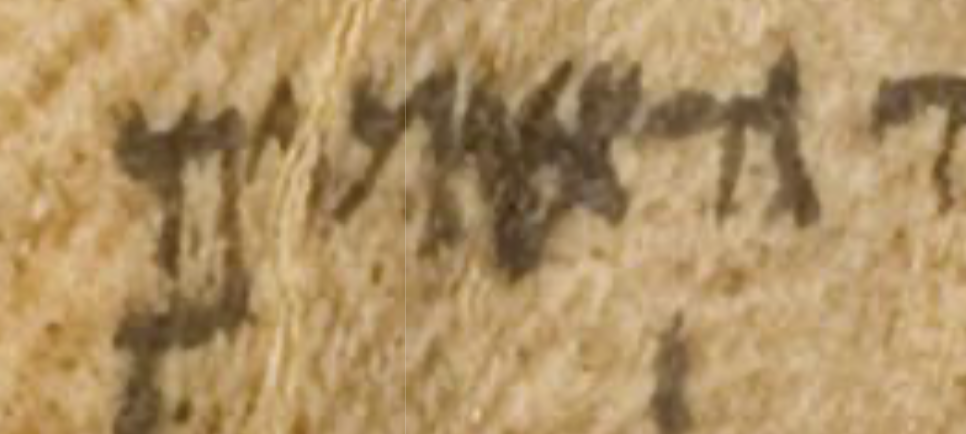
This second example is especially important since the reshaped letter is probably an aleph. Most likely the scribe was in the process of written ארצ (with a non-final sade) based on the context but realized his mistake and corrected the text to read השמים.

Correcting ancient manuscripts could get messy as these above examples prove. It is important that textual critics and those concerned with the transmission of Bible remind ourselves of this reality. What is easy and neat for us, was not always neat for ancient scribes copying the Bible. 

Monday, January 17, 2022

Pluritext Conference Proceedings (and a Little Backstory)

0

Some of you may remember times when people actually attended conferences in person. I hear that some living humans, in fact, met at SBL last November, an achievement I highly applaud (and, as a Central European, observe with a sense of remote envy).

Anyway, perhaps some of our readers might be familiar with the Project Pluritext, which, sadly, went through some bleak times owing to the criminal conviction of Jan Joosten. (In fact, I’m not sure the Project still exists at this point, as its website appears to be down.)  In Novemeber 2018, the Project organised a lovely conference entitled ‘Scribal Activity and Textual Plurality’, bringing together a rather diverse battery of scholars working on scribal matters in various traditions. I was rather surprised to have received an invitation (I guess strange things begin to happen once you’re old enough), which I readily accepted. As one might expect, I was asked to present on scribal activity and textual plurality in the New Testament. My paper mainly dealt with general matters such as what sort of textual pluriformity one might encounter in the NT and how it normally came about. It was kind of the organisers to allocate generous time slots for the Q&A, hence I was able to receive helpful feedback from some of my fellow presenters.

Oddly enough, this presentation proved to be something of a prophetic enactment of the age to come: due to the family circumstances (my daughter was to be born soon), I had to opt out from presenting in the beautiful Parisian surroundings and present from via Skype instead (yes, Skype was a thing back then). As of now, this mode of presentation seems to be something of a new normal, and one wonders whether the tide will ever swing back once the pandemic subsides.

With a bit of an understandable delay, the proceedings were finally published last year. And, as it turns out, this blog announcement, too, is rather late, but who cares – we’re in the midst of a global pandemic and the notion of time has taken on a whole new semantic layer.

The proceedings were published as a special issue of the Henoch journal, including a revised version of my paper, cheekily entitled ‘The More the Merrier? Scribal Activity and Textual Plurality in the New Testament Tradition’

I hope you enjoy perusing this publication. As always, any critical comments welcome.

Tuesday, November 13, 2018

Apocryphal Gospels and Textual Criticism: An Interesting Case of P.Egerton 2 + P.Köln VI 255

0
This forum is primarily concerned with textual criticism of biblical literature—and rightly so. Yet, the basic skills acquired in the course of studying biblical manuscripts can also come in handy when studying other textual traditions, including the ever-popular apocryphal Gospels.

This summer, I published a little study of the so-called Egerton Gospel (GEg), an intriguing late second-/early third-century papyrus containing non-canonical Gospel-like material. (Many of our readers will have been familiar with this text, and I'd refer those who aren't to a brief but very lucid discussion in Markus Bockmuehl, Ancient Apocryphal Gospels [Louiseville 2017] 106–10.) The topic of this article was borne a while ago as I read Francis Watson's Gospel Writing, in preparation for Peter Head's reading group (which, I'm afraid, I never ended up attending, but that's another story).

In his chapter on the composition of John, Watson argues that the fourth evangelist re-interprets some of the material found in the GEg, hence the latter preserves a tradition anterior to the Johannine account. Although Watson's overall argument is rather extended and intricate, the point of departure for his entire discussion is, in fact, a single reading of the Cologne fragment of the GEg (the main portion of the text is housed in the British Library). In particular, Watson contends that, at ↓ 23, GEg should read 'our fathers'. Thus, the entire GEg parallel goes like this: εἰ γὰρ ἐπι[ϲτεύϲατε Μω(ϋϲεῖ)]· ἐπιϲτευϲάτε ἄ[ν ἐμοί· πε]ρ̣[ὶ] ἐμοῦ̣ γὰρ ἐκεῖνο[ϲ ἔγραψε]ν̣ τοῖϲ πατ[ρά]ϲ̣ι̣ν ἡμῶ[ν] ('If you had believed Moses you would have believed me, for he wrote them about me—to your fathers'). Most of this resembles John 5.46 quite closely, apart from the 'our fathers' bit, which Watson sets in contrast with John 6.49 where Jesus says: 'Your fathers ate the manna in the wilderness, and they died'. This being the case, GEg preserves what Watson calls a 'Mosaic' stratum of the tradition, while John's material is a reinterpretation in view of the severance of his community from the synagogue.

At any rate, it would seem that Watson's argument is based on a misunderstanding of editorial conventions as well as of the reading itself. To begin with, he criticises Gronewald for reading ὑ̣μῶ[ν] in his articulated transcription whereas in the diplomatic transcription he prints ⟦η⟧`ϋ̣΄μω[ν. This, however, is a standard papyrological practice of editing previously unknown literary texts: a diplomatic transcript is followed by a full/articulated transcription (as well as a translation based on the latter) where abbreviations are resolved and scribal corrections of initial errors are incorporated into the main text. Moreover, Watson doesn't seem to appreciate that his preferred reading is quite likely to have been an error corrected by the scribe himself (there are three further examples of such scribal behaviour in the papyrus). Although the surface is a bit damaged at this point, one can make out the remains of the eta having been partly written over by a supralinear upsilon (notice the trema over it, right below the iota on the previous line):

P.Köln VI 255↓ 22–3.

You can easily follow Gronewald's reasoning on the basis of this reconstruction. Obviously, there's always a possibility that both readings are 'good' (i.e. non-erroneous) but reflect divergent traditions—though this would be more plausible in a text with a wider circulation. Who knows how wide, if any, distribution GEg may have enjoyed. In his aforementioned book, Bockmuehl observes that there's little reason to think that GEg was widely read in early Christian communities. I tend to agree.

For a fuller discussion of this problem, see ‘Whose Fathers?: A Note on the (Un-)Johannine Echo in the Egerton Gospel’, EC 9 (2018) 201–11.

Tuesday, August 02, 2016

New Books

3
A couple of new books I am looking forward to reading at some point:

Alan Mugridge, Copying Early Christian Texts: A Study of Scribal Practice (WUNT 362; Tübingen: Mohr Siebeck, 2016).
Blurb: It is widely believed that the early Christians copied their texts themselves without a great deal of expertise, and that some copyists introduced changes to support their theological beliefs. In this volume, however, Alan Mugridge examines all of the extant Greek papyri bearing Christian literature up to the end of the 4th century, as well as several comparative groups of papyri, and concludes that, on the whole, Christian texts, like most literary texts in the Roman world, were copied by trained scribes. Professional Christian scribes probably became more common after the time of Constantine, but this study suggests that in the early centuries the copyists of Christian texts in Greek were normally trained scribes, Christian or not, who reproduced those texts as part of their trade and, while they made mistakes, copied them as accurately as any other texts they were called upon to copy.
Scott D. Charlesworth, Early Christian Gospels: Their Production and Transmission (Papyrologica Florentina XLVII; Florence: Gonnelli, 2016). ToC

Thursday, August 20, 2015

A Working Bibliography of Scribal Habits

4
With the help of Pete Malik, I’ve put together the following bibliography of scribal habits. It is noticeably weighted toward the Greek New Testament, but I wouldn’t mind expanding it beyond that. I should add that Pete and I used slightly different formatting and I have not bothered to align them. Let me know what we’re missing either by email or in the comments and I’ll try to add them to the main list.

Aland, Barbara. “Das Zeugnis der frühen Papyri für den Text der Evangelien: diskutiert am Matthäusevangelium.” In The Four Gospels 1992, edited by F. van Segbroeck, C. M. Tuckett, G. van Belle, and J. Verheyden, 325–335. BETL 100. Leuven: Leuven University Press and Peeters, 1992.
———. “Kriterien zur Beurteilung kleinerer Papyrusfragmente des Neuen Testaments.” In New Testament Textual Criticism and Exegesis: Festschrift J. Delobel, edited by A. Denaux, 1–13. BETL 161. Leuven: Leuven University Press and Peeters, 2002.
———. “Neutestamentliche Handschriften als Interpreten des Textes? P75 und seine Vorlagen in Joh 10.” In Jesu Rede von Gott und ihre Nachgeschichte im frühen Christentum, edited by Dietrich-Alex Koch, Gerhard Sellin, and Andreas Lindemann, 379–397. Gütersloh: Gütersloher Verlagshaus Gerd Mohn, 1989.
———. “Sind Schreiber früher neutestamentlicher Handschriften Interpreten des Textes?” In Transmission and Reception: New Testament Text-critical and Exegetical Studies, edited by Jeff W. Childers and D.C. Parker, 114–122. TS 3.4. Piscataway: Gorgias Press, 2006.
———. “Was heißt Abschreiben? Neue Entwicklungen in der Textkritik und ihre Konsequenzen fur die Überlieferungsgeschichte der frühesten christlichen Verkündigung.” In Mark and Matthew I: Comparative Readings: Understanding the Earliest Gospels in their First Century Settings, edited by Eve-Marie Becker and Anders Runesson, 55–76. WUNT 1.271. Tübingen: Mohr Siebeck, 2011.
———. “Welche Rolle spielen Textkritik und Textgeschichte für das Verständnis des Neuen Testaments? Frühe Leserperspektiven.” NTS 52 (2006): 303–318.
Ashton, June. Scribal Habits in the Ancient Near East: C. 3000 BCE to the Emergence of the Codex. Mandelbaum Studies in Judaica 13. Sydney: Mandelbaum Publishing, 2008.
Burleson, Douglas Y. “Case Studies in Closely Related Manuscripts for Determining Scribal Traits.” PhD diss. New Orleans Baptist Theological Seminary, 2012.
Colwell, E. C. “Hort Redivivus: A Plea and a Program.” Pages 148–71 in Studies in the Methodology in Textual Criticism of the New Testament. NTTS 9. Leiden: Brill, 1969.
———. “Method in Evaluating Scribal Habits: A Study of P45, P66, P75.” Pages 106–24 in Studies in Methodology in Textual Criticism of the New Testament. NTTS 9. Leiden: Brill, 1969.
Dain, Alphonse. Les manuscrits. Collection d’études anciennes. Paris: Belles Lettres, 1949.

Wednesday, November 10, 2010

Emanuel Tov's Publications On-line

0
Emanuel Tov has graciously made available a large number of his publications on his website here, including his two volumes on Scribal Practices and Approaches Reflected in the Judean Desert.

Congratulations!

Wednesday, June 17, 2009

Scribal Practices in the DSS

0
SBL is offering Emanuel Tov's Scribal Practices and Approaches Reflected in the Texts Found in the Judean Desert in their Brill paperback series. However, I cannot yet find it on the SBL pages.
Paper $49.95 • 444 pages • ISBN 9781589834293 • Studies on the Texts of the Desert of Judah 54 •Hardback edition www.brill.nl
This monograph is written in the form of a handbook on the scribal features of the texts found in the Judean Desert, the Dead Sea Scrolls. It details the material, shape, and preparation of the scrolls; scribes and scribal activity; scripts, writing conventions, errors and their correction, and scribal signs; scribal traditions; differences between different types of scrolls (e.g., biblical and nonbiblical scrolls); and the possible existence of scribal schools such as that at Qumran. In most categories, the analysis is meant to be exhaustive. Numerous tables as well as annotated illustrations and charts of scribal signs accompany the detailed analysis. The findings have major implications for the study of the scrolls and the understanding of their relationship to scribal traditions in Israel and elsewhere.