Showing posts with label COVID-19. Show all posts

Monday, January 17, 2022

Pluritext Conference Proceedings (and a Little Backstory)

0

Some of you may remember times when people actually attended conferences in person. I hear that some living humans, in fact, met at SBL last November, an achievement I highly applaud (and, as a Central European, observe with a sense of remote envy).
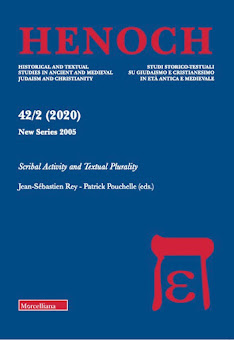
Anyway, perhaps some of our readers might be familiar with the Project Pluritext, which, sadly, went through some bleak times owing to the criminal conviction of Jan Joosten. (In fact, I’m not sure the Project still exists at this point, as its website appears to be down.)  In Novemeber 2018, the Project organised a lovely conference entitled ‘Scribal Activity and Textual Plurality’, bringing together a rather diverse battery of scholars working on scribal matters in various traditions. I was rather surprised to have received an invitation (I guess strange things begin to happen once you’re old enough), which I readily accepted. As one might expect, I was asked to present on scribal activity and textual plurality in the New Testament. My paper mainly dealt with general matters such as what sort of textual pluriformity one might encounter in the NT and how it normally came about. It was kind of the organisers to allocate generous time slots for the Q&A, hence I was able to receive helpful feedback from some of my fellow presenters.

Oddly enough, this presentation proved to be something of a prophetic enactment of the age to come: due to the family circumstances (my daughter was to be born soon), I had to opt out from presenting in the beautiful Parisian surroundings and present from via Skype instead (yes, Skype was a thing back then). As of now, this mode of presentation seems to be something of a new normal, and one wonders whether the tide will ever swing back once the pandemic subsides.

With a bit of an understandable delay, the proceedings were finally published last year. And, as it turns out, this blog announcement, too, is rather late, but who cares – we’re in the midst of a global pandemic and the notion of time has taken on a whole new semantic layer.

The proceedings were published as a special issue of the Henoch journal, including a revised version of my paper, cheekily entitled ‘The More the Merrier? Scribal Activity and Textual Plurality in the New Testament Tradition’

I hope you enjoy perusing this publication. As always, any critical comments welcome.

Thursday, April 30, 2020

Some Light COVID-19 Reading from Wuppertal

0
Few texts are more pertinent during a time when paracetamol, hand sanitisers, toilet paper, pasta, and yeast are hopelessly sold out (perhaps never to be seen again on this side of eternity) than the Apocalypse of John.

In this vein, I'd like to bring to everyone's attention a recently published collection of essays Studien zum Text der Apokalypse III (ANTF 51), edited by Marcus Sigismund and Darius Müller, in collaboration with Matthias Geigenfeind. This is the third instalment in a series of studies primarily by internal and external collaborators on the ECM Revelation project housed at the Institut für Septuaginta- und biblische Textforschung at Kirchliche Hochschule Wupperal. In keeping with the previous two volumes, the vol. 3 too is broad in scope and might have just something to lighten up your pandemic-laden days.

Here's the TOC:

TEIL I: ARBEITSBERICHT
Aus der laufenden Arbeit an der ECM der Apokalypse, by Marcus Sigismund

TEIL II: GRIECHISCHE ÜBERLIEFERUNG
Kollation und Auswertung neu zugänglicher Minuskeln der Apokalypse, by Markus Lembke and Darius Müller

Apk-Zitate bei Gregorios Palamas, by Marcus Sigismund

Form und Funktion der Apk-Zitate bei Theodoros Studites, by Marcus Sigismund

TEIL III: VERSIONELLE ÜBERLIEFERUNG
Die Vetus Latina Apocalypsis Iohannis, by Matthias Geigenfeind

The Earliest Attainable Text of Ethiopic Revelation, by Curt Niccum

Die georgische Überlieferung der Johannesapokalypse, by Nino Sakvarelidze

Ein früher Textzeuge der arabischen Johannesoffenbarung, by Martin Heide

Ein Apk-Zitat des Hypatios von Ephesos, by Marcus Sigismund

TEIL IV: PARATEXT
Marginalglossen in GA 2323: Edition und Übersetzung, by Peter Malik and Edmund Gerke

The last essay is, as you may have noticed, co-authored by yours truly, and presents the first fruits of my continuous work on this tradition of scholia. On this particular occasion,  I was happy to team up with Edmund Gerke who concocted a German translation of the scholia and rigorously checked each gloss.

Monday, April 27, 2020

Text critics who are cat people

17
I figure we could all use a bit of lighthearted fun during these difficult times, so I give you: textual scholars and manuscript specialists with cats!

Image credit: co-blogger Amy Anderson (used with permission)

Obviously, I would love to include myself in the following list, but since my current landlord doesn’t allow pets, I’m limited to hoping the neighbor’s friendly cat stops by when she’s out prowling the neighborhood, or stopping to pet any cats I find on the street while I’m out running errands. Anyway, some of the rest of us are in alphabetical order.

Amy Anderson
Amy writing a book review. Image credit: Amy Anderson (used with permission).
Christian Askeland
Christian, with his daughter’s cat, “Mouse,” who, I’m told “would kill and eat her human slaves under the right circumstances,” but nevertheless is “super soft and hilarious.” Image credit: Christian Askeland (used with permission).
Josephine Dru
“Easter cat.” Image and caption credits: Josephine Dru (used with permission).
We met on Resurrection Sunday. She was a stray trying to join my friends’ kids in their backyard egg hunt.
[L] This photo may look slightly blasphemous, but please note: 1. my hand is in the human’s spot, and 2. I still consider Bella my second best Easter gift ever.
[R] She insisted on helping. Her contributions were brief but bilingual. Fitting for her middle name (Natanya).
Peter Gurry
Pete getting some help in a YouTube debate.
Dan Gurtner
Gus Gus working on P.Oxy. 403. Image credit: Dan Gurtner (used with permission).
Rendel Harris (1852–1941)
According to this recent biography by Alessandro Falcetta. See Harris and his cat Zenon here.
Hugh A.G. Houghton
Dorcas and Barnabas, before they began work on the ECM. Image credit: Hugh Houghton (used with permission).
Larry Hurtado (1943–2019)
On his cat, Cupar, see the preface to Hurtado’s book, Earliest Christian Artifacts.
David Parker
Source: the possibly-now-defunct “Cats Who Edit” page (HT: Hugh Houghton), thankfully still available here via the Wayback Machine because nothing on the internet ever truly goes away.
Elizabeth Schrader
Elizabeth hard at work. Image credit: Elizabeth Schrader (used with permission).
James Snapp
James (here with Elway) blogs at http://www.thetextofthegospels.com/. Image credit: James Snapp (used with permission).
Klaus Wachtel
Source: “Cats Who Edit“ (see caption above under David Parker’s picture).
Nigel Wilson
Image credit: Wilson’s faculty page at the Faculty of Classics, University of Oxford. Who knew that the legendary palaeographer is a cat person? This is a new life goal for me right here—to make it to a point in my life where I can have a faculty/staff page with a photo like this one.
Mae Gilliland Wright
With Hermione the “office cat” who likes to eat important documents. Thankfully, Mae’s excellently organized thesis on Clement of Alexandria’s text of Paul remains uneaten and available here. Image credit: Mae Gilliland Wright (used with permission).


Honorable mentions:

Whoever runs this Twitter account.

The anonymous monk of Reichenau monastery who wrote (or perhaps copied) the 9th-century poem in Old Irish, Pangur Bán, about ‘hunting words’ while his cat, Pangur Bán, was hunting for mice.

Whoever made and/or owned these manuscripts.

The University of Michigan’s Karanis excavation teams in the 1920s and 1930s, who had dogs and also two cats named Topsy and Sipsy. See Terry G. Wilfong, “Dig Dogs and Camp Cats at Karanis: The Animals of the 1924–1935 University of Michigan Expedition to Egypt“, in Beyond Hatti: A Tribute to Gary Beckman, ed. Collins/Michalowski (Atlanta, Lockwood Press, 2013), pp. 325–341.


UPDATE: I have updated the post to add Dan Gurtner.