Showing posts with label book notes. Show all posts

Thursday, May 21, 2026

New book: Scribal Habits in Greek New Testament Manuscripts

4

Andrew Wilson has a new book coming out in SBL’s Text-Criticism Studies series. It’s a major study of scribal habits and is something Andrew’s been working on for some 20 years! (I remember reading his chapter on the subject in MAR’s Festschrift during my PhD.)

Publisher's Description

Singular readings (textual variants attested in only one Greek New Testament manuscript) are considered among the least reliable of all textual variants, far more likely to be scribal changes than the words of the authorial text. In this groundbreaking study, Andrew W. Wilson revisits long-held suppositions about textual variants and how they arose through a thorough analysis of more than ten thousand readings likely to be scribal errors. Wilson takes this evidence and reevaluates previous studies of scribal habits to assess the strengths and weaknesses of various methodologies for determining what those habits were and what impact they might have had on the wording of New Testament textual transmission. Biblical scholars and students interested in the formation of biblical texts will find new possibilities for how to approach disputed wording in the New Testament.

Table of contents 

To give you a taste of the book, here is the table of contents courtesy of Andrew.


Discount

Finally, over on Facebook, Juan Hernández, who edits the series, shared that you can order the book at a 30% discount through June 5 via the SBL online bookstore. Use discount code SP2026.

Tuesday, March 10, 2026

New Greek New Testament Study Bible

6

I’m not often surprised by new Bibles, but today I was. On his Facebook page, Con Campbell shared the cover of a new Greek NT he’s edited called The Greek New Testament Study Bible. It’s published by Zondervan. I suppose you could compare it to Crossway’s Guided Annotating Edition of the THGNT, but at 1168 pages, this appears to be much more than that. The release date in the U.S. is not until October and I couldn’t find a list of contributors at Zonderan’s website. Here is the description from Amazon:

The Greek New Testament Study Bible provides you with access to the insights into the Greek text from some of the world’s leading scholars, while encouraging and assisting you in the use of your Greek reading skills for sermon preparation, devotional study, and New Testament courses. If you sense you are losing your competence in Greek because of the passage of time or the pressures of ministry, yet you desire to study the text in Greek for preaching, teaching, and personal study, then The Greek New Testament Study Bible will help.

In one convenient volume, you get access to the full Greek text as it is found in the Reader’s Greek New Testament. At the bottom of each page of Greek text you will find a list of infrequently occurring words with short definitions, which means you don’t need to consult a separate lexicon for basic translation work. Right page notes identify key areas of grammar and syntax pertinent to the text under consideration, including insights into the use or absence of articles; particular lexemes; connectives; prepositions; pronouns, adverbs, and particles; verbal aspect; voice; questions; case; discourse analysis; prohibitions; the use of the imperative, subjunctive, and infinitive moods; and important textual variants.

The Greek New Testament Study Bible will:
  • Give you competence and confidence in your handling of the Greek text
  • Enable you to make exegetical decisions based on the Greek text, grammar, and syntax
  • Equip you to continue using your knowledge of the Greek language beyond seminary in pastoral ministry and devotional studies
  • Provide you with a quick reference guide to some of the key questions and insights in the text.
  • Help you discern the major contributions that a study of the Greek text brings to your understanding of Scripture
Key features of The Greek New Testament Study Bible:
  • Lefthand pages provide the Greek text based on UBS5, while righthand pages contain study notes
  • Contains more than 9,500 study notes on the Greek text
  • At the bottom of each page of Greek text, definitions are provided for Greek words that appear 30 times or fewer in the New Testament.
  • Includes contributions from 19 internationally recognized experts on the translation and interpretation of the Greek New Testament.
  • Study notes comment on the use, or absence of articles; particular lexemes; connectives; prepositions; pronouns, adverbs, and particles; verbal aspect; voice; questions; case; discourse analysis; prohibitions; the use of the imperative, subjunctive, and infinitive moods; and important textual variants.
  • Includes a glossary of 198 technical terms.
It is not clear to me what the Greek text is exactly. It says it is “based on UBS5” but then also says it’s the Greek text found in the Reader’s edition, which is really a retroversion from the NIV. So, perhaps they mean it’s based on the UBS5 the way the NIV is. It’s a bit of an odd way to say that though.

Saturday, December 06, 2025

40% Conference Discount on The Oxford Handbook of Textual Criticism of the Bible

0

At the SBL in Boston I met my co-editor Sidnie White Crawford at the OUP booth to take a picture with our “baby” – The Oxford Handbook of Textual Criticism of the Bible which has just been published (see here for more details). 

There is an SBL/AAR promocode, EXAAR25, which is valid thru 9 December (three more days) which gives 40% discount! (which means $136 in US and only £69 in UK/Europe).

You will find the whole conference promotion list here. 

Monday, November 03, 2025

The Oxford Handbook of the Textual Criticism of the Bible, eds. Crawford & Wasserman

9

Any day now, Oxford University Press will publish The Oxford Handbook of the Textual Criticism of the Bible edited by Sidnie White Crawford and myself. I think we began working on this handbook in 2019, and there were many hurdles along the way, but soon I will hold the volume in my hand. Hopefully, the OUP will bring some copies to the SBL in Boston, but you can never be sure. In the meantime you can get 30% off with the promotion code AUFLY30 (enter code at checkout) at https://global.oup.com/academic/product/the-oxford-handbook-of-textual-criticism-of-the-bible-9780197581315.

Below the flyer, I have pasted the table of contents (minus page numbers).

It is possible to read a bit on google books (e.g., the whole introduction which summarizes the chapters). 

https://fdslive.oup.com/www.oup.com/academic/images/authors/promotion/9780197581315-discount.png  

Introduction

PART I OVERARCHING ISSUES


1. The Formation of the Jewish Canon

James C. VanderKam


2. The Formation of the Christian Canon

John D. Meade


3. Philosophies of Textual Criticism for the Hebrew Bible

Ronald Hendel


4. Beyond “Textual” and “Literary” Criticism: A New Paradigm for the Study of Textual History

Molly M. Zahn


5. Philosophies of Textual Criticism for the New Testament

Michael W. Holmes


6. Book History, New/ Material Philology, and Paratextual Criticism

David Davage and Liv Ingeborg Lied


PART II THE HEBREW BIBLE AND THE DEUTEROCANON


7. The History of Textual Criticism of the Hebrew Bible from Antiquity to the Twentieth Century

Eugene Ulrich and Sidnie White Crawford


8. The Earliest Texts of the Hebrew Bible

Emanuel Tov


9. The Masoretic Text and Its Value for Textual Criticism of the

Hebrew Bible

Armin Lange


10. The Significance of the Septuagint in the Textual Study of the Hebrew Bible

Anneli Aejmelaeus


11. The Samaritan Pentateuch and Its Value for Textual Criticism of the Hebrew Bible

Hila Dayfani


12. The Syriac Peshitta and Its Value for Textual Criticism of the Hebrew Bible

Bradley J. Marsh Jr.


13. The Latin Versions and Their Value for Textual Criticism of the Hebrew Bible

Andrés Piquer Otero and Pablo A. Torijano


14. The Targumim and Their Value for Textual Criticism of the Hebrew Bible

Leeor Gottlieb


15. Editing the Hebrew Bible: Biblia Hebraica Quinta

Innocent Himbaza


16. Editing the Hebrew Bible: The Hebrew University Bible Project

Michael Segal


17. Editing the Hebrew Bible: The Hebrew Bible: A Critical Edition

Ronald Hendel


18. Teaching Textual Criticism of the Hebrew Bible

John Screnock


19. The Theory and Practice of Textual Criticism of the Septuagint

Tuukka Kauhanen


20. The Practice of Hebrew Bible Textual Criticism in the

Twenty- First Century

Drew Longacre


21. Issues in the Textual Criticism of the Deuterocanon

Benjamin G. Wright III


PART III THE NEW TESTAMENT


22. The Practice of New Testament Textual Criticism in the Twenty- First Century

H. A. G. Houghton


23. The History of New Testament Textual Criticism

Jan Krans and An- Ting Yi


24. The Dating of Early Christian Manuscripts: Paleography and Material Culture

Pasquale Orsini


25. Text- Types and the Coherence- Based Genealogical Method

Peter J. Gurry


26. The Greek New Testament Manuscripts and Other Witnesses

Elijah Hixson


27. The Syriac and Christian Palestinian Aramaic Versions of the New Testament

Andreas Juckel


28. The Latin Versions of the New Testament

Georg Gäbel


29. The Coptic Versions of the New Testament

Christian Askeland


30. The Ethiopic Version of the New Testament

Curt Niccum


31. The Gothic Version of the New Testament

Carla Falluomini


32. Patristic Evidence in New Testament Textual Criticism

Holger Strutwolf


33. Criteria for the Assessment of Readings in New Testament Textual Criticism

Tommy Wasserman


34. The New Testament Text, Paratexts, and Reception History

Jennifer Wright Knust


35. New Testament Textual Criticism and Exegesis

Elizabeth E. Shively


36. New Testament Textual Criticism and Digital Humanities

Claire Clivaz


37. Critical Editions of the Greek New Testament from the Twentieth to Twenty- First Century

Annette Hüffmeier and Gregory S. Paulson


38. New Testament Textual Criticism in Teaching and Practice

Amy S. Anderson


Monday, September 15, 2025

Bates Reviews New Book on the Origins of Greek Minuscule

1

For those who don’t know Clark Bates, he wrote his ThM thesis under my supervision on the origin of minuscule script. I learned a lot from his research. He has gone on to finish his PhD at the University of Birmingham (UK) on catena MSS. In the latest issue of The Byzantine Review, he has a substantive review of a new book on that subject. Here is how the review starts:

It is not very often that one has occasion to review a work that disrupts,challenges, and refutes one’s own earlier research and suppositions. Neither is it often that such disruption is well-received. Nina Sietis’s recentmonograph on the origin of the ‘Studite Minuscule’ has provided me withboth opportunities.

Well, that got my attention! He goes on:

In this thoroughgoing and well-written book, Sietis offers readers an outline of the institution of the Studios Monastery andthe biography of its most influential abbot, Theodore, as well as a comprehensive analysis of the research related to the development of the literary minuscule script often associated with the same monastery and abbot. The historical and paleographical details of the first volume are accompaniedand amplified by a catalogue of Studite manuscripts in the second one. Because most researchers will probably engage with Volume I, I will devote most of my review to it but reserve some comments for the catalogue of Volume II.

Sietis’s book is in two volumes, the first of which is open access. But for those of us who can’t read Italian or can’t read it well, you will want to read Clark’s review to get a good sense of the book’s argument. I will be among those who need to update my lecture notes accordingly.

Thursday, September 11, 2025

Updated Essential Works in New Testament Textual Criticism

8

I have just started to update our most popular blogpost ever, the bibliography on the Top Ten Essential Works in New Testament Texual Criticism. Yes, it has now surpassed Elijah Hixson's magnificent piece on First-Century Mark as well as Peter William's breaking news on the archaelogical discovery of Q (I am thankful to see that someone added a disclaimer "THIS POST IS A JOKE FOR APRIL FOOLS DAY!"). In any case, I just added in some few new entries to the bibliography, two of which got an asterisk (among the top ten). But there are many more to add. Do you have any suggestions? Leave them in the comments!

Introductions and surveys


Current trends views and debates

  • Holmes, Michael W. "New Testament Textual Criticism in 2020." Early Christianity 11.1 (2020): 3–20.

Working with manuscripts

  • Lied, Liv Ingeborg and Brent Nongbri. Working with Manuscripts: A Guide for Textual Scholars. New Haven: Yale University Press, 2025. [This is a general guide, not focused on biblical manuscipts]

Current trends in dating NT papyri

  • Nongbri, Brent. God's Library: The Archaeology of the Earliest Christian Manuscripts. New Haven: Yale University Press, 2018. [A provocative monograph summarizing Nongbri's several challenges to narrow and too early dating of the papyri].
  • Wasserman, Tommy. “Beyond Palaeography: Text, Paratext and Dating of Early Christian Papyri.” Pages 151–162 in The Chester Beatty Biblical Papyri at Ninety:Literature, Papyrology, Ethics (open access). Edited by Garrick V. Allen, et al. Manuscripta Biblica 10. Berlin: Walter de Gruyter, 2023. [This chapter contains a response to some of Nonbgri's challenges and emphasizes the continuity between Christian and Jewish scribal cultures.]

Scribal habits

  • Hixson, Elijah. Scribal Habits in Sixth-Century Greek Purple Codices. NTTSD 61. Leiden: Brill, 2019.
  • Malik, Peter. P.Beatty III (P47): The Codex, Its Scribe, and Its Text. NTTSD 52. Leiden: Brill, 2017.
  • Mugridge, Alan. Copying Early Christian Texts: A Study of Scribal Practice. WUNT I.362.  Tübingen: Mohr Siebeck, 2016.

Practice of NT textual criticism

  • *Houghton, H. A. G. A Textual Commentary on the Greek New Testament: A Companion to the Sixth Edition of the United Bible Societies' Greek New Testament. Stuttgart: Deutsche Bibelgesellschaft, 2025.

Conjectural emendation

  • Kamphuis, Bart L. F. New Testament Conjectural Emendation in the Nineteenth Century: Jan Hendrik Holwerda as a Pioneer of Method. NTTSD 56. Leiden: Brill, 2018.

Update: I have added Charles Quarles new introduction under Introductions and surveys and marked it with an asterisk.

Monday, May 12, 2025

Quarles: Introducing New Testament Textual Criticism for the 21st Century

14

It seems to me that we are due for an up-to-date introduction to NT textual criticism since the standard classic in our field (Metzger-Ehrman) is out of date in some key areas (e.g., re: text-types and computer tools like the CBGM) and since others like Jongkind's and Anderson's are brief by design. That's why I was pleased to see Chuck Quarles's new introduction that came out in March of this year. I asked Chuck if he would mind telling our readers a bit about what motivated him to write it and what distinguishes it. —Peter


Several respected introductions to New Testament textual criticism have guided New Testament students in the exercise of restoring the New Testament text for generations. These volumes are generally considered to be “tried and true,” and professors and students may be reluctant to replace them or even supplement them with the latest book on the topic. I sympathize with that sentiment. These trusted volumes have shaped my own approach to the discipline in important ways and I am grateful for them.

However, as I taught master’s courses and PhD seminars in New Testament textual criticism over the last decade, I became increasingly convinced that a new introduction was badly needed. The standard introductions masterfully explain the methods and approaches to textual criticism applied in most of the 20th century. Yet, these leave readers unaware of some of the sweeping changes that occurred in the field in the late 20th and early 21st century.

For example, the standard introductions still affirm the old text-type approach, even though the leading specialists in the field have offered persuasive evidence that the approach is flawed. Among other problems, old theories about the relationships between texts were sometimes based on a relatively small sample of variant units or shared tendencies. However, developments in computer technology enable researchers to track the level of agreement between two texts on every shared variant unit resulting in much more accurate information about the relationships between texts. The data demonstrates that leading representatives of the so-called Western text have greater similarity to representatives of other textual groups than with witnesses supposedly belonging to the same text type! (see Appendix III of the book)

Computer applications made other advances possible too. Westcott and Hort famously argued that “ALL TRUSTWORTHY RESTORATION OF CORRUPTED TEXTS IS FOUNDED ON THE STUDY OF THEIR HISTORY, that is, of the relations of descent or affinity which connect the several documents.” They called for the development of a “genealogical tree of transmission” and stated that the more exactly text critics are “able to trace the chief ramifications of the tree, and to determine the places of the several documents among the branches, the more secure will be the foundations laid for a criticism capable of distinguishing the original text from its successive corruptions.”

Friday, January 31, 2025

The Top Ten Essential Books in NT Textual Criticism—According to AI

7

AI destroying the joy of human creativity, 
as drawn by AI
Tommy's list of top ten essential works in NT textual criticism has had a very good run on this website. It remains our most read blog post ever. It could probably use a minor update given that it's more than a decade old, but it's still useful. Until then, I thought I would see what AI says are the top ten books in our field. I asked two AI platforms, Google Gemini and Microsoft's Copilot. I have no real insight into how either of these work or what the LLMs are behind them. But here are their answers.

Copilot

Here are ten essential books in New Testament Textual Criticism that are highly recommended for anyone interested in the field:

  1. The Text of the New Testament by Kurt and Barbara Aland - A comprehensive guide to the text of the New Testament.
  2. The Text of the New Testament in Contemporary Research edited by Bart D. Ehrman, Michael W. Holmes, and Bruce M. Metzger - An overview of the current state of research in New Testament textual criticism.
  3. The Orthodox Corruption of Scripture by Bart D. Ehrman - Examines how early Christological controversies affected the text of the New Testament.
  4. Studies in the Theory and Method of New Testament Textual Criticism by Eldon J. Epp and Gordon D. Fee - Focuses on the theory and methodology of textual criticism.
  5. The Text of the New Testament by Bruce M. Metzger and Bart D. Ehrman - Discusses the transmission, corruption, and restoration of the New Testament text.
  6. An Introduction to the New Testament Manuscripts and Their Texts by D. C. Parker - A technical guide to New Testament manuscripts.
  7. The Living Text of the Gospels by D. C. Parker - Explores the text of the Gospels in detail.
  8. Introduction to the New Testament in the Original Greek by B. F. Westcott and F. J. A. Hort - A classic work laying the foundation for textual criticism.
  9. The Story of the New Testament Text: Movers, Materials, Motives, Methods, and Models by Robert F. Hull - Covers the history and development of the New Testament text.
  10. Textual Scholarship and the Making of the New Testament by David C. Parker - Discusses the procedures and challenges of New Testament textual scholarship.

These books provide a solid foundation for understanding the principles and practices of New Testament textual criticism. Do any of these titles catch your interest?

Gemini

Here are ten essential books in New Testament Textual Criticism, presented in no particular order:

  1. The Text of the New Testament: Its Transmission, Corruption, and Restoration by Bruce M. Metzger: A classic and comprehensive overview of the field.
  2. Misquoting Jesus: The Story Behind Who Changed the Bible and Why by Bart D. Ehrman: A popular and accessible introduction to textual variants.
  3. A Textual Commentary on the Greek New Testament by Bruce M. Metzger: A detailed reference work examining variant readings for each verse of the Greek New Testament.
  4. The Text of the New Testament: An Introduction to the Critical Editions and to the Theory and Practice of Modern Textual Criticism by Kurt and Barbara Aland: A foundational work on the principles and methods of textual criticism.
  5. A Student's Guide to Textual Criticism of the Bible: Its History, Methods and Results by Paul D. Wegner: A user-friendly guide for students.
  6. New Testament Textual Criticism: A Concise Guide by David Alan Black: A brief and accessible introduction.
  7. Studies in the Theory and Method of New Testament Textual Criticism by Eldon J. Epp and Gordon D. Fee: A more advanced work exploring critical methodologies.
  8. The Orthodox Corruption of Scripture: The Effect of Early Christological Controversies on the Text of the New Testament by Bart D. Ehrman: A controversial but influential work examining the impact of theological biases on the transmission of the text.
  9. The Text of the New Testament in Contemporary Research: Essays on the Status Quaestionis edited by Bart D. Ehrman, Michael W. Holmes, and Bruce M. Metzger: A collection of essays by leading scholars.
  10. A History of the Synoptic Problem by David L. Dungan: While focused on the Synoptic Gospels, this work delves into the complexities of textual transmission within the Gospels.

Note: This is not an exhaustive list, and the "best" books will depend on your individual needs and level of expertise.

I hope this helps!

What I take away from this exercise is that, in this case at least, AI is little more than repackaged search engine. Both results are basically just Tommy's post with maybe some rearrangement or rewording. For example, I suspect Gemini's description of Ehrman's Orthodox Corruption as "controversial" is coming straight from Tommy's post. The same can be said of Copilot's description of Westcott and Hort's introduction. Some of the descriptions are obviously just the book's subtitles. So, kudos to the authors for picking descriptive subtitles, but not exactly a win for AI. 

Only Gemini gives any sources but, alas, only one of them makes much sense. They are a random blog post on Isaiah, a Catalan Wikipedia entry on the Hebrew Gospel hypothesis, and a German theology faculty booklist. None of them are Tommy's blog post, which appears to be the main source. Positively, these lists are pretty good (thanks to Tommy!) and all the books listed are real books.

I did ask ChatGPT as well and its answers were similar except that it oddly included Raymond Brown's Introduction to the New Testament and Ehrman's edition of the Apostolic Fathers (which it recognizes was not directly about NTTC). Finally, one point of praise goes to ChatGPT for this introductory line which is spot on: "New Testament textual criticism (NTTC) is a fascinating and complex field."

Tuesday, September 10, 2024

Book Notices

1

Following Tommy’s post about an older book newly released as an ebook, I thought I would share some of the books that have recently come to my attention that might be of interest to our readers. 

I’ve only read one of them (Gordon’s) and can recommend it as really excellent. But, since I’ll have a review coming out soon, I’ll save my comments for that. Allen’s book just arrived and I’ve only dipped in, but it will be of special interest to ETC readers. Though Vallejo’s book has been out for a while, I’ve just got a copy and started it. So far, it’s a lot of fun and the chapters are super short, making it an easy side read. Mugridge’s is the only one I haven’t seen in person and haven’t read any of. So, I can’t say anything personal about it except that it follows his Copying Early Christian Texts (2016). 

The descriptions below are from the publishers.

Words Are Not Enough: Paratexts, Manuscripts, and the Real New Testament
by Garrick V. Allen

An innovative study of the manuscript history of the New Testament, encompassing its paratexts—titles, cross-references, prefaces, marginalia, and more. How did the Christian scriptures come to be? In Words Are Not Enough, Garrick V. Allen  argues that our exploration of the New Testament’s origins must take account of more than just the text on the page. Where did the titles, verses, and chapters come from? Why do these extras, the paratexts, matter? Allen traces the manuscript history of scripture from our earliest extant texts through the Middle Ages to illuminate the origins of the printed Bibles we have today. Allen’s research encompasses formatting, titles, prefaces, subscriptions, cross-references, marginalia, and illustrations. Along the way, he explains how anonymous scribes and scholars contributed to our framing—and thereby our understanding—of the New Testament. But Allen does not narrate this history to try to unearth a pristine authorial text. Instead, he argues that this process of change is itself sacred. On the handwritten page, scripture and tradition meet. Students, scholars, and any curious reader will learn how the messy, human transmission of the sacred text can enrich our biblical interpretation.

The Bible: A Global History 
by Bruce Gordon

For Christians, the Bible is a book inspired by God. Its eternal words are transmitted across the world by fallible human hands. Following Jesus’s departing instruction to go out into the world, the Bible has been a book in motion from its very beginnings, and every community it has encountered has read, heard, and seen the Bible through its own language and culture. In The Bible, Bruce Gordon tells the astounding story of the Bible’s journey around the globe and across more than two thousand years, showing how it has shaped and been shaped by changing beliefs and believers’ radically different needs. The Bible has been a tool for violence and oppression, and it has expressed hopes for liberation. God speaks with one voice, but the people who receive it are scattered and divided—found in desert monasteries and Chinese house churches, in Byzantine cathedrals and Guatemalan villages. Breathtakingly global in scope, The Bible tells the story of this sacred book through the stories of its many and diverse human encounters, revealing not a static text but a living, dynamic cultural force.

Scribes, Motives, and Manuscripts: Evaluating Trends in New Testament Textual Criticism
by Alan Mugridge

In this volume Alan Mugridge reviews claims that scribes of New Testament manuscripts altered the text of their copies to further their own beliefs, to stop people using them to support opposing beliefs, or for some other purpose. He discusses the New Testament passages about which these claims are made in detail, noting their context, exegesis, and supporting manuscripts. He concludes that while a small number of such claims are valid, most are doubtful because, unless a scribe’s habits are clear in one manuscript, we cannot know how the changes came about, why they were made, who made them, and when they were made. He argues that the bulk of the erroneous readings in New Testament manuscripts reviewed were made by scribal slips during the copying process, and not in order to further anyone’s personal agenda, adding strength to the reliability of the Greek New Testament text available today, despite the need to refine current editions to be as close as possible to the original text.

Papyrus: The Invention of Books in the Ancient World 
by Irene Vallejo, trans. by Charlotte Whittle

Papyrus is the story of the book’s journey from oral tradition to scrolls to codices, and how that transition laid the very foundation of Western culture. Award-winning author Irene Vallejo evokes the great mosaic of literature in the ancient world from Greece’s itinerant bards to Rome’s multimillionaire philosophers, from opportunistic forgers to cruel teachers, erudite librarians to defiant women, all the while illuminating how ancient ideas about education, censorship, authority, and identity still resonate today. Crucially, Vallejo also draws connections to our own time, from the library in war-torn Sarajevo to Oxford’s underground labyrinth, underscoring how words have persisted as our most valuable creations.

Monday, October 23, 2023

New Book: Can We Recover the Original Text of the New Testament?

9

Released last week is a new book edited by Abidan Shah and Dave Black called Can We Recover the Original Text of the New Testament?. It includes all the papers given last year at Abidan’s church conference (more on that here and here). 

Notably, the contributors all answer yes to the book’s title but disagree on how best to identify the original text. In this way, the book serves as a kind of update to Dave Black’s 2002 book Rethinking New Testament Textual Criticism, a book I cut my methodological teeth on. A huge thanks to Abidan and Dave for editing this and especially to Abidan and his staff for spearheading the conference.

Here is the publisher’s description:

In recent decades, the traditional definition of the original text of the New Testament (NT) has shifted from seeking one singular text to seeking a number of texts. Instead of one “authorial” text, now it is claimed that it could be one of several different texts based on their locations in the history of transmission: preauthorial, authorial, canonical, and postcanonical. These distinctions were first listed by Eldon Epp in his article “The Multivalence of the Term ‘Original Text’ in New Testament Textual Criticism” as “predecessor,” “autographic,” “canonical,” and “interpretive” text-forms. It is apparent that with such changing definitions of the original text of the NT, text-critics are ambivalent regarding reaching the traditional goal of NT textual criticism. Instead, attention is now given towards hypothesizing regarding the emergence of the variant readings. Furthermore, any attempt towards utilizing text-critical principles to reach the original text is looked upon as being out of date and pointless. All such shifting definitions of the original text and the ensuing claims have far-reaching consequences for biblical faith and praxis. 

In this work, three different scholars will present their methodologies for retrieving the original text of the NT. No matter how each of the presenters evaluates the text-critical evidence, it is obvious that they all believe in the inerrancy and retrievability of the NT text.

Table of contents:


Friday, October 20, 2023

New book on Sinai Palimpsests (Open Access)

0

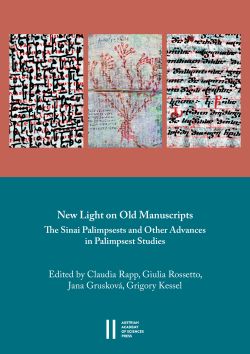
A very interesting new book has just been published by the Austrian Academy of Sciences (and is available on Open Access): 


Claudia RAPP - Giulia ROSSETTO - Jana GRUSKOVÁ - Grigory KESSEL (Eds.), New Light on Old Manuscripts: The Sinai Palimpsests and Other Advances in Palimpsest Studies (link here)

The English abstract: 

The study of palimpsest manuscripts has a long tradition and has led to spectacular discoveries of new texts or new text versions. Recent decades have seen the development of advanced nondestructive methods of multispectral imaging and computer-based image processing. The focus of such research have been individual manuscripts, such as the Archimedes palimpsest that was studied in Baltimore, or the Dexippus fragments in Vienna. The Sinai Palimpsests Project broke new ground by studying for the first time a collection of palimpsest manuscripts that have been preserved for centuries in the library of the Monastery of Saint Catherine in the Sinai (Egypt). The erased layers preserve texts in eleven languages of the Christian Orient. An international team of scholars has identified numerous new texts or versions of texts, often in very early scripts. This volume has its origin in a conference that was held in Vienna in 2018, where these results of the Sinai Palimpsests Project were presented, along with the advances in image capture and image processing that have made them possible. Additional contributions about current projects in the study of palimpsests, also including Jewish and Muslim text traditions, place the study of palimpsest manuscripts within the larger context of the cultural history of the middle ages. The 30 contributions in this volume thus offer a cross-section, including the most recent technologies, of the current state of research in palimpsest studies.

Wednesday, May 31, 2023

New Series “Papyri and the New Testament”

0

I just discovered today that Brill has a new series called “Papyri and the New Testament” edited by Peter Arzt-Grabner, John S. Kloppenborg, and Christina M. Kreinecker. Here’s the publisher’s summary:

Papyrology has always interested scholars of the New Testament and of Christian origins, mainly because of the discovery of papyrus copies of texts from the Christian scriptures. However, what documentary papyri, ostraca, and tablets indicate about issues of everyday Greco-Roman life has also much to contribute to the understanding of early Christ groups. These issues include ancient economy and agriculture, labor and social relations, reading cultures, administration, and a variety of other topics. The PNT series is designed to introduce students and teachers to the value of this material. The volumes provide introductions, evaluations, and conclusions. Many documents are presented in their entirety with an English translation and commentary. The authors cover the state of papyrological research and supplement it with their own conclusions and updates, making the series also of interest to scholars of Papyrology, Biblical Studies, Ancient History, and Classics.

The first two volumes are scheduled for release this year.

The first volume is More Light from the Ancient East: Understanding the New Testament through Papyri edited by the series editors. The title is an obvious ode to the pioneering volume by Adolf Deissmann.

The first volume of the new series “Papyri and the New Testament” introduces students, teachers, and scholars to the value of the study of papyrological documents and their impact on the understanding of early Christ groups. Papyri, ostraca, and tablets document the social, economic, political, and multilingual circumstances of the Greco-Roman period and are the best sources for understanding New Testament times. Compared to the first studies devoted to this topic about 100 years ago, the amount of available material has grown twentyfold. In addition, the days have passed when papyri were found exclusively in Egypt: a significant number of texts from Israel, Syria, North Africa, Britain, Switzerland, and other Greco-Roman regions demonstrate that these sources shed light on general conditions throughout the Roman Empire. The volume both introduces the main issues of comparing papyri with New Testament texts and presents many comprehensive examples.

The second volume is Letters and Letter Writing by Peter Arzt-Grabner.

New Testament letters are compared with the private, business, and administrative letters of Greco-Roman antiquity and analyzed against this background. More than 8.000 letters – preserved on papyrus, potsherds or tablets from Egypt, Israel, Asia Minor, North Africa, Britain, and Switzerland – have been edited so far. Among them are not only short notes by writers with poor writing skills, but also extensive letters and correspondences from highly educated authors. They testify to the high art of Paul of Tarsus, who knew how to make excellent use of epistolary formulas or enrich them with new variants, but they also show that some New Testament letters clearly fall outside the framework of standard epistolography, raising new questions about their authors and their genre. The introductions and discussions offered in the volume reflect the current state of research but also offer new results. Over 130 papyrus and ostracon letters are newly translated in their entirety.

Tuesday, February 28, 2023

New Book on Greek Palimpsests at Saint Catherine’s

1

An email informs me of a new, open-access book that will be of interest to readers here. It’s called Greek Palimpsests at Saint Catherine’s Monastery (Sinai): Three Euchologia as Case Studies. The author is Giulia Rossetto. You can read it online here. 

The Monastery of Saint Catherine in the Sinai peninsula preserves one of the largest collections of manuscripts in the world, which include a significant number of palimpsest manuscripts (over 170). This book deals with Saint Catherine’s palimpsests in Greek language and offers their first-ever inventory. Three selected cases studies are then extensively described in order to showcase the richness and heterogenity of Sinai palimpsest books.

Wednesday, January 04, 2023

Robinson Reviews Stanojević’s Orthodox New Testament Textual Scholarship

4

In the latest issue of the Southeastern Theological Review, Maurice Robinson has a review of Jovan Stanojević’s recent book Orthodox New Testament Textual Scholarship: Antoniades, Lectionaries, and the Catholic Epistles, Texts and Studies (Third Series) 26 (Piscataway NJ: Gorgias Press, 2021). 

The review is interesting because Stanojević is Eastern Orthodox himself and argues for a revision to the Antoniades edition, the standard form of the Greek NT text in the Orthodox church, as I understand it. Robinson, of course, has coedited a Byzantine edition which is not the Orthodox standard. No one in this situation is apparently happy. The review is online (p. 97ff).

Tuesday, November 29, 2022

Book Notice: Evangelicals and Digital Bible Use

2

I’ve just ordered the new book by John Dyer from OUP titled People of the Screen: How Evangelicals Created the Digital Bible and How It Shapes Their Reading of Scripture. John is a longtime evangelical and has been programming Bible software for years (for example). He’s also written a very well received book on the theology of technology. This new book is a version of his PhD thesis, I believe. I’m sure our ETC readers will be interested in this. Here is the description: 

People of the Screen traces the history of Bible software development, showing the unique and powerful role evangelical entrepreneurs and coders have played in shaping its functionality and how their choices in turn shape the reading habits of millions of people around the world. Examining advancements in Bible software from the first desktop applications to pioneering Bible websites, and later to mobile apps and virtual experiences, this book argues that evangelical creators have a distinct orientation toward societal change and technology called “Hopeful Entrepreneurial Pragmatism” that uniquely positions them to lead the digital Bible market, imbuing their creations with evangelical ways of understanding the nature and purpose of Scripture.

This book offers a blend of historical research, interviews with developers, and field work among digital and print Bible readers, offering a nuanced look at the interconnected ecosystem of publishers, developers, pastors, institutions, and software companies. Digital Bibles aren’t replacing print Bibles, author John Dyer shows. Rather, the future of Bible engagement involves readers using a mix of print, audio, and screens to suit their needs. He shows that sometimes the God of the page seems to say different things than the God of the screen, suggesting that we are still in the early stages of a multimedia approach to scripture.

I would also like to add that this is the first and only book cover I’ve seen that can appropriately use Verdana. It was designed for screen use and was one of the world’s most ubiquitous fonts for at least a decade. Please, publishers, do not use it for other books.

Thursday, August 25, 2022

50% Off Scribes & Scripture Book

14

My new book with John Meade comes out in October and should interest ETC readers. The subject—how we got the Bible—is intentionally broad and so is the audience. The goal is to introduce the subject to new readers. I’m not 100% sure, but it may be one of the only books in this category written by those with training in each testament.

Another feature I hope serves readers well is that we wrote the book following several years of field testing the material in churches through our conference of the same name. That taught us what works and what doesn’t in terms of examples, anecdotes, key figures, etc. While we tried to make the material accessible, I don’t think you’ll find it dumbed down. We also included lots of charts, sidebars, and pictures to make it more engaging to the youngins (and our parents). Until it releases, you can get it for 50% off + free US shipping via TCI. 

Publisher info

Scribes and Scripture: The Amazing Story of How We Got the Bible

By John D. Meade, Peter J. Gurry

Answers to Common Questions about the Writing, Copying, Canonizing, and Translating of the Bible

There are many common questions and misconceptions surrounding the formation and history of the Bible: Why is the Bible composed of the current 66 books instead of others? Why are there so many translations? How are we to understand both the human and divine elements of the Bible? In Scribes and Scripture, scholars John D. Meade and Peter J. Gurry answer these questions and give readers tools to interpret the evidence about God’s word. 

Beginning with the history of the Bible—from the invention of the alphabet to the most recent English translations—the book focuses on three main areas: the writing and copying of the Bible, the canonization of the Bible, and the translation of the Bible. Using Old and New Testament scholarship, Meade and Gurry help God’s people better appreciate the story of the Bible as a way to better appreciate the stories in the Bible.

Table of Contents

Introduction

Part 1: Text
Chapter 1: Writing the Bible
Chapter 2: Copying the Old Testament
Chapter 3: Copying the New Testament

Part 2: Canon
Chapter 4: Canonizing the Old Testament to the Reformation
Chapter 5: The Old Testament in the Reformation Period
Chapter 6: Canonizing the New Testament

Part 3: Translation
Chapter 7: Early and Medieval Bible Translation
Chapter 8: English Bible Translation to the King James
Chapter 9: The English Bible after the King James

Conclusion
Appendix 1: Modern Canons
Appendix 2: Early Christian Canon Lists
Glossary

Endorsements

“One of the striking features of the book is its fairness and its reasonableness. No book, of course, is written without a perspective, but Meade and Gurry aren’t trying to win a debate or to demonize opponents. They carefully present and analyze the evidence so that readers can make their own judgments. I can’t think of another book that introduces in such a brief and illuminating way matters of text, canon, and translation.”
—Thomas R. Schreiner, James Buchanan Harrison Professor of New Testament Interpretation, The Southern Baptist Theological Seminary

“I don’t have time to read this.”
—Elijah Hixson, Research Fellow, Center for the Study of New Testament Manuscripts, Forger of Sinaiticus (probably)

“The history of the Bible is complex: it involves multiple languages (ancient and modern), and it divides into two very much distinct (but also overlapping) branches we call the Old and New Testaments. Christians need trusted guides to lead us through that history. This is why I am so grateful for the work of Old Testament specialist John Meade, New Testament specialist Peter Gurry, and their Text & Canon Institute. They represent the newest generation of evangelical historians of the Bible, and they are both able and eager to keep a foot in the academy and a foot in the church. There are many threats to the orthodox viewpoint on text, canon, and translation. Scribes and Scripture is their attempt to serve the church by guiding Christians toward an accurate and faith-filled grasp of the Bible’s history.”
—Mark Ward, Editor, Bible Study Magazine; author, Authorized: The Use and Misuse of the King James Bible

“Is your book finally done??”
—My Kids, Kindergarten through 6th grade

“Misconceptions and myths about the Bible’s origins lead many to reject it and continue to confuse sincere believers. Now, at last, we have a book that shatters these misconceptions. This impressively informative book is based on solid scholarship, yet it is accessible, easy to read, and profitable for any reader at any level. Not for a generation have we seen such a helpful book on this topic! I heartily recommend it to everyone.”
—Peter J. Gentry, Distinguished Visiting Professor of Old Testament and Senior Research Fellow of the Text & Canon Institute at Phoenix Seminary

“Please tell me this book gets royalties.”
—John’s Wife

Tuesday, May 24, 2022

Book Notice: Jerome’s Epistle 106

5

Michael Graves sends word that his new edition of Jerome’s Epistle 106 is now available from SBL Press. he told me about it last Fall and I am very pleased to see it’s out. There is lots of very interesting material in this letter of Jerome for the textual history of the Bible. Here’s the publisher's description:

The present volume offers the first accessible English translation and commentary on Jerome’s Epistle 106, an important work of patristic biblical interpretation. In his treatise Jerome discusses different textual and exegetical options according to various Greek and Latin copies of the Psalms with input from the Hebrew. Epistle 106 provides insightful commentary on the Gallican Psalter, Jerome’s translation of Origen’s hexaplaric edition. Jerome’s work offers a unique window into the complex textual state of the Psalter in the late fourth century and serves as an outstanding example of ancient philological scholarship on the Bible.