

I’m teaching NTTC again at the seminary and that means having guest lecturers visit to share their work. The first two videos are now up at the TCI YouTube channel. If you subscribe there, you’ll get new videos when they’re posted. Thanks to Mike and Edgar for letting me share these.
Showing posts with label P46. Show all posts
Showing posts with label P46. Show all posts
Monday, September 20, 2021
Tuesday, October 08, 2019
Corrections in P46
Jacob W. Peterson has a new article out on the corrections in P46, the very useful, ‘An Updated Correction List for Chester Beatty BP II & P. Mich. Inv. 6238 (Gregory-Aland Papyrus 46 [P46])’ BASP 56 (2019), 173-195.
Abstract:
This study offers an update to previous works on the scribal corrections in Papyrus 46 (P46) of the Pauline Epistles. These prior studies are introduced and used for comparison throughout. Using the latest digital images, I identify thirteen new corrections, show that four previously identified corrections are doubtful, and provide clarification for seven difficult to interpret correction events. An updated total is provided as well as the distribution of corrections by each hand and book.

Abstract:
This study offers an update to previous works on the scribal corrections in Papyrus 46 (P46) of the Pauline Epistles. These prior studies are introduced and used for comparison throughout. Using the latest digital images, I identify thirteen new corrections, show that four previously identified corrections are doubtful, and provide clarification for seven difficult to interpret correction events. An updated total is provided as well as the distribution of corrections by each hand and book.

Friday, April 19, 2019

Tuesday, June 13, 2017
Error in NA28 apparatus (Phil 1.23)
I should say at the outset that finding errors in NA28 is rewarding because they are so few and far between, and because you are pitting your wits against the best in the business. Finding errors in NA28 is a sport based on a fundamental level of respect in the colleagues who have over the years made the NA into the gold standard in our field. It is also a challenge because many things that look at first sight like errors turn out not to be errors, but rather misunderstandings on the part of the challenger.
So with this brief introduction I shall note an error I spotted today following a great Logos seminar on page 170 (fol. 87R) of P46 [there is a problem already hidden there for the inquisitive, but I won’t say any more on that right now].
At Phil 1.23 NA28 notes that the word EIS is omitted before the articular infinitive TO ANALUSAI in P46c D F G. You wouldn’t be at all sure about the reading of P46* on this basis - a first guess might be that P46* did read EIS and a corrector has marked it for deletion - but you wouldn’t know anything except that there was some complexity in the manuscript here. [Incidentally, you might also wonder why DFG are agreeing with P46c but not (by definition) P46* - which could also be interesting if it really happened.] To figure out what was going on with P46 here you’d have to consult a good image.
But when you did consult a good image you would realise that the entry in NA28 is an error, at least the little “c” is an error. There is no correction to the text of P46 at this point:
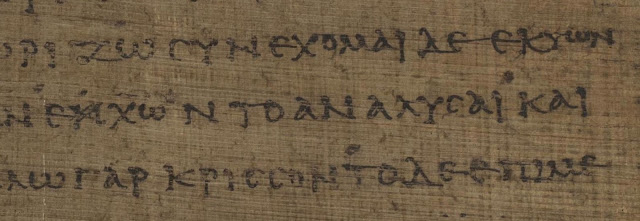
I offer this small post as a homage to NA28 with a hope that this might be corrected in future editions (NA27 correctly noted P46 D F G as witnesses to the omission).
So with this brief introduction I shall note an error I spotted today following a great Logos seminar on page 170 (fol. 87R) of P46 [there is a problem already hidden there for the inquisitive, but I won’t say any more on that right now].
At Phil 1.23 NA28 notes that the word EIS is omitted before the articular infinitive TO ANALUSAI in P46c D F G. You wouldn’t be at all sure about the reading of P46* on this basis - a first guess might be that P46* did read EIS and a corrector has marked it for deletion - but you wouldn’t know anything except that there was some complexity in the manuscript here. [Incidentally, you might also wonder why DFG are agreeing with P46c but not (by definition) P46* - which could also be interesting if it really happened.] To figure out what was going on with P46 here you’d have to consult a good image.
But when you did consult a good image you would realise that the entry in NA28 is an error, at least the little “c” is an error. There is no correction to the text of P46 at this point:

I offer this small post as a homage to NA28 with a hope that this might be corrected in future editions (NA27 correctly noted P46 D F G as witnesses to the omission).
Tuesday, October 06, 2015
Recent Journal Articles on Textual Criticism
While looking at the new journals shelf last week I noticed a number of text critical articles have come out recently.
 Novum Testamentum 57.5
Ronald H. van der Bergh, “Old Testament Awareness” and the Textual Tradition of the Explicit Quotations of Isaiah in Codex Bezae’s Acts, pp. 360–378
This article investigates the textual history of the explicit quotations of Isaiah in the Acts of the Apostles of Codex Bezae Cantabrigiensis (Acts 7:49–50; 13:34; 13:47) by introducing the concept of “Old Testament awareness.” This concept can be defined as the degree to which a NT tradition, at any stage of its transmission history, is aware of a quotation stemming from the OT. OT awareness can be identified in the layout of Codex Bezae (e.g., the indentation of text in the manuscript to indicate OT quotations), the text of quotations (e.g., readings that can be shown to be a subsequent change towards an OT tradition) and the context of the quoted text (e.g., the quotations’ introductory formulae). Through assessing the OT awareness of Codex Bezae’s explicit quotations of Isaiah, different stages in the transmission history of the text of these quotations in Codex Bezae’s Acts can be identified.Laurent Pinchard, Des traces vétérotestamentaires dans deux variantes du Codex de Bèze (Mt 26,55 et 28,8) jugées harmonisantes, pp. 418–430
Codex Bezae is traditionally famous for its harmonising tendency compared to other early majuscule manuscripts of the Gospels. In this article we suggest that, based on two examples drawn from Matthew, some of its variant readings have striking lexical correspondence with passages from the Old Testament. As a result, it is more likely that they probably transmit an original reading as opposed to being the result of a less capable scribe, who would have corrected an earlier text to make it closer to the parallel passages from the Synoptics. The passages examined are Jesus’ arrest on the Mount of Olives (Mt 26.55) and the women’s encounter at the tomb on Easter day (Mt 28.8).Also in NovT, Simon Crisp and J. K. Elliott review vols. 1–2 of the New Cambridge History of the Bible and Hugh Houghton reviews Die Vetus Latina-Fragmente aus dem Kloster St. Gallen.
 New Testament Studies 61.4
Joel D. Estes, Reading for the Spirit of the Text: nomina sacra and πνεῦμα Language in P46, pp. 566–594This study examines every reference to πνεῦμα in NT Papyrus 46 (P. Chester Beatty ii / P. Mich. Inv. 6238) and whether or not it is contracted as a nomen sacrum. Against expectations, the scribe does not always use nomina sacra to designate the divine Spirit, nor are other kinds of spirits always written out in full. This discovery destabilises the assumption that we can access the scribe’s understanding of πνεῦμα simply by identifying where nomina sacra do and do not occur. At the same time, such scribal irregularity itself may illustrate wider theological ambiguities among some early Christian communities concerning the status and role of the Holy Spirit.Peter Malik, The Corrections of Codex Sinaiticus and the Textual Transmission of Revelation: Josef Schmid Revisited, pp. 595–614
The role of manuscript corrections in studying textual transmission of the New Testament has been long recognised by textual critics. And yet, the actual witness of corrections may at times be difficult to interpret. A case in point is Josef Schmid’s seminal work on the text of Revelation. Following Wilhelm Bousset, Schmid argued that a particular group of corrections in Codex Sinaiticus reflected a Vorlage with a text akin to that of the Andreas text-type. By dating these corrections – unlike Bousset – to the scriptorium, Schmid utilised their witness to trace the text of Andreas back to the fourth century. Recently, Juan Hernández has shown that the corrections cited by Schmid were significantly later, hence calling his fourth-century dating of Andreas (among other things) into question. Through an analysis of the corrections cited by Schmid, supplemented by a fuller data-set of Sinaiticus’ corrections in Revelation, this study seeks to reappraise Schmid’s claims concerning the textual relations of these corrections, and identify their role in the later transmission of the text of Revelation.

Tyndale Bulletin 66.1
Lincoln Blumell, A New LXX Fragment Containing Job 7:3–4 and 7:9, pp. 95–101
This article presents an edition of a papyrus fragment from LXX Job that is housed in the Hatcher Graduate Library at the University of Michigan. The fragment likely dates to the sixth century A.D. and comes from a codex. On the recto the fragment contains Job 7:3–4 and on the verso Job 7:9. [Includes two black and white photos.]
Wednesday, April 09, 2014
Ebojo on P46: When Nonsense Makes Sense
New Article: E.B. Ebojo, ‘When Nonsense Makes Sense: Scribal Habits in the Space-intervals, Sense-pauses, and Other Visual Features in P46,’ The Bible Translator 64 (2013), 128-150.
Abstract
This article explores the visual and paratextual features embedded in P46 and assesses how these reflect a microcosm of ancient book production enterprise as well as its eventual construal by the reading community that used it. Accordingly, it also suggests ways in which the copying habits of the scribe who produced this manuscript may be similarly unveiled through these features.
Edgar completed his PhD on P46 in Birmingham and this is, I think, the first published fruits of his research (I am hoping there will be much more). This article offers a helpful introduction to P46 and also takes up the challenge which I issued on this blog in 2009: ‘I think it would be a good study to look at the use of space for ‘pauses in sense’ in P46, but there would be quite a few method issues to think through.’ (see here: http://evangelicaltextualcriticism.blogspot.co.uk/2009/08/significant-spaces-in-p46.html; referenced on p. 131). This whole issue (along with the previous one) of The Bible Translator is in honour of Roger Omanson, and includes other essays of interest (see here and here).
Abstract
This article explores the visual and paratextual features embedded in P46 and assesses how these reflect a microcosm of ancient book production enterprise as well as its eventual construal by the reading community that used it. Accordingly, it also suggests ways in which the copying habits of the scribe who produced this manuscript may be similarly unveiled through these features.
Edgar completed his PhD on P46 in Birmingham and this is, I think, the first published fruits of his research (I am hoping there will be much more). This article offers a helpful introduction to P46 and also takes up the challenge which I issued on this blog in 2009: ‘I think it would be a good study to look at the use of space for ‘pauses in sense’ in P46, but there would be quite a few method issues to think through.’ (see here: http://evangelicaltextualcriticism.blogspot.co.uk/2009/08/significant-spaces-in-p46.html; referenced on p. 131). This whole issue (along with the previous one) of The Bible Translator is in honour of Roger Omanson, and includes other essays of interest (see here and here).
Thursday, November 04, 2010
New Dissertations from New Orleans Baptist Theological Seminary
The Center for New Testament Textual Studies and New Orleans Baptist Theological Seminary announce details on two tc dissertations.
Yesterday, Min-Seok Jang successfully defended his PhD dissertation entitled “A Reconsideration of the Date of Papyrus 46.” Jang (BA Yonsei University; MDiv Korea Baptist Theological Seminary; ThM NOBTS) compared 15 characteristics of p46 to a large number of papyri. In addition to the 80 papyri examined in previous p46 research , Jang examined 154 documentary papyri, 108 literary papyri, and 48 reformed documentary papyri, all categorized into five periods ranging from the second half of the first century to the second half of the third century. He concluded that p46 appears to have more in common with the papyri produced between A.D. 75 and A.D. 200 than with papyri from the later period. A narrower range between A.D. 100 and A.D. 150 is possible, but problematic.
Last week, David Champagne (BS Florida State University; BS Mississippi College; MA NOBTS; ThM NOBTS) passed his PhD comprehensives and has now begun work on his dissertation tentatively entitled, “An Analysis of Superscription and Subscription Traditions in New Testament Manuscripts.”
Yesterday, Min-Seok Jang successfully defended his PhD dissertation entitled “A Reconsideration of the Date of Papyrus 46.” Jang (BA Yonsei University; MDiv Korea Baptist Theological Seminary; ThM NOBTS) compared 15 characteristics of p46 to a large number of papyri. In addition to the 80 papyri examined in previous p46 research , Jang examined 154 documentary papyri, 108 literary papyri, and 48 reformed documentary papyri, all categorized into five periods ranging from the second half of the first century to the second half of the third century. He concluded that p46 appears to have more in common with the papyri produced between A.D. 75 and A.D. 200 than with papyri from the later period. A narrower range between A.D. 100 and A.D. 150 is possible, but problematic.
Last week, David Champagne (BS Florida State University; BS Mississippi College; MA NOBTS; ThM NOBTS) passed his PhD comprehensives and has now begun work on his dissertation tentatively entitled, “An Analysis of Superscription and Subscription Traditions in New Testament Manuscripts.”
Tuesday, January 05, 2010
Sinn Fein Leader Gerry Adams in Search for Jesus and Papyrus 45
 Somewhat surprising, Sinn Fein Leader Gerry Adams is involved in the search for "the real Jesus of the Gospels" as part of a new seven-part television series for Channel 4 called "The Bible: A History." Adams is one of seven commentators who will explore the Bible "from their own, very personal, perspective". Adam's episode will focus on Jesus' teachings on "love, forgiveness, and repentance". Adams will both meet scholars who put Jesus in historical context and victims of violence in Northern Ireland.
 In a statement Channel 4 says that Mr Adams, "as a former supporter of political violence" would also examine the "contradiction between Jesus' teachings and the involvement of Christians, and followers of other faiths, in conflict the world over. Further, Ralph Lee of Channel 4 says the programme will "offer an insight into how a man so strongly associated first with conflict and then with peace in Northern Ireland, has reconciled his religion with the decisions he has taken in his life".
Read the whole story at BBC News here.
The Daily Mail, on the other hand, reports on the outrage it has caused as "Channel 4 invites Gerry Adams to preach... on forgiveness." Apparently, the former Tory minister Lord Tebbit, who was injured in an IRA bombing in 1984, burst out laughing when he heard about Gerry Adams's programme, and said: 'I wish him well. And I hope he also comes across the doctrine of hell and the consuming of pernicious unrepentant murderers and sinners in general by the fires of hell for all eternity."
It has come to my knowledge that the English film crew that produces this particular episode has recently visited the Chester Beatty Library in Dublin to shoot the significant Gospel MS Chester Beatty Biblical 1 (P45). (Note that the proper designation is Chester Beatty Biblical 1, or I, not Chester Beatty 1; the latter is in fact another manuscript, an ancient Egyptian Love Poem, published in the 1920's.)
See image and brief description of P45 here.
See also the on-line exhibition of Chester Beatty Biblical 2 (P46), "In the Footsteps of Saint Paul" including manuscript images.
Friday, October 02, 2009
Heb 2.9 in P46 (and NA27)
Just a couple of points:
- In the inner margin of NA the numbered kephalaia are given as 'most widely used in the manuscripts' (p. 78*). These are often interesting and sometimes illuminating, and sometimes very relevant to textual criticism (e.g. on the pronoun of Romans 8.2; cf. Romans keph. 11). Right here (at Heb 2.9) the placement of the number is interesting in the sense of 'strange'. (Assuming for the moment that this placement is accurate to the placement in most manuscripts [which in any case I cannot check].) It is strange because it breaks up Hebrews' interaction with Ps 8: the final clause of Ps 8.7 is in view in Heb 2.8c as not yet seen; whereas the two preceding clauses of Ps 8.6 are in view in Heb 2.9a-b as now seen (this also confirms the decision to follow the shorter text of Ps 8.7 in the citation in Heb 2.7). So this particular chapter division is interesting in the sense of being profoundly unhelpful.
- The reader marks of P46 (see my earlier post) are interesting in 2.9 as signalling a pause between DIA TO PAQHMA TOU QANATOU and the following clause (from Ps 8) DOXH k.t.l.
.jpg) This could be read as associating the 'lower than the angels' directly with Jesus' death; and separating the 'crowning' as subsequent (with plenty of modern commentators). I take the crowding of ESTEFANWMENON (unusually given the whole page) as a kind of punctuation too - ending this clause at the end of the line and leaving the OPWS clause to a new line.
This could be read as associating the 'lower than the angels' directly with Jesus' death; and separating the 'crowning' as subsequent (with plenty of modern commentators). I take the crowding of ESTEFANWMENON (unusually given the whole page) as a kind of punctuation too - ending this clause at the end of the line and leaving the OPWS clause to a new line. - Hebrews' use of Ps 8 is clearly very interesting and purposeful. In my own thinking about it I see Hebrews as really crediting the title of the Psalm as significant (EIS TO TELOS): he knows from this that it is eschatological, hence his approach to this section is to differentiate precisely between what is already and what is not yet - this is not an arbitrary reading but a LXX-canonical reading that Hebrews is pursuing (of the LXX clearly, not a Hebrew Bible).
- I actually quite like to see the NA27 note about the conjecture to omit the OPWS clause (the deletion of all conjectural emendations is one aspect of NA28 that I am not looking forward to). It is a signal to me that scholars have found the clause awkward and so it is a stimulus to think it through carefully (I confess that I am unlikely to follow proposed conjectural emendations without any external evidence). They are also interesting for the history of scholarship (over to Jan for more ...).
- P46 already reads XARITI QEOU here, which suggests that if in fact XWRIS QEOU is the original text, the alteration to XARITI took place pretty early and established itself fairly readily as the manuscript reading. (Although of course even if you don't think XWRIS QEOU is original we must all acknowledge it as an ancient reading preserved for a millenium in manuscripts no longer extant and then appearing in some late uncials and early minuscules) I don't have the strength right now to defend this reading (read the brilliant treatment in B.D. Ehrman, Orthodox Corruption, 146-150 for a compelling argument at this point).
.jpg)
Subscribe to:
Posts
(
Atom
)