Showing posts with label Codex Bezae. Show all posts

Friday, December 17, 2021

New Book on Edgar Goodspeed

0

There is a new book just out on two important years in the life and work of Edgar J. Goodspeed.
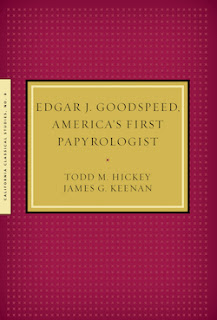
Todd M. Hickey & James G. Keenan, Edgar J. Goodspeed, America's First Papyrologist (California Classical Studies 8, 2021). https://calclassicalstudies.org/?page_id=219

Blurb: This is a study whose main sources are archival, principally Edgar J. Goodspeed’s “Student Travel Letters” from 1899–1900. These letters home recount Goodspeed’s daily and sometimes hourly activities during nearly two years abroad, in continental Europe, England, Egypt, and the Holy Land, in pursuit of scholarly seasoning. The book’s focus is on his engagement with the newly emergent field of papyrology—the decipherment and study of the ancient Greek manuscripts then being discovered in Egypt. The letters allow for a tracking of this engagement in far greater depth than that allotted in his 1953 autobiography, As I Remember, or in his 90-page unpublished memoir, “Abroad in the Nineties,” filling in some apparently intentional gaps, casting doubt on some of his later self-assessments but putting much additional substance to the claim that he was indeed “America’s First Papyrologist.” The result, part biography, part travelogue, part diary, part academic history, is a description of Goodspeed’s progress, beginning with his enthusiastic commitment to the fledgling field in the late 1890s, ending with his abandonment of it in the early 1900s, possibly a result of his complicated dealings with Oxford papyrologist Bernard P. Grenfell in the fateful summer of 1900. Along the way the book introduces the reader to the world of papyrology in its early days, but it is mainly an account of one budding scholar’s experiences in pursuit of recognition in that subject, a story that has its own complications, narrative arc, and human interest.­­­

You can read the whole thing online (here: https://calclassicalstudies.org/?page_id=219). It is especially interesting for the history of papyrus purchasing, exporting, and distribution; and for seeing something of Oxford in the summer of 1900 where he worked on the Tebtunis papyri with Grenfell and Hunt. He was quite an aggressive networker (he called it “lion hunting”), so there is a large supporting cast of papyrologists and other manuscript scholars mentioned in his letters. There is also a collection of photos from his travels, especially from sites in Egypt. There is not a lot of direct connection with his later academic interests in the text and exegesis of the New Testament text, but it is an interesting exploration of some of his formative years, through the letters he sent home to his family.

Goodspeed visited Cambridge (where he met up with Mrs Lewis, Rendel Harris, Solomon Schechter, as well as some friendly girls!) and there, once he’d seen Schecter’s “Genizah stuff” he says ‘I got an attendant to shew me some leaves of “D” (Codex Bezae), which is a beautiful Manuscript’ (p. 111). This is a curious expression which suggests the manuscript may have been disbound at this point (6th August 1900).

Thursday, August 05, 2021

The Text of Codex Bezae in Finnish

1

Pasi Hyytiäinen has let me know that he has finished a translation of the text of Bezae in Acts into Finnish. You can find it here. I can’t say anything about the translation, of course, but I trust it’s good.


Thursday, November 23, 2017

Elijah Hixson discovers lost text in Codex Bezae

0
At SBL this week, Elijah Hixson presented his discovery of lost text in Codex Bezae. The full research is forthcoming in New Testament Studies, but you can read about how Elijah found the missing text at the Cambridge special collections blog.

Here’s a snippet explaining how Elijah made the discovery.
Samuel P. Tregelles noted that although there was no visible writing [in Gregory-Aland 33/Paris, Bibliothèque nationale de France, gr. 14) where there should have been, the text was not completely lost. It was just in the wrong place: on the opposite page, backwards. The damp storage conditions had caused the pages to stick together. When they were pulled apart, the ink often adhered to the facing page.

The same phenomenon occurs in Codex Bezae. In at least one place, a few letters from the Greek side have stuck – backwards – to the facing page of Latin text. What is significant, however, is that in this one place, the Greek page was subsequently lost. We have no record of what this page looked like or what Greek text it contained. Thanks to the wonderful images of Codex Bezae on the Cambridge University Digital Library, it is possible to work with the images in photo-editing software to recover some of the lost text.
Here is one example:

Reversed ink in Bezae 455r
Fantastic work on this, Elijah. As he said in his paper, even the most studied manuscripts still have secrets to reveal to those willing to look carefully enough.

And happy Thanksgiving to all our American readers!

Monday, June 27, 2016

Just How Much Longer Is Codex Bezae’s Text in Acts?

18
Acts 1 in Bezae. (Photo)
It’s frequently reported that the text of Acts is longer in the Western text than in the Alexandrian. But just how much longer is it? The most commonly cited number is 8.5%. You’ll find this in Metzger’s Textual Commentary (p. 223 n. 3).

This number comes from F. G. Kenyon’s The Western Text in the Gospels and Acts published in 1939. But, interestingly, this number is not taken from comparing two manuscripts but rather two modern editions. Kenyon compared the text of WH in Acts with that of A. C. Clark. The former is taken as representative of the Alexandrian text and the latter of the Western.

One other comparison I found was in Pete Head’s article on the text of Acts. He compared the text of Codex Bezae with the NA26/UBS3 and found the former to have 800 more words than the latter.

Neither of these comparisons completely satisfied me though. In both cases, the comparison is made with a modern edition. I thought it would be better to compare manuscript with manuscript. To do that, I used two of the leading representatives of the Western and Alexandrian text: Bezae and Sinaiticus. I compared the text of their first hands in all places in Acts where Bezae is extant. (Bezae has lacunae in Acts 8.29–10.14; 21.2–10, 16-18; 22:10–20; 22:29–28.31) It turns out that the difference is minimal and Kenyon’s figures are about the same as mine.

I found that Bezae is about 7.9% longer than Sinaiticus in Acts. The raw numbers are Bezae: 71,872 characters; Sinaiticus: 66,594 characters.

One point about my method: I compared letters rather than words for reasons I’ll explain. The comparison is pretty straightforward. I took the transcriptions of both Sinaiticus and Bezae that are available for free in Logos Bible Software. These in turn come from INTF/ITSEE/IGNTP transcriptions which means their format is very similar. There’s clearly a lot of work behind both so a big thank you to those responsible.

I copied the text from Logos into Word and stripped out extra content like verse numbers, punctuation, quire numbers, running titles, parentheses, ellipses, nomina sacra lines (because Word counted those as characters), etc. Basically, I cut everything out but the letters.

The reason I counted characters is because these transcriptions are on the diplomatic end of the spectrum and that means that many individual words in Sinaiticus are split between lines. Putting all these back together did not seem like a good use of time. So instead I counted characters without spaces. I checked the count with charactercounttool.com.

It’s nice to know that Kenyon’s method didn’t put us far off the mark.

Friday, March 11, 2016

Codex Bezae on Display Now

10
Just a note to those in or near Cambridge that Codex Bezae is said to go on display today at the University Library.

Probably not the page they’ll put on display.
I was there a few days ago and saw them setting up, but the displays themselves were off limits. Hopefully I can get over there this weekend to see the great manuscripts. If you’re not in Cambridge, you can still view the manuscript online.

Other Biblical items on display include:
All the items on display are available for viewing online as well.

Update: I went over today and Bezae is on display along with the other items listed above. Also Codex Zacynthius, one of two (?) fragments of Origen’s Hexapla, a medieval Hebrew Bible, some papyri and other interesting books were on display. Unfortunately the the three- and four-year-old accompanying me were not as impressed as I hoped so our visit was cut short. I’ll have to go back.

Update: Some photos (PMH):


Tuesday, October 06, 2015

Recent Journal Articles on Textual Criticism

4
While looking at the new journals shelf last week I noticed a number of text critical articles have come out recently.

Novum Testamentum  57.5

This article investigates the textual history of the explicit quotations of Isaiah in the Acts of the Apostles of Codex Bezae Cantabrigiensis (Acts 7:49–50; 13:34; 13:47) by introducing the concept of “Old Testament awareness.” This concept can be defined as the degree to which a NT tradition, at any stage of its transmission history, is aware of a quotation stemming from the OT. OT awareness can be identified in the layout of Codex Bezae (e.g., the indentation of text in the manuscript to indicate OT quotations), the text of quotations (e.g., readings that can be shown to be a subsequent change towards an OT tradition) and the context of the quoted text (e.g., the quotations’ introductory formulae). Through assessing the OT awareness of Codex Bezae’s explicit quotations of Isaiah, different stages in the transmission history of the text of these quotations in Codex Bezae’s Acts can be identified.
Laurent Pinchard, Des traces vétérotestamentaires dans deux variantes du Codex de Bèze (Mt 26,55 et 28,8) jugées harmonisantes, pp. 418–430
Codex Bezae is traditionally famous for its harmonising tendency compared to other early majuscule manuscripts of the Gospels. In this article we suggest that, based on two examples drawn from Matthew, some of its variant readings have striking lexical correspondence with passages from the Old Testament. As a result, it is more likely that they probably transmit an original reading as opposed to being the result of a less capable scribe, who would have corrected an earlier text to make it closer to the parallel passages from the Synoptics. The passages examined are Jesus’ arrest on the Mount of Olives (Mt 26.55) and the women’s encounter at the tomb on Easter day (Mt 28.8).
Also in NovT, Simon Crisp and J. K. Elliott review vols. 1–2 of the New Cambridge History of the Bible  and Hugh Houghton reviews Die Vetus Latina-Fragmente aus dem Kloster St. Gallen.

New Testament Studies 61.4

Joel D. Estes, Reading for the Spirit of the Text: nomina sacra and πνεῦμα Language in P46, pp. 566–594
This study examines every reference to πνεῦμα in NT Papyrus 46 (P. Chester Beatty ii / P. Mich. Inv. 6238) and whether or not it is contracted as a nomen sacrum. Against expectations, the scribe does not always use nomina sacra to designate the divine Spirit, nor are other kinds of spirits always written out in full. This discovery destabilises the assumption that we can access the scribe’s understanding of πνεῦμα simply by identifying where nomina sacra do and do not occur. At the same time, such scribal irregularity itself may illustrate wider theological ambiguities among some early Christian communities concerning the status and role of the Holy Spirit.
Peter Malik, The Corrections of Codex Sinaiticus and the Textual Transmission of Revelation: Josef Schmid Revisited, pp. 595–614
The role of manuscript corrections in studying textual transmission of the New Testament has been long recognised by textual critics. And yet, the actual witness of corrections may at times be difficult to interpret. A case in point is Josef Schmid’s seminal work on the text of Revelation. Following Wilhelm Bousset, Schmid argued that a particular group of corrections in Codex Sinaiticus reflected a Vorlage with a text akin to that of the Andreas text-type. By dating these corrections – unlike Bousset – to the scriptorium, Schmid utilised their witness to trace the text of Andreas back to the fourth century. Recently, Juan Hernández has shown that the corrections cited by Schmid were significantly later, hence calling his fourth-century dating of Andreas (among other things) into question. Through an analysis of the corrections cited by Schmid, supplemented by a fuller data-set of Sinaiticus’ corrections in Revelation, this study seeks to reappraise Schmid’s claims concerning the textual relations of these corrections, and identify their role in the later transmission of the text of Revelation.

Tyndale Bulletin 66.1

Lincoln Blumell, A New LXX Fragment Containing Job 7:3–4 and 7:9, pp. 95–101

This article presents an edition of a papyrus fragment from LXX Job that is housed in the Hatcher Graduate Library at the University of Michigan. The fragment likely dates to the sixth century A.D. and comes from a codex. On the recto the fragment contains Job 7:3–4 and on the verso Job 7:9. [Includes two black and white photos.]

Monday, July 20, 2015

Calhoun: Acts 17.27 in Bezae as a Reader’s Note

0
The latest issue of Early Christianity (6.2) has an interesting short article from Robert M. Calhoun on the reading of Codex Bezea at Acts 17.27. Instead of reading that every nation has been made “to seek God” (ζητεῖν τὸν θεόν), Bezae says that it was “especially to seek the divine” (μάλιστα ζητεῖν τὸ θεῖόν ἐστίν). Several other witnesses attest τὸ θεῖον as well (gig, Clement, Irenaeus), but all of them, in one way or another, smooth the awkward syntax introduced by ἐστίν. As Metzger says, the text of Bezae “cannot be construed with the rest of the sentence” and must be emended either by removing ἐστίν or changing τό to something like ὅ (Commentary, p. 405).

Calhoun, however, points out that if Bezae’s text is taken as a complete sentence, it reads quite naturally as a reader’s note: μάλιστα “ζητεῖν τὸ θεῖόν” ἐστιν = “certainly [the correct reading] is ‘to seek the divine.’” At some point, the comment was misread so that instead of just replacing θεόν with θεῖον, the entire sentence was placed in the main text. Calhoun further suggests that this may give us a (small) clue about the editorial process behind the text of Bezae.

While this isn’t the kind of scenario one can definitively prove, and while I would like to see some uses of μάλιστα in similar contexts, it looks to me like a convincing solution and comes with the distinct advantage of not resorting to emendation.

Here is the relevant page in Bezae (line 2) courtesy of Cambridge’s nifty manuscript viewer:


----
Robert Matthew Calhoun, “The D-Text of Acts 17:27 (μάλιστα ζητεῖν τὸ θεῖόν ἐστιν),” Early Christianity 6.2 (2015): 230-234.

Wednesday, December 12, 2012

Codex Bezae Goes Digital

6


The digital Codex Bezae has been released today in Cambridge Digital Library along with transcriptions of the International Greek New Testament Project (IGNTP). There is also a description of the codex written by David Parker. Here is the first paragraph:

There are half-a-dozen ancient manuscripts which are the foundation of our understanding of the text of the New Testament writings. Among these stands the copy known since the sixteenth century as Codex Bezae Cantabrigiensis. Any manuscript which has survived from antiquity is a marvel for this reason alone, and as we explore its pages, we have a rare opportunity to explore a little of the written culture of late antique Christianity. Although in the past century some remarkable papyrus manuscripts have been recovered from the sands of Egypt, their discovery has in general served more to highlight the significance of the parchment manuscripts than to diminish it. 
Click this link to access high-resolution images and transcriptions of the IGNTP.