Showing posts with label J. K. Elliott. Show all posts

Tuesday, June 11, 2024

J. K. Elliott (1943–2024)

16

Last week marked the passing of one of the great NT textual critics of the 20th/21st-centuries. J. Keith Elliott has been a staple of textual criticism as long (and longer) than I’ve been a student of the subject. I first heard him at a conference on the ending of Mark at Southeastern Baptist Theological Seminary in 2007 as an undergraduate. That conference, later published as a book, was instrumental in pushing me to become a text critic.

Elliott taught for many years at the University of Leeds after having studied under G. D. Kilpatrick at Oxford from whom he picked up his thoroughgoing eclecticism. This method is known for putting primary (though not exclusive) emphasis on internal evidence and a willingness to accept a reading regardless of its source. 

As a proponent of this method, he could write negatively about “the cult of the oldest and best manuscripts” though he was careful to add that he did not treat all manuscripts the same. Positively, his approach meant he could be extremely careful and insightful when writing about matters of Greek syntax and authorial style. All this left me surprised when, in my viva, he left my criticisms of his method virtually untouched. I had claimed that the results of the CBGM basically made his method untenable. But he seemed completely unbothered and was nothing but a delight as an examiner. Even typos were forgiven!

Speaking of typos, he was a very close reader, as any who read his book reviews will know. He had plenty of practice as as the long-time book review editor for Novum Testamentum. Receiving a positive review from Elliott gave one a sense, not so much of pride, as relief. I will never forget him referring to what he considered to be a book’s overly sanctimonious acknowledgements as “cringe-making and toe-curling.” Besides moving me to keep my own acknowledgments short, this particular line taught me that good academic writing did not have to be stiff and boring; it could be careful and still colorful. Elliott’s writing was both. 

In my mind, his meticulousness as a scholar is encapsulated in two books on my shelf: his Bibliography of Greek New Testament Manuscripts and his Survey of Manuscripts Used in Editions of the Greek New Testament. The former he updated regularly and it is amazing to read it and see all that Elliott kept his pulse on. If readers would like a good sample of his work, Brill has kindly made his essay on thoroughgoing eclecticism open access.

Besides serving as an editor for Novum Testamentum and secretary of SNTS, Elliott served the IGNTP for 43 years in various roles as editor, secretary and member. (See the interview with Tommy at his retirement.) It surprised me to learn that Elliott was instrumental in the work of the Luke volumes as early as the 1970s. Much more surprising, but still indicative of the kind of person he was, Elliott was also a member briefly of the Majority Text Society for some years of the Dean Burgon society. Hixson will have to confirm this for me, but my understanding is that he was asked to give a talk at one of their meetings and he maintained his membership in order to get their newsletter and stay abreast of their work. He was ever the consummate bibliographer.

Elliott truly was a giant in our field. His passing feels like a great loss, one impossible to replace. But I take it as a moment to remind myself how important it is for those of us in the field to inspire the next generation. For myself, Elliott did that most of all through his speaking and writing. He remains for me a model of precision and thoroughness.

Posted below is a video of Elliott with Craig Evans to get a good sense of the man. (By the way, did you know Elliott has an IMDB page?)

Tuesday, November 17, 2020

Interview with Elliott after 43 Years with the IGNTP

7

A few days ago, in conjunction with the recent meeting of the IGNTP Committtee, Professor J. Keith Elliott stepped down from active service after being on the committtee for 43 years (as editor, secretary and member). That is in fact a record hard to beat. If you look at the historical data on the IGNTP webpage, you can see that Eldon Epp was on the committee for 42 years, Gordon Kilpatrick (Elliott's Doktorvater) for 41 years, and Bruce Metzger and Thomas Pattie "only" for 38 years.

As the current secretary, I took the opportunity to interview Elliott. You will find the interview here. By the way, there is also a link back to our blog (to the post about how Kurt Aland got two votes on the UBS Committee). 

The picture here is of the file with papers that I inherited from Elliott, who served as secretary to the IGNTP Committtee 1987–2010 (I celebrate 10 years as secretary). It is packed with communication, editorial reports, treasurer's reports, and minutes. Nowadays there is a digital archive but we still keep hardcopies of the signed minutes.

Wednesday, February 20, 2019

Elliott’s Doctoral Thesis on the Text of the Pastoral Epistles

7
At some point in college, I remember looking through J. K. Elliott’s The Greek text of the epistles to Timothy and Titus, a detailed textual commentary on those books from a thoroughgoing eclectic perspective.

Recently, while putting a bibliography together I discovered that the two-volume Oxford DPhil that lies behind this book is freely available online from Oxford. As I don’t have a copy of the published version, I don’t know if there are any significant differences. But, if it’s like most published British dissertations, it is probably very similar. If someone can check, let me know. [Update: Elliott emails to say, “Very few changes were made.”]

Here’s the first part of the abstract:
To my knowledge there has been no thoroughgoing eclectic study of the text of any New Testament book, although the principles of eclectic textual criticism have been applied to individual readings. This thesis attempts to provide a study of all the known variant readings in the Greek text of the Pastoral Epistles. To this end, a full critical apparatus has been compiled and a discussion on each variant reading is provided with the object of establishing the original text and of explaining how variants arose.

The theory, on which these discussions are based is found in an introductory chapter. This introduction begins by arguing that previous methods of textual criticism based largely on the “cult of the best manuscript” are untenable and unreliable nowadays due partly to the growing realisation that no one manuscript or group of manuscripts contains the original text. Many scholars realise that the original reading may be found in any given manuscript. The implication of this is of course that the peculiar readings of every manuscript must (ultimately) be examined. 

Wednesday, June 13, 2018

Latest Book Reviews from Keith Elliott

3
Keith Elliott’s reviews are always a highlight for me. His prose is a delight and his pen can be almost as sharp as his eye for detail. They always challenge me to improve my own book reviews.

In the latest NovT, he has reviewed at least four recent works on NT textual criticism: the Tyndale GNT, the ECM Acts, and two books on the CBGM by yours truly and Tommy (the latter of which is being given away right now, FYI). I was sent a digital copy, which was most welcome given my lack of digital access to NovT these days. Here is a taste of each:

On THGNT:

The publication of a Greek New Testament is not usually a headline event for general readers but this Tyndale edition (under the editorship of its re- searchers, led by Dirk Jongkind and Peter Williams) is significant. It takes a proud place alongside other edited Greek testaments currently on the market. Significantly it appears c.500 years after Erasmus’ first printed and published Greek (and Latin) Novum Instrumentum and the anniversary of Luther’s initiating the Protestant Reformation and his German New Testament (of 1522). ... A Preface opens the book and contains a brief explanation of the editorial motives. (It ends with the evangelical slogan “Soli Deo Gloria” even though gratia is conveyed later—especially to financial donors—on pages 525–6). ... Fulsome acknowledgements conclude the volume. We reiterate the praise there for the researchers, editors and assistants who together have achieved their goal, against many commercial and scholarly odds. We must wait and see how influential this edition proves to be in the academic world of New Testament studies.

On ECM Acts

[See his much longer review in JTS 2018.] Many passages agree with the Byzantine text-type and therefore differ from “the established (sic) text” (i p. 19*). Among the 52 readings where ECM differs from NA28 (I pp. 34*-35*) thirty-six move towards Byz. Only three move away from Byz. ... This edition will be with us for many decades and its text will be used as the text in NA and UBS. We express our gratitude to the Münster Institut, its Direktor and Mitarbeiter. They have done themselves—and the scholarly world at large—proud, yet again.

On the CBGM books

[On my thesis:] At the viva voce at the University of Cambridge the examiners of Gurry’s thesis had no problem in recommending it as a worthy example of original thinking and a proper contribution to learning. Academic text-critics have known of—and pussyfooted around—CBGM for several years, suspicious of it because of its apparent lack of careful explication. Now Gurry has peered behind the veils of mystery and exposed the importance and significance of its methodology.
[On my book with Tommy:] This combined effort (although seemingly mainly Gurry’s work, if source criticism be applied) is a welcome introduction to the Coherence-Based Genealogical Method (= CBGM) devised by Gert [sic] Mink at Münster for coping with the large number of Greek New Testament manuscripts extant. Several of us have been wary about extolling its apparent virtues, partly because it looks so complicated and Mink’s own published explanations seemed opaque. Now Wasserman and Gurry have explained its history, use and consequences. They also highlight its limitations—always an honest approach to such matters. However, they hope that those promulgating the methodology (hitherto restricted to a few dedicated scholars) may soon allow its rich databases to become freely available. Yet another theological disciplina arcani is highly undesirable. “Transparency” need not be a term currently (over)used in business and politics! 
I note that Elliott thinks the CBGM is a “suitable resource” for thoroughgoing eclectics. He writes, “From my own preferred text-critical principles, whereby I put great score by readings compatible with an author’s style, language and theology and by first-century Greek etc., CBGM seems to be a suitable resource for so-called thorough-going text-critics to apply.”

Put this way, it may be so. But I am intrigued that Elliott—both here and in my viva—says ne’re a word about my argument in the thesis that the CBGM’s results challenge the foundational premise of thoroughgoing eclecticism, that premise being that we simply do not know enough about textual relationships to think that some manuscripts could be consistently preferred over others.

In fact, the CBGM tells us enough about witness relations that we cannot deny that some manuscripts lie closer (statistically, at very least) to the initial text, whatever we take that be. In other words, if Elliott were to use the CBGM on the front end using his own preferred principles, he would have to conclude on the back end that some manuscripts deserve his attention more than others.

Wednesday, July 26, 2017

What goes around comes around

0
Sometimes we need to know the history of our discipline better. In his brief bio of Kirsopp Lake in the Dictionary of Major Biblical Interpreters, J. K. Elliott writes,
The link between textual criticism and interpretation was one already made by Lake as early as 1904 with his study The Influence of Textual Criticism on the Exegesis of the New Testament. This was based on the inaugural lecture he gave on January 27, 1904, at the University of Leiden, and it shows how he made that theme pivotal for this professorial appointment. It has taken nearly a century for his general thesis that textual variants must be used as an invaluable source for our study of the history of the church to bear fruit in a determined way. B. D. Ehrman, following Lake’s example, published The Orthodox Corruption of Scripture in 1993... That book was justifiably well reviewed, but for many readers it was as if such opinions were new. Lake had already been preaching some ninety years earlier that text critics had a duty to do more than establish a supposed original text. According to Lake, exegetes must expound the meaning not only of one printed text but also of the ecclesiastical Bible in use at different times, and to see textual variants as a window on the exegesis of the church. To do that, they need to keep a close eye on the critical apparatus (pp. 637–638).
Here is a taste of Lake on this point:
In the first place, he will need to expound the meaning, not of Westcott and Hort’s text, but of the ecclesiastical Bibles in use at different times; for I take it that to explain what a passage in the Gospels ought philologically to mean, or what it probably did mean originally, is only the beginning of exegesis: we need to know what the early Church thought it meant and how it altered its wording in order to emphasize its meaning (pp. 11–12).

Thursday, July 30, 2015

Accessing Elliott’s Bibliography (3rd ed.) Online

0
In a comment that, for some inexplicable reason, did not appear in the sidebar, Hugh Houghton has given details about how to access Elliott’s bibliography of GNT manuscripts online. Unfortunately the process is laborious, but it will save you a lot of cash (or quid).

Here are Hugh’s instructions (I’ve added the numbers):
  1. Go to https://bibil.unil.ch
  2. Select the Recherche thésaurus tab [NB: there is an English option in the top right of the page]
  3. Click on the ‘+’ symbol next to Thésaurus BiBIL
  4. Click on the ‘+’ symbol next to Nouveau Testament (Problèmes d’Introduction)
  5. Click on the ‘+’ symbol next to Critique textuelle du Nouveau Testament
  6. Click on the ‘+’ symbol next to Textes grecs
  7. Click on the ‘+’ symbol next to Manuscrits
  8. Click on the ‘+’ symbol next to the category of manuscript (Papyrus, Majuscule, Minuscules, Lectionaries)
  9. Click on the ‘+’ symbol next to the range of Gregory-Aland numbers
  10. Click on the Gregory-Aland number of the manuscript itself, so that it is highlighted.
  11. Scroll to the bottom of the page and click on ‘Rechercher’
  12. Below this will now appear a list of publications corresponding to those in the third edition of Elliott’s bibliography.
  13. Clicking on the title of any of these will open up the full entry, which sometimes includes links to online versions of these publications.
Hugh also adds:
Now, if a programmer could devise an interface which enables users simply to enter a Gregory-Aland number and be taken directly to the bibliography of that manuscript, they will spare textual critics from wearing out the mouse on their computers through constant clicking! I imagine it would also increase traffic to the site: at the minute, the bibliography on the online Kurzgefasste Liste is far easier to access.
I also found that searching from higher levels up the category tree gives you results as well. So you can select ‘Manuscrits’ and then click search and it will give you what I assume is everything in Elliott’s Bibliography. The system says there are 1,100 results when I do that. If you were really enterprising, you could then check all the boxes and download these into your bibliography software.

Speaking of Elliott, Hugh has alerted me to the pre-pub version of his NovT review of the book which you can download here. I’ll take the liberty of clipping the conclusion for you:
As it stands, this third edition serves as a reminder, if any is needed, that the transition from print to digital (and back again) is rarely smooth. Nevertheless, all involved should be congratulated on the accomplishment of this major change in format: with a few adjustments and regular updating, this Bibliography will continue to guide students and scholars through the ever-growing literature on Greek New Testament manuscripts.
Many thanks, Hugh!

Update

Troy Griffitts sends good news that he has added links to Elliott’s bibliography in the NTVMR. You should find them in the bibliography section for each manuscript. Thanks, Troy!

Friday, April 17, 2015

A Bibliography of Greek New Testament Manuscripts (3d ed.)

10
The third edition of A Bibliography of Greek New Testament Manuscripts by J. Keith Elliott, with the assistance of the Institut romand des sciences bibliques (IRSB) Université de Lausanne, has been published by Brill. This is a must-have tool.

ISBN13: 9789004289239
E-ISBN: 9789004289680
Format: Hardback
Price: €115 / $149
  
Publisher’s description

Monday, October 06, 2014

Keith Elliott Festschrift

0
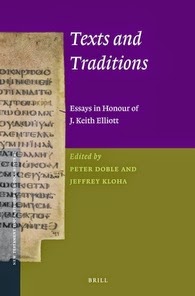
Texts and Traditions: Essays in Honour of J Keith Elliott (ed. J. Kloha & P. Doble; NTTSD 47; Leiden: Brill, 2014),
http://www.brill.com/products/book/texts-and-traditionsThe methodology of New Testament textual criticism, the critical evaluation of readings, and the history and texts of early Christianity is the focus of the influential work of J. K. Elliott. Readings in Early Christianity: Texts and Traditions offers eighteen essays in his honour. The essays, by colleagues and students from his long career, reflect Elliott's wide interest and impact. From questions of the purpose and practice of textual criticism, to detailed assessment of New Testament literature and the readings of its manuscripts, to provocative studies of the reception of Jesus and the New Testament in the second century, this volume will be of value to those studying the New Testament and Early Christianity.

Table of contents

  • Michael W. Holmes, When Criteria Conflict
  • D. C. Parker, Variants and Variance
  • Eldon Jay Epp, In the Beginning Was the New Testament Text, But Which Text? A Consideration of ‘Ausgangstext’ and ‘Initial Text’*
  • Jenny Read-Heimerdinger, Eclecticism and the Book of Acts
  • James A. Kelhoffer, Hapless Disciples and Exemplary Minor Characters in the Gospel of Mark: The Exhortation to Cross-bearing as both Encouragement and Warning
  • James W. Voelz, The Characteristics of the Greek of St. Mark’s Gospel
  • Tjitze Baarda, The Syro-Sinaitic Palimpsest and Ephraem Syrus in Luke 2:36-38 and 1:6
  • Peter Doble, Codex Bezae and Luke 3:22: A Contribution to Discussion
  • Jeffrey Kloha, Elizabeth’s Magnificat (Luke 1:46)
  • H. A. G. Houghton, A Flock of Synonyms? John 21:15-17 in Greek and Latin Tradition
  • L. W. Hurtado, Textual Ambiguity and Textual Variants in Acts of the Apostles
  • Holger Strutwolf, Urtext oder frühe Korruption? Einige Beispiele aus der Apostelgeschichte
  • J. Lionel North, 1 Corinthians 8:6: From Confession to Paul to Creed to Paul
  • Peter M. Head, Tychicus and the Colossian Christians: A Reconsideration of the Text of Colossians 4:8
  • David R. Cartlidge, How to Draw an Immaculate Conception: Protevangelium of James 11-12 in Early Christian Art
  • Paul Foster, The Education of Jesus in the Infancy Gospel of Thomas
  • Denise Rouger et Christian-B. Amphoux, Le projet littéraire d’Ignace d’Antioche dans sa Lettre aux Ephésiens
  • William J. Elliott, How to Change a Continuous Text Manuscript into a Lectionary Text
  • Bibliography J. K. Elliott

Monday, March 31, 2014

Wallace reviews Elliott

44
From the SBL Review of Biblical Literature 26 March 2014

J. K. Elliott
New Testament Textual Criticism: The Application of Thoroughgoing Principles
http://www.bookreviews.org/bookdetail.asp?TitleId=8709
Reviewed by Daniel B. Wallace

 This is an interesting and helpful review of Elliott's collected essays. That is really a daunting book to review and Dan has done a good job of summarising. Dan says he has been persuaded to come over to the correct view of Hebrews 2.9 through reading this book. He also offers some general comments on thoroughgoing eclecticism and some critical reflections. Only on one point did I think he missed a trick. Dan mentions that he found a lot of typos in the book, stating: "I counted over 150". I would have thought that in the spirit of Keith Elliott we deserved the entire list!!!

Thursday, January 10, 2013

Elliott Reviews Parker, Textual Scholarship

1
J. K. Elliott has reviewed David Parker's, Textual Scholarship and the Making of the New Testament (Oxford: OUP, 2012) in Times Literary Supplement, 14 Dec, 2012. Here is an extract of the review:
In 2011, the Lyell Lectures in Bibliography at Oxford were given by David Parker. His five public addresses offer an insight into a twenty-first-century approach to New Testament textual criticism. Parker surveys the varied manuscript heritage of the New Testament, the interrelationships of the witnesses, and the shape of a future, electronicaly created critical edition of the text based on the earliest recoverable text of each book, an authorial original being a chimera. ... Much of what David Parker has to say about the New Testament in this enthusiastically written book is applicable to other literatures, especially those that also have such a rich but fluid manuscript and literary heritage.

Thursday, December 15, 2011

New from Brill: Textual Research on the Psalms and Gospels

1
A new publication from Brill has appeared:

Textual Research on the Psalms and Gospels / Recherches textuelles sur les psaumes et les évangiles: Papers from the Tbilisi Colloquium on the Editing and History of Biblical Manuscripts. / Actes du Colloque de Tbilisi, 19-20 septembre 2007.
Edited by Christian-B. Amphoux & J. Keith Elliott with Bernard Outtier.
Novum Testamentum, Supplements 142
ISBN13: 9789004209275
Pages, Illustrations: xxvi, 274 pp.
List price: €105.00 / $144.00


Publisher's description
"Recent research on the text of the Psalms and Gospels in Greek and in certain versions, principally Coptic, Georgian and Armenian, reveals common characteristics when attempting to separate later editions of a text from its earliest forms. The essays in this collection give concrete examples of the issues involved and suggested explanations for textual changes."

Table of Contents
Part I The Psalms/psaumes

Gilles Dorival, Titres hébreux et titres grecs des psaumes

Mzekala Shanidze, Old Georgian Psalter and the Titles of the Psalms

Florence Bouet, Pluralité et choix éditoriaux: étude des variants λόγος-νόμος au Ps 118, 105 et νόμου-ὀνόματος au Ps 129,5

Charles Renoux,Quelques psaumes dans les documents liturgiques anciens géorgiens et arméniens

Part II The Gospels/évangiles

Christian-Bernard Amphoux, Qu’est-ce que le type de texte “césaréen”?

Didier Lafleur, Le codex de Koridethi (Θ.038) et la famille 13: une nouvelle collation de l’évangile de Marc

J.Keith Elliott, The Endings of Mark’s Gospel and the Presentation of the Variants in the Marc multilingue Edition

Josep Rius-Camps, Le Codex de Bèze: Base indispensable pour une edition de l’évangile de Marc

Jenny Read-Heimerdinger, The Problem of Editing a Text with a Multiple Textual Tradition

Bernard Outtier, Les types de texte des évangiles en géorgien ancient
Appended: D.M. Lang, Recent Work on the Georgian New Testament

Darejan Tvaltvadze, The Manuscripts of Georgian Translations of the Gospels from the Black Mountain

Manana Machkhaneli, The Manuscript Anbandidi

Jost Gippert, Fragments of St John’s Gospel in the Language of the Causasian Albanians
Appended: Review, The Caucasian Albanian Palimpsests of Mount Sinai, Simon Crisp

Anne Boud’hors, Le caractère harmonisant des traditions de l’évangile de Marc en copte sahidique


Extract from the preface
(kindly shared by J. K. Elliott)

... As far as the Psalms are concerned, there are four essays here. Two concern the titles, the first by Gilles Dorival. He revisits a topic that he has made his own, namely the headings of the individual Psalms in Hebrew and Greek.

...

Mzekala Shanidze’s essay parallels Dorival’s, by looking at the titles of the Psalms in Georgian. As in other essays dealing with the Georgian versions, we are obligated to examine the Georgian ‘Vulgate’ as well as the earlier, often more fluid, pre-Athonite versions, and note any differences and changes between the texts.

...

Florence Bouet homes in on two highly significant variants in the Psalms, those at Ps. 118 (119):5 νόμος/λόγος and at Ps. 129 (130):5 νόμου/ ὀνόματος. ... Obviously here Christian and Jewish influences seem to be in evidence but the attestation as a whole cries out for explanation.

...

Inevitably and appropriately, because these essays originated at a conference in the Caucasus, there are also important examples from the Georgian and Armenian traditions concerning the history of the Psalms. Charles Renoux takes up the important liturgical uses of the Psalter in those languages. Obviously, the Psalms were used from their beginnings in liturgical contexts in the Temple and for particular Jewish festivals. Renoux’ essay explores how, where and when the Armenian and Georgian Christian communities made use of the Psalms. They seem to have originated from the Jerusalem liturgical practices of the 4th-5th centuries....

Moving to the New Testament and the Gospels there are eleven major contributions in this volume. The first, by Christian Amphoux, concerns itself with the Caesarean text-type. Amphoux’ own distinctive contribution to the history of the New Testament has been to locate the differing forms of text within the history of the fissiparous early church and his idiosyncratic and carefully-argued conclusions are to be found in the essay here. ... Amphoux is a keen defender of the Caesarean text-type and his paper here stresses the position of this form of the Gospels in relation to other text-types, ‘Western’, Alexandrian and Byzantine.

...

As a corollary to Amphoux’ paper, Didier Lafleur’s contribution happily meshes with it. He fortuitously writes about the text of a major Caesarean witness, namely Codex Koridethi (Θ, 038), a manuscript that happens to be housed in Tbilisi. Alongside that, his new collations of the manuscripts of family 13 in Mark confirm the homogeneous character of this family and he also shows the agreements of the family with not only Koridethi but also minuscules 28, 565, 700 and uncial W 032. He establishes that one of the family members, minuscule 788, stands closest to the archetype of that family and how frequently family 13 as a whole allies itself to Codex Koridethi. Consequently, he, like Amphoux, encourages the use of the Caesarean text-type (obviously not a geographically-centred ‘local’ text) as a serious and distinctive grouping and a legitimate textual form found not only in Mark but in the New Testament Gospels as a whole.


J. Keith Elliott’s essay focuses on two other early Greek manuscripts א 01 and Vaticanus B 03 particularly in that perennial textual crux, the ending of Mark which they conclude at 16:8. These two manuscripts are both accorded separate sections amid the seven differing manuscripts of Mark in Marc mutilingue as both demonstrate differing textual stages in the history of Mark. But they happen to agree in their form of the ending of Mark and are the only two ancient Greek witnesses to the shorter text. Among other supporters of the shorter reading are the two earliest Georgian witnesses. Elliott’s paper shows whatever Mark’s original intention may have been – and it is unlikely that anything he may have written beyond 16:8 has survived – his Gospel once circulated in the truncated form now exhibited by these two old Greek uncials. Inevitably, and within the second century, attempts were made to repair the damaged ending and Mark was duly provided with a ‘proper’ and satisfying conclusion that included references to the anticipated post-Easter appearances. The longer ending, commonly numbered Mark 16:9-20, represents a later editing of the text of Mark and, as such, belongs to a history of this Gospel that had an inevitable impact on a reader’s understanding of Mark as narrator and on his theology.

...

Rius-Camps’ paper advocates the use of this bilingual [Codex Bezae] in any establishing of an edition of Mark. Jenny Read-Heimerdinger looks at D in Luke. Based on her and Rius-Camps’ studies of D in Acts, she is prepared now to promote D in Luke as an early and coherent writing that must be taken into account because it represents the first volume of a comprehensive ‘demonstration’ of the claims of Christianity from a Jewish perspective.

Luke 24: 13-35 is taken as an example to show how Jesus in this work was interpreted in Jewish written and oral traditions.

...

As befits a contribution by the director of the Orioni project at Tbilisi State University responsible for examining the Georgian Gospels, Sophio Sarjveladze’s essay is an over-arching survey that may be seen as a worthy introduction to the other essays in this volume dealing with aspects of the Georgian version. But as is typical of most articles in this volume, broad principles and generalised summaries give rise to, and are indeed supported by, specific and well-chosen Biblical references. Sophio Sarjveladze’s examples reveal the complexity of her text-critical researches and the care with which her team’s efforts are rooted in close philological examination.


Following this is Bernard Outtier’s essay. With his long-established and wide-ranging expertise in Georgian studies he is well placed to proffer a general survey of current research in the area of the Georgian version of the Gospels and its text-types. He appends a valuable bibliography. Once more we are enabled to observe parallels between the materials and methodologies applied by Georgian scholarship and those relevant to other versions as well and also to the Greek New Testament manuscript tradition as well.


Attached to Outtier’s piece is an important but now inevitably outdated article by David M. Lang (1924-1991).

...

Darevan Tvaltvadze’s article narrows Outtier’s and Lang’s surveys to the Georgian manuscripts emanating from the Black Mountain where Georgian monks produced a distinctive form of the pre-Athonite Gospels that began a process of examining the Georgian against the Greek. Her analysis of certain of the Black Mountain manuscripts reveals where older readings still survive. These manuscripts thus form a median position between the oldest forms and Giorgi’s Athonite Vulgate.


Focussing even more narrowly, Manana Machkhaneli examines one Georgian manuscript under the microscope, namely the so-called Anbandini manuscript. Following her researches into its distinctive readings she reports here that she has been able to place it in the family tree of Georgian Gospel manuscripts as a ‘mixed’ type, comparable to the Ksani manuscript that shared some characteristics with the protovulgate text and with the Adish recension but which also has singular readings. Another building block in the multifaceted history of the Georgian Gospels now seems to have been placed.


Shortly before the Tbilisi colloquium in 2007 we became aware that a publication was about to emerge that concerned Biblical writings in a hitherto virtually unknown language, Caucasian Albanian. It was entirely appropriate that one of that publication’s editors, Jost Gippert of Frankfurt am Main, should introduce that version and its importance, especially in its relation to the Georgian and Armenian versions. In the time between the conference and the present book the publication appeared. As a consequence, Gippert’s paper here is a revision of his original text which describes the recently deciphered manuscripts. As well as having this insider’s contribution, it seemed worthwhile to append to it a review of it by Simon Crisp of the United Bible Societies. His review was commissioned as an article for Novum Testamentum and is reproduced here to emphasise the significance of this new version.

...

In the present volume Anne Boud’hors looks at the situation of the Coptic, a version as early as the Latin and Syriac. Here, after a comprehensive tour d’horizon concerning the current state of Coptic study of the Gospels, she zooms in on five textual variation units in Mark to demonstrate what may be learned from the Sahidic Coptic manuscripts. She observes a harmonising tendency not only in relation to its revised version but also in the earliest redactions. Her conclusions are preliminary and tentative as work is still underway and to a certain extent pioneering in its attempt to trace and track the history of the early Coptic version. As in other essays, this article also flags up potentially profitable methodologies that consider variants not only within one particular tradition but in connexion with other versions. The approach again is interdisciplinary and cross-cultural.


UPDATE: Order page from Eisenbrauns

Monday, May 30, 2011

Sinaiticus in Times Literary Supplement Again

0
In the Times Literary Supplement published 27 May, pp. 26-27, appears J. K. Elliott's review of the facsimile of Codex Sinaiticus (combined with a review of David Parker's book on the codex).

See also last year's appearance of Sinaiticus in TLS here.

Thursday, January 06, 2011

Fifty-Seven Collected Essays by Elliott Published

0
An important book has just been published by Brill:

New Testament Textual Criticism: The Application of Thoroughgoing Principles Essays on Manuscripts and Textual Variation by J. K. Elliott


Details
Series: Novum Testamentum, Supplements, 137
ISBN-10: 9004189521
ISBN-13: 9789004189522
Cover: Hardback
Number of pages: xvi, 662 pp.
List price: € 184.00 / US$ 259.00

Publisher's description
J.K. Elliott has been identified as one of the Main exponents of so-called thoroughgoing textual criticism. In this collection of fifty seven of his essays from the past forty years are articles on methodology as well as on praxis (with a selection of important textual variants, including some of especial interest for exegesis). Also included are several essays on textual criticism which emphasise its relevance for the discussion of the synoptic problem and there are also a number of assessments of printed editions of the Greek New Testament. A bibliography of Elliott's writings is appended.

Those interested in the New Testament text and in Greek manuscripts as well as scholars working on the history of exegesis or the Greek language which thoroughgoing criticism encourages will find this collection of value. The selection will enable readers to have an overview of Elliott's contribution to the discipline.

Order page from Eisenbrauns

This make me wonder in passing just how many scholars have written fifty-seven essays in New Testament textual criticism. There is something special with fifty-seven.

Monday, November 08, 2010

P52 and John Rylands Library in the Press

0
J. K. Elliott has written a piece in Times Literary Supplement 29 October on the collection of biblical MSS in John Rylands Library in Manchester ("Manchester bibles").

Here is an extract:
A. S. G. Edwards’s Commentary article
(January 29) on the digitization of
forty Middle English manuscripts in
Manchester’s John Rylands Library as part of
an ongoing programme paid due respect to
Manchester’s medieval English texts. But its
holdings of biblical materials are also particularly
noteworthy, and many of them qualify
for various superlatives. The Library’s biblical
manuscripts – the largest number in Britain
outside London, Oxford, and Cambridge
– are regularly consulted and their distinctive
readings cited in most modern critical editions
of the Bible.

Two of its treasures are particularly well
known and regularly seen by visitors to its
newly refurbished building in Deansgate.
One (P.Ryl. 457) is the famous papyrus fragment
containing four verses of John 18 and
known to New Testament scholars as P52.
Experts are generally agreed that it was written
by the mid-second century, and thus this
tiny fragment is not only our first witness to
this Gospel, but the oldest example of any
New Testament text in the world – and probably
the earliest Christian writing extant. The
other is a papyrus portion of Deuteronomy in
Greek (P.Ryl. 458).

One can access the whole article by signing up for a free trial of TLS here.

Friday, November 05, 2010

Oxford Bibliographies Online - Biblical Studies and Textual Criticism

0
The recently launched Oxford Bibliographies Online, claims to be an "expert guide to the best available scholarship across the social sciences and humanities." I cannot evaluate this claim, but there is a strong section on Biblical Studies. Below are the subjects and authors:

Afterlife and Immortality by Stephen L. Cook
Apocrypha and Pseudepigrapha by David A. deSilva
Canon, Biblical by Lee Martin McDonald
Chronicles, 1 and 2 by Steven Shawn Tuell
Corinthians, 2 by Thomas D. Stegman
Daniel by Carol Newsom
David by Victor H. Matthews
Deuteronomistic History by Gary N. Knoppers
Deuteronomy by Stephen L. Cook
Epistles, Catholic by Peter H. Davids
Exodus, Book of by Thomas B. Dozeman
Galatians by Mark D. Nanos
Galilee by Mark Chancey
Genesis, Book of by Victor H. Matthews
Gospels, Apocryphal by James Keith Elliott
Hebrews by Ellen B. Aitken
Interpretation and Hermeneutics by Stephen L. Cook
Isaiah by Marvin A. Sweeney
Israel, History of by Marc Brettler
Jesus of Nazareth by Pierluigi Piovanelli Job Carol Newsom
Joshua by Thomas B. Dozeman
Judaism, Hellenistic by Lester L. Grabbe
Judaism, Rabbinic by Rivka Ulmer
Judges, Book of by Gregory Mobley
Kings, 1 and 2 by Gary N. Knoppers
Mark, Gospel of by James Keith Elliott
Martyrdom by Jan W. van Henten
Matthew, Gospel of by Daniel J. Harrington
New Testament and Early Christianity, Women, Gender, and Sexuality in the by Todd C. Penner
New Testament, Rhetoric of the by Duane F. Watson
New Testament, Social Sciences and the by Dietmar Neufeld
New Testament, Textual Criticism of the by James Keith Elliott
Old Testament, Social Sciences and the by Victor H. Matthews
Passion Narratives by Ellen B. Aitken
Pastorals by Raymond F. Collins
Pentateuch by Thomas B. Dozeman
Philo of Alexandria by David T. Runia
Proverbs by Timothy J. Sandoval
Psalms by Stephen Breck Reid
Q by John S. Kloppenborg
Qumran/Dead Sea Scrolls by Carol Newsom
Revelation (Apocalypse) by Daniel J. Harrington
Sacrifice by William K. Gilders
Scriptures by Vincent L. Wimbush
Slavery by John Byron
Solomon, Wisdom of by Daniel J. Harrington
Synagogue by Anders Runesson
Synoptic Problem by John S. Kloppenborg
Thomas, Gospel of by Stephen J. Patterson
Twelve Prophets, Book of the by Marvin A. Sweeney


The section on New Testament textual criticism is authored by J.K. Elliott and includes the following sections (the introduction is freely available):


Introduction
Introductory Works
In English
In Other Languages
General Overviews
Essays
Collected Essays
Festschriften
Series
Reference Works and Bibliographies
Critical Editions of the Greek New Testament
Critical Editions of Synoptic Texts
Apparatus Critici and Thesauri of Readings
Text-Critical Methodology
Variants in Selected Books of the New Testament
Mark
The Acts of the Apostles
The Pastoral Epistles
The Letter of Jude
The Book of Revelation
Theology and Textual Variation
Text-Types
Western
Byzantine
Alexandrian
Facsimiles, Full Collations, and Photographs of Manuscripts
Introduction to Manuscripts
Papyri
Majuscules
Minuscules
Lectionaries
History of Printed Editions
Versions
Latin
Coptic
Syriac
Patristic Citations
Codicology and Paleography
Scribal Activity