Showing posts with label Festschrift. Show all posts

Thursday, December 14, 2023

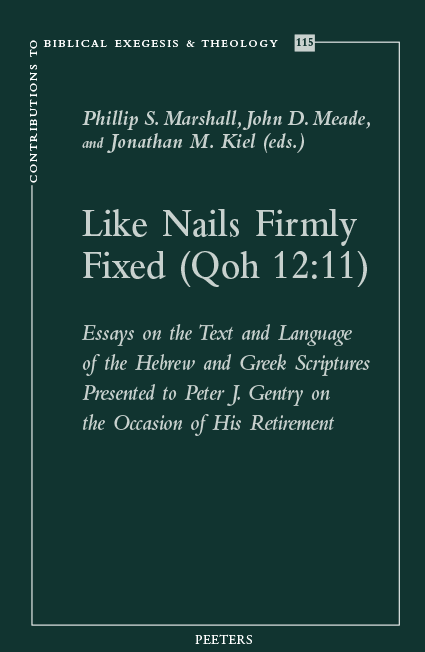
20% Discount on Gentry Festschrift

0

The latest Text & Canon Institute newsletter went out yesterday and some of you may be interested in a 20% discount code we included for the new Festschrift for Peter Gentry. 

Publisher's description

This Festschrift honors the life and work of Peter J. Gentry on the occasion of his retirement (2021) from The Southern Baptist Theological Seminary after 22 years of faithful service. The volume includes two personal reflections by family members and a close friend, followed by nineteen essays written by an international assemblage of scholars, all of whom admire the work of Gentry, and some of whom were his own doctoral students. These essays cover several of the academic fields with which Peter Gentry’s own research and writing intersect: biblical languages and linguistics, and the translation, transmission, and reception of the sacred texts of Judaism and Christianity.

Table of contents


Wednesday, March 03, 2021

Festschrift for Chuck Hill Published

4

Congratulations to Chuck Hill on the publication his Festschrift! The book is Studies on the Intersection of Text, Paratext, and Reception edited by Gregory R. Lanier and J. Nicholas Reid (both colleagues of his at RTS). Don’t miss the interview we did with Chuck back in 2016 (part 1 and part 2). Here’s a bit more on Greg Lanier’s blog on the presentation for Chuck today.

Description

Studies on the Intersection of Text, Paratext, and Reception brings together thirteen contributions from leading scholars in the fields of textual criticism, manuscript/paratextual research, and reception history. These fields have tended to operate in isolation, but recent years have seen a rise in valuable research being done at their multiple points of intersection. The contributors to this volume show the potential of such crossover work through, for example, exploring how paratextual features of papyri and minuscules give insight into their text; probing how scribal behaviors illumine textual transmission/restoration, and examining how colometry, inner-biblical references, and early church reading cultures may contribute to understanding canon formation. These essays reflect the contours of the scholarship of Dr. Charles E. Hill, to whom the volume is dedicated.

Table of Contents

  1. Punctuation and Paragraphs in P66 (P.Bod. II): Insights into Scribal Behavior
    Peter M. Head 
  2. The Text and Paratext of Minuscule GA 1424: Initial Observations
    Gregory R. Lanier and Moses Han 
  3. Marginal Paratexts in GA 2323: A Thirteenth-Century Witness to the Medieval Reception of Revelation
    Peter Malik 
  4. Writing and Writers in Ancient Mesopotamia: A Brief Sketch for New Testament Scholars
    J. Nicholas Reid 
  5. On Not Preferring the Shorter Reading: Matthew as a Test Case
    Peter J. Gurry 
  6. Codex Bezae as Repository
    Jennifer Knust and Tommy Wasserman 
  7. What Is a Text? The Linguistic Turn and Its Implications for New Testament Studies
    Stanley E. Porter 
  8. Second Peter 3:2, the Apostolate, and a Bi-covenantal Canon
    Michael J. Kruger 
  9. MasPsa and the Early History of the Hebrew Psalter: Notes on Canon and Text
    Peter J. Gentry 
  10. Problems with the Explicit Marking of Quotations in Translations and Scholarly Editions of the New Testament
    Peter J. Williams 
  11. Polycarp’s Teaching: The Reception and Development of Theology
    Paul Foster 
  12. A Neglected Reference to John the Elder as Bishop of Ephesus (Const. ap. 7.46.7)
    Richard Bauckham 
  13. The Acts of John within the Johannine Corpus James W. Barker 
A Bibliography of the Works of Charles E. Hill
Indices

Monday, March 23, 2020

Festschrift for Maurice A. Robinson On-line

1
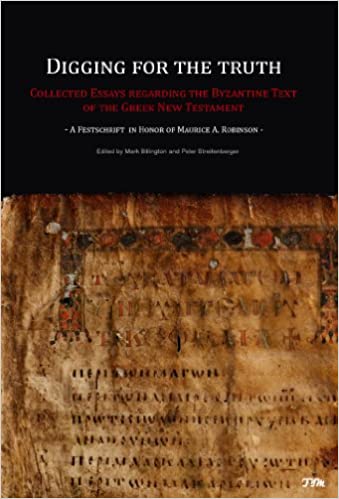
In 2014, Mark Billington and Peter Streitenberger edited a volume of essays, Digging for the Truth: Collected Essays Regarding the Byzantine Text of the Greek New Testament, to honor Maurice A. Robinson, Professor Emeritus of New Testament at Southeastern Baptist Theological Seminary (SEBTS).

One of the contributors to the volume, Abidan Paul Shah, former PhD student of Robinson, introduced the Festschrift at SEBTS and made available this videoclip of the presentation. At 4.20 you can see the honoree enter the stage to receive his book.

Since the book is now out of print, one of the editors, Peter Streitenberger, has now made it freely available here.

As readers will notice, the volume is written mainly from a pro-Byzantine text perspective, which is understandable since Robinson, in my opinion, is the most respected proponent of this school, which represent a very small minority of scholars in the discipline today. Read more about this perspective in Robinson’s own article, “The Case for Byzantine Priority,” in TC: A Journal of Biblical Textual Criticism.

Neverthelesss, it is a pity that there has not been another Festschrift for our co-blogger Maurice reflecting a wider perspective. I would have liked to contribute to that. On the other hand, I did participate in a symposium at SEBTS in 2014, invited by Maurice, to discuss the pericope adulterae, the text to which he has devoted much of his career (read my reports here and here with more links to summaries). The result of this consultation was published in The Pericope of the Adulteress in Contemporary Research, LNTS 551, ed. by D. A. Black and J. N. Cerone (London: Bloomsbury T&T Clark, 2016). See my announcement here.

Let me conclude this blogpost by citing from the preface of my recent book To Cast the First Stone (co-authored with Jennifer Knust) where I express my gratitude to Maurice as he reached out to a Swedish new-comer to the field:
Tommy would first like to thank Maurice Robinson, who was willing to suggest a topic for his bachelor’s thesis at Örebro School of Theology on a particularly interesting variant in the pericope adulterae, which led to his first research visit to the INTF in Münster and eventually resulted in his first academic publication [here]. In spite of different views regarding the history of the New Testament text, Maurice has always been gracious and helpful to both of us.

Monday, January 06, 2020

The New Testament in Antiquity and Byzantium: Festschrift for Klaus Wachtel

0
Back in early November, Elijah noted Klaus Wachtel’s retirement from his many years of service at INTF. It seems, however, that we haven’t yet noted that Klaus was also honored with a Festschrift later that month at SBL. Congratulations, Klaus!

The New Testament in Antiquity and Byzantium: Traditional and Digital Approaches to its Texts and Editing, A Festschrift for Klaus Wachtel
Ed. by H.A.G. Houghton, David C. Parker, Holger Strutwolf

Description

Klaus Wachtel has pioneered the creation of major editions of the Greek New Testament through a blend of traditional philological approaches and innovative digital tools. In this volume, an international range of New Testament scholars and editors honour his achievements with thirty-one original studies. Many of the themes mirror Wachtel's own publications on the history of the Byzantine text, the identification of manuscript families and groups, detailed analysis of individual witnesses and the development of software and databases to support the editorial process. Other contributions draw on the production of the Editio Critica Maior, with reference to the Gospels of Mark and John, the Acts of the Apostles, the Pauline Epistles and the Apocalypse. Several chapters consider the application of the Coherence-Based Genealogical Method. A wide selection of material is considered, from papyri to printed editions. The Greek text is analysed from multiple perspectives, including exegesis, grammar and orthography, alongside evidence from versions in Latin, Syriac, Coptic and Gothic. This collection provides new insights into the history of the biblical text and the creation, development, analysis and application of modern editions.

xvii, 482 pages; 12 Fig., 30 Tables

Table of Contents

Klaus Wachtel: An Appreciation
Klaus Wachtel: Bibliography
  1. Michael W. Holmes, The “Western” Text of Acts: A Challenge for Historians
  2. Christina M. Kreinecker, In anderen und eigenen Sprachen: wenn alle sprechen und alle verstehen. Ein textkritisch-exegetisch motivierter Blick auf Apg 2,1–13
  3. Andreas Juckel, Acta 2:1–22 in der Revision des Jakob von Edessa
  4. Tommy Wasserman, New Traces of an Old Text: The Corrections of Gregory-Aland 424 in Acts 1–14
  5. Carla Falluomini, The Longer Ending of Mark in Gothic
  6. Christian-B. Amphoux, La géographie marcienne et ses corrections ecclésiales
  7. Christian Askeland, A Coptic Papyrus without John 21?
  8. Annette Hüffmeier, GA 382: Byzantinisches „Allerlei“
  9. J.K. Elliott, The Case of the “Rule of Three” in the Gospels
  10. Hans Förster, The “Power on the Head” of a Woman. A New Appraisal of 1 Corinthians 11:10 and its Variants
  11. Georg Gäbel, The Text of Hebrews in GA 1739, in Selected Other Greek Manuscripts, and in Works of Origen: Preliminary Quantitative Assessments
  12. Roderic L. Mullen, Photius: A Re-evaluation of the Johannine Evidence in Light of Modern Tools
  13. Marcus Sigismund, ὡς ἐν τῇ Ἀποκαλύψει λέγεται. (Vermeintliche) Apk-Zitate am Ende der byzantinischen Epoche
  14. Dirk Jongkind, Manuscripts of the Greek Bible
  15. Georgi Parpulov, Kr in the Gospels
  16. Jan Graefe, Eine Dromone in GA 013? Gedanken zu einer Schiffszeichnung 
  17. Jan Krans, The Earliest Printed Portions of the Greek New Testament
  18. Martin Karrer, Von den Evangelien bis zur Apk. Die Ordnung der Schriften in der Edition des
  19. Holger Strutwolf, Von den Kanones der Textkritik zu einer Theorie der Variantenentstehung im Rahmen der Kohärenzbasierten Genealogischen Methode. Einige vorläufige Überlegungen
  20. Gerd Mink, Manuscripts, Texts, History, and the Coherence-Based Genealogical Method (CBGM): Some Thoughts and Clarifications 
  21. Gregory S. Paulson, Improving the CBGM: Recent Interactions
  22. Peter J. Gurry, The Byzantine Text as the Initial Text 
  23. D.C. Parker, Family 1 in the Gospel of John: Its Members, Text and the Coherence-Based Genealogical Method 
  24. H.A.G. Houghton, An Initial Selection of Manuscripts for the Editio Critica Maior of the Pauline Epistles
  25. Bruce Morrill and Ulrich B. Schmid, Editorial Activity and Textual Affiliation: The Case of the Corpus Paulinum 
  26. Darius Müller, Die mehrheitsbildenden Gruppen der Apokalypse-Überlieferung: Textgeschichtliche und editorische Herausforderungen 
  27. Marie-Luise Lakmann, Transkription und Kollation neutestamentlicher Handschriften. Analyse der Fehlermöglichkeiten und ihrer Ursachen
  28. Bill Warren, A Text-Critical Approach to Punctuation in the New Testament: 1 Corinthians 14:33
  29. Peter J. Williams, When Does συν- Assimilate?
  30. Siegfried G. Richter und Katharina D. Schröder, Digitale Werkzeuge zur Systematisierung koptischer Handschriften
  31. Wilhelm Blümer, Die Vetus Latina-Edition der Apostelgeschichte: Überlegungen zu Chronologie, Konstituierung und Disposition der „Texttypen“ 
Index
Contributors photo (courtesy of Jeff Cate)

Wednesday, October 17, 2018

Forthcoming Festschrift for Harry Gamble

6
Next month SBL Press has a Festschrift for Harry Gamble coming out. I can’t find a table of contents for it so, if anyone knows what’s in it, let me know in the comments, please. The table of contents is available at the link to Amazon. From the publisher:

A book about the role of books in shaping the ancient religious landscape

This collection of essays by leading scholars from a variety of academic disciplines explores the ongoing relevance of Harry Gamble’s Books and Readers in the Early Church (1995) for the study of premodern book cultures. Contributors expand the conversation of book culture to examine the role the Hebrew Bible, the New Testament, and the Qur’an played in shaping the Jewish, Christian, and Muslim religions in the ancient and medieval world. By considering books as material objects rather than as repositories for stories and texts, the essays examine how new technologies, new materials, and new cultural encounters contributed to these holy books spreading throughout territories, becoming authoritative, and profoundly shaping three global religions.

Features:

  • Comparative analysis of book culture in Roman, Jewish, Christian, and Islamic contexts
  • Art-historical, papyrological, philological, and historical modes of analysis
  • Essays that demonstrate the vibrant, ongoing legacy of Gamble’s seminal work

Details

Paperback $32.95
ISBN 9781628372236
Hardcover $47.95
ISBN 9780884143291 

Tuesday, September 12, 2017

The Press of the Text: Festschrift for James W. Voelz

3
Back in May a Festschrift was published in honor of James Voelz who has worked across many topics in his career including Mark’s Gospel, Greek grammar, and occasionally matters of text-critical interest. Sometimes the three came together as in his NovT essay “The Greek of Codex Vaticanus in the Second Gospel and Marcan Greek,” which I remember reading with interest in seminary.

I haven’t seen the book in person, but thought I would let our readers know about it. You can see the table of contents below with articles on TC by Elliott and Kloha that will be of interest.


Wednesday, December 17, 2014

Mark, Manuscripts, and Monotheism (Festschrift for Larry Hurtado)

3
Recently, I had the great privilege to contribute to a Festschrift for my friend and colleague Larry Hurtado, Mark, Manuscripts and Monotheism, edited by two of his outstanding students and friends of mine, Chris Keith and Dieter Roth, and published by T&T Clark/Bloomsbury, just in time for the SBL.

Two years ago, I suggested to Chris that he and Dieter should edit this FS that would give Larry's former students the opportunity to honor their Doktorvater, and there were already three contributions to include by Thomas Kraus (on manuscripts as artifacts), Richard Bauckham (on Christology) and myself (on textual criticism) from the Larry Hurtado day held in Edinburgh in 2011.

Chris and Dieter gladly accepted the task, and in conjunction with the SBL in San Diego in November, we could present the volume to Larry at a nice Brazilian restaurant (see image), where each contributor present said a few words about their essay and what Larry has meant to them as mentor, colleague and friend. Many memories were shared and we had many good laughs (this was the first time I heard Chris tell about this crazy experience from his time as a PhD student in Edinburgh).

Larry was apparently deeply moved and filled with gratitutde, and just recently he has started a blog series to engage with the contributions in the volume, several of which will be very interesting for readers of this blog. So far the following posts have appeared: