Showing posts with label Red Letter Bibles. Show all posts

Thursday, September 10, 2009

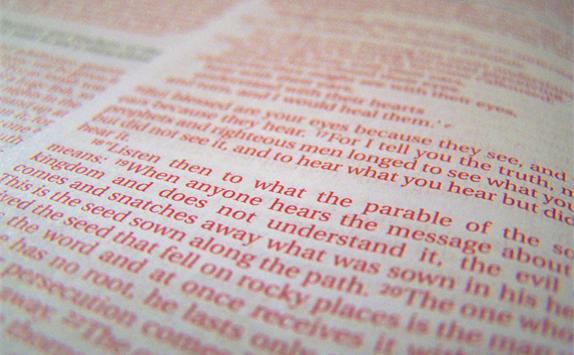
Chaplin on Red Letter Bibles

7
Doug Chaplin aka Clayboy thinks Bibles with the words of Jesus in red might be “the worst evangelical heresy” for three reasons:
1. It lies about the nature of the books we have – reports and narratives by witnesses of words (most of them anyway) spoken in another language, and already someone else’s words by the time they reach us.

2. It overthrows the nature of scripture. The whole canon is the locus of inspiration and witness to revelation.

3. It denies the incarnation. The whole point about the nature of gospel as witness to the Word made flesh is that Jesus’ deeds do God’s work, and his words are one part only of the story. Story is the category through which we know Jesus, not dictation, because we need to see and know God’s life lived out in human flesh and not simply instructions dictated in a vacuum. The stories are not just a rather unimportant framework for the words; the stories are the essence of the god news of the incarnate Word.
Also read Peter Head’s defence of the red letter bibles and a subsequent discussion here.

Update:

In the comments to this post, Stephen Carlson pointed out that Chaplin’s arguments against red letters “also argue against the modern practice of using quotation marks in the narrative” for the following reasons:
(1) Just as the red lettering mark words Jesus didn’t actually say (because he spoke in Aramaic), so too are the words in quotation marks not really the exact words of the speakers especially in the gospels.

(2) Just as red lettering give focus to Jesus’ words over others, so too do quotation marks give focus to some words of the biblical text but not to others.

(3) Just as red lettering distinguish Jesus’ words (in red) from his actions, so too do quotation marks.
Peter Williams points out that many languages manage without speech marks and before the twentieth century English Bibles managed well without them.

Chaplin has responded to Carlson on his blog Red Letter Bibles strike back arguing that quotation marks are not to same. However, he concludes that “it might be possible to construct a purist argument that all our texts should be written in a largely unpunctuated stream of uncials … BUTIDONTTHINKTHATWILLCATCHON.”

Wednesday, April 22, 2009

Red Letter Bibles Again

18
About one year ago, Peter Head posted a brave defence of Red Letter Bibles.

In summary, Peter defended Red Letter Bibles because:
  • In effect, Jesus said hearing and doing ‘these words of mine’ are foundational to the faithful life; allegiance to ‘me and my words’ is announced as a criteria for judgement (Mark 8.38; Luke 9.26). His words are eternal (Matt 24.35; Mark 13.31; Luke 21.33). He is the Word of God, his own words come directly from God, and so the one who loves Jesus will pay special attention to his words (e.g. John 14.23f), abiding in Jesus involves abiding in his words (John 15.7).
  • The evangelists themselves place special emphasis on Jesus words with the result that the synoptic evangelists agree much more closely in the wording of the words of Jesus than in the narratives which surround those words.
  •  Paul too seemed to place special importance in Jesus words as basis for Christian instruction (see e.g., 1 Cor 7.10; 9.14; 11.23ff; cf. instruction not based on Jesus’ words in 1 Cor 7.12, 25).
He also pointed out that the red ink was originally intended to connect the words of Jesus with the plot line of Jesus’ redeeming death: a symbolism of Christ’s blood.

The post was followed by a very stimulating discussion with over fifty comments (admittedly with some help from Peter: “Can’t we make this up to fifty comments? I always feel better when a post gets fifty comments.”)

Anyway, I was reminded of this today when I read a post at The Eagle and Child who pointed out that two books isolating the words of Jesus have been published recently: The Words of Jesus: A Gospel of the Sayings of Our Lord with Reflections by Phyllis Tickle and The Red Letters: The Sayings and Teachings of Jesus by Timothy J. Beals.

The publisher of the latter book describes it thus:
A groundbreaking book that presents Jesus’ own words from the Gospels, topically arranged but without any commentary, so that people may hear his message in his terms.

While the entire Gospel narrative is essential to Christian theology, Jesus’ own words distinctively teach us how to live and how faith makes a difference in one’s life. The Red Letters gives a clear overview of Christianity’s foundational message in a unique way: allowing Jesus to speak for himself, without any human commentary.

This groundbreaking book simply includes all of Jesus’ words from the Gospels, arranged by topic and rendered in the ESV translation. Jesus’ own words. Nothing more, nothing less. For everyone who would like to rediscover the heart of Christianity—or perhaps discover it for the first time—as Jesus Christ himself communicated it.
This is of course something different than a Red Letter Bible since it means Jesus’ words have been completely taken out of their context, which I find highly questionable; one may even get the impression that the black letters are equated with “human commentary.”

To return to Red Letter Bibles, the Eagle and Child blog does not like them, basically because:
  • The words of Christ are not “more Scripture.”
  • It is sometimes difficult to determine where Jesus’ words begin and end, e.g., John 3:16 (is it still Jesus speaking?; TNIV does not include v 16 as part of Jesus’ words).
  • The red print is distracting.
I think it is a hard call, there are good arguments for and against, but in the end, I think I prefer my black letter Novum Testamentum.

Wednesday, May 14, 2008

In Defence of Red Letter Bibles

58
Red Letter Bibles are Bibles with the words of Jesus printed in red ink. This has been a fairly common and popular publishing format since Louis Klopsch printed his first Red Letter Testament in 1899 (or 1900). The terminology has recently been picked up by Tony Campolo in defining the idea of ‘Red Letter Christians’ as those who pay particular attention to Jesus’ teaching: ‘In adopting this name, we are saying that we are committed to living out the things that He said.’ Campolo attaches this to what might be perceived as a somewhat left-wing agenda. This in turn has prompted Don Carson to complain that basing our theology on such ‘foolishly printed Bibles’ is basically just another form of having a ‘canon within the canon’ (summarised here, also printed last week in Evangelicals Now).

Without diving into this particular debate I do want to ask whether printing Jesus’ words in red is foolish, or whether it preserves a genuine Christian instinct. As a historical point it is worth noting that in its origin the use of red ink was not actually an attempt to disconnect the words of Jesus from ‘the narrative framework of each of the canonical gospels, in which the plot-line takes the reader to Jesus’s redeeming death and resurrection’ (Carson). On the contrary, the use of red ink was intended to connect the words of Jesus precisely with the plot line of Jesus’ redeeming death: it was the symbolism of Christ’s blood, prompted by Luke 22.20 (“This cup is the new testament in my blood, which I shed for you”) which led Klopsch to print Christ’s words in red.

But notwithstanding this important sybolism, the primary reason for treating Jesus’ own words as of particular importance is because this is what Jesus himself says: hearing and doing ‘these words of mine’ are foundational to the faithful life (Matt 7.24ff; Luke 6.47ff); and indeed, allegiance to ‘me and my words’ is announced as a criteria for judgement (Mark 8.38; Luke 9.26). Jesus’ words are eternal: ‘heaven and earth will pass away, but my words will not pass away’ (Matt 24.35; Mark 13.31; Luke 21.33). Since Jesus himself is the Word of God, his own words come directly from God, and so the one who loves Jesus will pay special attention to the words of Jesus (e.g. John 14.23f), abiding in Jesus involves abiding in his words (John 15.7).

A secondary reason is of course that the evangelists themselves place special emphasis on Jesus words - their emphasis is on his words not so much on their own. It is well known that the synoptic evangelists agree much more closely in the wording of the words of Jesus than in the narratives which surround those words. Matthew’s Gospel is particularly insistent on the importance of Jesus’ words (hence the five-fold discourse structure of Matthew), but so in various ways do Mark, Luke and John.

Paul too can be appealed to as treating the words of Jesus as of special importance in early Christian instruction. Although to be sure God’s revelation was not limited to what Jesus himself said, nevertheless he knew the difference between instruction based directly on Jesus’ words (e.g. 1 Cor 7.10; 9.14; 11.23ff) and instruction not based on Jesus’ words (1 Cor 7.12, 25).

So what do you think?