Monday, April 08, 2019

New Printed Liste Coming from INTF

0
The most recent printed K-Liste
Greg Paulson has good news out of Münster today: a new printed K-Liste is in the works. This is very good news in my view. The work of tidying up the Liste for this may be the most obvious benefit but I think there is an even greater one in having a list that is, shall we say, frozen in time for comparison’s sake. The online K-Liste is wonderful but it can be easily changed frequently and without notice, something not true of a printed edition. From the announcement:
The Hermann Kunst-Stiftung has generously funded a short-term position at the INTF solely focused on preparing the Liste for publication. This has enabled a new concerted effort to verify the data in the VMR and update incorrect or outdated information in preparation for publication. The Liste will always be a work in progress. While it may not be possible to double-check every detail about every manuscript that is already in the Liste, our goal is to carefully and thoroughly verify as much information as possible based on the resources available to us.

These resources include printed catalogues, recent scholarship, and notifications from individuals. Through the VMR Forum we have been alerted to a number of location changes and new digital images available. We’ve also been making many direct inquiries to holding institutions to stay up to date with manuscript location changes, inquire about manuscript details, and request images to help us check our information in the VMR.
Please note Greg’s request for help. If you know of updates, send them his way.
One particular challenge is keeping up with manuscripts that have changed locations. Currently there are 137 manuscripts in the Liste where the owner/institution is unknown (listed as “besitzer unbekannt”). In addition, a number of manuscripts have been auctioned on Sotheby’s, Christies, Heritage Auctions, etc. While we have been able to ascertain the new locations of many of these auctioned manuscripts, we are asking for your help in tracking down the current location of five manuscripts in particular.
Read the whole post here.

HT: PJW

Wednesday, April 03, 2019

Plans for the NA29 and UBS6

11
At SBL last November, Holger Strutwolf gave an update on the plans for the next editions of the NA and UBS editions. I took some notes and thought I would share them. (Sorry it’s taken so long to get these out.)
  • Both editions now have the same editorial committee. These editions will follow the work on the ECM volumes, but the committee is not bound to the same decisions as the ECM editors. They will make their own judgments. (That was a point that had not been entirely clear to me before.) Note that this means NA29 will be different in principle at least from NA28.
  • The UBS has heard from translators that the UBS edition has more variants than they really need to do their field translation work so the UBS6 will probably have fewer than the UBS5.
  • Greg Paulson and Dora Panella will be assistants on the editions
  • Holger mentioned 2022 as a possible date for the NA29 with the UBS6 following after that. They are waiting for at least one more ECM volume to be finished, probably on Mark. In that case, they can incorporate the ECM work on at least two more books (Acts and Mark). What’s happening with John, I don’t know.

The Material Gospel Conference at Notre Dame

5
Jeremiah Coogan and David Lincicum are continuing their good work at Notre Dame on first millennium books with a conference schedule for May 31, 2019.
This conference brings together leading scholars of Gospel literature and material texts to discuss the history and significance of the material Gospel in the first five centuries CE.

Session I

David Lincicum (Notre Dame): Welcome
Clare Rothschild (Lewis University): “Galen’s De indolentia and the Early Christian Codex”
Jeremiah Coogan (Notre Dame): “Navigating the Gospel: Nonlinear Access and Practical Use”
Respondent: Nathan Eubank (Notre Dame)

Session II

Chris Keith (St Mary’s University Twickenham): “The Gospel Read, Sliced, and Burned: The Material Gospel and the Construction of Christian Identity”
Angela Zautcke (Notre Dame): “Erasing the Gospels: Insights from the Sinai Syriac Gospel Palimpsest”
Respondent: Paul Wheatley (Notre Dame)

Session III

Sofía Torallas Tovar (University of Chicago): “Resisting the Codex: Christian Rolls in Late Antiquity”
Matthew Larsen (Princeton): “Codex Bobiensis: A Real-and-Imagined Biography of One Gospel Manuscript”
Respondent: Robin Jensen (Notre Dame)
Website is here. Wish I could go.

Tuesday, April 02, 2019

Scribes & Scripture: A New Conference on the History of the Bible

5
It is about time co-blogger, Peter Gurry, and I announce another project we have been working on for the past few months: Scribes and Scripture: A Conference on the History of the Bible. You can read more about it on the website. Here, I want to announce our first mini-conference this Saturday 9:00-12:00 at Church on Mill in Tempe, AZ.

We have a couple of other conference possibilities that we are discussing with pastors in AZ and NC, and we will let you know the details of those as the time draws closer.

In short, Peter and I want to bring some of our expertise on the matters of OT and NT Text, Canon, and Bible Translation into churches that are seeking more understanding on how we received the Bible. Should be fun and informative!

Monday, April 01, 2019

A New Second-Century Matthew?!

8
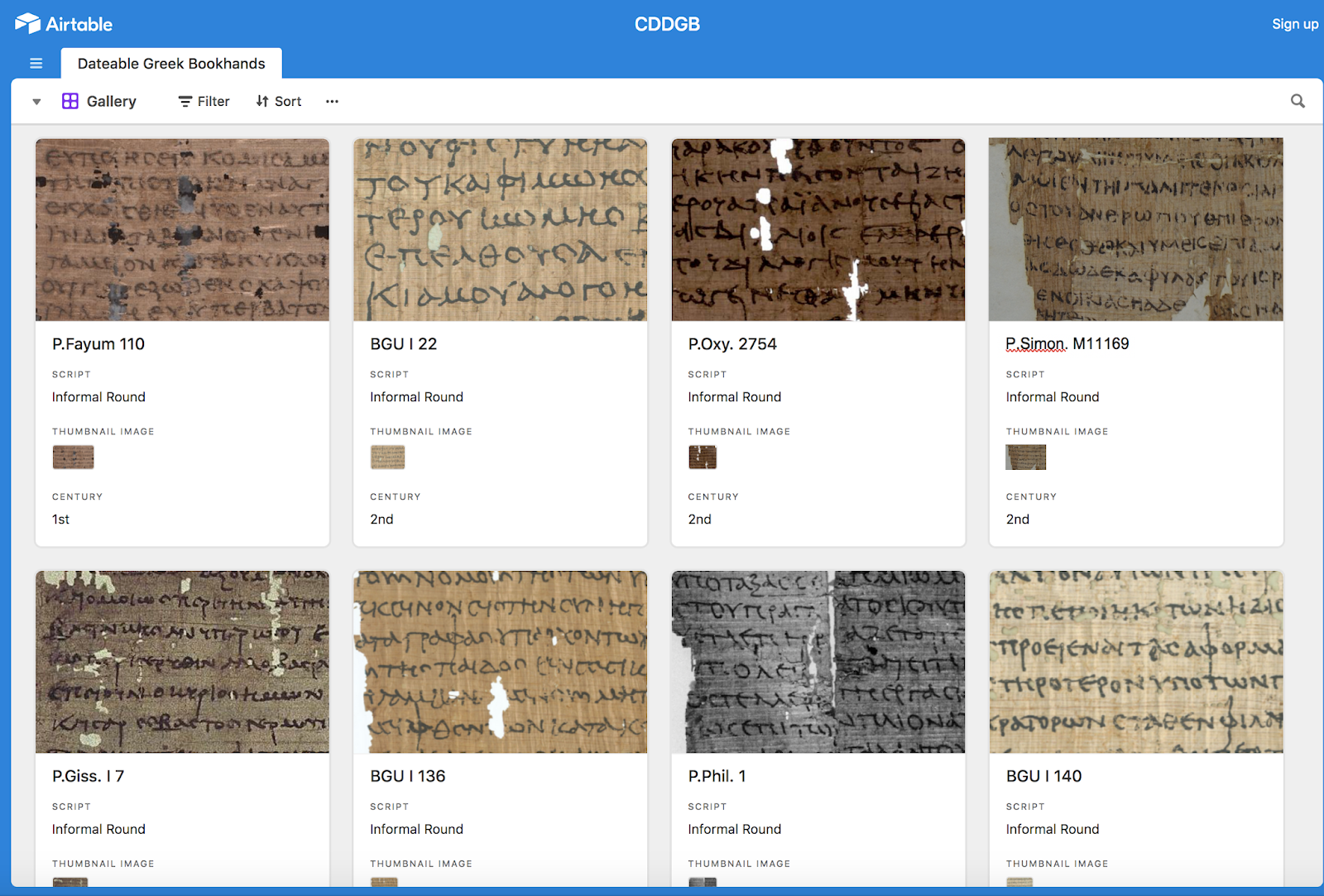
I just browsed the new database of objectively dateable Greek bookhands, “The Collaborative Database of Dateable Greek Bookhands” (see previous blogpost), and came across P.Simon. M111690 (top right corner on the image below). It is listed as 2d century and contains text from the Gospel of Matthew (ch. 19), but I cannot find it in the official registry of New Testament manuscripts – is this a new unregistered manuscript?


Here is the description of the hand:
The hand on the fragments is upright, with letters that are mostly separate with some abutting, with an irregular baseline, and biliniarity aspirational rather than always maintained, written without ligatures.
The papyrus has a very notable reading in 19:24, ευκοπωτερον εστι καλων δια τρυπηματος ραφιδος  διελθειν η πλουσιον  εισελθειν εις την βασιλειαν του θεου, “It is easier for a cable to go through the eye of a needle than for someone who is rich to enter the kingdom of God” (my italics).

The word καλων (image below) is unique, though καμιλον (which can mean “cable”) is attested in 579. 1424 arm. The translation “rope” is also attested in the Georgian version (the Adysh Gospels reads, ზომთსაბლისაჲ, “cable”). The Babylonian Talmud (Berakhot 55b) talks about an elephant going through the eye of a needle. The confusion of cable and camel may go back to a very early period, since the meanings “camel” and “thick rope” are derived from the same stem in Semitic languages. On camels in the Gospels, including this passage, see further our blogmember Martin Heide’s, The Camel in the Biblical World (Penn State University Press, forthcoming).


This will be a very welcome addition to the few manuscripts we have from the second century. Papyrus 64+67 containing Matthew (dated to 175-225 by Orsini and Claryssee) are of course among them.

Link to the entry in the Collaborative Database of Dateable Greek Bookhands (CDDGB).

Database of Objectively Dated Greek MSS: The CDDGB

3
A few days ago, Grant Edwards, PhD student at ITSEE in Birmingham and affiliated to Baylor University announced a new resource he has been compiling for some time, "The Collaborative Database of Dateable Greek Bookhands" (image below). This will be a collaborate and growing resource as users are able to sign up and submit new dateable manuscripts as well as suggesting revision to existing entries.

Here is Edwards announcement (via Papy-L) with links to the database and further description:
Dear Colleagues, 
I am pleased to announce a new online resource: The Collaborative Database of Dateable Greek Bookhands. The CDDGB is a catalogue of objectively dated Greek manuscripts written in a literary script between 0-899 CE. In time, manuscripts from earlier centuries will be included as well. 
The database and a complete description of the project can be found here: 
To access the database directly click below:
I hope this resource proves useful to those tasked with assigning dates to Greek manuscripts and to anyone interested in Greek handwriting.
If you have questions or comments please email me directly at cddgb.baylor@gmail.com.
Best regards,
Grant Edwards | PhD student 
Institute for Textual Scholarship and Electronic Editing
University of Birmingham