Showing posts with label UBS GNT. Show all posts

Friday, October 02, 2020

Sung: How Kurt Aland Got Two Votes on the UBS Committee

32
The following is an email sent to me by Felix Sung and shared here with his permission. I have confirmed the gist of this second-hand account with another student of Dr. Bob Lyon. I would be happy to have others add any firsthand knowledge.
I read with interest your Aug 4, 2016 post on Kurt Aland’s opposition to voting in the ECM and the comments on the apparent inconsistency between his stated opposition to voting and his membership on the UBS editorial committee. I think I can shed a little light, albeit second hand, on the backstory.

I was a M.Div. (academic track) student at Asbury Theological Seminary from 1985–1988, during which I took five or six courses (several of which were independent studies) in NT TC with Robert W. Lyon [MA (Princeton) in NT TC under Metzger; Ph.D. (St. Andrews) in NT TC under Matthew Black (Diss. A Re-examination of Codex Ephraemi Rescriptus, 1958)].

Dr. Lyon—Bob, as he insisted we call him—served as Recording Secretary for the UBS Committee from 1957–1961 and claimed to have been present for the negotiations that led to a “gentlemen’s agreement” (Bob’s phrase) that resulted in UBS and NA printing the identical text.

The story, as Bob recounted it, is that during the runup to publication of UBS 1, Metzger and Black got wind of a rumor that Kurt Aland—without having informed either Nida or the Committee—was preparing a new edition of NA that he planned to publish after the UBS was published, but which would reflect his critical judgments alone, without regard to whether or not those judgments agreed with those of the Committee.

When confronted by Metzger and Black, Aland admitted that that was indeed the case, at which point Metzger and Black demanded that the NA text be identical to the UBS text, believing (probably rightly) that, since the NA text, with its fuller critical apparatus, was at the time—and in many circles still is—considered the “scholarly” text, it would reflect negatively on their competence if the NA text differed from the UBS text, i.e., Aland would be saying, in effect, “Here’s what the UBS text should have been, except I was outvoted by those other incompetent boobs.”

Aland refused.

Metzger and Black went to Eugene Nida (American Bible Society’s Executive Secretary for Translations, who organized and oversaw the workings of the UBS Committee, “who also took part in Committee discussions, especially those relating to major decisions of policy and method,” Preface to UBS 1) and threatened to resign from the Committee.

Nida, who to this point knew nothing of Aland’s plan, and seeing years of work, planning, and tremendous expense about to go up in flames, put the screws to Aland and got him to agree to publish a text identical to that of the UBS … but not before Aland had extracted his “pound of flesh”—Matthew Black’s expression, according to Bob, for the concession Nida made to get Aland’s agreement. That is, Nida agreed that Aland’s view would be printed in the body of the text whenever the Committee deadlocked on which variant represented the “original” or “best” reading. In effect, Nida gave Aland two votes in those instances, meaning that whenever the Committee was evenly divided on a reading or split 3–2 with Aland in the minority, Aland’s view ended up in the text, because he could use his second vote to break the tie or force a deadlock. (This naturally raises the question of whether or not the other Committee members ever “ganged up” against Aland to ensure that one of his pet readings didn’t make it into the text.)

Incidentally, Bob—whom Metzger arranged to have fill in for him at Princeton while Metzger was on sabbatical in 1964 to work on the Textual Commentary—speculated that the phrasing “Some members … others” and the “A majority of the Committee … a minority …” in the Textual Commentaries was Metzger’s way of indicating the places where Aland exercised his second vote to prevail against the simple majority of the Committee.

Wednesday, September 30, 2020

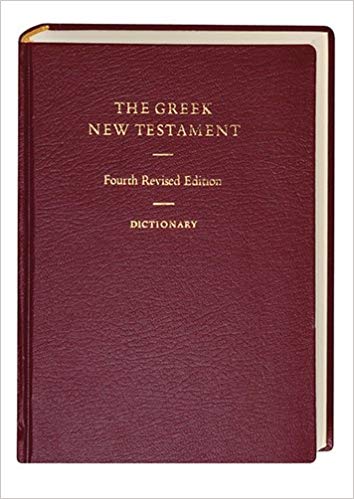
Brief Update on the UBS6 from Florian Voss

3
Over on Twitter, Florian Voss gives a short update on updates being made for the UBS6.


Readers may remember that last year at SBL Holger Strutwolf gave 2022 as a possible date for the NA29 with the UBS6 following after that.


Tuesday, August 27, 2019

The Textual Optimism of the UBS4

2
The grading system for variants in the UBS editions is probably its most distinctive feature. These ratings rank from A to D and indicate the relative level of certainty the editors felt in their decision (A being the most confident). I suspect this system has been a help to many translators over the years. For myself, the system is a rare and welcome peek behind the editorial curtain to one of our most important (and bestselling?) editions.

Over time, however, there is a noticeable and well-documented shift in these ratings without any additional explanation or justification. For example, the reading of Eph 5.22 is given a C in the UBS3 and a B in UBS4, but the textual commentary for this decision remains word-for-word the same. Kent Clarke called this “textual optimism” and his work on this is well worth consulting. (See the helpful summary from Mark Ward here.)

What I didn’t realize until today is that several of the editors owned up to this “textual optimism” and wrote about it even before the UBS4 was in print. Kurt and Barbara Aland say as much in their Text of the New Testament. On p. 45, they write about the UBS3 that “The only question is whether the editors have not been too cautious in applying the classifications, so that a B should often be replaced by an A, a C by a B, and a D by a C (a thorough reexamination has led to a revision of these for the fourth edition of GNT).” It does lead one to wonder how much responsibility for the increased textual optimism is the responsibility of the Alands.

Wednesday, April 03, 2019

Plans for the NA29 and UBS6

11
At SBL last November, Holger Strutwolf gave an update on the plans for the next editions of the NA and UBS editions. I took some notes and thought I would share them. (Sorry it’s taken so long to get these out.)
  • Both editions now have the same editorial committee. These editions will follow the work on the ECM volumes, but the committee is not bound to the same decisions as the ECM editors. They will make their own judgments. (That was a point that had not been entirely clear to me before.) Note that this means NA29 will be different in principle at least from NA28.
  • The UBS has heard from translators that the UBS edition has more variants than they really need to do their field translation work so the UBS6 will probably have fewer than the UBS5.
  • Greg Paulson and Dora Panella will be assistants on the editions
  • Holger mentioned 2022 as a possible date for the NA29 with the UBS6 following after that. They are waiting for at least one more ECM volume to be finished, probably on Mark. In that case, they can incorporate the ECM work on at least two more books (Acts and Mark). What’s happening with John, I don’t know.

Thursday, September 29, 2016

Question from Mike Holmes on the NRSV and UBS3

4

Mike Holmes sends this note for readers of the blog:
In the preface to the NRSV, the Committee states that the NRSV is based on UBS3, and that “Only in very rare instances have we replaced the text ... by an alternative.” I know of two, at Luke 11:33 and Acts 16:12, but am wondering if there is a comprehensive list. So, here’s my question: does anyone on the ETC Blog have or know of a list of UBS3—NRSV textual differences?
Any help for Mike? 

Tuesday, May 10, 2016

How Many Variants Make It into Your Greek New Testament?

22
Greek students sometimes get the wrong impression that their Nestle-Aland apparatus records all the variants for the New Testament. I certainly thought this at one point. And it’s not just students. I once heard a story about one of Kurt Aland’s colleagues who called him up in a state of distress because he had found a variant in the Syriac that was not in the NA apparatus! Aland had to break the news to him that this poor variant was not alone. The Nestle apparatus, like most apparatuses is selective.

But just how selective is your Greek New Testament? Since we now have complete collations for several small parts of the NT, and since I’ve done the boring exciting work of counting the variants in them, we can now get a sense of just how selective our standard editions are in their apparatuses.

Drawing on the data available for John 18, Philemon, and Jude, we can see just how many of the total number of variants the UBS4, NA28, and ECM apparatuses include. It’s not a perfect comparison because these editions all include variants from versions and fathers which the exhaustive collations don’t. They also don’t necessarily share the same variant units either. But for giving a general sense of the data, I think these comparisons are helpful.

Results

Here are the results of my comparison:


And in table form with percentages:

Section Number of Variants (% of total)
UBS4 NA28 ECM TOTAL
John 18 10 (0.3%) 183 (6.0%) 3,058
Philemon 16 (1.4%) 55 (4.6%) 1,185
Jude 47 (2.8%) 145 (8.6%) 789 (46.6%) 1,694

From these numbers we can see just how selective the UBS and NA apparatuses are. In the UBS, we only get 0.3 percent of the total variants in John 18 and it’s still only 2.8 percent in Jude. The NA does better, of course, but it is still just a drop in the bucket of the total number. Somewhat surprisingly, even the ECM with its extensive apparatus comes in below 50 percent.

Signficance

I see at least two conclusions we can draw from these comparisons. The first is that unqualified claims that most of our variants were created early on are simply false. Given that the NA, UBS, and ECM apparatuses all lean heavily toward the earliest evidence, it follows that the bulk of our variants were created (or at least are first attested) later on. In Jude, for example, over 53 percent of variants don’t show up in an edition that represents the text’s first 1,000 years of development (i.e., the ECM). So we cannot blithely claim that most of our variants were created early. It may be true that most of our most interesting or most important variants were created early, but that would take us well beyond the time I have for this blog post.

Second, insofar as these editions succeed in presenting the most significant variants for exegesis and translation (I’m thinking now of the NA and UBS editions), we can conclude that most of our variants are pretty insignificant.

Now that phrase “insofar as” is a pretty important qualifier and I can already hear many astute blog readers protesting that the NA/UBS editions leave out too much of value. I hear your protest. But editors have to draw the line somewhere and I don’t envy them for that. Even knowing that editors leave out some readings we think should be there, my comparisons here still give us at least one concrete way to answer the question “How many variants matter?” If we adjust the question to “How many variants mattered enough that the editors included them in my Greek New Testament?” the answer is less than ten percent.

HT: Greg Lanier for suggesting the idea.

Tuesday, September 22, 2015

ETC Interview with John Karavidopoulos

27
It is a pleasure for me to introduce our next interview. John (Ioannis) Karavidopoulos (1937–) is Emeritus Professor of the Theological School of Aristotle and is best known among English-speaking scholarship for his membership on the editorial committee of the UBS Greek New Testament. He has written numerous articles and books during his career and it is a real honor to interview him here.


Peter Gurry: Can you tell us about how you came to the academic study of the Bible and, in particular, what led you to textual criticism?

John Karavidopoulos: As you know the Bible is the basis of Christian belief and life. All the other disciplines of Christian theology are based on the Bible. So the academic study of the Bible gives you the opportunity to get into the heart of theology. Personally, as a Greek theologian, I was attracted to textual criticism because I think that the different readings of the manuscripts prove the richness of Christian tradition.

[PG] What is the academic study of the New Testament like in Greek Universities both in your experience and now in view of the current financial situation?

[JK] In both Greek university theological faculties (in Athens and Thessaloniki) as well as in all the ecclesiastical high schools, the academic study of the Bible is a fundamental discipline in which the support of the Orthodox Tradition (Fathers of the Church, liturgical life etc). And, of course, with the knowledge of modern international Biblical scholarship, Greek biblical scholars can be in contact and in dialogue with their colleagues all over the World. Especially in the current difficult financial situation, the Bible gives comfort and support to the Greek people.

Do you have a favorite edition of the Greek New Testament? Do you use a critical text in your study and an ecclesiastical text in church and in prayer? How does that work out?

The academic teaching and the scholarly work are based, of course, on the critical editions of the New Testament (NA28/UBS5) although in the Church and in prayer we use the patriarchal edition of the byzantine text. This causes no problem at all. All modern Greek translations of the New Testament are based on the Byzantine Text because people are familiar with this type of text. The Greek people know the byzantine text type and cite it from memory in everyday speech.

If I’m not mistaken, you joined the UBS editorial committee in 1981 along with Barbara Aland. How did you come to join the committee?

I was invited by the late professor Kurt Aland to join the committee because he and the rest of the editorial committee wanted an Orthodox member. So I accepted, not without some hesitation. In the end, I do think that I contributed to the enrichment of the critical apparatus with many byzantine reading which, in limited cases, were also adopted in the text.

Greek Lecture on Jesus


Dr. Karavidopoulos speaking at the 2nd General Pastoral Assembly of the Holy Metropolis of Demetrias on “What can we really know about the earthly presence of Jesus Christ historically?”

Can you give us any sense for what the committee meetings were like? How long they lasted, how frequently they met, the personalities involved, particular passages you fought over, etc.?

This is a difficult question to answer. The committee did not meet very frequently, but I was given the financial possibility to set up a group of collaborators in the University of Thessaloniki with the purpose of collating a select number of byzantine manuscripts. I fought especially for New Testament verses which are very familiar to the Greek Orthodox audience because of their liturgical use (e.g., Mark 9.29: “This kind can come out only by prayer and fasting”). But I did not succeed in many cases.

A few years ago, you met with a team from CSNTM digitizing manuscripts in Zagora, Greece. How do you think such easy access to so many manuscript images will change the discipline of NT textual criticism?

I appreciate very much the work of CSNTM and of professor Dan Wallace and I helped as much as I could to facilitate their task in photographing manuscripts in Greece in spite of the understandable negation of some Greek institutions. I hope that their work will contribute to the discipline of New Testament textual criticism.

Last year, a new UBS committee was announced. Having been part of the previous committee, is there any advice you would give the new members as they begin their work?

The only thing I can say is that some short byzantine Readings could be adopted by the committee of which I am no longer a member.

From your vantage point, what aspects of the NT’s transmission are most in need of serious investigation?

The byzantine text type must be more seriously investigated.

———
Many thanks to Dr. Karavidopoulos for his time!

Friday, June 12, 2009

A New Rating System for UBS GNT

20
United Bible Societies are ahead of their time! The July issue of Bible Translator (Technical Papers) is already out, just in time for the TTW –Triennial Translation Workshop, which is being held in Bangkok right now.

In this issue I propose a new rating system for Greek New Testament editions. It is a revised version of a proposal that was included in my monograph on Jude.

Tommy Wasserman. "Proposal for a New Rating System in Greek New Testament Editions." Bible Translator 2009 60/3:140-157.

Summary:

Various rating systems have been employed in critical editions of the Greek New Testament ever since the eighteenth century. The current letter-rating systems in the UBS Greek New Testament editions have been subject to severe critique ever since they first appeared in the first edition of 1966. In my experience, however, there is still a need for this kind of basic guidance among Bible translators and students of the New Testament.

In this article, I present a new descriptive rating system based on the generally accepted principles of textual criticism that takes into account external and internal evidence. This, in itself, is a pedagogical advantage that may enhance the individual learning process and the increased engagement with the textual problem in question. The rating will show the state of the evidence from the perspective of the editor(s), and, at the same time, it will invite the users of the edition to struggle with this same evidence on their own.

Thus, the following symbols are used to describe the evidence:

{e + i}
External and internal evidence unequivocally support the adopted variant reading.

{e > i}
External evidence favors the adopted variant reading, whereas internal evidence is ambiguous.

{e < i}
External evidence is ambiguous, whereas internal evidence favors the adopted variant reading.

{e = i}
External and internal evidence are balanced or, alternatively, external evidence favors one variant reading, internal evidence another.

(The latter symbol is roughly equivalent to the bold dot in the ECM.)

In the article I provide several examples of these various ratings in variation-units in the Epistle of Jude. Scholars and editors can use this system when they make textual decisions in any given unit of variation, weighing external and internal evidence, however they are perceived. I propose it for the future editions of the United Bible Societies' Greek New Testament.