Showing posts with label Uppsala University. Show all posts

Monday, December 20, 2021

A New Lectionary Leaf (L1663) in Uppsala

5

Until recently, sixteen Greek New Testament manuscripts in Sweden were included in the official register of Greek NT manuscripts maintained by the Institut für neutestamentliche Textforschung (INTF) in Münster, the Kurzgefasste Liste der griechischen Handschriften des Neuen Testaments (Liste). Some years ago I published an article in Svensk Exegetisk Årsbok that describes these manuscripts, "Greek New Testament Manuscripts in Sweden (With an Excursus on the Jerusalem Colophon)" available here.

In 2011, Eva Nyström and Patrik Granholm initiated a project to digitise and catalogue all the Greek manuscripts in Sweden. A new website, www.manuscripta.se, was launched and the scope of the project was subsequently widened to include all medieval and early modern manuscripts kept in Swedish libraries. Currently, the database contains 379 manuscripts in seven languages, 221 of which have been digitised in full, including fifteen Greek New Testament manuscripts in Uppsala, Gothenburg and Linköping, but not the Gospel manuscript in the National Museum in Stockholm which I found there some years ago.

Last year, as I perused this database, I found to my surprise a parchment leaf from a Gospel lectionary (Uppsala University Library, Fragm. ms. graec. 1). The manuscript has now been identified and registered as a new leaf of Lectionary 1663 (L1663) in the Liste—this is the seventeenth Greek New Testament manuscript in Sweden. 

I have just published an article and made it publicly available, "A New Leaf of Constantine Theologites the Reader’s Lectionary in Uppsala University Library (Fragm. ms. graec. 1 = Greg.-Aland L1663)" in the current volume of Svensk Exegetisk Årsbok in which I describe this new lectionary leaf its provenance and its place in the larger codex. As I mention in the article, this happens to be the leaf right next to one in Montreal which was described by Brice Jones on his blog in 2014. The main part of the codex is in the University of Chicago Library.
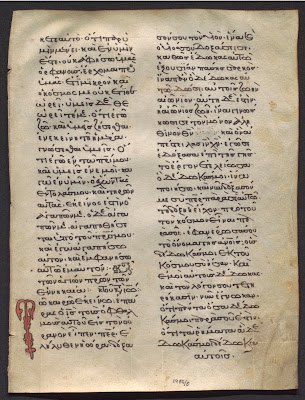
 

This is an image of the Uppsala leaf, fol. 1r (click on it for higher resolution), and in col. 1, line 2 you can see an example of the distinct μέν-distendu, which has given the style its name. It can be dated to the early thirteenth century (thus, I propose that the current fourteenth-century date in the Liste be changed). I take the opportunity to thank Georgi Parpulov who gave me good advice on palaeographical matters (he and other colleagues are acknowledged in my publication too).


Thursday, July 21, 2011

Postdoctoral Fellow in New Testament Exegesis in Uppsala

2
Uppsala professor Jim Kelhoffer tells me that Uppsala University declares the following position to be open for application:

Postdoctoral Fellow in New Testament Exegesis

at the Department of Theology for a period of two years, beginning per agreement.

The Faculty of Theology is the oldest of ten faculties at Uppsala University and encompasses all areas of religious studies at both the undergraduate and postgraduate levels (M.A. and PhD): History of Religions, Biblical Studies, Church and Mission Studies, Systematic Theology, Ethics, Psychology of Religion, and Sociology of Religion. The Faculty of Theology is one of Sweden’s largest institutions for education and research in theology and religious studies.

The position as Postdoctoral Fellow in New Testament Exegesis involves primarily pursuing a research project of choice (e.g. a new monograph project beyond the published dissertation).

Kelhoffer tells me that research in textual criticism is welcome. If anyone is interested I can assist with advise.

Official announcement here.

Tuesday, June 29, 2010

James Kelhoffer Proposed Professor in Uppsala

9
James Kelhoffer, Associate Professor at Saint Louis University, has been officially proposed as Professor and Chair in New Testament Exegesis in Uppsala (job description in English). However, some other candidates for the post have appealed the decision, as often happens, so the formal appointment has been somewhat delayed.

In any case, the chair has been vacant for a very long time, after the predecessor Kari Syreeni left in 2007, so it is indeed very good news for New Testament exegesis in Sweden, and of course particularly in Uppsala, that the chair will soon be occupied again.

Many readers of this blog will know that James Kelhoffer's dissertation subsequently published by Mohr Siebeck is of great interest to text-critics as it examines the Long Ending of Mark:

Miracle and Mission: The Authentication of Missionaries and Their Message in the Longer Ending of Mark (WUNT Reihe 2/112; Tübingen: Mohr Siebeck, 2000).

James has been to Sweden many times for long and short periods and has had much contact through the years, especially with the Department of Biblical Studies in Uppsala. I know from experience that he already speaks some Swedish (and reads it even better). I have met him on various conferences, including SNTS 63d meeting that took place in Lund 2008 (reported on here).

Last year, in April, he gave an invited lecture on “Suffering as Defense of Paul’s Apostolic Authority in Galatians and 2 Corinthians 11″ in the Advanced Exegetical Seminar in New Testament. This piece was published as an article with the same name in Svensk Exegetisk Årsbok 74 (2009): 127-143.

James has an academic homepage here with CV and publications. His publications, including two full length monographs in the WUNT series, are available for download (sic), but hurry up! I assume these pages (under SLU.EDU) will disappear when Kelhoffer takes up his new post in Uppsala. From these pages you can also find very positive bookreviews by Elliott, Holmes, Hurtado, and others of Kelhoffer's Miracle and Mission.

Update: I just learnt that some candidates have appealed to have the decision changed (which I assume is highly unlikely in this case), so the formal appointment has been delayed. I have updated the original post accordingly.