Showing posts with label GA L1663. Show all posts

Wednesday, April 13, 2022

Donation of a Manuscript Leaf (L1663) to the Goodspeed Collection

1

Two years ago or so I discovered a new leaf from a lectionary in Uppsala. This was the seventeenth Greek New Testament manuscript in Sweden and I started to research it, which eventually led to the publication of the open-access article "A New Leaf of Constantine Theologites the Reader’s Lectionary in Uppsala University Library (Fragm. Ms. Graec. 1 = Greg.-Aland L1663)." I blogged about this manuscript in December last year and provided a link to my newly published article (blogpost here).

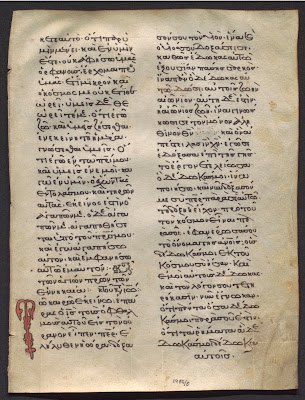
At the time of writing and blogging, this lectionary was divided between at least four collections in three countries; besides the leaf in Uppsala,  the other three were: McGill University (Montreal), Ms. Greek 11 (one leaf); University of Chicago, Joseph Regenstein Library Ms. 879 [formerly Goodspeed Ms. Grk. 34] (110 leaves); Edgar M. Krentz (s. n.) in Chicago (one leaf, which is in the image here). 

On 18 March, 2014, Brice C. Jones announced in a blogpost his discovery of the missing leaf in the Rare Books and Special Collections of McGill University in Montreal and managed to connect it to the two other parts in Chicago and (then) St Louis (where E. Krentz lived at the time). Jones had found out in the library files that it had come to McGill library in the 1930s and that it was purchased from the Swede Erik von Scherling (1907–1956) who run a bookshop in Leiden and traded in manusripts and other ancient artifacts over a period of almost 30 years. Interestingly, Edgar Krentz, the only private owner of another leaf, noted Jones’s blogpost and commented, “I got my leaf in 1961 from the Internationale Antiquaria[a]t in Amsterdam, Menno Herzberger the owner."

In November last year, the sad news reached me that Edgar M. Krentz had passed away (obituary here). Before that, Krentz had been made aware by Margaret Mitchell of my research and the fact that the larger codex of which he owned a leaf (image above) was located in the same town, in the university library, and he expressed a wish to donate it. However, he passed away shortly thereafter. I offered my condolences to his son Peter Krentz, W. R. Grey Professor of Classics and History at Davidson College, and told him about my research, and both he and representatives of Chicago University Library have now notified me that the donation has been realized a few days ago. Krentz was able to see the bound codex, and reports that it looks like his father's leaf had been extracted from the bound volume (the stitching matched up), and I believe that this will be true also of the McGill and Uppsala leaves.

In my article, I treat the problematic practice of biblioclasty, i.e., when manuscripts are torn apart and loose leaves are sold in order to increase profit. This donation is a marvellous and very unusual example of the opposite practice – to reunite what once belonged to one and the same codex. Perhaps other private owners of loose leaves can follow the same example and donate leaves to public institutions that have the facilities to curate and preserve ancient manuscripts and make them available for research and display.
Monday, December 20, 2021

A New Lectionary Leaf (L1663) in Uppsala

5

Until recently, sixteen Greek New Testament manuscripts in Sweden were included in the official register of Greek NT manuscripts maintained by the Institut für neutestamentliche Textforschung (INTF) in Münster, the Kurzgefasste Liste der griechischen Handschriften des Neuen Testaments (Liste). Some years ago I published an article in Svensk Exegetisk Årsbok that describes these manuscripts, "Greek New Testament Manuscripts in Sweden (With an Excursus on the Jerusalem Colophon)" available here.

In 2011, Eva Nyström and Patrik Granholm initiated a project to digitise and catalogue all the Greek manuscripts in Sweden. A new website, www.manuscripta.se, was launched and the scope of the project was subsequently widened to include all medieval and early modern manuscripts kept in Swedish libraries. Currently, the database contains 379 manuscripts in seven languages, 221 of which have been digitised in full, including fifteen Greek New Testament manuscripts in Uppsala, Gothenburg and Linköping, but not the Gospel manuscript in the National Museum in Stockholm which I found there some years ago.

Last year, as I perused this database, I found to my surprise a parchment leaf from a Gospel lectionary (Uppsala University Library, Fragm. ms. graec. 1). The manuscript has now been identified and registered as a new leaf of Lectionary 1663 (L1663) in the Liste—this is the seventeenth Greek New Testament manuscript in Sweden. 

I have just published an article and made it publicly available, "A New Leaf of Constantine Theologites the Reader’s Lectionary in Uppsala University Library (Fragm. ms. graec. 1 = Greg.-Aland L1663)" in the current volume of Svensk Exegetisk Årsbok in which I describe this new lectionary leaf its provenance and its place in the larger codex. As I mention in the article, this happens to be the leaf right next to one in Montreal which was described by Brice Jones on his blog in 2014. The main part of the codex is in the University of Chicago Library.


This is an image of the Uppsala leaf, fol. 1r (click on it for higher resolution), and in col. 1, line 2 you can see an example of the distinct μέν-distendu, which has given the style its name. It can be dated to the early thirteenth century (thus, I propose that the current fourteenth-century date in the Liste be changed). I take the opportunity to thank Georgi Parpulov who gave me good advice on palaeographical matters (he and other colleagues are acknowledged in my publication too).