Showing posts with label Charles Hill. Show all posts

Wednesday, March 03, 2021

Festschrift for Chuck Hill Published

4

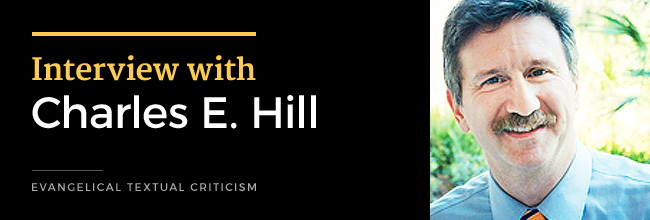
Congratulations to Chuck Hill on the publication his Festschrift! The book is Studies on the Intersection of Text, Paratext, and Reception edited by Gregory R. Lanier and J. Nicholas Reid (both colleagues of his at RTS). Don’t miss the interview we did with Chuck back in 2016 (part 1 and part 2). Here’s a bit more on Greg Lanier’s blog on the presentation for Chuck today.

Description

Studies on the Intersection of Text, Paratext, and Reception brings together thirteen contributions from leading scholars in the fields of textual criticism, manuscript/paratextual research, and reception history. These fields have tended to operate in isolation, but recent years have seen a rise in valuable research being done at their multiple points of intersection. The contributors to this volume show the potential of such crossover work through, for example, exploring how paratextual features of papyri and minuscules give insight into their text; probing how scribal behaviors illumine textual transmission/restoration, and examining how colometry, inner-biblical references, and early church reading cultures may contribute to understanding canon formation. These essays reflect the contours of the scholarship of Dr. Charles E. Hill, to whom the volume is dedicated.

Table of Contents

  1. Punctuation and Paragraphs in P66 (P.Bod. II): Insights into Scribal Behavior
    Peter M. Head 
  2. The Text and Paratext of Minuscule GA 1424: Initial Observations
    Gregory R. Lanier and Moses Han 
  3. Marginal Paratexts in GA 2323: A Thirteenth-Century Witness to the Medieval Reception of Revelation
    Peter Malik 
  4. Writing and Writers in Ancient Mesopotamia: A Brief Sketch for New Testament Scholars
    J. Nicholas Reid 
  5. On Not Preferring the Shorter Reading: Matthew as a Test Case
    Peter J. Gurry 
  6. Codex Bezae as Repository
    Jennifer Knust and Tommy Wasserman 
  7. What Is a Text? The Linguistic Turn and Its Implications for New Testament Studies
    Stanley E. Porter 
  8. Second Peter 3:2, the Apostolate, and a Bi-covenantal Canon
    Michael J. Kruger 
  9. MasPsa and the Early History of the Hebrew Psalter: Notes on Canon and Text
    Peter J. Gentry 
  10. Problems with the Explicit Marking of Quotations in Translations and Scholarly Editions of the New Testament
    Peter J. Williams 
  11. Polycarp’s Teaching: The Reception and Development of Theology
    Paul Foster 
  12. A Neglected Reference to John the Elder as Bishop of Ephesus (Const. ap. 7.46.7)
    Richard Bauckham 
  13. The Acts of John within the Johannine Corpus James W. Barker 
A Bibliography of the Works of Charles E. Hill
Indices

Wednesday, March 23, 2016

ETC Interview with Chuck Hill: Part 2

2
This is part 2 of our interview with Chuck Hill. Part 1 is here.


In The Early Text of the NT, you suggest that David Parker “gives the impression that concern for the original text is simply a religious phenomenon, driven by pressure from churches who desire an ‘authoritative text’” (p. 4). You point out, rightly in my opinion, that religious belief is hardly the only motivation for seeking a work’s original text. But what is the relationship between a high view of Scripture (as found, say, in the Westminster Confession) and the quest for the original text? Is such a view of scripture viable without the concept of a single original text?

Having a high view of Scripture, as you pointed out, is not the only motivation for seeking an original text. I don’t know why anyone would make that assumption. But is a high view of Scripture viable without ‘the concept of a single original text’? The short answer, I suppose, has to be ‘yes’, but it depends, of course, on what is meant by ‘the concept of a single original text.’ You can, of course, make a distinction between the original text (let’s just define it as the text as it left the author’s hands for the last time, with the author’s intent for release) and the ‘Initial text’ or Ausgangstext (the text we reconstruct as the source of all the known readings). But even the ‘Initial text’ is a form of the text that originated with the author. Different compositional stages of a book (e.g., a book before the author added a prologue, or decided to insert new material, etc.) are not different editions of the book, and it just seems like obfuscation to bring them into the picture.

The main, possible complication, I suppose, would be if the author did make a second edition (as some people have argued for the text of Acts). Let’s say (for the sake of argument) Paul sent a letter to the Roman church and kept his own personal copy, then later modified his copy in some way, intending to make this revised copy the basis for copies that would be more widely distributed to the churches, perhaps along with a collection of his letters. In this case you could say there are two ‘original’, authorial texts of Romans, essentially two editions.

Each of these would have originated with the author with his intention to be ‘released’ or published. Each one, I think we would have to say, was inspired, written by Paul in the exercise of his apostolic ministry. So here we would have two ‘originals’. In my opinion, the natural standard we would be seeking (if we could tell the difference) would be the final version that left Paul’s control, as representing the author’s final, intended ‘original’, even if it was not the ‘original’ original.

Or, let’s say that the ‘release’ of a book like Revelation, or even one of the Gospels, for that matter, was marked by the sending out of several ‘initial’ copies as part of the release. What if there were minor scribal differences between them? In this case, presumably there was still one single master copy from which other copies were made, which would be the logical ‘original’. But what if this, or any other, first exemplar itself contained errors that were made and somehow not corrected, in the inscription process? Then the ‘original’ text, or the normative text, would presumably go back to the author’s intention, no matter what happened between thought and words appearing on a page. This is why Warfield, in his book on NT textual criticism, identified the original text as the text intended by the author.

You teach in an institution that holds the Bible to be “absolutely and finally authoritative as the inerrant Word of God.” How do you respond to critics who say that such a belief is necessarily restrictive and even incompatible with the academic study of the Bible? Does belief in inerrancy restrict your scholarship in any way?

Yes, I’m sure it has restricted the number of stupid things I would otherwise have said. I can’t say I feel restricted in a negative way. Inerrancy can be defined in unhelpful ways but I see it not as ‘a thing in itself’ so much as simply a corollary of a couple of very basic articles of the Christian faith: that God is true and cannot lie, and that Scripture is his word. If we were starting over today, perhaps we would have found another word besides ‘inerrancy’ because it seems so prone to misunderstanding. But it has entered the theological vocabulary and it does have its value – and not to affirm it sounds a lot like not affirming God’s truthfulness. God speaks in a way that is ultimately true, not false. For me, that doesn’t predetermine very much about what the text must say or look like; God might speak, and speak truly, in ways and in forms I don’t expect. Human language (which God seems happy to employ, thankfully, because we are humans) is full of surprises.

It’s true that my convictions about God and Scripture will make me loathe to declare historical or theological problems in Scripture to be real errors or material contradictions, preferring instead to lay out options and sometimes withhold judgment until more evidence is in. But I don’t know why that should be judged to be incompatible with academic study. The ability to jump to conclusions should not be considered an essential attribute of academic scholarship. (I know that might be controversial.)

I think those who have a high appreciation for the divinity of Scripture will often look at a text much more carefully and insightfully than those who don’t, who might be satisfied with (or even eager to take) a shallower and less sympathetic treatment. And, of course, I think we would have much, much deeper problems without such a God who has spoken to us in Scripture.

If you had a particularly gifted student who wanted to pursue graduate work in textual criticism or canonicity (or both!), are there any particular issues you might want to steer them toward? Any you would advise them to avoid?

Studies of particular manuscripts are now starting to come into their own, and this is a good thing that should be encouraged in every way. I think the study of textual division is one area that holds a lot of potential (see on next question).

Sorting out the issues behind what has been called the ‘Western’ textual tradition, in my view, would be helpful, particularly the relationship between the early Latin and Syriac translations and their presumed Greek Vorlagen. How much of what has been attributed to a Greek Vorlage is really a result of translation technique? I don’t think the Greek fragments of Irenaeus that contain Biblical citations have been adequately analyzed and compared with the Greek manuscripts and the Old Latin translation(s).

More work is being done on early patristic appropriations of Scriptural texts, and that is a welcome sign, but more can still be done. More attention could be given to early Christian book collections, of churches or of individuals. There are a number of signs that Christians in the second half of the second century already believed that Scripture consisted of a ‘closed collection’ of books. These could be explored further.

I can’t think of any to avoid, except anything that won’t hold your interest for years of study.

2016 Academic Lecture  |  Listen here

Dr. Charles E. Hill, delivers the Spring 2016 Academic Lecture at RTS Orlando on the theory of the early development of the NT text. Offering an alternative solution to long held views.

Can you share any of your current research projects with us?

Of most interest to readers of this blog might be the work I’m doing on textual divisions in early manuscripts. For the Michael Holmes FS I did an investigation of early manuscripts of John, focusing on what appears to be a very early template for textual division, best preserved in P75 and in B. Among other things, I think it indicates that the scribes of Vaticanus probably had access to a very early copy, or copies, of John. My paper at SBL last November (2015) carried the study through to the other three Gospels, and I’m hoping to take this research further.

Following up on the work begun in ETNT, I’m working on updating the prevailing theoretical model for the early development of the NT text. Extending work on the Johannine Corpus (The Johannine Corpus in the Early Church) I’m also working on a book on the composition of John, in which I’m revisiting theories of multiple editions of the Gospel. Also I’m writing something on the socio-theological context of 13 John. If I should live long enough, I’m hoping to write a commentary on John.

Dr. Hill, thank you so much for your time and experience.

Thank you for your interest!

Thursday, March 10, 2016

ETC Interview with Chuck Hill: Part 1

5
I am pleased to introduce our next interviewee in our ETC interviews series. Dr. Charles E. Hill completed his PhD on eschatology in the early Church at the University of Cambridge under Lord Rowan Williams of Oystermouth (yes, they still use such fantastic titles in England). More recently Dr. Hill has turned his attention to issues of NT text and canon in his Who Chose the Gospels? Probing the Great Gospel Conspiracy (2010) and The Early Text of the New Testament (2012) which includes several contributions from our ETC bloggers. He is also a member of the Studiorum Novi Testamenti Societas and is currently the John R. Richardson Professor of New Testament and Early Christianity at Reformed Theological Seminary in Florida. Thanks to Pete Head for some of these questions.


PG: Few people probably know that your first degree was in fine art and you worked for a period as a graphic artist (a fine job to have, if I may say so). Is there any particular piece of art that you find yourself coming back to again and again?

CH: Not really, though I would say that I find myself being more and more fascinated by the beauty of creation. I can stare at trees and clouds for a long time (hopefully this is not just a sign of aging). I still have favorite artists: Michelangelo, Rembrandt, Dürer, Caravaggio, and now, my kids. Somebody else who heard of my art background and didn’t realize that I’ve been out of it for the past several decades actually invited to give a lecture this spring on Salvador Dali before leading a tour through the Dali Museum in St. Petersburg, FL. That ought to be an interesting experience.

Readers of this blog will probably be familiar with your more recent text critical work, but your Cambridge dissertation was on the topic of eschatology in early Christian thought. Having worked on that topic, what led to your interest in textual criticism?

In the early nineties I was given a book on the Muratorian Fragment to review. At the time, I didn’t know very much about the formation of the NT canon per se. But having spent a great deal of time in the second century for my dissertation, I found several of this author’s conceptions about the second-century writers to be at odds with those I had developed. The experience of writing that review, along with some other things that were happing in scholarship at about that time (Bart Ehrman’s The Orthodox Corruption of Scripture, for example), convinced me that the issues of canon and text were ones where there might be a real need for scholarship.

Shortly after that, I came to RTS, where teaching both NT textual criticism and the NT canon happened to fall to my lot. From very early on I also had an interest in manuscripts. I think the art background was certainly part of that, not only because of the aesthetics of the manuscripts, but also the artefactual, material-culture aspect. Maybe for all these reasons, and because I was not trained as a textual critic, my particular interest has not been so much on what you might call textual criticism in the traditional sense, the art/science and methods of establishing the text. I’ve been most interested in what happened with the text in the process of transmission, in how Christians were using the text, and in what the NT manuscripts as material objects can tell us about those things. We live in very exciting times, as you know, with more and more discoveries and with the wonderful increased access to digitized images. I hope this will lead to a real renaissance of manuscript and textual scholarship.

Wednesday, December 04, 2013

Hill and Kruger Respond to Parker's Review of The Early Text of the NT

6
Recently I responded in a blogpost (here) to a review by David Parker in JTS of the volume The Early Text of the New Testament (eds. Hill and Kruger; OUP, 2012). In the review I expressed the assumption that the editors Charles E. Hill and Michael J. Kruger would respond somewhere else, and speak for the whole volume and for their introductory chapter.
 
Now inedeed the editors have written a long response on Kruger's blog. I will only cite their conclusion:
In sum, we appreciate Parker’s prompt engagement with ETNT so soon after its publication.  While no book is beyond criticism, many of Parker’s specific criticisms stem from a misunderstanding of the scope of this project and its purpose.  It is our hope that the clarifications we have offered here will help address some of these misunderstandings and allow for more productive dialogue on these important issues.

Wednesday, October 30, 2013

Reply to Parker's Review of The Early Text(s) of the New Testament

8
I have recently read David Parker's review of The Early Text of the New Testament (eds. Hill and Kruger; OUP, 2012) with great interest, since I have contributed to that volume with an essay. The review has just published in the current Journal of Theological Studies, Vol. 64/2 (October) 2013, pp. 642-45.

However, I became suprised with the generally negative critique, although Parker concludes with the reservation that, "These shortcomings in the conception of the volume should not deter anyone from reading and benefiting from individual contributions to which it has given rise."

Parker brings up three main critical points in his review, and I will attempt to give a response to each of them in this blogpost, in particular to the second and third points, as they relate to my own contribution (I assume the editors Hill and Kruger will respond somewhere else, and speak for the whole volume and for their introductory chapter):

First of all, Parker complains that the focus of the volume is difficult to discern.  Whereas the editors say it "intends to provide an inventory and some analysis of the evidence available for understanding
the pre-fourth-century period of the transmission of the NT materials, some MSS in Section II are dated after 300 and Section III lack reference to third-century writers, in particular Origen."

I think Parker is correct about a lack of focus, which probably reflects the freedom given to each author. As the editors point out in the introduction, "the editors have not asked the individual authors . . . to endorse one approach or method over another" (p. 18). Further, Parker is entirely correct in his latter observation – there is an omission in terms of patristic authors. However, I do not understand the problem with including manuscripts (papyri) dated after 300, first because the dates themselves are seldom exact. Let me take an example from my own chapter where I write in a footnote concerning the dating of P110: "The first editor W.E.H. Cockle dates P110 to the 4th cent. but at the same time notes the similarity of script to P45 (3rd cent.) and P. Flor. II 108 (ante c. 260). The evidence points to the first half of the 4th century" (p. 87, table 5.1, note j).

Further, I am certain that Parker is aware of the importance of tracing textual trajectories between the early papyri and later MSS. For example, it would be a serious omission to speak about the early text of Luke and John (chs. 7-8), while not mentioning Codex Vaticanus (B 03) because of its date after 300.

Parker's second point is as follows:
The book does not address methodology for comparing and analysing the witnesses, beyond adopting the terminology of the Aland handbook as updated in its second edition and by Barbara Aland in an article of 2002 (manuscripts are listed under the categories of ‘Strict’, ‘At Least Normal’, ‘Normal’, ‘Free’, and ‘like D’ on p. 11).
Parker then proposes that Hill and Kruger have confused this method with the Coherence Based Genealogical Method (CBGM) – "a serious misunderstanding" – when they refer to it as the "Münster approach" to classify early manuscripts "in three major groups" (although the editors are well aware of the CBGM to which they refer on p. 8 n. 38).

To this I would reply that one thing does not have to exclude the other.  The Alands' approach to analyzing early, in particular small, papyri and categorize them as "strict," "normal," or "free" should not be seen as a relic from the past now made redundant by the CBGM. In fact, Barbara Aland's last doctoral student, K. S. Min used the method to analyze over a dozen papyri in his excellent dissertation on the earliest transmission of the Gospel of Matthew, published in 2005 in the ANTF series (a series now edited by Parker). By that time the CBGM had been applied for many years. Arguably, this method of analysis, as described by Barbara Aland in the Festschrift for Delobel, New Testament Textual Criticism and Exegesis (Leuven, 2002), pp. 1-13, and elsewhere, can justifiably also be labeled a "Münster approach" (although I would personally avoid it).

To take this one step further, one could actually question whether the other Münster approach, now in vogue, the CBGM, is a suitable tool for analyzing the text of fragmentary papyri. As Gerd Mink, the inventor of the method himself states in a very helpful essay, "Problems of a Highly Contaminated Tradition: The New Testament. Stemmata of Variants As a Source of a Genealogy for Witnesses,” in Studies in Stemmatology II (ed. Pieter van Reenen, August den Hollander and Margot van Mulken; Amsterdam: John Benjamins 2004), 71:
Badly fragmented witnesses certainly present a very special risk. The genealogical relationship between a fragmentary witness and another witness is determined on the basis of its limited text supply. As the distribution of prior and posterior variants in a text can be very different it is possible that an entirely different picture would have resulted from the complete witness, if it had been preserved. 
It is perhaps not a coincident that it is possible to exclude fragmentary MSS when running the CBGM software. In an extensive presentation (downloadable here) of his method as applied to the Catholic Letters, Mink explains further how the method does not take fragmentary MSS into account, and it seems like many papyri actually fit the criterion he indicates:
The pre-genealogical and genealogical data used rests upon the entire corpus of the Catholic Letters (not upon single writings). When agreements with a given witness are checked or potential ancestors are searched for, smaller fragments are excluded. Smaller fragments are those which share less than 50% of the variant places in the given witness.
Hence, when Eldon J. Epp in his important essay "Textual Clusters: Their Past and Future," in The Text of the New Testament in Contemporary Research (eds. B. Ehrman and M.W. Holmes; NTTSD 42; Leiden: Brill, 2013), 564, asks what is the appropriate method for identifying the D-cluster ("Western" text), he questions the usefulness of the CBGM, since it does not take into account fragments (the D-cluster contains the fragmentary P38 and P48).

On the other hand, Epp gives a rather positive evaluation of Alands' system of classification for the papyri in another essay in the same volume, "The Papyrus Manuscripts of the New Testament," in The Text of the New Testament in Contemporary Research, 27, 
Yet, this classification system, with its considerable relativity, is not without value, for it reflects the general scribal process. For example, the close textual relationship between P75 and Codex B . . . does show a 'strict' connection with their respective exemplars–and with others along that line of transmission.
The final and probably most severe point of criticism in Parker's review concerns the second section of the volume, including my own essay:
I find it really remarkable, and a serious flaw, that none of the contributors to Section II seems to pay attention to, or in some cases even to be aware of, the Text und Textwert series (I except the chapter on the catholic epistles). These volumes make it possible to compare a witness with any other witness in a systematic manner, and to take an important step towards an overview of the textual history of a work. They are far more valuable, since they provide hard facts, than the Aland categories. The first volumes were published in 1987. How can what purport to be articles dealing with contemporary scholarship ignore them?
I have several objections to this harsh criticism, especially if it is applied to my own essay, "The Early Text of Matthew" (pp. 83-107). First of all, in my introduction, I explicitly point out that "numbers and percentages are more important than corresponding labels like "free," "normal," and "strict" and that "the validity of the results ultimately depends on the size of the sample and the specific nature and pattern of textual variation–variants should be weighed as well as counted" (p. 84). In my opinion, I use a proper method providing facts as hard as they can be in this business.

More importantly, I do not see how I could have used Text und Textwert in order to analyze most of these small papyri. When I wrote my chapter, I of course had to relate it to Min's recent and extensive examination of the Matthean papyri, and I felt that I could improve on some aspects, and in a few cases I came to slightly different conclusions regarding the classifications. But then I basically had to use the same method on the material.

In Min's case, Barbara Aland, director of the very institute that produced the Text und Textwert series, apparently did not see the need to use that tool either, because Min never refers to it in his monograph, as far as I can tell. Instead, as I have pointed out, Min uses the method of analysis which Aland continued to develop and describe (long after the development of the CBGM and the Textwerttool).

If we turn to one of the most significant examinations of NT papyri, that of James R. Royse in his magnus opus, Scribal Habits in Early Greek New Testament Papyri (NTTSD 36; Leiden: Brill, 2008), he does not use the Text und Textwert tool either, as he analyses six of our most significant and extensive papyri. On the contrary, he is entirely occupied by examining how well the scribe copied the exemplar. In his introductory chapter on methodology, we may further note that he gives a rather positive evaluation of Barbara Aland's method of analysis (pp.60ff), although he chooses to analyze the singular readings only (which is particularly useful when dealing with larger papyri).

In Parker's recent essay, “Understanding How Manuscripts are Related” in Textual Scholarship and the Making of the New Testament. The Lyell Lectures, Oxford, Trinity Term 2011 (Oxford: Oxford University Press, 2012), 65-100, in which he describes ways of understanding relationships between MSS, he does not explicitly mention the Text und Textwert tool (although the index claims so), albeit there is a brief reference to "comparison of textual data in test passages in the Gospels." Instead, he rightly focuses on the CBGM, referred to as the "Münster Method."

Apparently, Parker concentrates on the method he thinks is most useful to apply to the material in order to solve the research question. In my own essay in the volume under review, I have tried to do the same thing. I did not mention (nor used) the Text und Textwert tool because I preferred to use a different "Münster method" which I find more suitable for analyzing early (and mostly fragmentary) papyri.

I sum, I think Parker is correct when he identifies a general lack of focus in the volume under review; this is because the individual authors were given great freedom in terms of method and approach. Further, Parker has rightly identified the omission of references to third-century writers (e.g., Origen), but I object to the other points of criticism.


Monday, March 25, 2013

New Review of The Early Text of the New Testament (Kruger & Hill)

20
Over at his new website, Brice Jones has published a review of The Early Text of the New Testament (eds. Kruger & Hill).

I note with satisfaction that this reviewer "found the approach and format of Wasserman’s essay to be the most clear of all the essays." However, the most interesting aspect of the review is that Jones identifies a theological agenda behind two of the articles (Charlesworth and Kruger): "In sum, it seems apparent that there is a theological agenda behind both Kruger's and Charlesworth's articles. The conservative and apologetic undertones in their arguments are clear."

Kruger's co-editor C. E. Hill also gets his share in the summary:

Overall, this book is an important addition to our field and thus is to be recommended to anyone interested in the text of the New Testament, in spite of the apparent apologetic predispositions on the part of the editors. 

Go ahead and read the whole review here and welcome to comment!


Update: I just went through the typos that Brice Jones identified in my essay, and this makes me so disappointed with Oxford University Press – they are responsible for all the typos.

In any case, the most embarrasing thing is that OUP has managed to duplicate my chart for P77 and insert it under P70 (including a typo).

So, here is the correct chart for P70 (p. 97) which any owner of the book can print out and insert.


Textual analysis

Text
Var.-units in NA27
Extra var.-units
Ratio of deviation
Type of deviation
Singular readings
2:13–16; 2:22–3:1; 11:26–27; 12:4–5; 24:3–6, 12–15
6
4
7/10 (70%)

1 x O
6 x SUB
3 x SUB


At some point someone made a mistake. Unfortunately, I did not read the proofs as I should have! (why don't I learn the lesson).

Monday, October 29, 2012

“This Book is Really Awesome”

11

Rick Brannan (ricoblog) has reviewed The Early Text of the New Testament (eds. Hill & Kruger; OUP 2012) in several blogposts, bit by bit. In his final post (which has links to all previous parts) he wraps it up:
I can’t say it enough: This book really is awesome; I only hope the publisher is able to release a more affordable paperback copy so more folks can use the book. It is that useful if you’re working through the text of a passage and want to take significant variants from early manuscripts (pre 5th century) into account. . . .

For this task, Part II, “The Manuscript Tradition” is really the gem within the book (TOC for Part II is given in a previous post).  While each article approaches the task differently, what you end up with is basically a focused discussion of the variations found in early manuscripts (mostly papyri) for a given NT book. If you are working with the text of the NT, this really is essential material to consult. If there are significant issues with the early witnesses for a section of text you’re working with, it will likely be discussed in this book.
In light of Rick’s review, I am all the more happy to have contributed to part II and I am sure co-bloggers Pete and Pete say the same:

5. The Early Text of Matthew , Tommy Wasserman
6. The Early Text of Mark , Peter Head
7. The Early Text of Luke , Juan Hernandez
8. The Early Text of John , Juan Chapa
9. The Early Text of Acts , Christopher Tuckett
10. The Early Text of Paul (and Hebrews) , James R. Royse
11. The Early Text of the Catholic Epistles , J. K. Elliott
12. The Early Text of Revelation , Tobias Nicklas
13. Where Two or Three Are Gathered Together: Evaluating Agreements between Two or More Early Versions , Peter Williams

Tuesday, December 07, 2010

Hill, Who Chose the Gospels?

14
One of the books I picked up at SBL, and the one I chose to read on the plane home was C.E. Hill, Who Chose the Gospels? Probing the Great Gospel Conspiracy (Oxford: OUP, 2010). Chuck, who has written a load of important things about the history of the NT canon (some listed on his faculty web page) has written a readable, but not sensational, treatment of the history of the four-fold gospel canon (he has also written a short summary here).

In fact Chuck doesn’t think that anyone chose the gospels, he thinks (quoting and following Bruce Metzger) that they ‘imposed themselves as canonical upon the church’. The approach works backwards from an excellent and thorough demonstration that Irenaeus was not alone in accepting an exclusive four-fold gospel canon towards the end of the second century (Hippolytus, Tertullian, Origen, Dionysius, Cyprian, Victorinus, Marinus and Euplus [yes a new one to me too] held fundamentally similar views). In working back through the second century Hill argues that Justin Martyr and Papias both also had a four-fold gospel collection, and there is perhaps room for some disagreement here (although it should be noted that Hill has published a long article on the “new” Papias material he discerned in Eusebius, and for a fuller argument see Hill, ‘What Papias Said About John (and Luke): A “New” Papian Fragment’ JTS 49 (1998), 582-629). If you work backwards from the really clear evidence I think you are more inclined to think that somewhat marginal evidence is actually proof that the four-fold gospel was known in a period when working inductively from the available evidence we might not be able to say that.

Overall I think this is a really useful book. It is not sensationalist (despite the talk of conspiracy, Hill is generally in respectful dialogue with other scholars [with a hint of frustration that they haven’t considered all the relevant evidence]). Occasionally I found myself not quite so convinced of Hill’s position as he was, but had to admit he had arguments for his position. Certainly if you accept that Papias had a four-gospel canon tradition this would be tremendously significant for how we read the less clear evidence in the early part of the second century.

I found quite a few problems / errors / something more than just differences of opinion, especially in relation to manuscripts and such things. Somethings to consider for the second edition:

  • p8. Here Hill is discussing how many other gospels existed in the second century and gives a list of nine, noting ‘It is not unlikely that more Gospels might have circulated before 175. But if they once existed they have left no record, even in later lists of books to be avoided ...’ But there are later lists of non-canonical gospels which do provide some record of numerous named gospels. For example, there is a Samaritan list of 35 named non-canonical gospels (J. MacDonald & A.J.B. Higgins, ‘The Beginnings of Christianity according to the Samaritans’ NTS 18(1971)54-80, esp. pp. 66-69), and the Decretum Gelasianum also names a number of gospels and other books.
  • p. 13. In discussing the Oxyrhynchus Papyri Hill mentions 500,000 pieces, ‘only about a tenth of which have so far been published’. But in fact it is more like a hundredth, since the most recently published is P. Oxy 5071 (Parsons, cited by Hill in note 7 confirms this).
  • p. 20f. Here Hill is discussing the lack of early manuscripts of Mark. He argues that since church fathers knew Mark, and since some manuscripts could have included Mark alongside other gospels, ‘there is reason to believe that at this time Mark was more widely used in Christian churches than the statistics of papyrus discoveries would, by themselves, lead us to believe’. I think on the contrary that there is no reason to believe this (and I have argued this more fully in an essay on Mark in a forthcoming book edited by Hill) - it is rather a consistent phenomena that church fathers who doubtless knew Mark did not often quote Mark (for Clement of Alexandria for example Cossaert has 274 quotations from Matthew; 143 from Luke; 72 from John and 1 from Mark; for Didymus Ehrman has 155 passages from Matthew; 146 passages from John; 111 passages from Luke; and 10 passages from Mark; Brogan found only one quotation from Mark in Athanasius!).
  • p. 25. Hill writes: ‘A “book” was a scroll, or roll, a long sheet of papyrus or parchment rolled up with rods attached at each end to serve as handles.’ In Greek bookrolls on papyrus no rods are used (either in contemporary illustrations or in actual archaeological finds).
  • p. 30f. Hill follows Hurtado’s idea that use of a codex might correspond with identification of the text as scripture by the scribe; and further that public reading in church required a large codex. Since non-canonical gospels are often on rolls or small codices, they probably were not regarded as equivalent with the four canonical gospels. But in discussing the size of two non-canonical texts Hill slightly cooks the books. This is perhaps not a big problem, but suggests that perhaps the overall argument is driving how the evidence is perceived and presented. Firstly by taking P. Oxy 4009 (G.Peter?) as representing a miniature codex (‘a strong possibility’), whereas we don’t really know that for sure, and the editors also suggest that it could have been from a double columned codex. Secondly by describing P. Ryl 463 (G. Mary) as ‘a miniature’ when as reconstructed (9cm x 13.5 cm) it certainly goes beyond the normal categorisation of a miniature codex.
  • p. 72. Here Hill is comparing Clement of Alexandria’s use of non-canonical gospels with his use of the canonical ones, citing a monograph by Mutschler [whose first name is misspelt as Bernard, when it is actually Bernhard] on Irenaeus that he used Matt 757 times; Luke 402 times; John 331 times and Mark 182 times. Now I haven’t been able to check Mutschler’s book, nor his definition of “use”; but it is plain that the more recent monograph actually on the subject (The Text of the Gospels in Clement of Alexandria by Carl Cossaert) offers significantly different figures: 274 quotations from Matthew; 143 from Luke; 72 from John and 1 from Mark (and actually discusses Clement’s lack of knowledge of Mark).
  • p. 84. Here Hill is discussing the Akhmin codex of the Gospel of Peter. He writes: ‘It has often been reported that this codex was found in the grave of a monk ... This is part of a legend that has grown up around the discovery. We don’t know if the person in whose grave it was found was a monk or not, or what the person thought of the book. As far as we know, the gravedigger could have thrown it into the grace to get rid of it!’ Well, the reason it is often reported is not because of legend, but because the original publication of the manuscript, by one of the French archaeologists who excavated the Christian cemetery at Akhmim, stated that it came from the grave of a monk. One might disagree with this, or wonder whether the archaeologists had sufficient basis for making this identification (as van Minnen does in an article cited by Hill), but the conclusion is more well-grounded than Hill’s speculation. Another grave in the same cemetery contained a mathematical papyrus - the phenomena of people being buried with texts that had some relevance/value to them is fairly widely attested.
  • p. 118. Here Hill is discussing various aspects of Skeat’s view that some NT papyrus manuscripts were originally four-gospel codices. I was especially interested in this bit, and read it especially carefully and found a couple of problems. a) He notes that the scribe of P75 has some harmonisations and suggests that these ‘seem to indicate the scribe’s knowledge of Matthew and perhaps Mark’. This reference to Mark goes beyond the evidence, even of Comfort and Barrett (cited as evidence) who note the scribe’s knowledge of Matthew (as also picked up in Royse), since the possible reference to Mark is only in a direct parallel to a passage also in Matthew - if the scribe knows uniquely Matthean readings it doesn’t make much sense to propose he drew a reading from Mark. b) Hill states ‘if copied around 200, it is more likely than not that it [P75] had such a companion volume [containing Matthew and Mark], whether attached or separated.’ This is interesting, but I have no idea how this likelihood is measured. I would think this is extrapolating beyodn the available evidence. c) In discussing Skeat’s view of P4, 64 & 67 he states that in Skeat’s view ‘the codex contained at least three Gospels, and other features of the papyri indicated that this condex in fact originally contained four.’ Hill gives no indication of what these ‘other features’ are. I had another look at Skeat and can’t find any comment in this direction. d) Hill says that ‘Skeat’s conclusions have indeed been accepted by a number of other papyrologists’, but the footnote refers only to van Haelst, writing more than twenty years before Skeat and who does not accept Skeat’s view (although he does accept that P4 is probably from the same codex as P64 & P67). e) Hill notes that Skeat’s views have ‘not gone unchallenged’ (with footnote to Head and Charlesworth) but then says: ‘it seems agreed, however, that the books of Matthew and Luke represented in P4, 64, 67 were copied by the same scribe, whether bound together with Mark and John or not.’ This fails to note the major disagreement about whether we should even think of Matthew and Luke as bound together.
  • p. 119. Hill says that P75 ‘has sectional divisions which would make it easier to read aloud to a congregation’. This is clearly either wrong or rather exaggerated. I’m not saying that P75 couldn’t be read aloud to a congregation, but it has less help in this than just about any other NT manuscript. (On p. 121 he refers to ‘the apparent liturgical design of the papyri P75’ which I also found very questionable).