Showing posts with label Tommy Wasserman. Show all posts

Monday, September 02, 2024

The Epistle of Jude: Its Text and Transmission as E-book

10

My monograph The Epistle of Jude: Its Text and Transmission is now available as an e-book for the first time through Amazon (Kindle).

Since the publisher went out of business and the dsitributor Eisenbrauns became an imprint of PSU Press many years ago it has been difficult to get the paperback but now it is possible to order the book in three different formats through Amazon:

E-book (Kindle) $9.99

Paperback $19.99 

Hardback $29.99

    The study treats the textual tradition of the Epistle of Jude. The nucleus of the study is an exhaustive critical apparatus presenting the evidence of 560 Greek MSS, including dozens of lectionaries. The major part of these textual witnesses have not received the attention they deserve. Now, for the first time, all these MSS have been collated in a complete book of the NT. The complete collation has brought many new readings to light, some of which were only known through ancient versions, and previously known and important readings have gained additional support.
As a comparison, the Editio Critica Maior of Jude present the evidence of ca 140 manuscripts and Metzger's textual commentary covers Jude in four pages whereas my textual commentary encompasses 105 pages.
 
Extracts from some reviews:
 

”Very few doctoral studies can claim to be magisterial, however, Wasserman’s study rightly deserves such a title. He presents an exhaustive study of the manuscript tradition of the Epistle of Jude. What this means in practice is assembling and collating the readings from 560 Greek manuscripts of this letter. The evidence is drawn from familiar papyrus and uncial texts, but the ground-breaking aspect is the integration of evidence from hundreds of minuscule manuscripts and lectionaries."—Paul Foster, School of Divinity, University of Edinburgh in Expository Times, 118, 2007


"This is obviously essential reading for those engaged in textual criticism of the NT, and particularly of Jude. It is also very important for anyone with a more general interest in Jude and, to a lesser extent, 2 Peter. Finally, it provides a helpful update on the current state of textual criticism for all scholars of the NT who may (like the author of this review) attend to the subject less than they should."—Terrance Callan, The Athenaeum of Ohio, in Catholic Biblical Quarterly, 69, 2007

 
"Wasserman's thesis is unsurpassed in accuracy and completeness. . . .  W. gives the reader the information necessary for checking the reliability of his text-critical presentation of Jude. In fact, he gives accurate and compete information about most text-critical problems. . . . I can only congratulate the young doctor on a good piece of scholarship."—René Kieffer, Uppsala University, in Journal of Theological Studies, 68, 2007


"Wasserman has made available to the text critic a massive amount of manuscript evidence for the book of Jude. The manuscript evidence is exhaustive and the textual commentary thoughtful. Commentators and text critics must deal with Wasserman’s evidence and textual conclusions in any future work on this little epistle. One may apply the same criteria and arrive at different conclusions, but no scholar can afford to dismiss Wasserman’s thoughtful and measured text decisions. "—Stephen D. Patton, North Greenville University in Review of Biblical Literature, April 2008

 
"It cannot be said of many doctoral theses that they have made a major and permanent contribution to human knowledge, but it can be said of this one. what has been achieved in the course of this published version of a doctoral dissertation at Lund University is quite incredible. The author has examined and collated the text of Jude in 560 different manuscripts, that is, in virtually all the continuous-text manuscripts of the epistle. Thus a work has been done that has considerably advanced our knowledge of the text of the New testament and will not need to be repeated. such full collations previously had existed only for the Apocalypse.”— P.J. Williams, Tyndale House in Themelios, 33: 1, 2008


"Wasserman’s presentation of evidence as completely as possible is really laudable, and the caution and reason of the author’s argument and the aim to encourage the readers to decide independently point in a direction in which textual criticism may get out of its ‘esoteric’ corner, and textual history can also become an important aid for exegesis." — Jörg Frey, University of Zurich in TC: A Journal of Biblical Literature 15, 2010 

Monday, December 03, 2018

Giveaway: Three Copies of To Cast the First Stone

65
Princeton University Press has just released Tommy Wasserman and Jennifer Knust’s major new book on the Pericope Adulterae: To Cast the First Stone: The Transmission of a Gospel Story. I currently have three copies sitting in my house ready to be given away. You know the drill: you have until Friday morning (Arizona time) to enter to win in any of the ways listed. We’ll pick the winners next week.

a Rafflecopter giveaway

Publisher details

The story of the woman taken in adultery features a dramatic confrontation between Jesus and the Pharisees over whether the adulteress should be stoned as the law commands. In response, Jesus famously states, “Let him who is without sin be the first to throw a stone at her.” To Cast the First Stone traces the history of this provocative story from its first appearance to its enduring presence today.

Likely added to the Gospel of John in the third century, the passage is often held up by modern critics as an example of textual corruption by early Christian scribes and editors, yet a judgment of corruption obscures the warm embrace the story actually received. Jennifer Knust and Tommy Wasserman trace the story’s incorporation into Gospel books, liturgical practices, storytelling, and art, overturning the mistaken perception that it was either peripheral or suppressed, even in the Greek East. The authors also explore the story’s many different meanings. Taken as an illustration of the expansiveness of Christ’s mercy, the purported superiority of Christians over Jews, the necessity of penance, and more, this vivid episode has invited any number of creative receptions. This history reveals as much about the changing priorities of audiences, scribes, editors, and scholars as it does about an “original” text of John.

To Cast the First Stone calls attention to significant shifts in Christian book cultures and the enduring impact of oral tradition on the preservation—and destabilization—of scripture.

Jennifer Knust is associate professor of New Testament and Christian origins at Boston University. Her books include Unprotected Texts: The Bible’s Surprising Contradictions about Sex and Desire. Tommy Wasserman is professor of Biblical studies at Ansgar Teologiske Høgskole in Norway. His books include The Epistle of Jude: Its Text and Transmission.

You can read the introduction here.

Endorsements

“This valuable and delightful book leaves no stone unturned in tracing the fascinating reception history of the biblical story of Jesus’s encounter with the adulterous woman. Deeply scholarly and wonderfully accessible, To Cast the First Stone will prove relevant for many discussions on the early church.” —AnneMarie Luijendijk, Princeton University

“Brilliantly conceived, massively researched, and convincingly argued, Knust and Wasserman’s wide-ranging analysis of the pericope adulterae is a milestone in the field of textual studies, destined to be the definitive account for a generation.” —Bart D. Ehrman, University of North Carolina, Chapel Hill

“Knust and Wasserman use the story of the adulteress to illustrate the fascinating transmission history of gospel literature and the various personalities and forces that contributed to the process. To Cast the First Stone will undoubtedly become the standard book on this story.” —Chris Keith, author of The Pericope Adulterae, the Gospel of John, and the Literacy of Jesus

Monday, August 13, 2018

The Text-Critical Seminar at SNTS in Athens 2018

8
Today I am flying home from Athens where I have participated in the 73rd SNTS meeting including three sessions in the text-critical seminar. This was the fifth and final year of the seminar, chaired by me, Claire Clivaz and Ulrich Schmid, and the theme of this year was NTTC in exegesis.

We had three wonderful presentations followed by responses and fruitful discussions by the sixteen or so participants and I think the presenters got some very useful feedback. 

Tommy Wassermans foto. Jennifer Knust kicked off on Wednesday with a brilliant paper on textual criticism as exegesis discussing Lachmann’s idea of recensere sine interpretatione, Origen on John 1:28 (Bethany/Bethabara) among other things followed by a stimulating response by Claire Clivaz, wherein she coined the term “Lachmannian utopia,” among other things.

Tommy Wassermans foto.
Next on Thursday, Klaus Wachtel gave an instructive presentation on the interactive commentary on ECM of Acts in the NT.VMR with an example in Acts 3:13, followed by a response by Mike Holmes, who also brought up the conjecture in Acts 13:33.

Tommy Wassermans foto.On the last day of the SNTS meeting in Athens (Fri), we had Juan Hernandez Jr. present on ”The Apocalypse in Light of Recent Advances: A Return to J. Schmid’s Studien to Contextualize Current Text-Critical Trends.” The paper presented and evaluated Josef Schmid’s work on Revelation which has now been translated into English by Juan, Garrick Allen and Darius Müller (Juan is holding the book in the picture), and concluded by briefly looking to the future.

This was followed by a response by myself where I posed several questions to the presenter about Schmid’s work in particular in light of recent advances in research on Revelation through Text und Textwert, monographs and articles by Juan himself, Darius Müller, Peter Malik, and many others.

Tommy Wassermans foto.A highlight was when Juan stood up and read out loud for us a paragraph from the new translation which answered one of the questions.

This session as the two others went great and I have had good feedback from many participants in the seminar who thought we had great sessions. The best thing with the meeting though is to meet wonderful colleagues (here I am with Jennifer Knust and Claire Clivaz).

And, now I can announce that our seminar was accepted for renewal for another five years with me, Claire Clivaz and Hugh Houghton as chairs.

These are the themes for the coming period:

1)    Significant manuscripts and scribal habits (2019) – joint session(s) with papyrology
We will begin with a focus on the physical manuscripts and their scribes. We have agreed with the papyrology seminar to arrange a joint seminar (or sessions) on significant New Testament MSS at the meeting in Marburg.

2)    The Latin Bible (2020)
This will coincide with the publication of the Oxford Handbook to the Latin Bible, and enable us to invite distinguished guests as well as contributions from existing members.

3)    New Testament editions (2021)
This topic is evolving so fast that there is no doubt that we will have new topics and novelties to discuss in 2021.

4)     Digital developments and challenges (2022)
The same remark can be made here, based on the successful seminar on this topic in 2017, which has led to new standards being adopted for digital data in this field. Moreover, we expect to see several new digital projects developed in NTTC in the next years.

5)    NTTC and Reception History (2023)
This topic acts as a link between the study of the text and its significance for those working in other areas of New Testament scholarship.

So, I hope I will see some of you colleagues out there in Marburg next year!

Wednesday, October 25, 2017

A New Approach to Textual Criticism – A Book that Will Keep You Awake

19
It is now possible to order my and Peter Gurry’s introduction to the CBGM from the SBL website or from Amazon.

Authors: Tommy Wasserman and Peter J. Gurry
ISBN: 9781628371994
Price: $19.95
Binding: Paperback (hardcover $34.95 here)
Publication Date: November October 2017
Pages: 164

Below is information from the publisher. Note in particular Peter Head’s endorsement, “It kept me awake almost the whole way through.”

Description

An essential introduction for scholars and students of New Testament Greek
With the publication of the widely used twenty-eighth edition of Nestle-Aland’s Novum Testamentum Graece and the fifth edition of the United Bible Society Greek New Testament, a computer-assisted method known as the Coherence-Based Genealogical Method (CBGM) was used for the first time to determine the most valuable witnesses and establish the initial text. This book offers the first full-length, student-friendly introduction to this important new method. After setting out the method’s history, separate chapters clarify its key concepts such as genealogical coherence, textual flow diagrams, and the global stemma. Examples from across the New Testament are used to show how the method works in practice. The result is an essential introduction that will be of interest to students, translators, commentators, and anyone else who studies the Greek New Testament.

Features

  • A clear explanation of how and why the text of the Greek New Testament is changing
  • Step-by-step guidance on how to use the CBGM in textual criticism
  • Diagrams, illustrations, and glossary of key terms

Authors

Tommy Wasserman is Professor of Biblical Studies at Ansgar Teologiske Høgskole, Kristiansand, Norway. He is secretary of the International Greek New Testament Project, serves on the board of the Centre for the Study of New Testament Manuscripts, and has started projects on manuscript transcription and manuscript forgeries for the Museum of the Bible. He is Associate Editor of TC: A Journal of Biblical Textual Criticism. Wasserman has authored and edited several books including The Epistle of Jude: Its Text and Transmission (2006) and Studies in Isaiah: History, Theology and Reception (2017).

Peter J. Gurry is Assistant Professor of New Testament at Phoenix Seminary. He has worked with the Center for the Study of New Testament Manuscripts and the Museum of the Bible to both preserve and publish New Testament manuscripts.
This is Resources for Biblical Study 80. Download a printable standing order sheet to see other available volumes in the series and to give to your librarian to set up a standing order.

View the hardcover edition of this title.

Praise for A New Approach to Textual Criticism

“This book is essential reading for everyone who wants to understand how contemporary research is changing our understanding of the text of the New Testament or the significance of this new method for all textual scholarship. It is a clear and perceptive explanation of the methodology behind the new editions of the Nestle-Aland and the United Bible Societies Greek New Testaments, as well as the major edition on which they are based. With a historical overview and suggestions for further reading, it contains a step-by-step guide and examples that shed new light on such difficult passages as the first verse of Mark’s Gospel. The authors, who have practiced the methodology and studied it in detail, are ideally placed to offer this simple but thought-provoking guide.”
David Parker
Professor of Digital Philology and Director of the Institute for the Textual Scholarship and Electronic Editing (ITSEE)
University of Birmingham


“Wasserman and Gurry have together written an extremely useful book. They introduce and explain in detail the history and inner workings of the Coherence-Based Genealogical Method, a method that has become extremely important to the textual criticism of the Greek New Testament through its foundational role in determining the Initial text for the Editio Critica Maior and, in consequence, the printed text in the current (28th) and future (projected) editions of the Nestle-Aland Novum Testamentum Graece. All students of the Greek New Testament … are in their debt for writing such a helpful and informed account. It kept me awake almost the whole way through.”
Peter M. Head
New Testament Tutor
Wycliffe Hall, University of Oxford


“A New Approach to Textual Criticism is a clear introduction to a complex method, the Coherence-Based Genealogical Method. It reflects the transition of textual criticism into the digital age, by showing a new path to deal with the multiplicity of the New Testament manuscripts, leaving behind the categorization of text-types.”
Claire Clivaz
Head of Digital Enhanced Learning
SIB Swiss Institute of Bioinformatics, Lausanne


“For anybody who cares about the text of the New Testament, there will be few books published in biblical studies over the next decade that will be more important than this one. Tommy Wasserman and Peter Gurry describe some of the tectonic shifts that are currently occurring in the way that New Testament text critics are reconstructing the earliest recoverable form of the Greek text of the New Testament. With great care and clarity, the authors explain the intricacies of the Coherence-Based Genealogical Method in ways that both scholars and nonspecialists can readily understand. For anybody who wishes to know how the text of latest printed scholarly editions of the Greek New Testament has been determined and why it differs from earlier editions, this is the book to read.”
Paul Foster
Professor of New Testament and Early Christianity
School of Divinity, University of Edinburgh


“This book will be of great service in helping scholars and serious students of the New Testament to grasp what the CBGM is. To this point it has largely been a “black box” for many.The explanations are clear, and the examples will be particularly helpful in showing what the CBGM offers and how to make use of the online access to it.”
Larry W. Hurtado, PhD, FRSE
Emeritus Professor of New Testament Language, Literature and Theology
University of Edinburgh
In addition to the endorsements so far published on the SBL website, we have received this one from Dan Wallace:
“Writing an introduction to the Coherence-Based Genealogical Method for the uninitiated must be akin to trying to teach the Amish how to drive a Ferrari. CBGM is a complex method that Wasserman and Gurry have simplified with a rather humane writing style, but this does not mean that those who have minimal exposure to this method will jump at the chance to understand it. They should, and Wasserman and Gurry are the right guides to gently bring them into the realm of 21st century NT textual criticism. This book is a welcome addition to the library of anyone (not just the neophyte) who wants to understand this arcane, yet foundational, discipline that has grown in intricacies and subtleties in recent years.”
Daniel B. Wallace
Executive Director
Center for the Study of New Testament Manuscripts

Monday, July 11, 2016

Manuscript Quiz

25
I’ve just returned from a week in Ferrara, Italy presenting on the CBGM. It was a great time despite the heat. While there I had the chance to look at Ferrara’s complete collection of Greek New Testament manuscripts. Okay, it’s only two, but one of them is a complete copy of the New Testament—a relative rarity. I will have more to say about this interesting manuscript in the future hopefully. But I thought I would share one particular image I took and see if astute readers can tell me its text-critical significance. Hint: it involves both of our blog editors.

GA 582, fol. 17v. 14th cent.

Tuesday, July 15, 2014

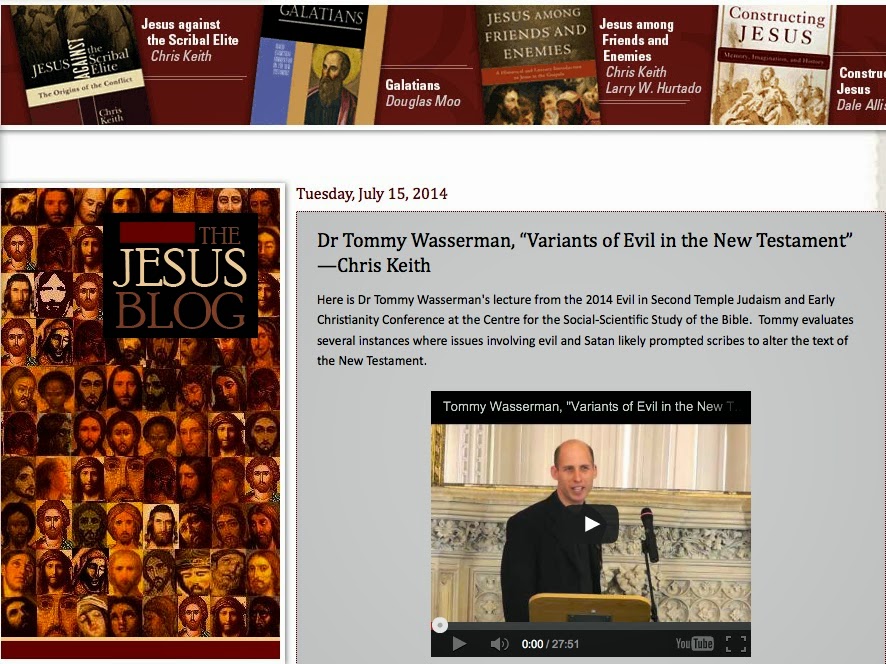
On-line Lecture "Variants of Evil in the NT"

3
Chris Keith (Historical Jesus blog) has uploaded my lecture  "Variants of Evil in the New Testament" from the conference on Evil in Second Temple Judaism and early Christianity. Thanks Chris for organizing this conference!


For my previous report on the conference, see here.


Saturday, April 26, 2014

Live Update from the Pericope of the Adulteress Conference

9
This is a quick live update from Southeastern Baptist Theological Seminar hosting the Pericpoe Adulterae symposium.
Image HT: Jacob Cerone


Right now Jennifer Knust is presenting her paper, "Neither Add Nor Take Away..."(photo by Chris Keith)

You can follow a live twitterstream at @ceronej  hashtag: paconf#

Update: There is liveblogging at www.jacobcerone.com and www.thomashudgins.com (with videoblog).

Second update: David A. Black summarizes the conference.

Friday, February 21, 2014

Pericope Adulterae Conference at Southeastern Baptist Seminary

7
Don't forget this awesome TC conference at Southeastern Baptist seminary coming up in April:

https://www.sebts.edu/news-resources/conferences/pericope_adulterae.aspx

See the prior announcement on ETC here: http://evangelicaltextualcriticism.blogspot.com/2013/11/pericope-adulterae-symposium-at-sebts.html

Friday, November 22, 2013

SBL Supersale on The Epistle of Jude: Its Text and Transmission

5
The Epistle of JudeThe SBL Annual Meeting is at hand. I will fly to Baltimore today. At the meeting (only) Andrew Knapp of Eisenbrauns will run a special sale on my monograph, The Epistle of Jude: Its Text and Transmission. My book is on display and sells for $20 (list price $83). I will gladly sign a copy if you run into me.


The Epistle of Jude
Its Text and Transmission
Coniectanea Biblica New Testament Series - CBNTS 43
by Tommy Wasserman
Almqvist and Wiksell, 2006
xv + 368 pages + XVI plates, English
Paper
ISBN: 9789122021599
List Price: $83..35
Your Price at SBL: $20.00

Extract from Paul Foster's review in ExpT:

"Very few doctoral studies can claim to be magisterial, however, Wasserman’s study rightly deserves such a title. He presents an exhaustive study of the manuscript tradition of the Epistle of Jude. What this means in practice is assembling and collating the readings from 560 Greek manuscripts of this letter. The evidence is drawn from familiar papyrus and uncial texts, but the ground-breaking aspect is the integration of evidence from hundreds of minuscule manuscripts and lectionaries."—Paul Foster, School of Divinity, University of Edinburgh in Expository Times, (2007) 118.

For a full description and extract from more reviews, see here.

Tuesday, November 19, 2013

Pericope Adulterae Symposium at SEBTS

3
Southeastern Baptist Theological Seminary (SEBTS) will host a Pericope Adulterae Symposium in honor of Maurice Robinson in April 25-26 2014 and I am one of the invited speakers. Here is the announcement from the conference webpage:


Scholars have long disagreed about the originality of the text of John 7:53-8:11, which contains the story of the woman caught in adultery. Traditionally known as the Pericope Adulterae, this text has concerned various textual critics as to whether it should be included in the canon of Scripture. Furthermore, Bible translators have debated how to include it in their translations, and pastors have debated whether they should preach it as inspired Scripture. Please join us as we explore these issues with some of the leading scholars in this area. 

Is the woman caught in adultery passage:
  • Original to John's Gospel? Or is it a later interpolation?
  • Should it be proclaimed or proscribed?
These questions will be discussed at Pericope Adulterae.
Join us on April 25 - 26, 2014

The cost will be $30 per person & $20 for students.


Speakers include:
Dr. David Alan Black; Dr. M.O. Owens Jr. Chair of New Testament Studies Professor of New Testament & Greek at Southeastern Baptist Theological Seminary
Dr. Chris Keith; Professor of New Testament & Early Christianity Director of the Centre for the Social-Scientific Study of the Bible at St. Mary’s University College in Twickenham, London
Dr. Jennifer Knust; Assistant Professor of New Testament & Christian Origins School of Theology & the Graduate School of Arts & Sciences, Boston University
Dr. John David Punch; Senior Pastor of City Church Denver
Dr. Maurice Robinson; Senior Professor of New Testament & Greek at Southeastern Baptist Theological Seminary
Dr. Tommy Wasserman; Academic Dean & Lecturer in New Testament at the Örebro School of Theology in Sweden