


The first of seven videos is now up. Watch/read more here.
The first of seven videos is now up. Watch/read more here.
Dwayne Green is a pastor up in Canada who’s been putting out a steady stream of video interviews on textual criticism and Bible translation lately. As a pastor, he’s especially interested in theology and methodology and likes the KJV himself but isn’t KJV-only. He seems genuinely open to views he doesn’t hold and has a lighthearted style about his videos. He’s been nothing but a nice chap in all my interactions with him. So far he’s interviewed Hixson and myself, Dirk Jongkind, Maurice Robinson, Mark Ward, Timothy Berg, Jeff Riddle, James Snapp, and several others. Go check out his YouTube channel. I especially recommend the most recent one with Maurice Robinson if you’ve ever wondered who the Pierpont in Robinson-Pierpont was.

For a while now I have been casually on the lookout for an article in the Emory University Quarterly, and so far I haven’t had access. I searched this morning and found it online: Ernest Cadman Colwell, “An Ancient Text of the Gospel of Mark,” (Emory University Quarterly 1.2 [1945]: 65–75).
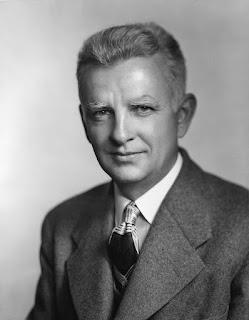 |
| E.C. Colwell Credit: University of Chicago Photographic Archive, [apf1-01777] Hanna Holborn Gray Special Collections Research Center University of Chicago Library. |
The script of the manuscript is more than unusual; it is unique, The scribe of the Chicago Mark had several habits to which we cannot find parallels anywhere, and others to which no parallel exists in Greek manuscripts. He divides his text into words and even puts periods after abbreviations. These actions seem entirely normal to the twentieth-century American, but were unknown in the Greek manuscript tradition. Out of seventy-seven manuscripts photographed by W. H. P. Hatch on Mount Sinai, only one has word division, and it has other elements which suggest that it may be copied from the Greek text of a bilingual. In the large collection at Jerusalem, two manuscripts have word division, and both were written in the eighteenth century. [p. 68; emphasis mine]
That being said, do enjoy the article if you have a few minutes and haven’t seen it before.
 |
| Hixson reading Burgon as a youth. Credit |
With the permission of Maurice Robinson, I am making available one of Pierpont’s unpublished papers, an evaluation of E.F. Hills’ defense of the textus receptus. Some formatting may have changed a bit, but I include here both text (to make it searchable) and images of the paper itself (for transparency).
a) the autographs of the NT were Divinely inspired, and therefore infallible, and thatb) because of this God must see that they were providentially preserved. (The logic for this step rests on Mt. 5:17+, 24:35, etc.)
1) The purpose of PP is to preserve the infallibility of the autographic text, and that God must have done so in a public way, i.e., so that all may know where and what it is-- not hidden somewhere among the MSS and requiring to be searched out.2) It is the Greek text which is thus preserved, not a translated version of it. (God never promised that a translation would be kept free of errors, great or small.) Further, there may not be competing authorities.3) During the long centuries of hand copying, PP operated through the Greek-speaking Christian community, who understood and used the language.4) PP operated through the testimony of the Holy Spirit: only through Bible-believing universal Christian preiesthood [sic], those who have taken a supernatural view of the text, applying to it standards of judgment directed by the Holy Spirit, and were thus enabled to distinguish the true from the false. This was not only through the Spirit’s testimony to the individual’s soul, but also in the collective priesthood of believers through the ages (continuing onward into the Protestant period). Thus errors entering were weeded out by Divine Providence and guidance.5) From the very first, PP supplied a multitude of trustworthy copies which were read and recopied, while faulty and untrustworthy ones fell out of use and passed into oblivion. Thus the genuine text was kept safe in the vast majority of MSS.6) Thus the consensus agreement of this vast majority of copies forms the Traditional Text (TT), which accurately represents the originals and is the Standard Text.
The other day I was looking at the textual variation in 1 Peter 5:7 between ἐπιρίψαντες an ἐπιρίψατε: “... casting/cast all your anxieties on him, because he cares for you.”
Now if one compares the
apparatus of NA28 to NA27, the likely attestation of επιριψατε – (the
imperative like in 1175 and Augustine) in 0206 has been removed from the apparatus. Apparently, in the ECM of 1 Peter, 0206 is cited for either επιριψατε/επιρριψατε.

I was very surprised to learn that 0206, a fourth-century uncial (which may be dated even earlier, as proposed by Don Barker who thinks that it may be as early as the late second century) is not included in NA28. As the apparatus stands now, minuscule 1175 is the only attesting Greek witness. In my opinion, it is significant that 0206 almost certainly support this reading (seventh line in the image below where you see -ΨΑΤΕΕΠΑΥ). I hope it will be reinstated in NA29!
