Tuesday, October 07, 2014

Early image of Christ holding a book

2
The BBC reports the find of a glass plate in Spain (here). It mentions a 4th century date for this artefact, which may be true or not. The reconstruction is interesting:


The central figure holding the cross is in all likelihood a depiction of Christ, while the two others I would take as the angels present at the resurrection, not unlike the Gospel of Peter. What is interesting though, is that Christ holds a small codex in his hand, while both companions each seem to hold a scroll.

Monday, October 06, 2014

Keith Elliott Festschrift

0
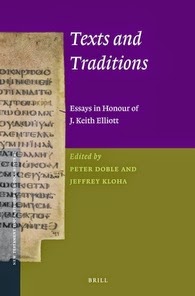
Texts and Traditions: Essays in Honour of J Keith Elliott (ed. J. Kloha & P. Doble; NTTSD 47; Leiden: Brill, 2014),
http://www.brill.com/products/book/texts-and-traditionsThe methodology of New Testament textual criticism, the critical evaluation of readings, and the history and texts of early Christianity is the focus of the influential work of J. K. Elliott. Readings in Early Christianity: Texts and Traditions offers eighteen essays in his honour. The essays, by colleagues and students from his long career, reflect Elliott's wide interest and impact. From questions of the purpose and practice of textual criticism, to detailed assessment of New Testament literature and the readings of its manuscripts, to provocative studies of the reception of Jesus and the New Testament in the second century, this volume will be of value to those studying the New Testament and Early Christianity.

Table of contents

  • Michael W. Holmes, When Criteria Conflict
  • D. C. Parker, Variants and Variance
  • Eldon Jay Epp, In the Beginning Was the New Testament Text, But Which Text? A Consideration of ‘Ausgangstext’ and ‘Initial Text’*
  • Jenny Read-Heimerdinger, Eclecticism and the Book of Acts
  • James A. Kelhoffer, Hapless Disciples and Exemplary Minor Characters in the Gospel of Mark: The Exhortation to Cross-bearing as both Encouragement and Warning
  • James W. Voelz, The Characteristics of the Greek of St. Mark’s Gospel
  • Tjitze Baarda, The Syro-Sinaitic Palimpsest and Ephraem Syrus in Luke 2:36-38 and 1:6
  • Peter Doble, Codex Bezae and Luke 3:22: A Contribution to Discussion
  • Jeffrey Kloha, Elizabeth’s Magnificat (Luke 1:46)
  • H. A. G. Houghton, A Flock of Synonyms? John 21:15-17 in Greek and Latin Tradition
  • L. W. Hurtado, Textual Ambiguity and Textual Variants in Acts of the Apostles
  • Holger Strutwolf, Urtext oder frühe Korruption? Einige Beispiele aus der Apostelgeschichte
  • J. Lionel North, 1 Corinthians 8:6: From Confession to Paul to Creed to Paul
  • Peter M. Head, Tychicus and the Colossian Christians: A Reconsideration of the Text of Colossians 4:8
  • David R. Cartlidge, How to Draw an Immaculate Conception: Protevangelium of James 11-12 in Early Christian Art
  • Paul Foster, The Education of Jesus in the Infancy Gospel of Thomas
  • Denise Rouger et Christian-B. Amphoux, Le projet littéraire d’Ignace d’Antioche dans sa Lettre aux Ephésiens
  • William J. Elliott, How to Change a Continuous Text Manuscript into a Lectionary Text
  • Bibliography J. K. Elliott

Sunday, October 05, 2014

Saturday, October 04, 2014

Hawarden Seminar on the OT in the NT

0
Since the study of the OT in the NT often (always?) depends on the study of the particular text forms involved, and because I have fond memories of attending some of these conferences years back, I include this note here:

The Annual (Hawarden) Seminar on the OT in the NT The 2015 Annual Seminar on the Use of the OT in the NT will be held at Gladstone's Library Hawarden (http://www.gladstoneslibrary.org/) from the evening of Wednesday 25th to lunch time on Friday 27th March 2015. This is an opportunity for all those working in this field to come together to share papers, hear about any new developments and publications, and to network informally. Both established scholars and PhD students are very welcome, but places are limited to approx. 20.

If you wish to participate in this year's seminar, please contact the booking office at Gladstone's Library directly to book your room by telephone on 01244 532350 or by email to enquiries@glad.lib.org>; please note that you cannot reserve your place via the online booking system, as we have made a group booking. Please let the staff know when booking that you are part of the OT in the NT Seminar group, so that they can allocate you to one of the group's reserved rooms. The overall cost will be in the region of £175, depending on what "extras" you opt for (e.g. ensuite bathroom), and a small deposit will be required at the booking stage. When you have booked, please also email the seminar convenor, Susan Docherty on S.E.Docherty@newman.ac.uk> in order to be added to the confirmed list of participants.

Offers of papers are welcome, so please send the proposed title and a short abstract by 10th December 2014 to S.E.Docherty@newman.ac.uk>. There is no one overall theme to this year's conference, so all abstracts which relate to the general field of the OT in the NT will be considered. Proposers will be informed whether or not their paper has been selected in mid-January, and further details of the timings and running order will be provided then.

Friday, October 03, 2014

A Newly Published Byzantine Greek Lexicon

2
There is a helpful review at BMCR of a newly published Byzantine Greek lexicon:

Eva Villani, Il lessico Ambrosiano inedito ΑΝΤΙΧΕΙΡ (C 222 inf., ff. 207r-208v).   Milano:  EDUCatt, 2014.  Pp. 248.  ISBN 9788867800865.  €15.00 (pb).

The review (by Eleanor Dickey), includes translations of some entries which offer unparalleled new definitions, and this includes a couple of biblical words (here I am selecting from and quoting the review):


 Φ 5: φαρὲς τὸ καθαρὸν ἑβραϊκὴ λέξις, ἤγουν τὸ ἀφωρισμένον τῷ θεῷ, ἐξ οὗ καὶ φαρισαῖος ἓν σίγμα·
‘Φαρές (means) ‘pure’ (and is) a Hebrew word, or rather (it means) something set apart for God, whence (comes) φαρισαῖος (‘Pharisee’) with one sigma.’ [The point about Hebrew is correct, for the root of ‘Pharisee’ is פרש ‘set apart’.]
  ...
 Σ 22: σμίλαξ εἶδος δένδρου καὶ κλί(νεται) τῆς σμίλακος·
‘Σμίλαξ (is) a kind of tree, and it is declined in the genitive σμίλακος, feminine.’ [The scribe originally wrote εἶδος βοτάνης ‘a kind of plant’ and then corrected it to ‘tree’. The correction is interesting because LSJ gives four meanings for σμῖλαξ (accented thus in LSJ; Villani’s accent probably goes back to the manuscript, which has accents), of which two are trees and two other kinds of plant: holm-oak, yew tree, kidney bean, and bindweed.]
 ...
Τ 7: τύχην τινὲς ἐπὶ τῶν εὐτελῶν πραγμάτων λέγουσιν, ἐξ οὗ εὐτυχῆ καὶ δυστυχῆ σκυτοτόμον καλοῦσι, καὶ οἰκοδόμον, τινὲς δὲ ἐπὶ τῶν μεγάλων ἀξιωμάτων τάσσουσι ταύτην· πανευτυχεστάτους καλοῦντες καίσαρας καὶ σεβαστοκράτορας, δοξάζουσι δὲ πάλιν ἄλλως ἕτεροι τὴν τύχην, τύχην καλοῦντες καὶ αὐτόματον περὶ τὰ ἀνθρώπινα πράγματα, εἰσὶ δὲ οὗτοι τῶν παλαιῶν φιλοσόφων·
‘Some people use τύχη (‘fortune’) for cheap things, whence they call a cobbler or a builder ‘fortunate’ or ‘unfortunate’, but others apply this word to great honours, calling emperors ‘most all-fortunate’. And others again think differently about ‘fortune’, calling ‘fortune’ (something that happens by) chance in human affairs, and these people are among the old philosophers.’ 
...
Σ 51: στέλεχος ὁ φλοιός, κυρίως δὲ ἡ ῥίζα τοῦ δένδρου·
‘Στέλεχος (is) the bark, but properly the root of a tree.’ [LSJ defines στέλεχος as ‘crown of the root, whence the stem or trunk springs’.]
 ...
Σ 39: σπεκουλάτωρ ὁ στρατιώτης ὁ βαστάζων ξίφος καὶ ἀποκεφαλίζων·
‘Σπεκουλάτωρ (is) the soldier who bears a sword and beheads.’ [LSJ gives among other meanings of σπεκουλάτωρ ‘one of the principales or head-quarters’ staff of a legionary commander or provincial governor (whose duties included the carrying out of executions).’] 

NB Dickey's closing comment: "In short, this work is good and useful and provides scholars with the rare opportunity to explore a previously unknown text containing a significant amount of ancient material; it would be lovely if there were more dissertations of this type."

Wednesday, October 01, 2014

Bible Odyssey Featuring "Alexandrian Text" and "Early Versions"

4
A year ago or so I was invited to contribute to SBL's project Bible Odyssey which was launched about two months ago. I was told that this week my article on the "Alexandrian Text" is highlighted on the Bible Oddysey home page, together with an article on  "The Earliest Versions and Translations of the Bible" by Brennan Breed and a timeline of "The History of the English Bible" and a newly added videoclip on Early Christian Martyrdom featuring Candida Moss.


Just a week ago, John Kutsko of the SBL sent out a report about the two first months of the website, and it turns out that "People are very interested in ... 'life in first century Galilee' and 'how the Hebrew Bible relates to the ancient Near East,' as well as 'the binding of Isaac' and 'the woman caught in adultery.'” The last entry is written by my friend Jennifer Knust and we have worked a lot together on this topic for some years now. There is a related video clip in which Amy Jill Levine discusses the pericope adulterae, and another entry on the manuscript history of the passage (John 8:1-11) by another friend of mine, Chris Keith. Earlier this year, Chris, Jennifer and I contributed to a conference at SEBTS, the Pericope Adulterae symposium.

Kutsko continues his report on the Bible Odyssey webpage saying that many visitors come from North America and Europe, but that there is also strong traffic from Australia, Malaysia, New Zealand, and Israel. Personally, Kutsko thinks the "Ask the Scholar" button (see the magnifying glass on the image above, or go here) is the coolest of all. Here they have received questions such as:
  • Why does God speak in the plural in Genesis?
  • Was John the Baptist an Essene?
  • How many scholars believe that Q existed as a source for Matthew and Luke?
  • Has the biblical figure of Satan evolved?
  • Why is ‘almah in Proverbs 30:19 translated differently?
  • How does domestic architecture vary in the Second Temple period?