Showing posts with label palimpsest. Show all posts

Thursday, February 13, 2025

An Excellent (Relatively) New Book on Palimpsests

0

I've been rather quiet over the past few years, due to the arduous (and occasionally enjoyable) task of editing the ECM Revelation, which was finally  published last year. Another little project I've been working on for longer than I care to admit is an edition of the Greek biblical texts in Codex Climaci Rescriptus.

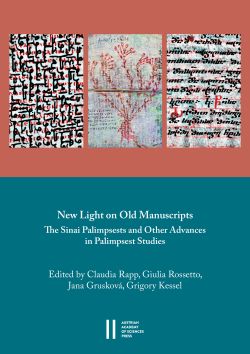
Always trying to keep up with the secondary literature, I was very happy to stumble across a fantastic volume edited by Claudia Rapp and her colleagues at the University of Vienna/Austrian Academy of Sciences entitled New Light on Old Manuscripts: The Sinai Palimpsests and Other Advances in Palimpsest Studies. The good folks at the AAS have an excellent track record in palimpsest research, and they are collaborating with some of the imaging scientists with whom my CCR colleagues and I have had the pleasure of working (most notably Roger Easton and Keith Knox). Anyway, the book is divided into five main sections, namely 'Saint Catherine’s Monastery and Its Palimpsests', 'Palimpsests and Their Contexts', 'Palimpsests and Their Contents', 'Imaging and Processing Methods', 'Management and Display'. The 32 (!) essays in the volume are full of interesting information on all aspects of palimpsest work, and their relevance extends far beyond the Sinai palimpsests. I was particularly pleased to see the chapters on the arcana of image processing, making it more accessible to the more technically ignorant, mono-dimensional philologists such as yours truly. 

And, best of all, the entire book is available via Open Access, so tollite, legite without delay! 
Friday, October 20, 2023

New book on Sinai Palimpsests (Open Access)

0

A very interesting new book has just been published by the Austrian Academy of Sciences (and is available on Open Access): 


Claudia RAPP - Giulia ROSSETTO - Jana GRUSKOVÁ - Grigory KESSEL (Eds.), New Light on Old Manuscripts: The Sinai Palimpsests and Other Advances in Palimpsest Studies (link here)

The English abstract: 

The study of palimpsest manuscripts has a long tradition and has led to spectacular discoveries of new texts or new text versions. Recent decades have seen the development of advanced nondestructive methods of multispectral imaging and computer-based image processing. The focus of such research have been individual manuscripts, such as the Archimedes palimpsest that was studied in Baltimore, or the Dexippus fragments in Vienna. The Sinai Palimpsests Project broke new ground by studying for the first time a collection of palimpsest manuscripts that have been preserved for centuries in the library of the Monastery of Saint Catherine in the Sinai (Egypt). The erased layers preserve texts in eleven languages of the Christian Orient. An international team of scholars has identified numerous new texts or versions of texts, often in very early scripts. This volume has its origin in a conference that was held in Vienna in 2018, where these results of the Sinai Palimpsests Project were presented, along with the advances in image capture and image processing that have made them possible. Additional contributions about current projects in the study of palimpsests, also including Jewish and Muslim text traditions, place the study of palimpsest manuscripts within the larger context of the cultural history of the middle ages. The 30 contributions in this volume thus offer a cross-section, including the most recent technologies, of the current state of research in palimpsest studies.

Wednesday, March 01, 2023

TC Journal vol. 27 (2022) Is Out

2

I have the pleasure to announce that vol. 27 (2022) of TC: A Journal of Biblical Textual Criticism is finally published after some delay. A number of reviews will be added soon, but we could not wait to get these articles out. In the previous blogpost, Peter announced a book about the Greek palimpsests at St Catherine's Monastery. Incidentally, in this volume of TC, my student Conrad Elmelund has produced an editio princeps of one of those palimpsests – Greek NF MG 99 (GA 0289), presumably from the fifth century. Do I need to say that I am proud?

 Below I paste the contents and links:

Volume 27 (2022)

Articles

Timo Tekoniemi, The Position of Old Latin Manuscript La115 in the Textual History of 2 Kings: Identifying kaige and (Proto-)Lucianic Readings in a kaige Section (pp. 1–15)

Abstract: The value of Old Latin witnesses in the textual criticism of Septuagint has been lately noted by a growing number of scholars. As a daughter version of the Septuagint, the Old Latin is an important witness to the textual history of the Septuagint, as well as to the Hebrew Vorlage behind it. This article seeks to elucidate and ascertain the text-historical position of the fifth century Old Latin manuscript Palimpsestus Vindobonensis (La115) in 2 Kings. This task is carried out by first mapping all the characteristic readings of the manuscript (248 cases in total) and then by studying fourteen most illuminating readings. In 2 Kings, the manuscript seems to be free of Hexaplaric and Vulgate influence and most probably also of kaige readings. There are few, if any, recensional Lucianic readings. For the most part, the text of La115 belongs to the proto-Lucianic layer and therefore mostly seems to preserve the Old Greek text—sometimes even when all preserved Greek witnesses have lost these Old Greek readings. La115 is thus argued to be an exceedingly important witness to the textual evolution of 2 Kings.

Leonardo Pessoa da Silva Pinto, The CBGM and Lachmannian Textual Criticism (pp. 17–31)

Abstract: The discipline of New Testament textual criticism has changed considerably in the last few decades. Among the most relevant developments is the Coherence-Based Genealogical Method, which, however, is often unknown to or misunderstood by textual scholars of both biblical and nonbiblical literature. This article explains the main concepts of the CBGM and compares them with the core principles of (Neo-)Lachmannian textual criticism. The comparison shows how deeply many steps and concepts of the CBGM are rooted in the traditional methods of textual criticism, the Lachmannian method in particular, but also the many differences in its procedures and terminology. Many of these changes result from the effort of integrating the potential of the computer tools now available to the discipline.

Katrin Maria Landefeld, Die textgeschichtliche Verbindung zwischen Codex Bezae (05) und dem Handschriftenpaar 08/1884 in Acta (pp. 33–49)

Abstract: The so-called Western tradition in the text of Acts is a much-discussed topic in New Testament Textual Research. There is still no agreement concerning possible theological tendencies in the text and the analysis of the transmission of this text is not completed. Present research uses the Coherence-Based Genealogical Method (CBGM) of the Institut für Neutestamentliche Textforschung in Münster. By measuring quantitative agreement between manuscripts and building local stemmata for variation-units, potential ancestors and descendants for manuscript texts can be found. This is more difficult with texts of the Western tradition. They often contain long insertions and these differ among the manuscripts of this tradition as well. So, the agreement rates between these manuscripts and others, and also among themselves, are quite low. Although these manuscripts have different wording, they are probably connected in the transmission of the text. This can be seen with the help of internal criteria. This essay will study variants in the manuscripts 05, 08, and 1884 and show that they most probably have a genealogical connection despite several textual differences. The discussed variants show the same insertions with regard to content and only show different wording or grammatical phrasing. By studying these, a possible chronological order of the variants can also be assumed. This can also be useful to assess other variation-units, as an example will show. The study shows that further analyses of this kind can help to clarify the transmission of the Western text and also make it visible in the CBGM.

Conrad T. Elmelund, The Undertext of Greek NF MG 99 from Sinai (GA 0289) (pp. 51–68)

Abstract: Despite having been included in critical editions since NA27, an edition with the full text of Sinai Greek NF MG/ΜΓ 99 (GA 0289) has not been published until now. The Greek undertext of the palimpsest, written in biblical majuscule, was provisionally dated in the Kurzgefaßte Liste to VII/VIII (600–799 CE) but has now been redated by Guglielmo Cavallo to the fifth century. The present edition, based on new multispectral images of the damaged palimpsest, not only corrects readings included in the NA28-apparatus but also brings to light and discusses a significant number of new readings that should be considered for inclusion in future editions.

Paul A. Himes, Lectio difficilior potior and an Aramaic Pun—Βεώρ vs. Βοσόρ in 2 Peter 2:15 as a Test Case for How a Classic Rule Might Be Refined (pp. 69–83)

Abstract: Lectio difficilior potior (“prefer the more difficult reading”), while still in use in recent scholarship, has been criticized for being overly subjective and of relatively little value as a canon of internal criteria. These criticisms have not been adequately addressed. Yet 2 Pet 2:15 provides a fertile testing ground for the refinement of this rule absent text-critical bias. Since every single current edition of the Greek New Testament, and almost all commentators, agree with Βοσόρ due to overwhelming external support, the rule is not needed to prove the superior reading of Βοσόρ. Rather, the near-universal agreement on the reading gives us an opportunity to develop a methodology for determining whether or not Βοσόρ is the lectio difficilior compared to Βεώρ, a methodology that would hopefully be free from bias. This methodology, which draws from Brooke Foss Westcott and Fenton John Anthony Hort’s distinction between “real and apparent excellence,” could then assist in rehabilitating lectio difficilior potior as a helpful, if secondary, principle in textual matters.

Note

Elvira Martín-Contreras, How to Deal with Annotations by Different Scribes When Studying and Editing the Masorah (pp. 85–92)

Abstract: This article tackles the problem posed by presence of annotations written by different scribal hands when studying and editing the masorah. What should we do? Should we ignore the differences between the annotations and merely focus on their content? Starting with a review of how second hands and other paleographic features have been treated in the most recent editions of the masorah from the Leningrad B19a codex, a step-by-step guide on how to include paleographic and other material aspects in the study of the masorah in critical editions (in particular in the Biblia Hebraica Quinta) is presented.


Tuesday, February 28, 2023

New Book on Greek Palimpsests at Saint Catherine’s

1

An email informs me of a new, open-access book that will be of interest to readers here. It’s called Greek Palimpsests at Saint Catherine’s Monastery (Sinai): Three Euchologia as Case Studies. The author is Giulia Rossetto. You can read it online here

The Monastery of Saint Catherine in the Sinai peninsula preserves one of the largest collections of manuscripts in the world, which include a significant number of palimpsest manuscripts (over 170). This book deals with Saint Catherine’s palimpsests in Greek language and offers their first-ever inventory. Three selected cases studies are then extensively described in order to showcase the richness and heterogenity of Sinai palimpsest books.

Tuesday, July 09, 2019

Batovici on L2484 (Trinity Cambridge MS O.9.27)

0

Dan Batovici, ‘Digital Palimpsests: Mark in Trinity College Cambridge MS. O.9.27’ Open Theology 5 (2019).

Abstract: The O.9.27 manuscript of Trinity College Cambridge is a minuscule manuscript of Hesiod’s Opera et Dies. In a 2001 PhD thesis on Greek palimpsests in Cambridge by Natalie Tchernetska, this manuscript is described to contain two distinct lower scripts, one of which identified as a New Testament text. The author read four lines and a partial fifth of the one-leaf palimpsest that contain Mark 1:44, which is remarkable considering that the washing made the lower script virtually the same colour as the page. This note re-examines the Markan lower script in O.9.27 and offers an account of the use of image processing software for the purpose to uncover more text in a difficult palimpsest, a method useful when MSI is not available.

Monday, February 19, 2018

What was the Hexapla?

7
What was the Hexapla? There is the question of what were the readings that were at one time in the Hexapla as presented herehere, and here. Then, there is the question of what was the Hexapla? We have to ask this question because it was not transmitted much (if at all), and there is no manuscript to date that we can point to and say, “that’s the Hexapla.” This is one of the saddest truths of literary history. Furthermore, these questions do not answer “Why the Hexapla?” or “How the Hexapla“, which are also interesting questions.

Quick Description

Now, the quick answer is that the Hexapla was Origen’s (ca. 185-254) six-columned synopsis containing the following versions of the Hebrew Bible/Old Testament: (1) the Hebrew text in Hebrew letters, (2) the Hebrew text in Greek letters, i.e., in Greek transliteration, (3) the Greek version of Aquila, (4) the Greek version of Symmachus, (5) the Greek version of the Seventy, and (6) the Greek version of Theodotion. So far this description matches the early patristic descriptions of Eusebius and Epiphanius of Salamis (who also say that for some books like Psalms, Origen had a Fifth and a Sixth edition; read about them here). Eusebius says:
Having collected all of these [Greek versions], he divided them into sections, and placed them opposite each other, with the indication (σημείωσις) itself of Hebrew [Ἑβραίων pl.] [versions?]. He thus left us the copies (ἀντίγραφον) of the so-called Hexapla, having arranged separately the edition (ἔκδοσις) of Aquila and Symmachus and Theodotion with the edition of the Seventy in the Tetrapla (Hist. eccl. 6.16.4; ANFP [adapted]).
The term σημείωσις “indication, inference from a sign” is an interesting way to describe a “text,” but perhaps this term indicates the Hebrew versions in Columns 1 and 2; that is, the Hebrew and its inference, meaning its sense or meaning in transliteration. Since he calls this work “the Hexapla“ and there are four Greek versions, he must envision the very “inference” of Hebrews as two texts. Now, there are two problems we should address.

Tuesday, January 25, 2011

L2451: A New Early Lectionary Palimpsest

3
Wieland Willker has recently posted an extensive description including images (2,5MB) of an early fragmentary lectionary (8th cent.) found in his hometown Bremen, which ETC-blogger Dirk Jongkind had drawn his attention to – life is full of surprises.

The MS was first described by Klaus Alpers, of Hamburg: "Ein Handschriftenfund zum Cyrill-Glossar in der Staats- und Universitätsbibliothek Bremen" in Lexicographica Byzantina: Beiträge zum Symposion zur byzantinischen Lexikographie (Wien, 1.-4.3.1989), Vienna: Österreichischen Akademie der Wissenschaften, 1991), 11-52.

The lectionary, Codex Bremensis Manuscripta c. 11, contains the following texts: John 18:18-28; Mark 1:2-3, 5, 7-8; and John 20:4-15. It has recently been assigned a Gregory-Aland number by the INTF, L2451.

So, look around in your own town, there may be some old Greek New Testament MS around somewhere, unknown to the text-critical world.

And, I wonder how Dirk found out about it? Did he stumble upon Alpers' description?