Showing posts with label Barbara Aland. Show all posts

Tuesday, August 27, 2019

The Textual Optimism of the UBS4

2
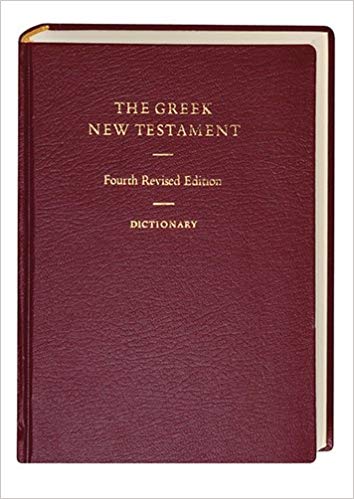
The grading system for variants in the UBS editions is probably its most distinctive feature. These ratings rank from A to D and indicate the relative level of certainty the editors felt in their decision (A being the most confident). I suspect this system has been a help to many translators over the years. For myself, the system is a rare and welcome peek behind the editorial curtain to one of our most important (and bestselling?) editions.

Over time, however, there is a noticeable and well-documented shift in these ratings without any additional explanation or justification. For example, the reading of Eph 5.22 is given a C in the UBS3 and a B in UBS4, but the textual commentary for this decision remains word-for-word the same. Kent Clarke called this “textual optimism” and his work on this is well worth consulting. (See the helpful summary from Mark Ward here.)

What I didn’t realize until today is that several of the editors owned up to this “textual optimism” and wrote about it even before the UBS4 was in print. Kurt and Barbara Aland say as much in their Text of the New Testament. On p. 45, they write about the UBS3 that “The only question is whether the editors have not been too cautious in applying the classifications, so that a B should often be replaced by an A, a C by a B, and a D by a C (a thorough reexamination has led to a revision of these for the fourth edition of GNT).” It does lead one to wonder how much responsibility for the increased textual optimism is the responsibility of the Alands.

Monday, July 18, 2011

Barbara Aland Receives Order of Merit

4
The former director of the Institut für neutestamentliche Textforschung in Münster, Professor Barbara Aland has been awarded a German order of merit, "Bundesverdienstkreuz am Bande" (equivalent to the Knight's Cross) by Bundespräsident Christian Wulff, specifically for her work on the New Testament text.

She received the order from the hands of Regierungspräsident Dr. Gerd Bollerman in a special ceremony last week.

Pressrealese from University of Münster

Report by Deutche Bibelgesellschaft

Report by Evangelisch in Westfalen

HT: Jim West

Saturday, July 09, 2011

Mark and Matthew I. Comparative Readings: Understanding the Earliest Gospels in their First Century Settings

2
Mark and Matthew I. Comparative Readings: Understanding the Earliest Gospels in their First Century Settings, edited by Eve-Marie Becker and Anders Runesson forthcoming in the WUNT series (Mohr-Siebeck) will be published in August. The volume of essays brings together the contributions to the first conference held in Århus, reported on here, here and here. Of particular interest to readers of this blog will be the essays on textual criticism by Barbara Aland, "Was heißt Abschreiben? Neue Entwicklungen in der Textkritik und ihre Konsequenzen für die Überlieferungsgeschichte der frühesten christlichen Verkündigung," and Tommy Wasserman, "The Implications of Textual Criticism for Understanding the ‘Original Text’."

Publisher's description:
The study of Mark and Matthew from a comparative perspective has a long history. Ever since the theory of Markan priority became firmly established in the 19th century however, many studies, especially commentaries on either Mark or Matthew, make observations related primarily to one of the Gospels only. Thus the most frequent result of studying Mark and Matthew is that one Gospel is overshadowed by the other. This collection of papers employs a sustained multiperspectival comparative approach which contributes simultaneously to the synoptic problem discourse and sheds light on the individual Gospels in their first century setting(s), a procedure that reveals new questions and discoveries. This highlights new aspects of the Gospels which are critical for our understanding of the rise and development of Gospel literature in the first century C.E.

Contributors:
Barbara Aland , David E. Aune , Wayne Baxter , Eve-Marie Becker, Cilliers Breytenbach , Warren Carter , Sean Freyne , Morten Hørning Jensen , John S. Kloppenborg , Stanley E. Porter , Anders Runesson , David C. Sim , Lorenzo Scornaienchi , Tommy Wasserman , Oda Wischmeyer , Adela Yarbro Collins , Linden Youngquist


Survey of contents:
Eve-Marie Becker and Anders Runesson : Introduction: Studying Mark and Matthew in Comparative Perspective
1. History of Research
Cilliers Breytenbach : Current Research on the Gospel according to Mark: A Report on Monographs Published from 2000-2009 - David C. Sim : Matthew: The Current State of Research

2. Reconstructing the Artifacts: Text-Critical and Linguistic Aspects of the Study of Mark and Matthew
Barbara Aland : Was heißt Abschreiben? Neue Entwicklungen in der Textkritik und ihre Konsequenzen für die Überlieferungsgeschichte der frühesten christlichen Verkündigung - Tommy Wasserman : The Implications of Textual Criticism for Understanding the ‘Original Text’ - Stanley E. Porter : Matthew and Mark: The Contribution of Recent Linguistic Thought

3. Date and Genre
Eve-Marie Becker : Dating Mark and Matthew as Ancient Literature - David E. Aune : Genre Theory and the Genre-Function of Mark and Matthew

4. Socio-Religious Location
Sean Freyne : Matthew and Mark: The Jewish Contexts - Morten Hørning Jensen : Conflicting Calls? Family and Discipleship in Mark & Matthew in the Light of First-Century Galilean Village Life - Linden Youngquist : Matthew, Mark and Q - Wayne Baxter : Matthew, Mark, and the Shepherd Metaphor: Similarities, Differences, and Implications

5. Conflict and Violence
Warren Carter : Matthew: Empire, Synagogues, and Horizontal Violence - Lorenzo Scornaienchi : The Controversy Dialogues and the Polemic in Mark and Matthew - John S. Kloppenborg : The Representation of Violence in Synoptic Parables

6. Building Community Using Text
Oda Wischmeyer : Forming Identity Through Literature: The Impact of Mark for the Building of Christ-Believing Communities in the Second Half of the First Century C. E. - Anders Runesson : Building Matthean Communities: The Politics of Textualization

7. Notes from the Conference: Further Discussion
Adela Yarbro Collins : Reflections on the Conference at the University of Aarhus, July 25-27, 2008


Link to publisher's description.

Thursday, January 21, 2010

Translating the New Testament

10

Eerdmans has a new book out (HT: Ekaterini G. Tsalampouni):

Stanley E. Porter / Mark J. Boda (eds.), Translating the New Testament: Text, Translation, Theology (McMaster New Testament Studies), Eerdmans 2009. ISBN: 978-0-8028-6377-5.

You can order the book from Eisenbrauns here.

The contributions come from the 2005 Bingham Colloquium Lectures at McMaster Divinity School, with the same title “Translating the New Testament: Text, Translation, Theology.” I think it is great that this material has finally been published. In my monograph on Jude from 2006 (p. 256 n. 77) I actually referred to Robinson’s essay “Rule 9” as forthcoming 2007. I suppose the editors had to wait for a long time for one or more contributors to get their work done.

In any case, there is a lot of textual criticism in this book, several contributions by co-blogger Maurice Robinson, and Barbara Aland and Philip Comfort. I wish I had been there to listen to the debate between Robinson and Aland over NA27.

Barbara Aland, “New Testament textual research, its methods and its goals”, 13-26

Maurice A. Robinson, “Rule 9, isolated variants, and the “test-tube” nature of the NA27/UBS4 text : a Byzantine-priority perspective”, 27-61

Philip W. Comfort, “The significance of the papyri in revising the New Testament Greek text and English translations”, 62-89

Barbara Aland, “The text of Luke 16”, 93-95

Maurice A. Robinson, “The rich man and Lazarus - Luke 16:19-31 : text-critical notes”, 96-110

Philip W. Comfort, “Two illustrations of scribal gap filling in Luke 16:19”, 111-113

And the summary chapter: Richard N. Longenecker, “Quo vadis? : from whence to where in New Testament text criticism and translation”, 327-346