Showing posts with label Textual Optimism. Show all posts

Tuesday, August 27, 2019

The Textual Optimism of the UBS4

2
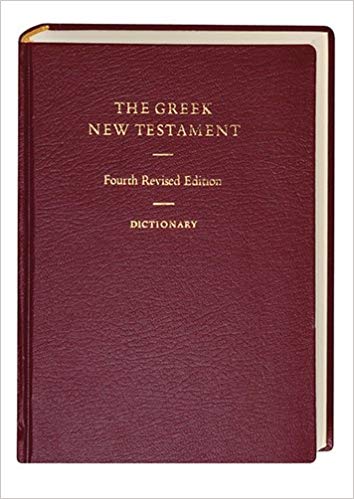
The grading system for variants in the UBS editions is probably its most distinctive feature. These ratings rank from A to D and indicate the relative level of certainty the editors felt in their decision (A being the most confident). I suspect this system has been a help to many translators over the years. For myself, the system is a rare and welcome peek behind the editorial curtain to one of our most important (and bestselling?) editions.

Over time, however, there is a noticeable and well-documented shift in these ratings without any additional explanation or justification. For example, the reading of Eph 5.22 is given a C in the UBS3 and a B in UBS4, but the textual commentary for this decision remains word-for-word the same. Kent Clarke called this “textual optimism” and his work on this is well worth consulting. (See the helpful summary from Mark Ward here.)

What I didn’t realize until today is that several of the editors owned up to this “textual optimism” and wrote about it even before the UBS4 was in print. Kurt and Barbara Aland say as much in their Text of the New Testament. On p. 45, they write about the UBS3 that “The only question is whether the editors have not been too cautious in applying the classifications, so that a B should often be replaced by an A, a C by a B, and a D by a C (a thorough reexamination has led to a revision of these for the fourth edition of GNT).” It does lead one to wonder how much responsibility for the increased textual optimism is the responsibility of the Alands.

Friday, April 20, 2018

Who said it?

14
It’s time for another round of everyone’s favorite game: “who said it?” Now, the invention of Google books has significantly diminished the challenge of this game, but it is best not to spoil it that way.
The point is that we have so many manuscripts of the NT and that these manuscripts contain so many variant readings that surely the original reading in every case is somewhere present in our vast store of material. ... We have, therefore, a genuine embarrassment of riches in the quantity of manuscripts that we possess, and this accounts, on the one hand, for the optimism in the discipline and for the promise of solid results.
So, who said it? 

Wednesday, September 07, 2016

In Praise of Westcott and Hort’s Uncertainty

7
It’s not uncommon today to read criticisms of past textual scholars for their overconfidence. First among the guilty in this regard is often Westcott and Hort who titled their edition The New Testament in the Original Greek. Eldon Epp recently referred to this title as “arrogant” and one that, along with their term “Neutral” text were “soon considered overstatements and have been abandoned.”*

Of course, Westcott and Hort did not think they could always attain the original Greek text of the NT and this fact explains many of their marginal readings, especially those discussed in the Appendix.

What I find interesting is that the charge of overconfidence seems to be of recent vintage. Closer to their own time, the much maligned editors were actually praised on occasion for their hesitance and uncertainty about attaining the original text. Here is Edward A. Hutton, for example, writing in 1911:
Our final text must therefore often be difficult of determination, and here Drs Westcott and Hort have shown their wisdom in giving a much larger number of alternative readings than any other critic, and thus better representing the present state of New Testament criticism. In other words, while the principles of criticism are satisfactory enough, the paucity of authorities makes it unsafe to be too confident in all cases. Hesitation is the truest wisdom, and in the New Testament best represents the present state of the case. Infallibility is the mark of the ignoramus, or of the charlatan. (An Atlas of Textual Criticism, p. 9).
So which is it? Were Westcott and Hort arrogant and overstated in their edition or wise and rightfully hesitant? Whatever your answer, it can't be because they thought they could always identify the original text.

———
*Eldon J. Epp, “Critical Editions and the Development of Text-critical Methods, Part 2: From Lachmann (1831) to the Present,” in The New Cambridge History of the Bible: From 1750 to the Present, edited by John Riches (Cambridge: Cambridge University Press, 2015), p. 27.