Wednesday, October 25, 2023

How Many Greek NT Manuscripts Are There Really?

4

That’s a question I get asked a lot. It’s a question many Christian apologists and skeptics of Christianity ask. And, it’s the question that Katie Leggett and Greg Paulson answered very carefully and very helpfully last month at the INTF blog. I’m tempted not to give you their answer here so that you have to read their entire post. 

But first, why is answering this so hard? Isn’t it just a matter of tallying up the highest manuscript number assigned in each of the four categories of papyri, majuscule, minuscule, and lectionary in the official list of manuscripts (known as the K-Liste)? It’s not. For at least three reasons. 

The first is the difficult question of what counts as a manuscript. Do amulets count? Should they count? What the Liste has included over the years has changed. 

Second, manuscripts can go missing, change hands without the list-keepers knowledge, or they can be lost or destroyed. If they were once on the list but are now unaccounted for, do they count? 

Third, what do we do when the same physical artifact contains portions of the New Testament in different hands from different centuries? Are we counting the resulting artifact or the varying copying events (for lack of a better term) that led to the one artifact? 

The point is not that these questions can’t be answered but that they must be answered before we can answer the original question. (By the way, these issues are all helpfully addressed in Jacob Peterson’s chapter in Myths and Mistakes.)

With all that said, what number do Leggett and Paulson arrive at? Drum roll, please... 5,700.
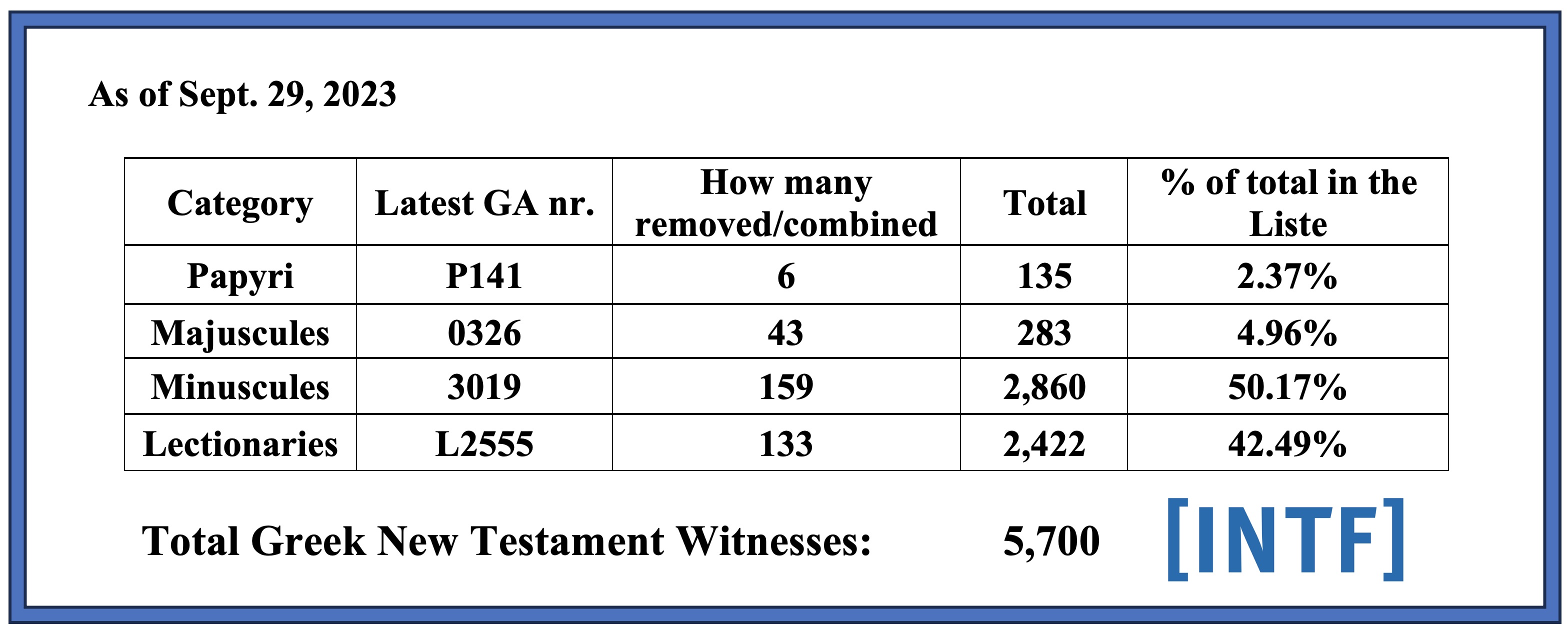
This is the number I will now be giving to people when they ask and it’s the number I would encourage you to use. Whenever you do, let me encourage you give the necessary caveats about the wide range in date, quality, and size of these 5,700 manuscripts. They are not all created equal! Furthermore, the number is not stable given new discoveries, the movement of manuscripts, and the ongoing identification of duplicates and the like. Still, it is very helpful to have a count from the same source that makes the official list we all use. Kudos to Leggett and Paulson!

Update (1/11/24): see the follow up posts on this here and here.

Monday, October 23, 2023

New Book: Can We Recover the Original Text of the New Testament?

9

Released last week is a new book edited by Abidan Shah and Dave Black called Can We Recover the Original Text of the New Testament?. It includes all the papers given last year at Abidan’s church conference (more on that here and here). 

Notably, the contributors all answer yes to the book’s title but disagree on how best to identify the original text. In this way, the book serves as a kind of update to Dave Black’s 2002 book Rethinking New Testament Textual Criticism, a book I cut my methodological teeth on. A huge thanks to Abidan and Dave for editing this and especially to Abidan and his staff for spearheading the conference.

Here is the publisher’s description:

In recent decades, the traditional definition of the original text of the New Testament (NT) has shifted from seeking one singular text to seeking a number of texts. Instead of one “authorial” text, now it is claimed that it could be one of several different texts based on their locations in the history of transmission: preauthorial, authorial, canonical, and postcanonical. These distinctions were first listed by Eldon Epp in his article “The Multivalence of the Term ‘Original Text’ in New Testament Textual Criticism” as “predecessor,” “autographic,” “canonical,” and “interpretive” text-forms. It is apparent that with such changing definitions of the original text of the NT, text-critics are ambivalent regarding reaching the traditional goal of NT textual criticism. Instead, attention is now given towards hypothesizing regarding the emergence of the variant readings. Furthermore, any attempt towards utilizing text-critical principles to reach the original text is looked upon as being out of date and pointless. All such shifting definitions of the original text and the ensuing claims have far-reaching consequences for biblical faith and praxis. 

In this work, three different scholars will present their methodologies for retrieving the original text of the NT. No matter how each of the presenters evaluates the text-critical evidence, it is obvious that they all believe in the inerrancy and retrievability of the NT text.

Table of contents:


Friday, October 20, 2023

New book on Sinai Palimpsests (Open Access)

0

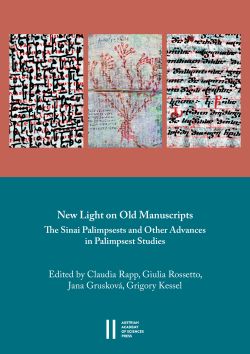
A very interesting new book has just been published by the Austrian Academy of Sciences (and is available on Open Access): 


Claudia RAPP - Giulia ROSSETTO - Jana GRUSKOVÁ - Grigory KESSEL (Eds.), New Light on Old Manuscripts: The Sinai Palimpsests and Other Advances in Palimpsest Studies (link here)

The English abstract: 

The study of palimpsest manuscripts has a long tradition and has led to spectacular discoveries of new texts or new text versions. Recent decades have seen the development of advanced nondestructive methods of multispectral imaging and computer-based image processing. The focus of such research have been individual manuscripts, such as the Archimedes palimpsest that was studied in Baltimore, or the Dexippus fragments in Vienna. The Sinai Palimpsests Project broke new ground by studying for the first time a collection of palimpsest manuscripts that have been preserved for centuries in the library of the Monastery of Saint Catherine in the Sinai (Egypt). The erased layers preserve texts in eleven languages of the Christian Orient. An international team of scholars has identified numerous new texts or versions of texts, often in very early scripts. This volume has its origin in a conference that was held in Vienna in 2018, where these results of the Sinai Palimpsests Project were presented, along with the advances in image capture and image processing that have made them possible. Additional contributions about current projects in the study of palimpsests, also including Jewish and Muslim text traditions, place the study of palimpsest manuscripts within the larger context of the cultural history of the middle ages. The 30 contributions in this volume thus offer a cross-section, including the most recent technologies, of the current state of research in palimpsest studies.

Tuesday, September 12, 2023

Synopsis of P.Oxy. 5575, Matt, Luke, and Thomas

15

I had a little time on Friday afternoon to work through the editors’ editio princeps of P.Oxy. 5575 and I hope to write some more on it soon. But in the meantime, I thought I might share a first pass I made at a Greek synopsis here [PDF]. 

For this, I have simply adopted the editors’ reconstructed text even though there are places where I’m of a different mind. They naturally include plenty of alternate possibilities in their discussion, so their reconstructed text should obviously not be treated as final. But you have to start somewhere. Feel free to use and share it. Corrections are welcome.

One initial observation from making this synopsis is that the inclusion of Luke is, to my mind, somewhat precarious. I don’t see anything in the fragment that is distinctive of Luke. The material from the canonical Gospels is from the so-called double tradition and, in the few places where Matt and Luke diverge, our fragment is lacunose, follows neither, or follows Matthew. I don’t see any point where it distinctly follows Luke. If so, then parsimony would suggest we leave Luke out of the equation in explaining what this fragment is. But maybe others will see something I missed—as I said, I only had an afternoon to spend with it so far.

As for other initial reactions, here’s a nice video from Bible Unboxed, and don’t miss Brent Nongbri’s post on the paleography.


Update: if you’re looking for an English synopsis, Mark Goodacre has uploaded one he made here. Mike Holmes also has a nice intro to the papyrus here, with an English translation.

Thursday, August 31, 2023

New 2nd-Century ‘Sayings of Jesus’ Oxyrhynchus Papyrus

13

Volume 87 of the Oxyrhynchus Papyri is apparently out today and it lists some pretty exciting papyri. From the website:

This volume includes editions of fifty-eight papyri and one text on parchment. Among the theological texts, three are of exceptional interest. 5575 is an early copy of sayings of Jesus corresponding in part to the canonical gospels of Matthew and Luke and in part to the apocryphal gospel of Thomas. Jesus is also the speaker in 5576 and apparently in 5577, where Mary is addressed. Both pieces may be loosely called “Gnostic”; the latter appears to be Valentinian.

Candida Moss has more detail at the Daily Beast here. From her article:

The significance of the fragment lies in its date and contents. In conjunction with distinguished papyrologist and paleographer Ben Henry, the editors—Jeffrey Fish, Daniel Wallace, and Michael Holmes—date the fragment to the second century CE. This is important because, as Dr. Fish told me, “Only a few gospel papyri can be securely dated to the second or beginning of the third century.” This is the earliest period from which we have Christian manuscripts. “What is so significant about this papyrus,” continued Fish, “is that it contains sayings of Jesus which correspond partly to canonical gospels (Matthew and Luke) and partly to sayings we know only from the Gospel of Thomas. It is as early or earlier than any of our papyri of the Gospel of Thomas [our earliest non-canonical Gospel],” including other fragments of the Gospel of Thomas found at Oxyrhynchus.

I will update this post as I learn more. But needless to say, this looks like a big deal.

Update (9/1/23)

Now that I’ve seen pictures and emailed the editors I can confirm this is the fragment I worked on as a student in the Green Scholars Initiative back around 2012. It was a treat to work on it and I’m very glad to see it finally published. I did get to spend an afternoon with the fragment. I’ll try to publish some more of the work I did on it back then later on the blog. I haven’t seen the official publication yet and, naturally, the editors went well beyond my meager student efforts. You’ll notice that comparing the photos from 2013 to the b/w images from the Oxy volume that another piece of the fragment was identified. So the color photos do not show the entire known fragment.

2012 Photos (by Ardon Bar-Hama)

2023 Photos from the Oxy volume (via Facebook)

Update (9/12/23)

See the Greek synopsis I put together here.

Friday, August 25, 2023

J. Gresham Machen on Conjecture

3

J. Gresham Machen is known for many things: starting Westminster Seminary, starting the Orthodox Presbyterian Church, writing a widely used introductory Greek grammar (one still used when I was in high school!), battling theological modernism, etc. Among his books, the most famous is Christianity and Liberalism, which is celebrating its 100th anniversary this year. It is a classic. If you’ve never read it, you should. 

One thing Machen is not known for is textual criticism. Nevertheless, one will find in his major study of the virgin birth a chapter devoted especially to the textual problem of Matt 1:16. It’s a nice treatment overall. But what caught my attention was his response to the conjecture proposed by A. Merx (and others, see here) that the text initially read “Joseph begat Jesus” and this was only later emended in various ways to include Mary and her virginity. Here is Machen:

In reply, it may be said, in the first place, that the method of conjectural emendation, which is here followed, can be applied only with the greatest caution to a work which has so extraordinarily rich a documentary attestation as has the Gospel according to Matthew. In the case of many classical authors, where we have only one or two late and obviously very imperfect manuscripts, an editor is often justified in rejecting the transmitted text of a passage and in substituting for it a reading which shall best account for the obviously incorrect wording of those manuscripts that happen to be extant. But in the case of the Gospels, the extant documentary attestation is so very abundant, and the various lines of transmission began to diverge at such an early time, that one has difficulty in understanding how the original text could have been so completely obliterated as to leave no trace. There may indeed be such instances, where all of our extant witnesses to the text have been corrupted; but surely they are very few. Thus although conjectural emendation cannot be excluded in principle from the textual criticism of the New Testament, it should certainly be employed there in the most sparing possible way. The employment of it in any passage should be regarded as a counsel of desperation, to be resorted to only when all ordinary methods fail. If it is possible to regard any one of the extant variants as original, that alternative should be chosen; and the critic should not undertake to reproduce by conjecture a text which has actually left no trace. 

In the case of Mt. 1:16, if there is any truth in what has been said above, we are by no means reduced to such desperate expedients. It is perfectly possible to understand the reading attested by our earliest Greek manuscripts as belonging to the original text of the Gospel, and both the variants as having been produced from that reading in the course of the transmission by well-known causes of textual corruption. But if such a solution of the problem is possible, it is surely—in view of the wealth of documentary attestation— decidedly preferable. What need is there of going so far afield to solve a problem for which a satisfactory solution lies near at hand? (pp. 183-184)

I’ll just note two points of interest to me. The first is that, despite his famously staunch defense of the Westminster Confession, Machen is willing to entertain that conjecture might be needed in the rarest cases in the Gospels: “There may indeed be such instances, where all of our extant witnesses to the text have been corrupted; but surely they are very few.” 

The second is that Machen’s hesitation about conjecture is based on two points not one. It is not only the “abundance” of manuscript evidence for the Gospels but also that the lines of transmission diverged so early. If this is true, then any convincing conjecture must not only explain why the original text was lost in so many manuscripts, but, more importantly, how it was lost in all the lines of transmission so early. Even still, Machen is not opposed to conjecture tout court.

P.S. It’s pronounced gress-um.