Showing posts with label scribes. Show all posts

Wednesday, March 12, 2025

Correcting a Dead Sea Scroll

5
Correcting a digital text today is simple and neat. I simply highlight the text to be deleted and press my “delete” button on my keyboard. When I notice a mistake right away, I can simply press the undo button to erase my last input. The phenomenon of simple and neat corrections is a modern reality, not an ancient one. In this post, I’d like to highlight some techniques scribes used to correct the biblical text. 

Deleting Text
When ancient scribes deleted text, they could use “cancellation” dots. Both examples below come from 1QIsaa. The second picture is quite peculiar since the initial scribe corrected the text, making the verbal stem explicitly qal, only for the same scribe or a future scribe to delete the correction with dots. The result of the cancelation dots is the verbal stem once again becomes niphal.
Scribes could cross out the material to be deleted. Here is an example from 1QIsaa.
Another option was to bracket the content in parentheses. Here is a partially extant example from 11QpaleoLev. Only the final bracket is preserved.

Scribes could also scrape the ink off the writing surface (i.e., erasure). The scribe of 1QS often resorts to this technique.
Adding Text
By far, the most common way to add originally omitted text was with a supralinear correction (i.e., adding the material above the line). This type of intervention is common, especially in 1QIsaa

Substituting Text
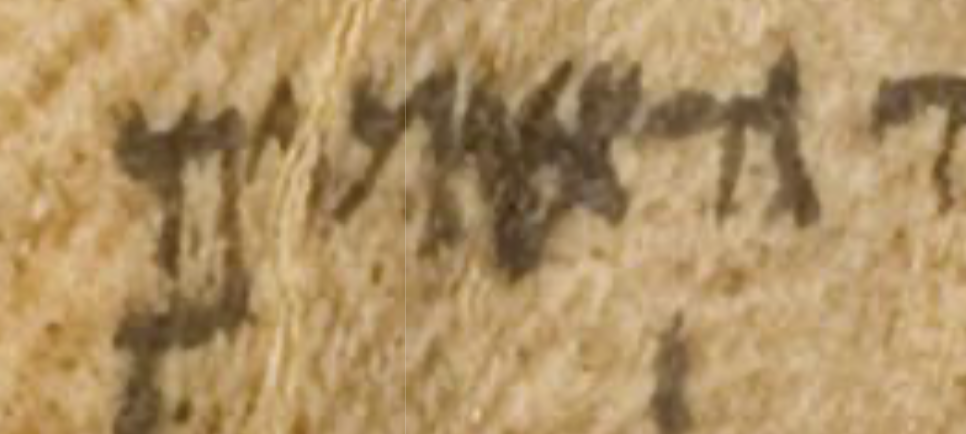
Scribes often needed to correct the text by substitution. They could do this by combining the features above such as cancellation dots plus a supralinear correction. Reshaping an errant letter was another option. This technique often resulted in recognizable but peculiar letters. Here are two examples from 1QIsaa.

This second example is especially important since the reshaped letter is probably an aleph. Most likely the scribe was in the process of written ארצ (with a non-final sade) based on the context but realized his mistake and corrected the text to read השמים.

Correcting ancient manuscripts could get messy as these above examples prove. It is important that textual critics and those concerned with the transmission of Bible remind ourselves of this reality. What is easy and neat for us, was not always neat for ancient scribes copying the Bible. 

Wednesday, September 19, 2018

Evaluating Ehrman’s Comparative Argument for Textual Unreliability

20
We have discussed at some length on this blog the value (or lack thereof) of what I called the comparative argument for the reliability of the NT text. In particular, we discussed Bart Ehrman’s three objections to it and why I find only one of them significant. In this post, I want to return to that same objection, but this time I’m going to stack it against one of Ehrman’s own reasons for thinking the NT textual tradition is unreliable or at least not reliable enough.

Ehrman’s Argument

Here is Ehrman in his NT introduction:
In the earliest centuries, the vast majority of copyists of the New Testament books were not trained scribes. We know this because we can examine their copies and evaluate the quality of their handwriting, and we can assess how accurately they did their work. The striking and disappointing fact is that our earliest manuscripts of the New Testament have far more mistakes and differences in them than our later ones. The earlier we go in the history of copying these texts, the less skilled and attentive the scribes appear to have been.*
And here is his objection to the comparative argument as applied to the number of manuscripts:
Second, and more important: just because we are WORSE off for other authors than for those of the New Testament does not in itself mean that we can trust that we know what the NT authors wrote. I am a lot stronger than my five-year old granddaughter. But I still am not able to bench-press a half-ton truck. Yes, but you are MANY TIMES stronger than her! It doesn’t matter. I’m nowhere near strong enough. We have far more manuscripts of the New Testament than for any other ancient writing. But that doesn’t mean that we can therefore know what the originals said. We don’t have nearly enough of the right kinds of manuscripts.

Tuesday, July 18, 2017

Batovici: Two B Scribes in Codex Sinaiticus?

1
In the Bulletin of the American Society of Papyrologists, Dan Batovici has a new article arguing against splitting the “B” scribe into two.
Abstract: The history of scribal hand identification in Codex Sinaiticus is a fairly complicated one. The most recent identification, splitting the work of Tischendorf’s scribe B in B1 and B2, was attempted by Amy Myshrall in a 2015 contribution, as a result of the work on the Codex Sinaiticus digitizing project completed in 2009. This article will assess the argument proposed by Amy Myshrall for distinguishing the two new scribes, and it argues that there is not enough reason to adopt the newly proposed distinction.
The article is on his Academia page.

Thursday, January 17, 2013

Conference on Scribal Practice in the Ancient and Antique Mediterranean World

4

Call for papers (HT: Jennifer Cromwell, Papy-L):

Observing the Scribe at Work: Knowledge Transfer and Scribal
Professionalism in Pre-Typographic Societies
Macquarie University, Sydney
27-28 September 2013

Prior to the typographic revolution of the 15th century, the figure of the scribe was one of the keys by which civilisations were able to disseminate their power, culture and beliefs beyond their geographic, temporal, and even linguistic limits. Our access to the pre-modern world is mediated by the material and technological remains of scribal activity, the manuscript as an artefact of culture and administration. Every text preserved prior to the advent of printing bears witness to the activities of scribes. Yet
as a social and professional group they are frequently elusive, obscured by other professional titles, reduced to mention in a colophon, or existing within a private sphere into which our sources do not reach. While much attention has been given to the scribe as a literary figure, the manuscripts offer a unique point of access to
this group without the distortions of the literary tradition. This perspective, however, has frequently been restricted to a catalogue of errors, reducing the scribe to the transmission of an acceptable text, without recourse to the physical characteristics of the manuscript itself.

This workshop is built around the Australian Research Council funded project ‘Knowledge Transfer and Administrative Professionalism in a Pre-Typographic Society: Observing the Scribe at work in Roman and Early Islamic Egypt’. The project sets aside the often futile search for the historical figures of the scribe in favour of a focus on observable
phenomena: the evidence of their activity in the texts themselves. Recognizing that the act of writing can be a quotidian and vernacular practice, it explicitly includes the documents of everyday life as well as the realms of the copying of literature, seeking paths back to an improved understanding of the role and place of scribes in pre-modern
societies.

‘Observing the Scribe at Work’ will bring together specialists in pre-modern societies of the Mediterranean world and adjoining cultures, from the ancient Near East, through the Egyptian and Classical worlds to Byzantium and Renaissance Europe. The papers will contribute to a deeper understanding of the processes that drive
the operation of pre-printing cultures, and transmit knowledge and traditions forward in human societies.

The workshop will be held at Macquarie University on 27-28 September 2013. Macquarie University cannot offer full funding for all participants traveling to Australia from overseas, but partial financial assistance will be awarded to select abstracts which closely address the themes of the workshop. Decisions to this
effect will be made by the end of April.
We call for abstracts of up to 300 words that address the objectives of this workshop. These should be sent to jennifer.cromwell@mq.edu.au by 31 March 2013.

Inquiries: Malcolm Choat (malcolm.choat@mq.edu.au); Jennifer Cromwell (jennifer.cromwell@mq.edu.au)

Organising Committee
Malcolm Choat, Jennifer Cromwell, Korshi Dosoo, Rachel Yuen-Collingridge

Sponsors:
Australian Research Council
Macquarie University
Faculty of Arts, Macquarie University
Macquarie University Ancient Cultures Research Centre