Showing posts with label apologetics. Show all posts

Monday, April 29, 2024

“Why I Trust the New Testament Is What God Wrote”: Contend 2024

55

Over the weekend, I spoke for one of the break-out sessions at Contend—an apologetics conference at New Orleans Baptist Theological Seminary that is geared for high school students. The title of my presentation was "Why I Trust the New Testament is What God Wrote," and that title was intentional. The talk wasn't so much to convince anybody that we do really have God's words as it was rather to tell them why I believe we do really have God's words.

My talk was based on what I presented a while back at the church where I was ordained. That itself was an interesting situation—it is a TR church that has always used the KJV or NKJV, but they also recognize that it's not an issue worth dividing over and consider other translations to be sufficient as well. My impression of the rationale at that church has always been that it was an unstated trust that TR translations are 'safe' in that God has obviously blessed their use, and since that's what the pastors typically used, they just stayed with it because there are more important things than becoming experts in textual criticism just to be sure that you have the best Bible when you already have a Bible that's not only good but perfectly sufficient. But they knew my position and actually asked me to speak about why we can trust the Bible. It was an interesting task to try to do that in a way that doesn't undermine the KJV/NKJV on the one hand or modern translations on the other (because plenty of people beyond myself at that church used translations like the ESV and LSB).

It may not be helpful to anyone, but in case it is, I wanted to post some of my slides from those two talks and give a few main points here.

1. Dunning and Kruger

I began (at the church; unfortunately this part had to be cut for Contend because I didn't have as much time) with explaining the Dunning-Kruger effect, which is named after the authors who described it in this 1999 article, and which Tom Nichols wrote about in his excellent book, The Death of Expertise (which should be required reading for anyone engaging in the TR/KJV issue). In short, when we first start to learn something, we don't know enough to know what we don't know, then there comes a time when we realize how much we don't know (and that can be unsettling), and finally, if we stick with it, we achieve competence. On a chart, these three phases are sometimes called Mount Stupid, the Valley of Despair, and the Plateau of Sustainability (I didn't come up with those names, but they fit). My casual observation is that a lot of the people who 'go wrong' when it comes to manuscripts and textual criticism do so because they get hurt falling from Mount Stupid into the Valley of Despair, so to avoid living in that pain, they climb back up Mount Stupid and build a fortress there. It's not the mountain that hurts, it's the fall. Basil Manly Jr. [The Bible Doctrine of Inspiration Explained and Vindicated] even observed this phenomenon in 1888.


2. Examples of Uncertainties

In the talk I did give a very brief "We have over 5,000 manuscripts" section, but I figure that most people who are coming to an SBC seminary for an apologetics event probably already have a baseline of belief in the Scriptures, so that part wasn't very long. It's probably what they came to hear though; sorry for the disappointment! I think it might be more helpful to dive right in to the uncomfortable part—uncertainties. Nobody likes to be uncertain about God's Word, but because of how God has acted in history, somebody has to sort out the differences among manuscripts, and if we are concerned about this, then we should have an accurate picture of what that looks like and what the degree of uncertainty actually is.
Wednesday, October 25, 2023

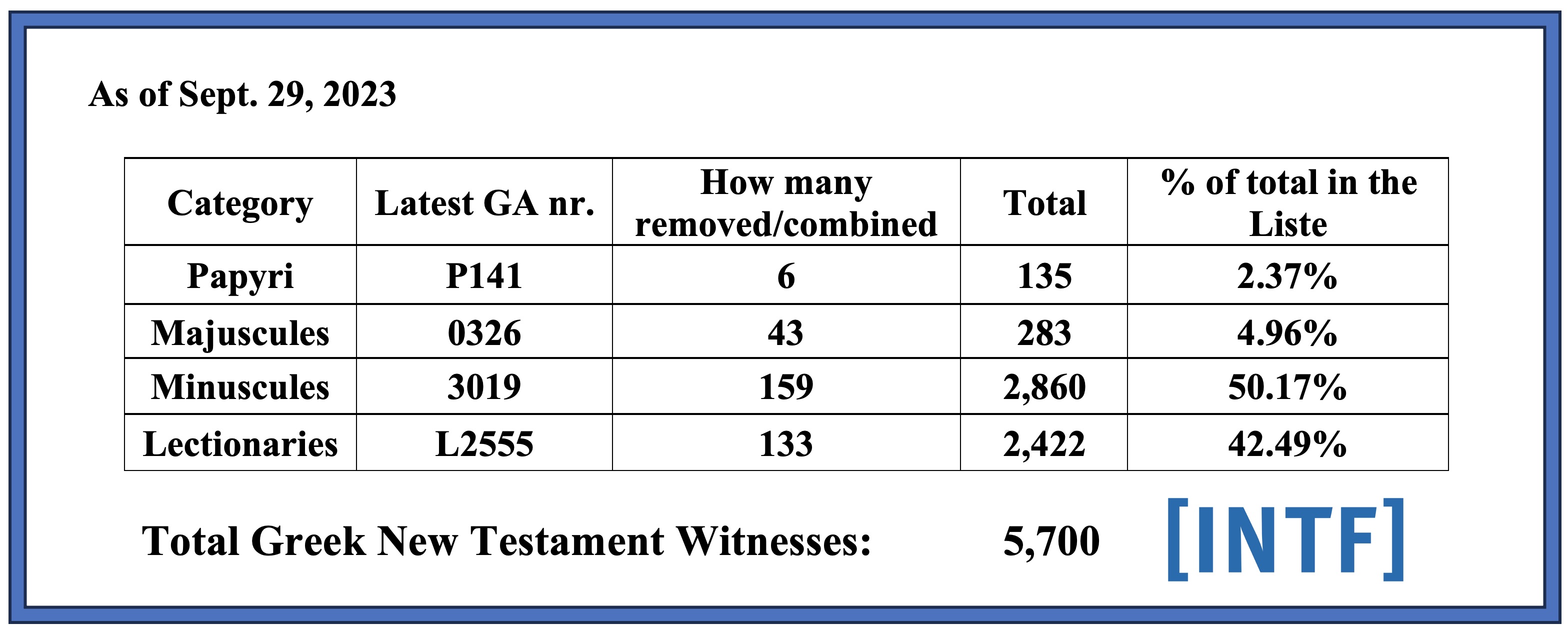
How Many Greek NT Manuscripts Are There Really?

4

That’s a question I get asked a lot. It’s a question many Christian apologists and skeptics of Christianity ask. And, it’s the question that Katie Leggett and Greg Paulson answered very carefully and very helpfully last month at the INTF blog. I’m tempted not to give you their answer here so that you have to read their entire post. 

But first, why is answering this so hard? Isn’t it just a matter of tallying up the highest manuscript number assigned in each of the four categories of papyri, majuscule, minuscule, and lectionary in the official list of manuscripts (known as the K-Liste)? It’s not. For at least three reasons. 

The first is the difficult question of what counts as a manuscript. Do amulets count? Should they count? What the Liste has included over the years has changed. 

Second, manuscripts can go missing, change hands without the list-keepers knowledge, or they can be lost or destroyed. If they were once on the list but are now unaccounted for, do they count? 

Third, what do we do when the same physical artifact contains portions of the New Testament in different hands from different centuries? Are we counting the resulting artifact or the varying copying events (for lack of a better term) that led to the one artifact? 

The point is not that these questions can’t be answered but that they must be answered before we can answer the original question. (By the way, these issues are all helpfully addressed in Jacob Peterson’s chapter in Myths and Mistakes.)

With all that said, what number do Leggett and Paulson arrive at? Drum roll, please... 5,700.

This is the number I will now be giving to people when they ask and it’s the number I would encourage you to use. Whenever you do, let me encourage you give the necessary caveats about the wide range in date, quality, and size of these 5,700 manuscripts. They are not all created equal! Furthermore, the number is not stable given new discoveries, the movement of manuscripts, and the ongoing identification of duplicates and the like. Still, it is very helpful to have a count from the same source that makes the official list we all use. Kudos to Leggett and Paulson!

Update (1/11/24): see the follow up posts on this here and here.

Wednesday, August 25, 2021

Documentary by Kipp Davis, “Josh McDowell: Manuscript Hunting and Mythmaking for Jesus”

10

Tonight I watched Kipp Davis’ new documentary about one of the most influential apologists in the US: “Josh McDowell: Manuscript Hunting and Mythmaking for Jesus” live in a webinar organized by the Lying Pen project at UiA, Kristiansand. My co-blogger Peter Head was there too I noticed. There was an introduction by Kipp, and brief responses by Roberta Mazza and Dana Ryan Lande. I only heard Roberta’s and then had to go.

 If you want to watch the documentary, it was released simultaneously on YouTube. I think everyone ought to see it, but perhaps in particular those involved in Christian apologetics. I already lacked confidence in McDowell before watching the film, in particular after his wheelings and dealings with manuscripts, mummy masks and Palmolive (though I doubt he knew Carroll somehow faked these sessions), etc. But this documentary brings out a lot more about McDowell’s own “testimony” that is highly disturbing and tragic.

Friday, February 12, 2021

Best board imaginable!?

68

Ravi fell, but he had help.

“It is with deep gratitude to God, joined by the best board anyone can imagine and affirmed by the rest of our senior leadership, that these two appointments have been made.”

These are Ravi Zacharias’s words as he celebrates the appointment of two executives of Ravi Zacharias International Ministries, namely his daughter Sarah Zacharias Davis as CEO and Michael Ramsden, a Christian apologist as president. Ravi Zacharias remained as the chairman of the board. It’s difficult to say who’s currently on the board, because I can’t find an annual report on the website and RZIM seems to have used a religious exemption to avoid filing a public 990 for several years. The 2014 statement has Ravi and his wife earning a total of $523,926 ($190,565 + 174,750 & 143,690 + 14,921). His daughter, Sarah Davis earned $208,995 plus $7,042 in other compensation. Naomi Zacharias, who oversaw poverty relief internationally, was subsisting on $129,679. 

If you serve on the board of a non-profit, you are responsible for oversight. When the poop hits the fan, it’s your fault. Why was the fan there? Why is poop being flung around the room? It is your fault; you should have been asking these questions! Family members of executive staff should not occupy a board seat. Contractors or employees of other organizations should never have a board seat or an executive position. Rarely do academics or public speakers possess any gifting with management or strategic planning. No matter how much prestige their name may carry, they should not manage or lead unless they have demonstrated ability.

Every board should review and publish an annual report and is responsible for setting the executive salary through its own research or consultants. Likewise, the board should ensure that compliance officers (HR and finance) have reporting mechanisms to catch ethical and legal violations when they are small.  In other words, the board should be interacting discretely with these staff to address problems.  A ministry the size of RZIM should undergo an external audit annually and should have published this audit on Guidestar.org or its own website. Problems are normal; cover-up allows gangrene to spread. 

From the 2014 990, the RZIM board seems to have had about twenty members, including Ravi, Ravi’s wife and his daughter. That’s too big and the lack of a board-approved annual report causes one to wonder whether any of the members of the board had assigned annual responsibilities. The founder and/or CEO can never be the chairman of the board, unless s/he owns the company. If the president/CEO is also chairman of the board, you have no oversight. Zero. 

Principles 

Centrality of Christ. Christian charities should be based on a gospel mission which itself focuses on Jesus Christ. Naming a charity after yourself is unacceptable. Serving as chairman of your own oversight committee reflects nothing more than narcissism. Put Christ at the center. "For I decided to know nothing among you except Jesus Christ and him crucified." (1 Cor 2:2)

Compliance and transparency. Compliance means knowing and following the legal and ethics mandates of your business. Transparency is speaking truth, telling people what they need to hear when or before they need to hear it. “Let God be true and every man a liar.” (Romans 3:4.) 

Accountability. Things will go wrong, because even the best people are selfish and depraved. Will your organization nip it in the bud or let the cancer spread? Recognize that the easiest way to solve a problem is to deny its existence. Acknowledge, however, that the easy solution is a lie. “Whoever loves discipline loves knowledge, but he who hates reproof is stupid.” (Prov 12:1) 

Greed. “For the love of money is the root of all kinds of evil.” (1 Tim 6:10) 

Victims. RZIM must be shut down and its assets designated toward the victims. Ravi’s family can’t earn money from his name and the employees need to move on. The board members as well as Ravi’s family are people of integrity who fell short on compliance, but the current organization’s continued existence under any name will only continue Ravi’s now-inexcusable legacy. The “Executrix” should release all parties from the Non-Disclosure Agreements and likewise release the documents related to the earlier investigation of RZ which found him innocent. “As for those who persist in sin, rebuke them in the presence of all, so that the rest may stand in fear.” (1 Tim 5:20) 

Backstory

This blog post responds to the Evangelical readers will have watched this scandal unfold through our niche media and may not realize that former-evangelical, now atheist skeptic, Steve Baugman played a central early role in building support for the victims. In other words, RZIM affiliated lawyers seem to have quashed the story and Christian media outlets pursued it with reticence. Baugman’s original discoveries entailed Zacharias’s extensive lies about academic credentials. Baugman himself was not shocked by the evangelical inability to hold its own accountable, saying, “This is exactly what my atheist worldview would have predicted.” 

RZIM has released a twelve-page commissioned report, which largely relies on interviews with women and some of Ravi’s cell phones. While most of the 200 images of women on his phone were clothed selfies, he requested nude images from at least two women and received nude images from at least one woman.  According to the report, another woman who purportedly sent nude images later requested “$5 million in exchange for a release of claims against him and the ministry.” Christian leaders would do well to consider the following summary paragraph:

[Ravi Zacharias] further claimed, “In my 45 years of marriage to Margie, I have never engaged in any inappropriate behavior of any kind.” Much of the inappropriate massage therapy behavior discussed above occurred prior to the Thompson matter, and Mr. Zacharias’s lengthy text and email communication with the massage therapist from Bangkok whose culinary schooling he arranged for through RZIM and whom he called the “love of his life” occurred in 2014. His claim that he had long made it his practice “not to be alone with a woman other than Margie and our daughters” was similarly false. As reported above, Mr. Zacharias’s inappropriate conduct often occurred when he was alone with massage therapists. Because his need for massage treatments was well known and accepted, he was able to hide his misconduct in plain sight. He further stated that, after reflection, he learned that the “physical safeguards” he had “long practiced to protect my integrity should have extended to include digital communications safeguards.” As the architect of those “physical safeguards,” Mr. Zacharias well knew how to elude them.

Thursday, November 05, 2020

How Many Manuscripts: Election Edition

24

How many manuscripts of the Greek New Testament exist today?

Jacob Peterson’s chapter, “Math Myths: How Many Manuscripts We Have and Why More Isn’t Always Better” in Myths and Mistakes in New Testament Textual Criticism attempts to shed some light on this question. It’s a complicated question because of double- (and triple-, etc.) counts, lost manuscripts, etc. Here is a summary from the Key Takeaways in his chapter:

Most manuscripts of the New Testament are only manuscripts of part of the New Testament, and providing an exact count of them is a fool’s errand. It is best to say that there are about fifty-three hundred Greek New Testament manuscripts in existence, although fifty-one hundred might be the safer estimate.

Or to provide a comparison that might make it easier to remember (because, as my pastor taught me when I started learning Greek, the weirder the analogy, the more likely it is that you will remember it), there are about half as many Greek New Testament manuscripts as there are people in Tennessee who voted for Kanye West:


Thursday, November 07, 2019

Myths and Mistakes Now Available

7
A new book on textual criticism is now available!


The New Testament is important, and defending it is important, but what we’ve noticed is that occasionally well-meaning defenders rely on other well-meaning defenders. If left unchecked, this can lead to a chain of citations that go back to resources now-outdated with plenty of opportunity to make mistakes along the way.

One problem is that it’s really hard for any one person to be up-to-date on everything. There’s no way around it—that’s difficult. That’s why this book is a co-edited multi-author volume and not a monograph. We thought that this sort of project is better done by a team of people, each of whom can do one thing well, than by one person trying to do all the things well.

So what is the book? It’s a self-corrective written by people who value the New Testament and think it should be defended, written for people who value the New Testament and want to defend it. We’ve taken some common mistakes about manuscripts and textual criticism that show up in “Why Trust the New Testament” talks, explained why these common mistakes are mistakes or otherwise poor arguments and tried to show what a better way might be.

Over at The Gospel Coalition, Justin Taylor has blogged some of our “Key Takeaways,” which we put at the end of each chapter. Of course, the chapters explain why we assert what we assert here, but Taylor’s post is a great example of what kinds of things the book aims to explain.

Saturday, March 02, 2019

New Book on Textual Criticism and Apologetics

12
We have had discussions on this blog before about mistakes well-intentioned Christians often make when defending the Bible. There was a lively discussion about three years ago when The Gospel Coalition published an excerpt from Greg Gilbert’s book Why Trust the Bible? titled “Debunking Silly Statements About the Bible“ that had a number of “silly statements” of its own. I seem to remember a lively comments section at TGC as well, but they seem to have removed comments sections at some point. To be clear, I am glad there are popular authors defending the Bible. That is an important work, and I would want to see more of that (and done well), not less.

I recently came across a couple of other posts in the last month that make some of the same mistakes, and I was again reminded of the words of one of our blog editors:


A New Book

I am happy to report that a book several of us have been working on for about three years now is finally seeing the light at the end of the tunnel. Peter Gurry and I co-edited a book that seeks to give a good resource to people who are doing good work but are not manuscript specialists themselves. It is hard to keep up-to-date with everything, and we get that, so we wanted to help where we can by showing where the problems often are and making suggestions for how to improve important discussions like “why trust the Bible?”. The book is Myths and Mistakes in New Testament Textual Criticism, and it is due out in November from IVP Academic. Just in time for ETS and SBL! IVP has a book page here.

Here is a table of contents:

Front matter
Foreword
Daniel B. Wallace
More front matter
  1. Introduction
    Peter J. Gurry and Elijah Hixson
  2. Myths about Autographs: What They Were and How Long They May Have Survived
    Timothy N. Mitchell
  3. Math Myths: How Many Manuscripts We Have and Why More Isn’t Always Better
    Jacob W. Peterson
  4. Myths about Classical Literature: Responsibly Comparing the New Testament to Ancient Works
    James B. Prothro
  5. Dating Myths 1: How We Determine the Ages of Manuscripts
    Elijah Hixson
  6. Dating Myths 2: How Later Manuscripts Can Be Better Manuscripts
    Gregory R. Lanier
  7. Myths about Copyists: the Scribes Who Copied Our Earliest Manuscripts
    Zachary J. Cole
  8. Myths about Copying: the Mistakes and Corrections Scribes Made
    Peter Malik
  9. Myths about Transmission: The Text of Philemon from Beginning to End
    S. Matthew Solomon
  10. Myths about Variants: Why Most Variants Are Insignificant and Why Some Can’t Be Ignored
    Peter J. Gurry
  11. Myths about Orthodox Corruption: Were Scribes Influenced by Theology and How Can We Tell?
    Robert D. Marcello
  12. Myths about Patristics: What the Church Fathers Thought about Textual Variation
    Andrew Blaski
  13. Myths about Canon: What the Codex Can and Can’t Tell Us
    John D. Meade
  14. Myths about Early Translations: Their Number, Importance, and Limitations
    Jeremiah Coogan
  15. Myths About Modern Translations: Variants, Verdicts, and Versions
    Edgar Battad Ebojo
End matter

Monday, January 08, 2018

Nothing new under the (skeptical) sun

6
The Swiss Protestant divine,
Louis Gaussen (1790–1863) 
Sometimes it’s useful to remember that most of objections to the Bible have been raised before. It provides some perspective, especially to those just made aware of some sensational objection and now feel they’ve been duped or had things hidden from them. In fact, most criticisms of the Bible have been raised (and answered) long before we came along.

Today I found one pertinent to this blog from a 160 years ago that bears remarkable similarity to a now well-known criticism leveled in our day.
From 2005: “What good is it to say that the auographs (i.e., the originals) were inspired? We don’t have the originals! We have only error-ridden copies, and the vast majority of these are centuries removed from the originals and different from them, evidently, in thousands of ways.” (Bart Ehrman, Misquoting Jesus, 7)
From 1841: “What matters to me (it would have been said [by one objecting to the Bible’s inspiration]), the assurance that the first text has been dictated by God, eighteen hundred years ago, if I have no longer the assurance that the manuscripts of our libraries contain it in its purity; and if it be true (as we are assured,) that the variations of these ancient transcripts are at least in number, thirty thousand?” (François Samuel Robert Louis Gaussen, Theopneustia: The Plenary Inspiration of the Holy Scriptures, 86.)
Noting the similarity does not answer the objection, of course. For that, you’ll have to read more of Gaussen’s book linked above. But for some, just knowing that an objection is not new and earth-shattering can help calm a person down.

Monday, November 27, 2017

Audio from our ETS Session on Apologetics and Textual Criticism

2
Credit to Matt Solomon for the action shot
The audio from my and Elijah Hixson’s special session at ETS a week or so ago is now online. The session was titled “Growing Up in the Ehrman Era: Retrospect and Prospect on Our Text-Critical Apologetic.” The first part of the session was given to several presentations drawn from chapters that will be in a book we are editing; the second part was a panel discussion featuring Dan Wallace, Timothy Paul Jones, Michael Kruger, Charles Hill, Peter Head, and Pete Williams. For more details on the session (and the book), see the original announcement here.

From our perspective as conveners, the session was a real success. The room was packed—we did try to get a bigger room—and there was helpful feedback both from our panelists and from the audience which included not only many apologists but also several unexpected special guests all the way from Münster. My thanks to all our presenters and especially our “mature” panelists.

For those who couldn’t make it, the audio files are $4.00/each. I haven’t listened to them yet myself so I don’t know how the quality is.
  1. Common Problems in Evangelical Defenses of the New Testament Text - Elijah Hixson and Peter Gurry
  2. Dating Myths: Why Later Manuscripts Can Be Better Manuscripts - Greg Lanier
  3. Math Myths: Why More Manuscripts Isn’t Necessarily Better - Jacob Peterson
  4. Panel Discussion - Dan Wallace, Timothy Paul Jones, Michael Kruger, Charles Hill, Peter Head, and Pete Williams

Monday, August 21, 2017

Dan Wallace Responds on the ‘Embarrassment of Riches’

26
Last week, I wrote about the charge made against some reasoned eclectics that they are guilty of praising the large number of NT manuscripts in their apologetic but then not actually using them in their text-critical work. For the details, see here.

I had hoped the post would spark some discussion and it certainly did! It’s now at almost 100 comments. Clearly, it touched a nerve. One of the people I mentioned in my original post was Dan Wallace and I am happy that he responded on the original post. I thought his response deserved its own separate post and so I present it here, only lightly edited by Dan.


This has been an interesting discussion (which I just learned about from a friend) on the quantitative argument that I have used in public debates and lectures. I’ve read through the comments as of yesterday (and noticed, but did not read, a mass of comments posted just in the last 24 hours) and noted the objections to this argument. I think the thread can be grouped as follows:
  1. Peter Gurry calls me an apologist. 
  2. Gurry mentions that both Ehrman and Robinson have argued against the quantitative argument for various reasons.
  3. The quantitative argument in isolation is weak and misleading. It’s not 5000+ MSS in any given place, and only 424 (Greek) MSS are from the eighth century or earlier. 
  4. I am apparently speaking hypocritically when I invoke the numbers because most of these are Byzantine MSS and I presumably think the Byzantine text isn’t worth much. A good analogy would be that I consider the Byzantine witnesses to be counterfeit in thousands of places.
I’m sure I’ve overlooked some of the arguments. But these are the major ones from what I can tell. My response:

Wednesday, August 16, 2017

On the ‘idle boast’ of having so many New Testament manuscripts

101
My post on the topic of the comparative argument for trusting our modern texts of the New Testament produced some good discussion. But one issue that got passed over in the ensuing comments deserves more attention and that is what I want to give it here.

A slide from Wallace’s presentation at Biola
The issue is whether apologists like James White or Dan Wallace, for example, are being inconsistent for practicing reasoned eclecticism and for appealing to the vast number of Greek NT manuscripts. Wallace, for example, likes to refer to our “embarrassment of riches” for recovering the original text of the New Testament. But his practice of reasoned eclecticism seems to suggest that he is “embarrassed” in quite a different way by these riches because he doesn’t actually use them (see, e.g., the NET Bible). Apologetically he wants to have his embarrassingly-rich cake, but text-critically he has already eaten it. That is the charge anyway and it is one I have heard Bart Ehrman use in debate against Wallace.

But Ehrman is not the only one to use it. He finds himself a strange bedfellow with Maurice Robinson on this who puts the problem this way:
The resources of the pre-fourth century era unfortunately remain meager, restricted to a limited body of witnesses. Even if the text-critical evidence is extended through the eighth century, there would be only 424 documents, mostly fragmentary. In contrast to this meager total,the oft-repeated apologetic appeal to the value and restorative significance of the 5000+ remaining Greek NT MSS becomes an idle boast in the writings of modern eclectics when those numerous MSS are not utilized to restore the original text.*
Robinson again:
Granting that a working presumption of most eclectic scholars (including Ehrman) is that the vast bulk of NT MSS basically should be excluded as irrelevant for the primary establishment of the text, Ehrman’s statement [against the comparative argument] makes perfect sense. Rather than claiming some sort of text-critical superiority to the classics based on the sheer quantity of extant MSS, modern eclectics perhaps should acknowledge that their actual preferred witnesses for establishing the best approximation to the “original” NT text number only in the few dozens, as opposed to the several thousands otherwise set aside from serious consideration.
I’d like to open this up to discussion again. Can reasoned eclectics make any apologetic appeal to the abundance of our NT witnesses without being inconsistent? If so, how?

———
* “Appendix: The Case for Byzantine Priority” in The New Testament in the Original Greek: Byzantine Textform 2005, p. 568.

Update: see Dan’s response here.

Monday, June 26, 2017

Special ETS Session: Growing Up in the Ehrman Era

18
It’s just over ten years since Bart Ehrman published his bestselling Misquoting Jesus (reviewed here) and almost ten years since Christanity Today called textual criticism one of “the hottest issues in evangelical theology.” In that time, textual criticism, particularly of New Testament, has become a staple of Evangelical apologetics, with articles on the subject in study Bibles, popular apologetics, and books on the reliability of the Bible. Unfortunately, the apologetic output too often suffers from ignorance of what we all know to be a highly technical field. At times, the results can be quite embarrassing (for example). And the problem does not seem to be improving despite the increasing number of well-trained, Evangelical text-critics.

So, about a year ago, Elijah Hixson and I began planning a way to address this problem. The result is a book project that we are excited to say has recently been accepted by IVP Academic. (More on that later.) Today, as part of that larger project, we would like to announce a special session at this year’s Evangelical Theological Society meeting in Rhode Island. Rather than offering one more response to Ehrman and co., however, the idea is to hold an in-house discussion, one which takes stock of our apologetic efforts over the last decade.

The session is two-part. The first part offers selections from the forthcoming book and the second part is a panel of top Evangelical scholars who have written on the apologetic topic at hand. Elijah and I are especially excited that everyone we asked to join the panel has agreed. We actually adjusted our original schedule to give our panelists extra time. Readers will notice several fellow ETC bloggers on the panel and at least one who will be participating in ETS for the first time. Don’t miss it!

Time & Location

1:00–4:10 PM in the Omni – Providence I
Here are the details:

Monday, May 08, 2017

What Is the Value of the Comparative Argument for the Reliability of the NT Text?

23
There is a common apologetic argument that says we should be far less skeptical about the text of the NT than we are for the text of other classical works since we have far more and far earlier manuscript evidence for the NT. You can find the basic comparison all the way back in Bentley. Among Evangelicals, the argument was deployed best by F.F. Bruce and his numbers for classical authors are still cited as if they have’t changed in over half a century. Today, the comparison is something of a staple of Evangelical apologetics.

But Bart Ehrman doesn’t buy it. He thinks the comparison is baseless and he gives three reasons why in a blog response to Dan Wallace. He explains:
First, it is not true that scholars are confident that they know exactly what Plato, Euripides, or Homer wrote, based on the surviving manuscripts. In fact, as any trained classicist will tell you, there are and long have been enormous arguments about all these writings. Most people don’t know about these arguments for the simple reason that they are not trained classicists. Figuring out what Homer wrote – assuming there was a Homer (there are huge debates about that; as my brother, a classicist, sometimes says: “The Iliad was not written by Homer, but by someone else named Homer” ) – has been a sources of scholarly inquiry and debate for over 2000 years!

Wednesday, February 10, 2016

Debunking Silly Statements about the Bible

45
There is a post about the textual transmission of the Bible at the (US) Gospel Coalition website: Debunking Silly Statements About the Bible. Unfortunately all around (for the author, Greg Gilbert, his book, the Gospel Coalition) this post contains a number of Silly Statements about the Bible. Christians who want to defend the Bible have a responsibility to know what they are talking about. Here are some quotations from the first half, with brief comments.
1. Whatever pieces of paper Luke, John, or Paul used to write Luke, John, or Romans have been lost to history, and it’s unlikely we’ll ever find a biblical manuscript about which we can say, “We are 100 percent certain this is the original piece of paper on which the author wrote.”
I think if we find a biblical manuscript on paper we can be 100 percent certain it is not the original.
2. even though we don’t have the originals, we do have thousands of other pieces of paper that contain original-language text from each book of the Bible—about 5,400 when it comes to the New Testament. These go back to the third, or second, or even (perhaps?) to the first century.
(just stepping over the ‘pieces of paper’ thing going on here) I think that it is seriously misleading to leap from a figure like 5,400 manuscripts to then say ‘these go back to the third ... century’. These 5,400 manuscripts do not go back that far. Less than 1% of that 5,400 figure goes back to to anything like the third century (or earlier, although clearly at this point none of them go back to the first century).
3. After all, the New Testament was written in the mid-to-late first century, and the earliest copies we have are from about the years 125 to 200. At best, then, there’s a gap of some 45 to 75 years between the originals and our earliest copies.
This is also potentially misleading. If we date P46 to around AD200 then we are looking at more like 140-150 years for the Pauline letters. For Mark we might have a gap of 200 years. For John perhaps 45-75 years works, but not for any other portion of the NT. Generalisations are not helpful.
4. One fascinating example is what’s called the “Codex Vaticanus,” a copy of the New Testament originally made in the fourth century, but which was re-inked in the tenth century so it could continue to be used. Do you see what that means? Codex Vaticanus was still in use 600 years after it was originally made! Therefore the claim that all we have are “copies of copies of copies of copies” of the originals is far overwrought. Indeed, it’s well within the realm of possibility that we have in our museums today copies of the originals, full stop.
A better example would be a manuscript (e.g. Sinaiticus) which shows more evidence of continuous usage than does Vaticanus. Nothing in this suggests that we have immediate copies of the originals in our museums, and as far as I am aware no one has ever argued such a case in any scholarly publication. Wishing doesn’t make it so.
5. Also, when you consider the gap between the originals and first copies of other ancient works, you can see just how small this “gap” for the New Testament really is. For example, for Thucydides’s History of the Peloponnesian War, we have exactly eight surviving manuscripts, the earliest of which is 1,300 years removed from the original!
I really wish people wouldn’t keep saying this sort of thing. It is nonsensically ill informed. In fact there are 99 early mansucripts of Thucydides, mostly papyrus, some of which go back to the third century BC, dozens from the first and second centuries (LDAB).
6. One scholar has asserted there are, astonishingly, up to 400,000 variants in the New Testament! There are several things to say about this charge. First, the manuscripts are not in fact riddled with variants, and that 400,000 number isn’t nearly as scary as it seems, even if it’s accurate. The scholar who used that number wasn’t just looking at the 5,000 pre-printing-press, original-Greek manuscripts we have, but also at 10,000 other manuscripts in other languages, and then on top of that another 10,000 or so instances where people quoted the New Testament during the first 600 years of church history! Put it all together, and what you’re really talking about is 400,000-ish variants across some 25,000 manuscripts and quotations covering 600 years. But at the far upper end, this comes out to . . . only about 16 variants per manuscript. To put it nicely, that’s really not many.
I’m really not sure where to start on this. It is nonsense from beginning to end.

Up-date: I don’t know who this “one scholar” is, there are several possible candidates. It is not particularly astonishing, but without any careful definition of “variant” it is not even clear what we are talking about. It is not the case that these relate to 10,000 other manuscripts in other languages (although being manuscripts they will have variations) since the languages tend to be cited as a unit in critical discussions. The purported logic of dividing 400,000 by 25,000 and coming up with only 16 variants per manuscript is completely vacuous. It suggests a lack of understanding of how the standard critical editions actually work, and no one who works with manuscripts would think like this. Do we forget that one single manuscript, Codex Sinaiticus, has 23,000 corrections reflecting within itself at least 23,000 “variants”? Of course we should define that term whenever we use it in that context. For the only reputable published discussion of the subject see Peter Gurry, “The Number of Variants in the Greek New Testament.” New Testament Studies 62.1 (2016): 97-121. He certainly was not concerned with variants in versions and quotations in church fathers.  
7. Finally, it’s not as if the variants in all those 25,000 manuscripts just show up everywhere; rather, they tend to cluster around the same few places in the text over and over again, which means the number of actual places in the New Testament really at issue is surprisingly small. The point is that when you think about it beyond the soundbites, you don’t get a picture here of a mountain of copies with so many variants that we can’t make heads or tails of it. Not even close. On the contrary, you get a picture of a remarkably stable transmission history for the vast majority of the New Testament, and a few isolated places where some genuine doubt about the original text has given rise to a relatively large number of variations.
This is so wrong. I doubt this person has ever read a manuscript.

Up-date: Remember that there aren’t actually 25,000 manuscripts (since even on the figures provided there are only 15,000 manuscripts and another 10,000 references in church fathers [where these figures come from I do not know]). The claim that textual variants within the New Testament “tend to cluster around the same few places in the text over and over again” is not supported by any sort of reality. Open the standard critical edition, some pages have more variants than others, some passages have more variants than others, but by and large variants are spread over the whole text of the Greek New Testament, from Matt 1.3 (whether to read ZARA or ZARE) to Rev 22.21 (whether to read AMHN at the end or not), there is no real clustering in the sense that only a few places within the New Testament text have variants - every page normally has dozens of variant readings cited with manuscript and versional support. How many passages are really “at issue” in the sense of textually uncertain is an interesting question and could be answered in different ways depending on the scholar or group of scholars (in NA28 there are diamond readings indicating that the editors are uncertain; there are many differences between different editions). Uncertainties exist even in relation to some questions of theological significance. And finally, to say that there are “places where some genuine doubt about the original text has given rise to a relatively large number of variations” has things the wrong way around: it is the variant readings in the manuscripts that give rise to our genuine doubt about the original text.

Surely we can do better than this.

Thursday, January 20, 2011

The Ehrman Project

11
Is the Bible historically reliable?
Did scribes doctor the MSS?
How do we explain the Bible’s 400.000 errors?
Why did certain texts make it into the canon
Why does a “loving God” permit evil in our world?
What answer does the Bible give for the problem of evil?
Who wrote the gospels?
Couldn’t it all have been a conspiracy?
What is inerrancy?

These questions are not new, but in his scholarship Bart Ehrman has raised them again in an engaging way. A new website has recently been launched which seek to provide responses to Ehrman’s provocative conclusions from a conservative and apologetic standpoint EhrmanProject.com.

The website features several videoclips by Alvin Plantinga, D. A. Carson, Ed Gravely, Michael Kruger, Darell Bock, Ben Witherington and Daniel Wallace. I haven’t looked at them yet.

HT: Dustin Smith

Wednesday, February 18, 2009

James White Comments on Ehrman’s Announcement

43
Until very recently, I was unaware of the Christian apologetic James White. Apparently, he has recently debated with Bart Ehrman on whether the Bible “misquote” Jesus or not (alluding to the title of Ehrman’s book Misquoting Jesus). On his Alpha & Omega Ministries Apologetics Blog he commented yesterday (here) on Bart Ehrman’s recent announcement that a second edition of The Text of the New Testament in Contemporary Research: Essays on the Status Questionis (eds. Bart D. Ehrman & Michael W. Holmes) is in the pipeline, in which he found “a very telling statement.”

Ehrman had said, “What was then the state of the question [status questionis] has now become a bit dated. A lot has happened in fifteen years! Arguably more than in any comparable fifteen year period in the history of the 300+-year-old discipline.”

Now I cite White’s interpretation of Ehrman’s statement:
What has happened in the past fifteen years that is “arguably more than in any comparable fifteen year period in the history of...the discipline”? Has there been a discovery of a new Sinaiticus? Something akin to the DSS in OT research? A massive papyri manuscript find? No, actually, nothing like that at all. So why the paradigm shift?

Simple: the arena has become predominated by post-modernists who have thrown in the towel on the “original text” and have openly and shamelessly said, “Hey, let’s talk about what we can impute to nameless scribes based upon our mind-reading the reasons for their textual variations!” This is nothing less than an abandonment of the paradigm of the preceding generations, a hi-jacking of the discipline itself. While speculation about possible scribal prejudices may have its place, it will alway be just that: speculation.
It is apparent that White knows very little of what he is talking about. Just because he happens to strongly disagree with Bart Ehrman’s views of the transmission of the NT, which I am not trying to defend, he seems biased against everything associated with Bart Ehrman in a very unfortunate way. Ehrman’s monograph from 1993, The Orthodox Corruption of Scripture was already out when the volume on the Text of the New Testament in Contemporary Research came out in 1995. To a great extent, the latter volume, with contributions from a wide range of twenty-three leading scholars, reflects a consensus on the status questionis in most areas of the discipline, while in some other areas a variety of views are represented. (Admittedly, the “Byzantine priority”-position held by e.g., Maurice Robinson is lacking.) In any case, I am quite confident that the second edition will in no less degree reflect the “width and depth” of scholarship in the field.

A lot has really happened in NT textual criticism in the last fifteen year period, which has very little to do with postmodernism. A lot of significant work has been and is being done in an increasing pace, most notably at the leading centres in Münster and Birmingham. In addition to a steady stream of new MSS (e.g., 26 more papyri and many more uncials, minuscules and lectonaries), we have seen the publication of new major editions, and significant developments in methodology. And, yes, even some new scholars have entered the field ;-). As one of those, who, btw, has not “thrown in the towel on the ‘original text’,” I very much look forward to contributing to the second edition.

Update Here is a link to a final response from James White, to which I had to respond in the comment section on this blog, since no comments are allowed on White’s blog.