Showing posts with label Stephen Carlson. Show all posts

Tuesday, December 14, 2021

ECM of Mark Cites the Letter to Theodore (Secret Mark Stuff)

13

Yesterday, as I was consulting the recently published ECM of Mark, I came across some patristic citations by Clem (= Clemens of Alexandria) in several variation-units in the critical apparatus: Mark 10:32/2–40 (and related in /2–4, /6–10, /15); 10:34/26–30, 32; and 10:35/4, and 6. As I turned to part 2 Supplementary Material to find the particular references, it turned out that they were to EpTheod, (Morton) Smith 61,1; 61,2 and 63,2 (see image below from the Patristic Citations database online).
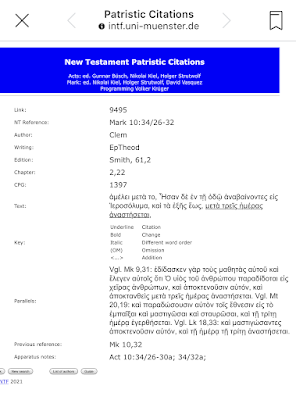
 

So, basically, these citations are from the controversial Letter to Theodore, which was discovered by Morton Smith in the Mar Saba monastery in the Judean Desert in 1958 in the back of a 1646–edition of Ignatius' Letters, copied by hand on the endpages. Smith took photographs of the pages and published his edition of the letter in 1973 (Greek text and Smith's photos here; English translation here). The implied author, Clemens of Alexandria, makes several references to both the (canonical) Mark and the infamous Secret Gospel of Mark (Theodore had posed questions about the latter; he apparently did not have a copy).  

There is an ongoing debate (though it has been a bit quiet lately) about whether this letter is genuine or a forgery (by Smith). For an introduction and negative assessment, see Stephen C. Carlson, The Gospel Hoax: Morton Smith's Invention of Secret Mark (Waco, TX: Baylor, 2005). For debate, see Tony Burke, ed., Ancient Gospel or Modern Forgery? The Secret Gospel of Mark in Debate (Eugene: Cascade Books, 2013).

I have heard that Geoffrey Smith and Brent Landau are currently working on a new book, The Secret Gospel of Mark: A Rogue Scholar, A Controversial Gospel of Jesus, and the Fierce Debate Over Its Authenticity (Yale University Press, 2022?). Does someone know what they will argue? We will see whether they will put an end to the debate.

In any case, these patristic citations are not included in Nestle-Aland 28, but will they be included in Nestle-Aland 29? I hope not, perhaps it was just a mistake. In my opinion, these citations should be treated with great caution and not on a par with Clement's other writings. What is your opinion?

If you are all fed up with this topic, you can always listen to and sing along with us at the ETC blogdinner in San Diego here.

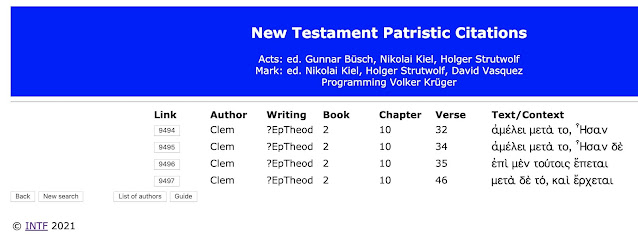
Update: Greg Paulson of the INTF informs us in a comment to the original post that, in light of this information, the editors have decided to add question marks to the references to EpTheod in the database (see image below), and "until a better scholarly consensus is reached" (of its genuineness), it will not be included in future Nestle-Aland editions. I am glad we caught this one.


Wednesday, March 16, 2016

Fischer’s Prescience in 1970 on the Use of Computers for Textual Criticism

7
I just read an article by Bonifatius Fischer on the use of computers in New Testament studies. What makes it interesting is that it was written in 1970. Here are a couple of points that stood out to me. I especially liked this quote near the beginning:
It is strange in general that the use of a computer is taken in the public mind as a proof of scholarly thoroughness. Why does the same not hold for the use of a fountain-pen or a typewriter, especially an electric one? 
Fischer does not think computers hold much promise for questions of authorship. But he is enthusiastic about their use for textual criticism.
After so much pessimism we come at last to a field where the computer is of great importance to the student of the New Testament, indeed where it opens up a new dimension and makes possible what hitherto the scholar had not even dared to dream of: that is, in textual criticism.
He distinguishes between manuscripts “with all their peculiarities” and the “purely abstract sequence of readings” that can be fed into computers.
In textual criticism a strict distinction must be made between the logical, abstract, order and the concrete, historical, order: one might say, between the abstract textual criticism of variants and the concrete study of the tradition which is rooted in the historical environment. The various manuscripts with all their peculiarities and casual errors belong to the concrete, historical, order, and with them the whole indirect tradition in quotations, translations, etc. In the logical order there corresponds to every manuscript a particular series or combination of readings, which are quite abstracted from space and time, from the question of what is true or false, original or derived, given or received. This is not the current distinction between the manuscript and the text it transmits: the text itself is here a purely abstract sequence of readings, not a historical object. So in the logical order we have only sequences of readings, not real but only nominal manuscripts. But these and all their mutual relationships can be represented in quantitative, mathematical, terms in set-theory by means of Venn diagrams. The same holds good for all the groups or sub-groups of these ‘nominal’ manuscripts. And since they can be mathematically represented, they can also be grasped and processed by a computer. 
Especially interesting is that near the end of the article he anticipates the basic procedure both of the CBGM and Stephen Carlson’s use of cladistic software for Galatians: the computer provides the basic structure of the textual forms and the human editor gives it direction by making judgments about the “truth or falsity of the readings.” In hindsight, it may seem fairly obvious, but this was 1970 and computers were using punch-cards.
Two stages must be distinguished. In the first the relations between the manuscripts and the texts are defined on the basis of all their readings, irrespective of whether these readings are true or false: this stage is a purely mathematical process which can be done by a computer—indeed in so complicated a case as the New Testament it should be done by a computer. Then follows the second stage, the proper task of the textual critic, the judgement of the truth or falsity of the readings, the recension of the original text and perhaps also of its more important subsequent forms, and the reconstruction of the history of its transmission. This is a task that only a man can perform: it is beyond the capacities of a computer. But it rests on the firm basis that the computer supplies.  
Source: Fischer, Bonifatius. “The Use of Computers in New Testament Studies, with Special Reference to Textual Criticism.” JTS 21.2 (1970): 297–308.

Tuesday, July 24, 2012

Stephen Carlson to Uppsala

7
 
A while ago I put up a job advertisement for a postdoctoral position in pre-Constantinian Christianity in Uppsala. Stephen Carlson, who recently finished his PhD on the text of Galatians (previously reported here), saw the news and decided to apply. Eventually he got the position. Here is what he writes on his blog (Hypotyposeis).


As the new post-doctoral researcher in Early (Pre-Constantinian) Christianity at Uppsala University, my project is to research and write about a long-term interest of mine: Papias. My project is tentatively entitled, “The Reception of Papias before Eusebius,” and I am looking at how second- and third-century writers were influenced by and interacted with the now-lost writings of this early second-century writer from Hierapolis.
Congratualations Stephen, and welcome to Sweden!