Showing posts with label ECM Mark. Show all posts

Tuesday, December 14, 2021

ECM of Mark Cites the Letter to Theodore (Secret Mark Stuff)

13

Yesterday, as I was consulting the recently published ECM of Mark, I came across some patristic citations by Clem (= Clemens of Alexandria) in several variation-units in the critical apparatus: Mark 10:32/2–40 (and related in /2–4, /6–10, /15); 10:34/26–30, 32; and 10:35/4, and 6. As I turned to part 2 Supplementary Material to find the particular references, it turned out that they were to EpTheod, (Morton) Smith 61,1; 61,2 and 63,2 (see image below from the Patristic Citations database online).
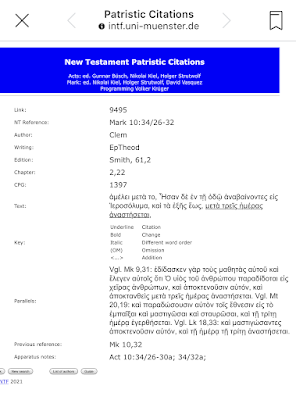
 

So, basically, these citations are from the controversial Letter to Theodore, which was discovered by Morton Smith in the Mar Saba monastery in the Judean Desert in 1958 in the back of a 1646–edition of Ignatius' Letters, copied by hand on the endpages. Smith took photographs of the pages and published his edition of the letter in 1973 (Greek text and Smith's photos here; English translation here). The implied author, Clemens of Alexandria, makes several references to both the (canonical) Mark and the infamous Secret Gospel of Mark (Theodore had posed questions about the latter; he apparently did not have a copy).  

There is an ongoing debate (though it has been a bit quiet lately) about whether this letter is genuine or a forgery (by Smith). For an introduction and negative assessment, see Stephen C. Carlson, The Gospel Hoax: Morton Smith's Invention of Secret Mark (Waco, TX: Baylor, 2005). For debate, see Tony Burke, ed., Ancient Gospel or Modern Forgery? The Secret Gospel of Mark in Debate (Eugene: Cascade Books, 2013).

I have heard that Geoffrey Smith and Brent Landau are currently working on a new book, The Secret Gospel of Mark: A Rogue Scholar, A Controversial Gospel of Jesus, and the Fierce Debate Over Its Authenticity (Yale University Press, 2022?). Does someone know what they will argue? We will see whether they will put an end to the debate.

In any case, these patristic citations are not included in Nestle-Aland 28, but will they be included in Nestle-Aland 29? I hope not, perhaps it was just a mistake. In my opinion, these citations should be treated with great caution and not on a par with Clement's other writings. What is your opinion?

If you are all fed up with this topic, you can always listen to and sing along with us at the ETC blogdinner in San Diego here.

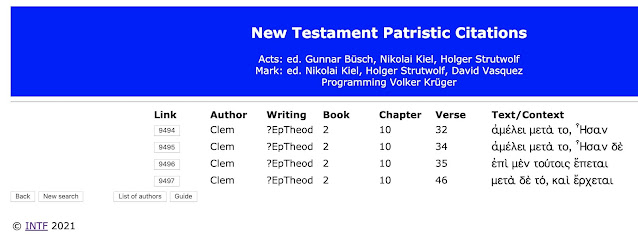
Update: Greg Paulson of the INTF informs us in a comment to the original post that, in light of this information, the editors have decided to add question marks to the references to EpTheod in the database (see image below), and "until a better scholarly consensus is reached" (of its genuineness), it will not be included in future Nestle-Aland editions. I am glad we caught this one.


Thursday, August 19, 2021

ECM of Mark: Thirty-three Changes to the Initial Text

9

The Novum Testamentum Graecum. Editio Critica Maior (ECM) of the Gospel of Mark has just arrived in Sweden in a shoebox size 43. First of all I want to warmly congratulate the team of the INTF in Münster for this splendid achievement, in particular for doing the finish during a long pandemic.

 There are of course many things to say, but here below I simply list the thirty-three changes to the initial text from NA28 to the ECM of Mark, indicating where how the Byzantine text aligns where it is not split itself (ECM Mark I:2,1, p. 20*). Apparently, in twenty twenty-five places the initial text moves towards the Byzantine text, and in six five places it moves away from it. In this context, however, it should be noted that there are thousands and thousands of variation-units (I have not checked how many).

A pdf of the list of changes as it appears printed in vol. 1 can be downloaded from the INTF, here

Further, there are 126 places where the editors print a split guiding line, i.e., where the decision between two competing variants is left open. This list can be downloaded from here

As for the accompanying digital tools, I wrote some years ago: “A desideratum for the future is an interactive interface that will enable users to pursue the complete critical process: to create their own local steammata of variants, build up a genalogical database, and successively evaluate the consequences of their textual choices” (Tommy Wasserman, “Criteria for Evaluating Readings in NT Textual Criticism,” in The Text of the New Testament in Contemporary Research, ed. Ehrman and Holmes [Brill, 2013], p. 607).  Well, the future is now here; to cite Klaus Wachtel, “Every user may now install the CBGM locally, make textual decisions, construct local stemmata, and make these the basis for their own genealogical evaluation” (ECM Mark I:2,3, p. 6). 

Thus, the CBGM toolbox (formerly called “Genealogical Queries”) for Mark is found here.

If you want to know more about how you can use the tools on your own, go here.

Again, congratulations to the editors and all contributors to this milestone in New Testament textual criticism! Now we look forward to the next volume.

Changes to the Initial Text of Mark

ECM / NA28 

  • 1:1/12-16
    υιου του θεου Byz / [υιου θεου] 
  • 1:2/18
    εγω Byz / om.  
  • 1:4/5
    om. Byz / [ο] 
  • 2:12/18
    εναντιον Byz / εμπροσθεν
  • 3:11/18-26
    προσεπιπτον αυτω και εκραζον λεγοντα / προσεπιπτον αυτω και εκραζον λεγοντες 
  • 3:14/6-14
    δωδεκα ινα ωσιν μετ αυτου Byz / δωδεκα [ους και αποστολους ωνομασεν] ινα ωσιν μετ αυτου
  • 3:16/1
    om. Byz / [και εποιησεν τους δωδεκα] 
  • 3:20/12-16
    συνερχεται παλιν οχλος Byz / συνερχεται παλιν [ο] οχλος 
  • 3:32/34-40
    om. / [και αι αδελφαι σου] Byz
  • 4:15/50-52
    εν αυτοις / εις αυτους 
  • 4:16/2-6
    και ουτοι εισιν ομοιως Byz / και ουτοι εισιν 
  • 4:31/4
    κοκκον Byz / κοκκω 
  • 6:22/30-40
    ο δε βασιλευς ειπεν τω κορασιω / ειπεν ο βασιλευς τω κορασιω Byz
  • 6:23/6
    αυτη Byz / αυτη [πολλα] 
  • 6:40/10-16
    ανα εκατον και ανα Byz / κατα εκατον και κατα 
  • 7:6/24-26
    ως γεγραπται Byz / ως γεγραπται [οτι] 
  • 7:9/28
    τηρησητε Byz / στησητε 
  • 7:12/2-10
    και ουκετι αφιετε αυτον ουδεν ποιησαι Byz / ουκετι αφιετε αυτον ουδεν ποιησαι 
  • 7:35/3
    om. / [ευθεως] Byz 
  • 7:37/22-30
    ποιει ακουειν και αλαλους λαλειν / ποιει ακουειν και [τους] αλαλους λαλειν Byz 
  • 8:35/28
    απολεση Byz / απολεσει 
  • 9:1/20-24
    των ωδε εστηκοτων Byz / ωδε των εστηκοτων 
  • 10:25/18
    εισελθειν Byz / διελθειν 
  • 10:28/22
    ηκολουθησαμεν / ηκολουθηκαμεν 
  • 11:3/20
    οτι Byz / om. 
  • 11:23/4
    γαρ Byz / om. 
  • 11:32/12-14
    τον λαον Byz / τον οχλον 
  • 12:36/20
    ο Byz / om. 
  • 14:31/12-18
    με δεη συναποθανειν σοι Byz / δεη με συναποθανειν σοι 
  • 14:44/34
    απαγαγετε Byz / απαγετε 
  • 15:12/19
    om. / [θελετε] Byz 
  • 16:14/4 
    om. Byz / [δε] 
  • 16:19/8
    κυριος Byz / κυριος ιησους 

Update: After I published this blogpost, Maurice Robinson asked me why the Byz was not indicated in a few additional passages, and in one case (16:19/8) it was indicated in the wrong place. When I looked at these passages I realized that the Byz had been dropped from the passages because the sign is not indicated where there is only a negative apparatus, but it certainly ought to be in the list on p. 20*. Greg Paulson of the INTF confirms that this is the case and will add them in the online PDF of textual changes (see link above). (I will ask him to check also the list with split guiding line.) In the last passage there was a printing error (the Byz sign was placed before κυριος ιησους too far to the right which created confusion; this has also been rectified).