Showing posts with label Inspiration. Show all posts

Friday, February 23, 2018

On the Relationship of Inspiration to Canon in the Church Fathers

4
Today, there is a renewed focus on the primary sources pertaining to the New Testament text (just peruse most of the posts on this blog) and its canon. Some of our source material is relatively new (MS finds, whole works of church fathers rediscovered etc.), but with regard to canon, the relevant sources have been at our fingertips for a long time. In any case, all of this evidence is under great scrutiny now, and this development is welcomed, for returning to the primary sources is the surest way forward in our current discussions.

One particular area under scrutiny is how to describe the nature of early Christian writings. Did early Christians think only the eventual NT books were inspired or did they view inspired literature as a wider category of books than what eventually became recognized as the canon of authoritative-for-doctrine Scripture? Michael Kruger has brought this issue to the fore in a recent blogpost and it is worth presenting his view along side of Lee McDonald’s, whose view he mentions in the post, in short order without attempting to resolve the differences between the two. Both views affirm the inspiration of the NT books. Both views affirm that early Christians thought their works were inspired in some sense. Both views affirm that early Christians recognized (at least eventually) the NT books as unique revelation. The disagreement is over why early Christians saw these NT books as unique, not whether they saw them as unique.

It’s important to remember that this is a blog exchange and that Kruger has written whole books and articles on the topic of canon. He didn’t say everything in his post. I bet Lee McDonald would even say he didn’t write everything in his most recent two volume tome on the biblical canon. I will include these works along with a few others in the Further Reading section below.

Monday, July 03, 2017

C. S. Lewis: Why the miracle of inspiration does not require the miracle of preservation

38
In his little book on miracles, C. S. Lewis has a chapter explaining why miracles should not be thought of as breaking the laws of nature. Instead, he says, they should be thought of as God introducing something new to nature which nature then acts on in typical fashion. He illustrates with a series of examples, one of which touches on the question of divine preservation.
If God creates a miraculous spermatozoon in the body of a virgin, it does not proceed to break any laws. The laws at once take it over. Nature is ready. Pregnancy follows, according to all the normal laws, and nine months later a child is born. We see every day that physical nature is not in the least incommoded by the daily inrush of events from biological nature or from psychological nature. If events ever come from beyond Nature altogether, she will be no more incommoded by them. Be sure she will rush to the point where she is invaded, as the defensive forces rush to a cut in our finger, and there hasten to accommodate the newcomer. The moment it enters her realm it obeys all her laws. Miraculous wine will intoxicate [but don’t tell Baptists], miraculous conception will lead to pregnancy, inspired books will suffer all the ordinary processes of textual corruption, miraculous bread will be digested. The divine art of miracle is not an art of suspending the pattern to which events conform but of feeding new events into that pattern.*
What constitutes the peculiarity of a miracle, Lewis goes on to say, is that it does not “interlock” with what comes before in the way that it does with what follows after. “And this,” he says, “is just what some people find intolerable.” They assume that nature is all there is and so they cannot tolerate anything invading it from beyond.

Related to textual criticism and inspiration, there is an unexpected agreement on this issue between Bart Ehrman and KJV-onlyists that Lewis is inadvertently touching on. The agreement lies in the belief that the miracle of inspiration must walk hand-in-hand with the miracle of preservation such that if you lose one, you end up losing both. For KJV-onlyists, this explains why they insist on the miracle of divine preservation; for Ehrman, if we are to believe what he says in Misquoting Jesus (p. 211), it explains why he came to deny the miracle of divine inspiration.

But Lewis helps us see why neither view is right. There is no reason to assume that God’s miraculous inspiration of the Bible should require him (or lead us to expect him) to miraculously preserve it from the “ordinary processes of textual corruption.” Instead, we have God, in the miracle of inspiration, introducing something from outside nature and then, in the non-miracle of transmission, letting nature take its course. (Or, as I would prefer to say it, we have God returning to his natural way of overseeing the world.)

Lewis helpfully reminds us that the inspiration and transmission of Scripture fit with the pattern of many of God’s other miracles. Just as we can expect the baby Jesus to gestate normally, so we can also expect the Bible to be transmitted normally. The miracle of origin does not require a second miracle of subsequent development.

---
*From the end of ch. 8 of Miracles: A Preliminary Study; emphasis mine

Monday, May 02, 2016

Is the Longer Ending of Mark Inspired? (with Poll)

46
Not a picture of the ending of Mark.
For some, the question of whether Mark 16.9–20 belongs to the original text of Mark’s Gospel settles the matter of whether it should be read, preached, and taught as Scripture. For others it’s not so simple. These 12 verses may have been added, but this does not mean they aren’t inspired by God.

I count myself among that small group that thinks Mark 16.9–20 is not Mark’s original ending but is still Scripture. These verses are attested early and widely and there is nothing in them that I can see that would discredit them theologically. The fact that they have been received by so many Christians as Scripture seems to me to weigh heavily in their favor.

But I admit I am probably in a minority in holding this position. So I was glad to find an ally this week in Samuel P. Tregelles who held the same view. I might still be wrong, but at least I’m in good company!

Here is how Tregelles explained his view:
As, then, the facts of the case, and the early reception and transmission of this section, uphold its authenticity, and as it has been placed from the second century, at least, at the close of our second canonical Gospel;­—and as, likewise, its transmission has been accompanied by a continuous testimony that it was not a part of the book as originally written by St. Mark;—and as both these points are confirmed by internal considerations—

The following corollaries flow from the propositions already established:—

I. That the book of Mark himself extends no farther than ἐφοβοῦντο γάρ, xvi. 8.

II. That the remaining twelve verses, by whomsoever written, have a full claim to be received as an authentic part of the second Gospel, and that the full reception of early testimony on this question does not in the least involve their rejection as not being a part of Canonical Scripture.

Tuesday, April 25, 2006

Does pointing matter?

11
Does Hebrew pointing matter? This may seem a strange question from someone who spent the good part of five years of his life teaching students to point Hebrew (see my exasperated The Great Pointing Crisis). However, I am asking it more as a theological question and in relation to evangelical doctrines of scripture.

Most are probably familiar with the story of how Elias Levita (1469-1549) called into question the antiquity of the Masoretic pointing and how the question of the antiquity and inspiration of the vowels became a matter of special controversy in the seventeenth century. Key elements included the bringing to Europe of the first copy of a Samaritan Pentateuch by Pietro della Valle in 1616, with a script that was (rightly) judged archaic and that lacked pointing. Johannes Buxtorf (snr) attempted to refute Elias Levita’s contention that the vowels were late, and this contention was continued by his son, Johannes Buxtoft (jnr), who particularly strove with Louis Cappel. Very much connected with this is John Owen’s controversy with the London Polyglot of 1657[1658].

Even towards the end of the seventeenth century the Helvetic Consensus Formula (1675) said that:
‘... The Hebrew original of the OT which we have received and to this day do retain as handed down by the Hebrew Church, “who had been given the oracles of God” (Rom 3:2), is, not only in its consonants, but in its vowels either the vowel points themselves, or at least the power of the points not only in its matter, but in its words, inspired by God.’ (Canon II, Klauber’s translation)
Subsequent opinion has concluded that those who argued for the antiquity or inspiration of the vowels were wrong.
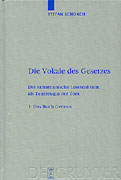
Some will also be aware that there has been some movement towards re-establishing the antiquity of the vowels—not arguing that they were ancient written entities, but rather affirming the antiquity of the reading tradition. Many who work within Masoretic studies find this plausible, and my Doktorvater, the great Semitist Geoffrey Khan, always used to say that the vowels were as old as the consonants. Even the Samaritans have their own oral system of pointing (with occasional marks in manuscripts) and this has been studied by Stefan Schorch (Die Vokale des Gesetzes: Die samaritanische Lesetradition als Textzeugin der Tora 1. Band 1: Das Buch Genesis [Beihefte zur Zeitschrift fur die alttestamentliche Wissenschaft 339; Walter de Gruyter, 2004]). It both agrees and disagrees with the Masoretic system.

I should like to distinguish between (a) the pointing as a source of information to us about ancient Hebrew and (b) the pointing as a necessary guide in the identification of lexemes and grammatical forms in particular instances.

It seems to me that the pointing is very important in giving us a knowledge of the language and in moving us closer to the position that a native speaker would be in (function a), but is relatively unimportant in actually identifying the lexical or grammatical forms being used (function b). I read through Jeremiah 36 and Genesis 1 last night in Hebrew with this in mind and came to the conclusion that with competence in the language (based on a knowledge of pointing) it was possible to identify the lexemes and grammatical forms in all words in these texts. I wonder how much this is the case across the Hebrew Bible.

Often when people have sought to disregard pointing, they have disregarded it in both functions a and b. Such was the case with Dahood. I wonder, however, what people think about the following as a possible evangelical approach:

To accept that pointing is a reliable guide to ancient Hebrew, to its repertory of lexemes and grammatical structures, but to argue that it is not necessary for the identification of lexemes and grammatical structures in particular cases. This would seem to me to have the advantage of being able to maintain that the ancient written text (consonants comprising words with clear lexical identity and in specific grammatical forms) is self-sufficient provided one has (from somewhere) expertise in the language.

Whether the object marker is pointed with sere or seghol is not relevant for grammatical function or lexical identification. Neither is the question of whether a form is in pause or not (though unit division itself can be sematically important).

The Helvetic Consensus Formula was IMHO wrong in attributing ‘inspiration’ to the vowels. However, I would like to think they were particularly striving to be able to maintain that words in the text had particular grammatical forms and lexical identities. If so, they would not have been so much in error.

Thoughts?

Thursday, January 05, 2006

God-given words and textual criticism

12
Back in October I posted a query about the strengths and weaknesses of evangelical textual criticism. In the light of the discussion of Ehrman’s Misquoting Jesus it seems that we might benefit from further discussion of this. In particular it would be worthwhile discussing the problems posed by textual criticism for the idea that God inspired particular words and their sequence within scripture.

Verbal inspiration is not merely an evangelical concept, but one presupposed in OT phrases that speak of God’s ‘words’ (e.g. Ps. 119:130). This pre-Christian idea has at various times been embraced by a wide range of historic churches. In fact, verbal inspiration has proven such a powerful notion that it has even been attributed to translations of the Bible, e.g. the Septuagint, or part thereof (Philo, De Vita Mosis 2.37-38), Vulgate, and, in the last century, even the KJV. This of course raises the question of the extent of such inspiration. We should avoid multiplying unnecessarily entities that have been thus inspired. Protestants at the Reformation maintained that verbal inspiration applied to the Hebrew/Aramaic text of the OT and the Greek of the NT, and evangelicals have generally continued in the same belief. My questions are as follows:

1) What, according to textual criticism, are the principal problems with maintaining that the 39 + 27 books of the (Protestant) Bible are verbally inspired in the original languages?

2) What are the ways one might go about addressing these problems?