Showing posts with label Hort. Show all posts

Tuesday, January 18, 2022

The Graves of Agnes Smith Lewis and F.J.A. Hort

10
 
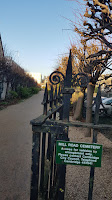
In a piece I was writing today I mentioned the Sinaitic Syriac and how the Smith sisters were involved in its identification. As the Cambridge connections are obvious I wondered where they were buried. The wonders of Wikipedia quickly informed me that Agnes Smith Lewis was buried in Cambridge at Mill Road Cemetery. I happen to cycle on Mill Road most days on my way into Tyndale House, but had never visited the place (it is set back from the road). On the Wikipedia page of this cemetery it was mentioned that F.J.A. Hort was buried at the same burial grounds! Imagine, cycling past for 22 years without ever taking the time to stop.


So as to beat the winter blues on these short days, I decided to see if I could find their graves. The area is now mainly used for walking and recreation. Some of the stones are heavily overgrown but most are still very accessible. The place has more of the feel of a small nature reserve than the somber atmosphere and formality that cemeteries can have.

With help of the excellent website of the cemetery, it didn't take me very long to identify the two graves. Agnes and Fenton John Anthony are buried only 10 – 15 meters away from one another. I have marked the places on the map.


Both monuments show their age, and especially Hort’s inscription is very difficult to read. You need to know which grave it is; a passer-by would never take the time to try and decipher the fading letters. Perhaps I should take a brush and see if I can clean it up, but weathering is mostly irreversible. In another century or so the stone may have gone completely.
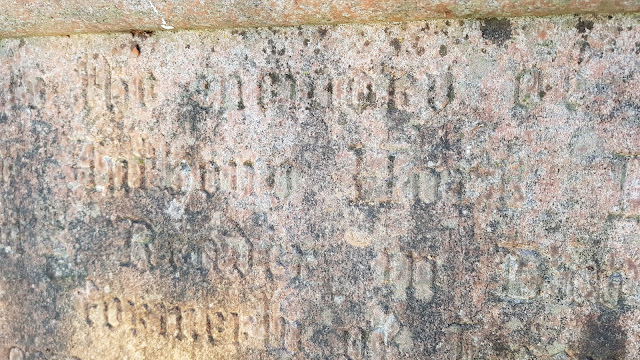
Second line: Anthony Hort 

Wednesday, November 09, 2016

Tischendorf’s ‘Wounded Vanity’?

6
In 1858, Hort reviewed the latest editions of both Tischendorf and Tregelles. He was much more positive about the latter than the former. In closing, he says this about Tischendorf:
Both editors in fact deserve the praise of conscientiousness in their actual work. But Tischendorf is becoming less careful than he used to be. We must add that the merits of his labours would be at least equally appreciated by duly qualified judges, if he were less given to proclaiming them himself. Even his title-page deserves reprobation: what he calls his seventh is to all intents and purposes his third edition: he has presumed far on his readers’ ignorance in reckoning his two Paris editions, which we should have thought he would have been only too glad to have forgotten. His old ungenerousness to every other editor is worse than ever: such an absurd effusion of wounded vanity and spite against his friend Dr Tregelles as he has prefixed to his third number will do him no good in the eyes of candid men.*
Now, in my experience, the British have a noticeable distaste for anything much beyond self-effacement. But this still seems a bit harsh from Hort. I’d like to hear from readers who have read more of Tischendorf than me: Is there some truth to what Hort says here or is he being unfair?

----
*F. J. A. Hort, “Notices of New Books,” The Journal of Classical and Sacred Philology, 4 (1858): 201–211 (211).

Thursday, October 27, 2016

Hort’s Review of Burgon’s Last Twelve Verses

14
In 1871, F. J. A. Hort wrote a short review of Dean Burgon’s well-known defense of the longer ending of Mark in The Last Twelve Verses of St. Mark. The review itself isn’t especially noteworthy. Hort found himself unconvinced and unimpressed by Burgon’s case. Burgon was no fan of Hort’s text critical work either, of course.

What is a bit more interesting is that Hort wrote his review just before the committee of the Revised Version was set to meet in Westminster to discuss this very text. So Hort must have gone into the meeting with the issues fresh on his mind. Here is what Hort wrote to Westcott about the review.
To the Rev. Dr. Westcott
St Ippolyts, All Saints’ Eve [Tuesday, October 31], 1871

Mr Burgon, aided by various interruptions, has swallowed up two precious days:—not more, I hope. I send you the result for correction or approval. I want to send it to Cheyne as early as possible, hoping that it may be in the Academy of the 15th, which will appear just when we are discussing Mark xvi.9–20 at Westminster. If you have not seen the book, you will still be able to judge on most points. Even the brief statement of principle may be useful. It was useless to attempt particulars without more space, and I have already transgressed. Is not what little I have said about Mr Burgon’s style necessary? It was difficult not to say much more. The point about + τέλος + is very curious and deserves further working.
Here is the review that was published in The Academy the same year (vol 2, pp. 518-519):

Monday, September 07, 2015

Reading in the Wren Library

2
I spent three wonderfully quiet hours this morning in the Wren Library, under the gaze of Richard Bentley (and other luminaries) checking out some leads for my research on Hort’s relationship with Tregelles.


During his life Tregelles had very cordial relations with Hort and supplied Hort with lots of information and early proof sheets of his NT edition (indeed one reason why Westcott and Hort’s edition was so delayed was their dependence on Tregelles’ edition). After Tregelles’ death in 1875 his wife corresponded with Hort since Hort had agreed to edit Tregelles’ Prolegomena (from his published work). After Mrs Tregelles death in 1882 her sister Augusta Prideaux wrote to Hort saying that both Dr and Mrs Tregelles had expressed their wish that all of Tregelles’ notes and collations should be given to Hort. Anyway, today  I found the letter from Augusta Prideaux to Hort along with Hort’s list of all the items she sent. Some of these I already knew about (and may even have blogged about), but others I didn’t. So with only a couple of exceptions I think we can locate almost all of Tregelles primary working transcriptions and collations (not his general papers and correspondence though).

Along the way it was fascinating to read letters from Lightfoot, Westcott, Mrs Tregelles and others. Two letters struck me. The first was from Mrs Tregelles writing to A.A. Vansittart in 1870 - a Fellow at Trinity College who was helping get the text of the Apocalypse ready for publication after Tregelles’ health had broken down:

S.A.T. to AAV (14 Nov 1870): “Dear Mr. Vansittart, Dr Tregelles wishes me to tell you how very satisfactory to him is your most kind letter received yesterday, and he also requests me to say that he does not believe that you will find anything queried that it will puzzle you to answer. They are merely questions which if he was well enough to use the books in his study, he could get through in a couple of hours. It has not been without some struggles of feeling that he has relinquished the hope of finishing the work himself, but he knows that all that is withheld as well as granted is ordered for him by a wise and loving Heavenly Father. With his kind regards, believe me, yours very truly, S.A. Tregelles.”
[Augustus Arthur Vansittart, by the way, was very interested in the text of the Greek New Testament, and his notes are full of mostly blank note books containing careful transcriptions of NT mss that do not seem to have been finished. He created a fascinating textual presentation of some books (notably Hebrews and 1 Corinthians) with the main text at the top and all the readings of the different manuscripts below (a kind of pre-Swanson type of presentation). But he published practically nothing. Except for his famous and clever Latin translation of Jabberwocky.]

A very similar tone is evident in a letter from Ezra Abbott to Mrs Tregelles after he had heard news of S.P. Tregelles’ death (July 22 1875):
“Rather would we thank God for all that he was to those who knew him best, and for all that he was permitted to do, as a faithful disciple of Christ for the good of his fellowman; and say, in humble resignation and trust, “The Lord gave; the Lord hath taken away; blessed be the name of the Lord!”