Showing posts with label Dallas Seminary. Show all posts

Monday, July 30, 2018

David Smith: Why GA 1411 Should Not be GA 1411: On Classifying Catenae Manuscripts

10
The following is a guest post from David C Smith. David and I worked together a few years ago in Athens with CSNTM. He is completing a ThM at Dallas Theological Seminary and is a Deacon in the Anglican Church in North America. His masters thesis, entitled “A Study of the Text and Paratext of the Catena on Luke in GA 1441,” should be completed this summer. Here is some of the fruit of that work.

Introduction

The question of Catenae Manuscript classification has been raised by some as the details and purpose for composition have been more clearly understood. I wish to contribute some data to the conversation that has come from my work on GA 1411, a relatively unexplored and unanalyzed MS from the National Library of Greece. I was fortunate enough to digitally preserve this artifact with my good friend Andrew Bobo as we worked for CSNTM in the summer of 2015.

The purpose and use of catenae manuscripts has been explained more fully in the NTTC world by scholars such as William Lamb, Hugh Houghton, and David Parker. Lamb in particular has argued that these manuscripts were not primarily written as witnesses to the New Testament, but were written as educational textbooks in the medieval Byzantine scholastic context. Much of his argument is based on situating these manuscripts in their historical context, and in turn showing how this understanding of the compositional purpose of catenae manuscripts explains the high amount of variance in not only their biblical text but in their patristic commentary. In addition, this explanation of their purpose calls into question their use as witnesses of the New Testament alongside other continuous-text manuscripts, which are clearly written to transmit the NT text.

For many reasons, not much work has been done on the Greek catenae manuscripts as artifacts to see if the actual details of the manuscripts support this conclusion from Lamb and others. That is, if we were to examine the textual and paratextual details of a given catenae manuscript, would the phenomena of the artifact be best explained by the theory that they are educational textbooks/anthologies?

My master’s thesis at Dallas Theological Seminary is a study of GA 1411 to attempt exactly this. I am trying to observe the details and phenomena of this manuscript to judge whether or not Lamb’s explanation best fits.

Tuesday, October 18, 2016

Dr. Charles Caldwell Ryrie’s Bible Collection to be Auctioned

1
NEW YORK, 6 October 2016—Sotheby’s is honored to announce the sale of one of the greatest private collections of printed and manuscript Bibles formed since the 19th century, The Bible Collection of Dr. Charles Caldwell Ryrie, which will be held in New York on 5 December 2016. Dr. Ryrie (1925–2016) was best known for his eponymous Study Bible, which contains 10,000 concise and cogent explanatory notes and has sold more than 2,600,000 copies. But while the Study Bible was directed towards the general reader, Dr. Ryrie was a titan among theological and Biblical scholars, and the author of numerous academic books and articles. The leading proponent of dispensationalism of our times, Dr. Ryrie influenced generations of students, teaching at Calvary Bible College, Westmont College, Dallas Theological Seminary and Philadelphia College of Bible (now Cairn University).


The New York sale on 5 December will include some 200 lots of manuscript and printed Bibles, ranging from the tenth-century “Benton” Gospels in Greek (estimate $50/$80,000) to a beautifully illuminated thirteenth-century Italian manuscript Bible in Latin (estimate $150/250,000) to two leaves surviving from the Gutenberg Bible, printed in Mainz about 1454 (estimate $50/70,000 each). But the core of the Ryrie Collection is the remarkable run of early English translations of the Bible, including multiple very rare early editions of the versions prepared by Myles Coverdale and William Tyndale, the latter of whom was martyred. Most remarkably, the Ryrie Collection includes a manuscript of John Wycliffe’s New Testament, produced in England about 1430 (estimate $500/800,000). The Authorized, or King James version is also well represented, including the tallest copy known of the first edition, from the celebrated library of Louis Silver (estimate $400/600,000). First and other early editions in many other vernacular languages are represented as well, including German, Spanish, Italian, Irish, Welsh, and the Indian Massachusett language.

Following November exhibitions of selected highlights in London and Chicago, the New York exhibition of the full Ryrie Collection will open on 1 December 2016, alongside the seasonal offerings of Fine Books and Manuscripts.

Selby Kiffer, International Senior Specialist, Books & Manuscripts remarked: “It is a testament to Charles Ryrie’s personal modesty that, despite his myriad accomplishments, he was not widely known as a book collector. The wider world first learned of the remarkable collecting achievement of Dr. Ryrie through the 1998-99 exhibition, Formatting the Word of God, at the Bridwell Library of Southern Methodist University. But that exhibition, remarkable as it was, featured fewer than half of the volumes in Dr. Ryrie’s collection and none of his extraordinary letters and documents signed by theological figures such as Martin Luther, John Calvin, and John and Charles Wesley. When the full extent of his collection—astutely gathered over the course of more than five decades—is revealed, it will surely be acknowledged as a string of bibliographical pearls of great price.”

The family of Charles Ryrie has expressed their hope that his books and manuscripts will go to other collectors who will treasure them as much as he did: “While our father’s collecting was largely a private endeavor, he keenly enjoyed sharing his books and knowledge with a small group of collectors, libraries, and dealers. We are sure that he would be pleased to know that his collection will now go to other collectors just as dedicated and as passionate he was.”

The Bible Collection of Dr. Charles Caldwell Ryrie will offer collectors, both individual and institutional, the opportunity to compete for a great variety of Biblical treasures, many of which have not been available on the market for decades.

COLLECTION HIGHLIGHTS
  • New Testament in English. Manuscript on vellum, England, ca. 1430, of the version inspired by and traditionally attributed to John Wycliffe (ca. 1330-1384).
    Estimate $500/800,000
  • Mamusse Wunneetupanatamwe Up-Biblum God Naneeswe Nukkone Testament kah wonk Wusku Testament. Cambridge, Massachusetts: 1661-63. The first Bible printed in America, translated into the Massachusett Indian language by John Eliot.
    Estimate $200/300,000
  • The Holy Bible, conteyning the Old Testament, and the New. London: Robert Barker, 1611. The largest known copy of the first edition of the King James Bible, “the only literary masterpiece ever to have been produced by a committee.”
    Estimate $400/600,000
  • The Holy Bible. London: Robert Barker, 1631. A detail from the “Wicked Bible,” which, due to error or mischief, omitted the “not” from the Seventh Commandment (Exodus 20:14).
    Estimate $15/20,000

HT: Fine Books Magazine

Friday, May 27, 2016

Fun Fact Friday

0
Tregelles’s 1549 Stephanus GNT
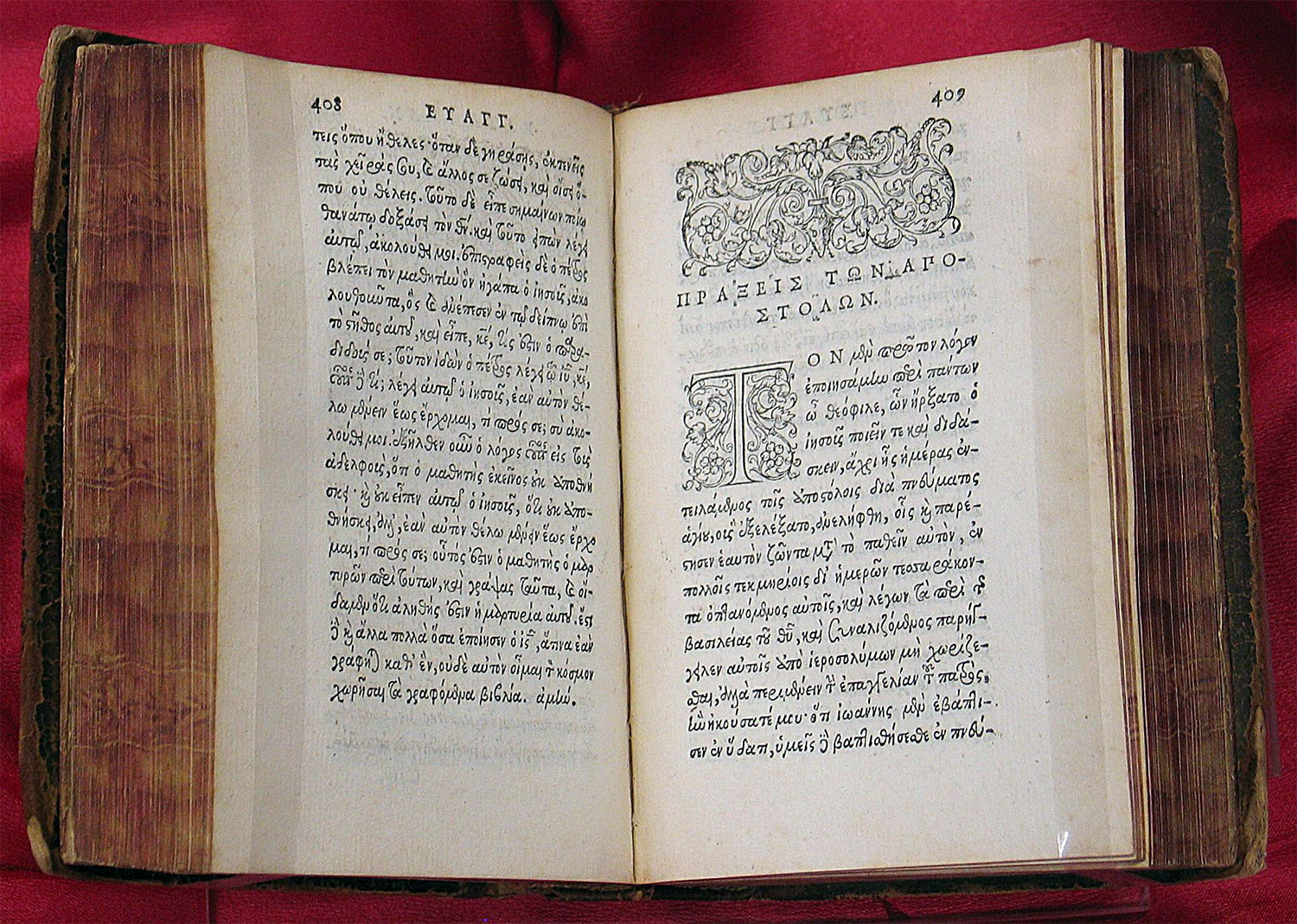
Dallas Theological Seminary’s Turpin Library owns a copy of Robert Stephanus’s 1549 Greek New Testament that was once own by Samuel P. Tregelles and was then given, by his wife, to B. F. Westcott. Stephanus, of course, is best known for adding versification to the NT in his 1551 edition.

The book was owned by DTS professor J. Dwight Pentecost who donated it to the library. Pentencost was still teaching classes when I graduated in 2012. He was then 93! We used to eat dinner with him fairly regularly because he lived in student housing. He was slowing down by then, but his mind was still sharp.

One night I got to talking to him about my text critical interests and I learned that he regularly used a form of the textus receptus for his own study. Apparently Tregelles and Westcott had not worn off on him.

If you’re in Dallas, stop by the Turpin Library and check out their nice collection of rare Bibles.