

A forum for people with knowledge of the Bible in its original languages to discuss its manuscripts and textual history from the perspective of historic evangelical theology.
- Contributors
- Peter M. Head (ed)
- Tommy Wasserman (ed)
- P. J. Williams, and others
Looks to me like it's on the same construction as the Hebrew inscription.
ReplyDeleteGreat... I've just spent the past hour on this, which I could have used on my "real" work. And I still can't work it out...
ReplyDeleteThere's too much glare to the right. Enlarging didn't help at all.
ReplyDeletePhotoshop might clear it up enough to read.
well, can't pass up a puzzle, but don't have time either.
ReplyDeleteThe Hebrew one took about 1.5 seconds, about the time for the image to come into focus. But that was a known text. I feel like I've seen it before somewhere.
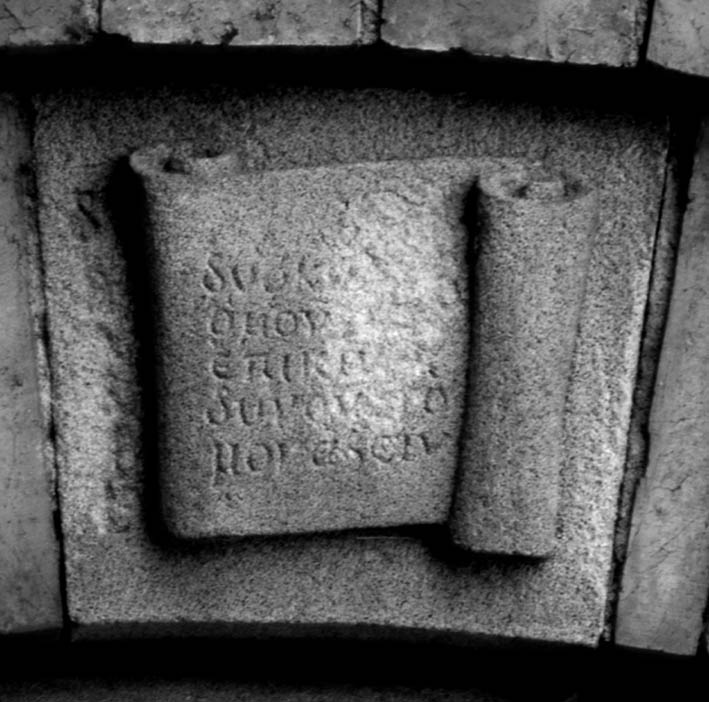
The greek one looks like a misspelled "...they were able to remain single"
... [η]δυναντω μοναζειν.
This would not be from the NT.
Maybe this will let tze-ming check LXX or other sources for a quote.
on second thought, looking at the nice line up of letters on the left,
ReplyDeleteperhaps the dun- word is
δυναμεθα
μοναζειν
we are able
to be alone
δυσκολον
ReplyDeleteομον
επικινειν
δυναμεθα
μοναζειν
difficult
together
to go forward
we are able
to remain alone
a strange proverb, if correct.
Randall,
ReplyDeleteI'll accept your take on the second and fifth word, and even on the second vowel of the fourth, but I don't see through the glare quite like you seem to.
I get:
duskwXXX
omon
epikwXX
dunanXXd
monazein
δυοκ[...]
ReplyDeleteομου[...]
επικω̣[..]
δυναντο
μον.ζειν
??
I like using Google's free tool "Picasa". Try opening this image with it. Go to effects and hit sharpen a couple of times.
Two points: the white area is not glare from a flash but corrosion.
ReplyDeleteThere are also some letters, a name perhaps, to the left of the scroll.
OK. I searched MONAZEIN on TLG and came up with a match:
ReplyDeleteDUSKOLON
OMOU KAI
EPIKIN
DUNON TO
MONAZEIN
This might be a better proverb than the brilliant one that Randall Buth came up with: 'It is difficult and dangerous to be alone.'
Basil of Caesarea quotes this twice:
Basilius Caesariensis Theol., Asceticon magnum sive Quaestiones (regulae fusius tractatae). {2040.048} Volume 31 page 901 line 19. and Volume 31 page 928 line 27t.
There is no other plausible match in TLG (assuming MONAZEIN).
Now how about some paleography?
ReplyDeleteThis is not your typical minuscule script. Rare enough it is to find such curved strokes in an inscription, but to find them lower-case and unattached--this doesn't leave us much to go on for dating purposes, does it?
Shalom Peter,
ReplyDeleteThank you for the TLG reading.
DUSKOLON
OMOU KAI
EPIKIN
DUNON TO
MONAZEIN
that's close enough for me without seeing the stone. On translation, without a context, I would be inclined to read a little differently:
"difficult together,
and dangerous to be alone"
That is, it is difficult to live or work together with someone, but it is dangerous to be alone.
Given that translation, I'd expect this inscription to grace the walls of a monastery somewhere.
ReplyDeleteThanks Randall,
ReplyDeleteThere is a usage of OMOU KAI meaning 'in like manner as, just like, as' (LSJ). This would suggest continuity rather than discontinuity. But I shall try to find some context!
P
So what's the answer to the quiz?
ReplyDelete