Tuesday, October 12, 2021

The New CSB Note at 2 Peter 3.10

1

Last night in class, the students and I were talking about how changes in the NA28 might affect English translations. So I pulled up 2 Peter 3.10 in the CSB as an example. I wrote about this note before and criticized it for being misleading. Lo and behold, the CSB has updated the note with what appears to be perhaps the first Bible footnote taken from an ETC blog post! I can’t be sure, of course, but the evidence looks compelling.

The old note at 2 Peter 3.10 said “Or will not be found” which read as if it was saying “some Greek mss read...” which is, of course, not the case. Now it says “Some Syriac and Coptic mss read will not be found.” That’s much better.

Here’s my ETC post.


And here’s the new CSB note.

Curiously, this change is not noted in the official list of changes in the CSB 2020 revision. But it certainly is a change from what I found in 2017.

Saturday, October 09, 2021

PhDs and Post-Docs in Textual Criticism at Leuven

0

 From an email: 

KU Leuven, Belgium, offers 2 full-time post-doctoral (2 years) and 3 PhD positions (4 years) for suitably qualified candidates to form part of the research team of the Research Foundation Flanders (FWO) funded Odysseus project “1Cor – Text, Transmission and Translation of 1 Corinthians in the First Millennium”. The project’s main goal is to produce full scholarly editions and textual analyses of 1 Corinthians with a multilingual perspective.

The successful post-doctoral candidates will work on the Greek and Coptic transmission of the text respectively. The doctoral studies will focus on citations of 1 Corinthians in Early Christian writers, the text in liturgical manuscripts, the textual developments in the Latin tradition or other versional evidence.

Further information about each position and application details can be obtained through the following links. The deadline for applications is 25th November 2021, the project will start on 1st March 2022.


Postdoctoral Position (Coptic): https://www.kuleuven.be/personeel/jobsite/jobs/60067697

Postdoctoral Position (Greek): https://www.kuleuven.be/personeel/jobsite/jobs/60067751

3 PhD Positions: https://www.kuleuven.be/personeel/jobsite/jobs/60067690


Please feel free to circulate this information more widely and to alert colleagues and students who you think may be interested and suited.

Informal enquiries may be addressed to christina.kreinecker@kuleuven.be

Friday, September 24, 2021

Hebrew Scribes at the End of the Line

9
Composing a text by hand demands an awareness of certain details that we can ignore when using a word processor. One of these details is if the next written word corresponds to the available space. At times, the space didn’t for Hebrew scribes, and when this happened, they had several ways to navigate this situation. Let’s review some of these. For more information on these practices, see Tov’s discussion in chapters 4 and 5 of his book Scribal Practices. This list depends on and derives in part from his helpful discussions.

First, scribes could utilize the margin to finish the word. This practice is not uncommon. Here is a portion of column 2 of 1QIsaa illustrating this practice.


Second, a scribe could fill in the remaining line with space fillers. The scribe of 1QIsaa resorts to using dots in 1QIsaa Col 3:6.


Third, a scribe at times began a word at the end of a line but didn’t finish it. Instead, the word was written in full at the beginning of the next line. Here is an example from 1QIsaa Col 2:11.


Fourth, it is possible that the scribe of 1QIsaa began a word and simply failed to finish it. See 1QIsaa Col 6:3.


Fifth, a scribe might begin a word at the end of the line and complete it on the next line. Tov states that this was a practice of scrolls written in paleo-Hebrew. 11Q1 Col 3:5, 6, 7 are examples of this.


Sixth, a scribe might resort to a smaller “font-size” to fit the word in the available space. See 1QIsaa Col 16:30 (the first line in the photo below).


Seventh, a scribe might write part of the word above the line. Here are some examples from 4QPsx.


Eighth, a scribe might cram words together leaving little space between the words. This tendency is common in 4QPsx and here in 1QIsaa Col 16:24.


Ninth, a scribe might leave bigger spaces between letters as here in 4QDeuth 1:5–7. Tov labels this device “proportional” spacing. 


These pictures were taken from photos found at the Leon Levy DSS Digital Library and the DSS Digital Project.

Monday, September 20, 2021

More NT Textual Criticism Guest Lecture Videos

5

I’m teaching NTTC again at the seminary and that means having guest lecturers visit to share their work. The first two videos are now up at the TCI YouTube channel. If you subscribe there, you’ll get new videos when they’re posted. Thanks to Mike and Edgar for letting me share these.

Ebojo on P46 and the Pastoral Epistles


Holmes on Editing and Translating the NT for Church and Academy

Thursday, September 16, 2021

Richard Porson’s Famous Handwriting

37
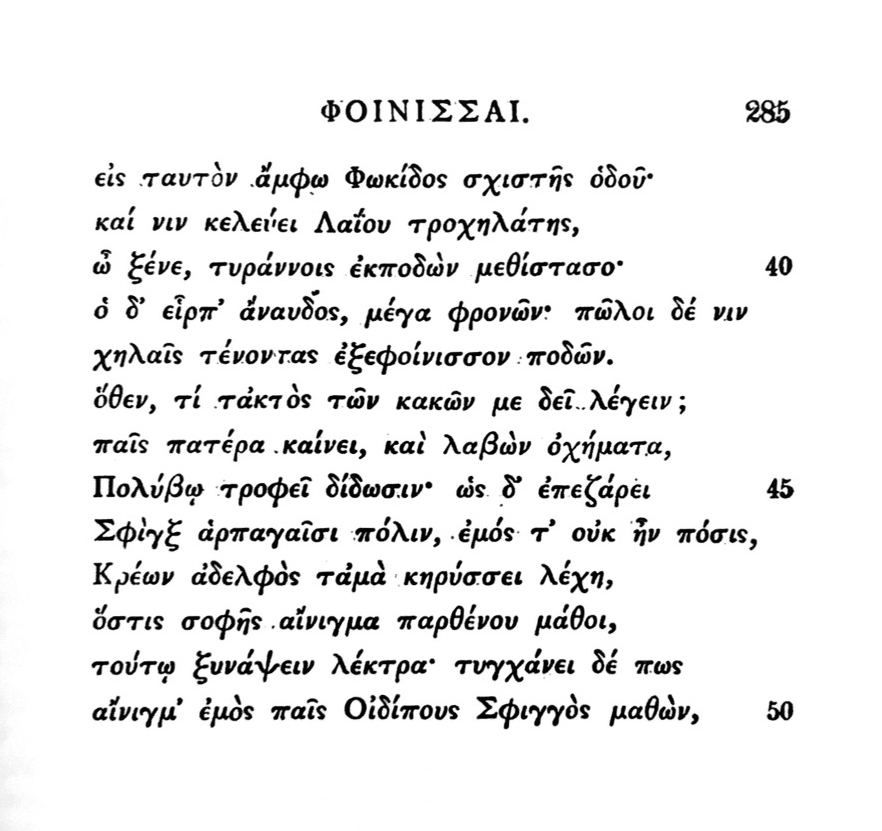
Although he published little, the Cambridge classicist Richard Porson (1759–1808) is best known for his insight into Greek meter, accentuation, and orthography. He was apparently skeptical of Granville Sharp’s rule about the use of the Greek article that has been so important to New Testament studies. he was even suspected by some of having written a tract against it under the pseudonym “Gregory Blunt” (pun intended). More popularly, he was known for “an astonishing memory, a turn for satire and badinage, beautiful penmanship, personal slovenliness, and alcoholism” (Naiditch, xxi). But Porson denied having written it and his biographer agrees (Watson, 267270). His greatest legacy, as far as I am concerned, is his Greek handwriting that was turned into what I consider the best Greek typeface ever designed in Britain. 

The original characters were cut by Richard Austin and cast by Caslon and Catherwood. Austin was paid 22 pounds and 7 shillings. It was first used in 1809 in E. D. Clarke’s Greek Marbles brought from the shores of the Euxine. Its simplicity and lack of ligatures made it easy to read so that it was quickly copied and by the mid 19th century it was “almost universal in Britain” (Bowman, 2). You can see it in all sorts of books from Metzger’s Lexical Aids to Westcott and Hort’s GNT to Loeb Classical Library. One reviewer at the time compared the new type to the “disgustingly luxuriant” types of Bodoni and said that, in contrast, “the eye of the scholar now peruses, with a satisfaction bordering on delight, the porsonic type” (Bowman, 2). 

Porson’s Book Notes from c. 1800 (source)

Porson’s handwriting

The original type specimen from Cambridge University Press (from Bowman)

It was also used for the early editions of the UBS Greek New Testament but this changed—to Metzger’s chagrin. He says that he was not happy about the change to the “less attractive and harder to read [type] than the beautiful Porson font of Greek type that I had recommended for the earlier editions” (Reminiscences, 73). Kurt Aland admits as much in the intro to the NA26 (p. 43*) when he says “the font used [for NA26] is certainly lacking in the simplicity and clarity of that used for The Greek New Testament.” Given its ties to Cambridge, I tried to get the THGNT editors to use it but they went with Adobe Text instead (not a bad choice).

Westcott and Hort’s GNT (1881)

You can download a digital version of Porson from the Greek Font Society.

Further reading

Wednesday, September 15, 2021

GA 048 and the Text of Ephesians 5:22

23

Some years ago, I wrote a blog post on the text of Ephesians 5:22. There I suggested that the neglected longer reading (ὑποτασσέσθωσαν) seemed to me to be the more difficult reading while noting a simple transcriptional explanation for the shorter reading.

Since then, I have fleshed out my argument in much more detail and the result is a new article in NTS. (For those without access, here’s the pre-pub version.) If my textual argument is sound, the upshot is a resolution to the longstanding debate about where Paul starts his instructions to the household. Beginning with the RSV, English translations started to reflect the uncertainty by putting paragraph breaks before 5.21 or before both 5.21 and 5.22 (NEB, NIV1984, NRSV, NCV, etc.) while some still put one only before 5.22 (NKJV, NASB, ESV, NET). Commentators, of course, also disagree and the issue has become a lighting rod for debates about Paul and gender.

As part of my work on this variant, I revisited the text of 048 (Vat. Gr. 2061). 048 is a palimpsest with a fifth-century undertext from Acts and Paul. Given its early date, it’s quite important and is consistently cited in NA28. However, it is not cited at Eph 5.22. My guess is that this is because the last major collation of 048, done by Dale Heath in 1965 from photographic plates, says the text is illegible at this point. Well, I gave it a crack using the images at the VMR and some Photoshop adjustments and I’m pretty sure that this fifth-century witness has ὑποτασσέσθωσαν. Not surprisingly, it also has a new paragraph at 5.22 too. 

You can see my attempt to reconstruct the text and judge how I did. Red letters are ones I’m pretty confident about and blue are ones where I really can’t be sure about.


Because I didn’t have color images or MSI, I included 048 with “vid” in my article. So, here is my formal appeal for the Vatican to digitize this early manuscript using MSI and for someone to write a fresh dissertation on it. Even without new photos, I think there’s quite a bit more text to be deciphered than what Heath was able to if someone is willing to work at it.

Update

Christian spotted that the Vatican now has color photos that weren’t there when I worked on this last. They seem to use UV light. Posted below is a close shot of the color image with some heightened contrast. I only had a little time to spare today. Anon also alerted me to the IGNTP transcriptions that I didn’t know about. They disagree with my reconstruction so be sure to check that out too.

fol. 300r