Wednesday, October 31, 2018

An Unidentified Fragment

4
The text of the fragment below is unidentified; that is, unidentified by me; that is, I know something about it, but not where this text comes from.
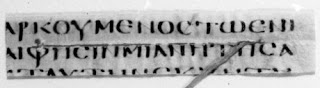

This is what I know. It is one of four parchment fragments found in a 6/7 century papyrus codex of Origen (Cairo, P. Inv 88748). These strips of parchment, taken from a codex that was by then about 200 years old, were used to provide more grip for the binding of the papyrus quire.

On the only website with images of the codex that I could find (here), there are only images of three different sides of the parchment strips. Two of them show text of Genesis 31:8, and the third one is unidentified. The editio princeps mentions that on the verso of the Genesis fragment there is text from Hebrews 12 (which did not make it into the Gregory-Aland list). But I have not been able to verify this. Incidentally, Scherer, the original editor, only mentions the text on the first of these fragments in a footnote:


However, Fraenkel in the Verzeichnis of manuscripts of the Greek Old Testament (p. 165-66) has more information. He gives the content of the two Genesis fragments, and identifies the third as Psalm 26:4a init. - εκζητη<σω>. I believe that he is talking about our fragment, as I can see from the second line onwards most of the first line of 26:4a μιαν ητησα[μεν παρα κυριου] ταυτην εκζητη[σω. However, this means that we have simply an ‘in-line’ citation of Psalm 26.

These are the two Genesis 31 fragments, the script looks very much like our unidentified bit.


I would be tempted to assume that, as there is Hebrews 12 text on the verso of the first, so also on the second. Both fragments belong together with only a single line missing in between.

The original manuscript that provided these parchment strips cannot have been a continuous text manuscript, but what it was I don’t know.

Any wisdom out there? Do we know of a work that combines Gen 31 and Heb 12 close together (within one folio), and perhaps also with a citation of Psalm 26 thrown in (near or far to the previous)?

Tuesday, October 30, 2018

Base Texts for Transcriptions Again

3
In a previous post on “Methodology in Transcribing Greek Manuscripts” I suggested that the use of two different base texts, Nestle-Aland and a Byzantine text like Oxford Textus Receptus 1873, for independent transcriptions of a manuscript might result in the elimination of errors resulting from the use of the same base text where transcribers would risk making the same mistake in trusting their base text too much.

In any case, a reader of our blog, Anthony Pope who for some technical reason could not comment on that post sent me a relevant example I could share of an error  in the Editio Critica Maior of Acts, 28:13 (4) which would likely have been avoided using two base texts:

a περιελοντες 01*. 03. 044. 6. 93. 321. 383. 398. 665. 1127. 1609. 1838. 1842. 2200. 2774

Only the uncials listed read περιελοντες. All the minuscules listed read περιελθοντες, as can be verified from the images on the NTVMR. The error has been reported to the editors and will be corrected in the next revised edition.

Do any readers have other examples or thoughts? Share them in the comments.

Monday, October 29, 2018

The Biblical Canon Lists Reviewed by Lee Martin McDonald in RBL

0
Reviews of The Biblical Canon Lists from Early Christianity keep coming out. See the earlier ones from Reading Religion and JETS
respectively. Last week, Review of Biblical Literature published Lee Martin McDonald’s (long-time canon scholar and recent author of The Formation of the Biblical Canon) musings on the book.

He provides a great summary of the work, a few items for Ed and me to think about in the event of expanding the work in the future (e.g. more comment about the texts of the books in these lists such as forms of Mark’s gospel or forms of Jeremiah et al.), a few disagreements with us  (e.g. whether Melito refers to Wisdom or not), and a strong recommendation for the book. You can read the whole review here [PDF]. McDonald concludes his review as follows:
Gallagher and Meade are also to be commended for their frequent use of the words “possibly” and “may be” when the evidence in their sources is not as clear as they would hope. I also want to commend them for their irenic position toward all those with whom they disagree without demeaning either the scholars or their positions. They have produced a superb volume with a wealth of information about canon formation that cannot be ignored in all future investigations of this topic. They have produced what I think may well remain the standard volume on canon lists that scholars and students alike will appreciate for years to come. I heartily recommend this impressive volume.
Thanks for a gracious and helpful review, Professor McDonald!

Wednesday, October 24, 2018

Methodology in Transcribing Greek Manuscripts

10
About two weeks ago I participated in a meeting in Volos, Greece, with the groups that are currently editing the Novum Testamentum Graecum Editio Critica Maior (from Münster, Birmingham, and elsewhere). We had a lot of stimulating presentations and discussions. At some point in a discussion I repeated an old suggestion I have made that independent transcriptions of manuscripts which are later reconciled (i.e., compared by software with each other and checked by a third person who resolves any differences between the files in order to create one reconciled transcription) could be transcribed from two different base texts – the Nestle-Aland text and a Byzantine text.

Personally, when I worked on my dissertation on Jude I transcribed some 560 manuscripts, most of which naturally followed the Byzantine majority, and so I used the Textus Receptus (Oxford, 1873) as a base text which I then edited for each manuscript. I did not want to use the Nestle-Aland text as a base text because I reckoned I would have to edit each Byzantine minuscule much more (i.e., more work), and when editing I would also risk introducing errors.

In fact, I transcribed first on paper because the computer tools for transcribing were not as good, and the paper method actually saved me precious time. I used a base text on the left side of the paper and recorded variants by underlining the text that had variation and recording the variant on the right side of the paper. The most common variants were already listed in the right margin so that I could just put a circle around the one attestested by the manuscript I transcribed ... I saved valuable "Münster-time" (yes, in these days you had to go to the INTF in Münster to collate manuscripts, there was no NT.VMR). When I came home I entered everything into the software Collate 2.0 developed by Peter Robinson (who sent me his software and manual for free – Kudos to him, I could not have done this without his software). I learnt the paper-transcription trick, i.e., to have the basetext with prepared variants on paper, from no other than the transcription master Maurice Robinson (who, to my knowledge, has not yet entered his collation data of the pericope adulterae into digitial form, but hopefully this will happen). UPDATE: Maurice informs us in a comment that all data has been digitized and he is waiting for an interested publisher.

In any case, I know that the INTF have used the Nestle-Aland text as a base text for a long time, and at the meeting in Volos someone pointed out that it is actually good that the manuscript to be transcribed differs from the base text – this will keep the transcriber alert and they will do less mistakes and this may well be the case. On the other hand, there was an openness to consider my proposal to use two different base texts for the initial independent transcriptions, at least it could make for an interesting experiment.

Here is my own experience as of today. I have just trained a student how to read and transcribe a manuscript in Philippians with the Online Transcription Editor, not the editor which is integrated in the NT.VMR, but the freestanding OTE (http://www.itsee.birmingham.ac.uk/ote/). There you upload a base text, transcribe your manuscript (using images from NT.VMR or elsewhere) and then export to an xml.file which you name after the manuscript you transcribe. As I was proofreading the first attempts by this student today I found the following seven errors (among others) which would likely have been spotted in a reconciliation where two students had used two distinct base text according to my proposal (NA28 and Textus Receptus):

Minuscule 365

1:27 ακουω (= base text NA28);
the manuscript reads ακουσω (= Byzantine text)

2:5 φρονειτε (= base text NA28);
the manuscript reads φρονεισθω (= Byzantine text)

2:23 αφιδω (= base text NA28);
the manuscript reads απιδω (= Byzantine text)

2:30 παραβολευσαμενος (= base text NA28);
the manuscript reads παραβουλευσαμενος (= Byzantine text)

3:6 ζηλος (= base text NA28);
the manuscript reads ζηλον (= Byzantine text)

3:10 συμμορφιζομενος (= base text NA28);
the manuscript reads συμμορφουμενος (= Byzantine text)

4:15 λημψεως (= base text NA28);
the manuscript reads ληψεως (= Byzantine text).

As I proofread I found another very interesting variant in Philippians 1:14. The manuscript does not read πεποιθοτας (both NA28 and Textus Receptus), but πεπονθότας. If I am not mistaken this translates, "and most of the brothers and sisters, having suffered in the Lord by my imprisonment, dare to speak the word with greater boldness and without fear." This variant is not listed in von Soden's edition. I haven't checked Tischendorf's 8th edition.


Tuesday, October 23, 2018

Third Annual ETC Lunch at ETS

13
In Cambridge they used to say that it only takes three years of doing something before you’ve started a new tradition. I don’t know if that’s true, but this year we are going to host our third annual ETC lunch at ETS in Denver, Colorado. Yes, we are planning to do the more famous SBL dinner as well, but we’re still working on details for that. Stay tuned. But, for those who can’t attend SBL, this lunch is a way to informally connect around two of the best things on God’s green earth: textual criticism and American fast food (you heard me right, Brits!).

Yummy
This year, we will plan to meet on Thursday, November 15 at 11:15am. That’s right after the business meeting. Let’s plan to meet in the lobby of the Sheraton where the conference is being held. From there we’ll walk to the Chipotle at 1600 California St. If you’re late to the lobby, just meet us there. There is also a Taco Bell and a Jason’s Deli nearby if high-calorie, overstuffed burritos are not your thing.

Please, do me a favor and leave a note in the comments if you plan to come. That gives us some idea of how many to look for. Hope to see you there!