

The textual criticism conference held by the Center for the Study of Christian Origins at New College Edinburgh on 27 April was a resounding success. Full credit to Paul Foster as organizer/co-ordinator of the event. The three papers from Klaus Wachtel and Holger Strutwolf of the Institute fur neutestamentliche Textforschung were informative and covered the methodology behind the Editio Critica Maior, the forthcoming NA28, and a criticism of the standard formulation of text-types.
A summary of the papers is being posted by Michael Leary at his blog Ekthesis. Who evidently took better notes that I did and his summary and assessment are worth reading.
Saturday, April 29, 2006
Wednesday, April 26, 2006
Interview with Maurice Robinson
Dave Black has posted two interviews with Maurice Robinson about his approach to NT textual criticism:
Interview One
Interview Two
Interview One
Interview Two
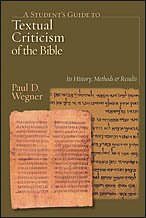
Student's Guide to Textual Criticism
 Also noted by Justin Taylor:
Paul D. Wegner, A Student's Guide to Textual Criticism of the BibleIts History, Methods and Results (IVP, 2006)—334 pages for just $14.40. Unusually this book seems to focus on both testaments.
IVP publicity here.
Commendations by Walter Kaiser and Bruce Waltke here.
Ehrman vs Bock on women
As noted by Justin Taylor on Between Two Worlds:
'Bart Ehrman and Darrell Bock debate textual criticism online. Ehrman says scribes intentionally downplayed women's leadership. Bock says Today's Bibles are faithful to the original text.'
'Bart Ehrman and Darrell Bock debate textual criticism online. Ehrman says scribes intentionally downplayed women's leadership. Bock says Today's Bibles are faithful to the original text.'
Tuesday, April 25, 2006
“Light” in Isa 53.11 and its possible effect upon Christian Resurrection Theology
Here’s a brief comparison of three translations of Isaiah 53.11
ESV: Out of the anguish of his soul he shall see and be satisfied; by his knowledge shall the righteous one, my servant, make many to be accounted righteous, and he shall bear their iniquities.
RSV: he shall see the fruit of the travail of his soul and be satisfied; by his knowledge shall the righteous one, my servant, make many to be accounted righteous; and he shall bear their iniquities.
NRSV: Out of his anguish he shall see light; he shall find satisfaction through his knowledge. The righteous one, my servant, shall make many righteous, and he shall bear their iniquities.
In translating the verse there is some debate as to what the Servant sees: (1) the fruit of his work (KJV, NKJV, RSV), (2) “light” meaning life, resurrection, vindication etc (NRSV, NIV, NJB), or (3) something unspecified (ESV).
Part of the problem is that there is no reference to “light” in the MT, Vulgate or Peshitta (hence the omission from the ESV, NASB etc) but it is included as part of the LXX and 1QIsa A and B. Additionally in the Isaiah Targum, it states that the Servant will see the “retribution” of his enemies. The ambiguity of modern translations derives from the textual confusion as to what the Servant sees after his suffering. It is quite possible that “light” was added in certain textual traditions in order to clarify this ambiguity. In this sense “light” could refer to either continued life in the face of death (Ps 36:9, 56:13) or life somehow attained beyond death (Ps 49:19; Job 33:28, 30, cf. 1 Clem 16:12).
In Jewish literature of the second-temple era it was possible to regard “light” as a catchword for “resurrection life”. Although the equation is somewhat debated (it could in some instances refer to the immortality of the soul), nevertheless several passages appear to link “light” with the life of the eschatological resurrection: 1 En 58:3; 92:3-5; 108:12-13; 2 En 65:8; Ps. Sol. 3:12; 1QS 4:8; Sib Or 1.379. If the resurrection connotations of “light” are imported into Isa 53.11 then in the words of G. E. Nickelsburg: “For Isaiah the resurrection of the righteous is in itself the vindication of the righteous” (Resurrection, Immortality, and Eternal Life in Intertestamental Judaism [HTS 26; Cambridge, MA: Harvard University Press, 1972] 19).
Early Christian interpretation of Jesus’ death and resurrection was understood via the grid of Isa 53.11-12 where the death and resurrection of Jesus was prefigured in the suffering and vivification of the Servant of Isaiah. It is this template that arguably stands behind the pre-Pauline formula of Rom 4:25 where Jesus “was handed over to death for our trespasses and was raised for our justification”. See further the references to the resurrection of the Servant/Jesus in 1 Clem. 16.12 and Justin, Apol. 1.51.
Thus, the interpolation of “light” in Isa 53.11 (if it was an interpolation?), particularly via the Septuagint, arguably affected the resurrection theology of the early Christians where it was understood as both (a) the vindication of Jesus, and (b) as part of the justification of those whom he represented. How early this influence goes back is disputable as some do not see in Rom 4.25 any echo of Isaiah 53 (e.g. Kasemann, Romans, 128). In any case, the post-NT reading of Isa 53.11 with an emphasis on resurrection is very much in keeping with pre-Christian understandings of this passage in the LXX and 1QIsa.
ESV: Out of the anguish of his soul he shall see and be satisfied; by his knowledge shall the righteous one, my servant, make many to be accounted righteous, and he shall bear their iniquities.
RSV: he shall see the fruit of the travail of his soul and be satisfied; by his knowledge shall the righteous one, my servant, make many to be accounted righteous; and he shall bear their iniquities.
NRSV: Out of his anguish he shall see light; he shall find satisfaction through his knowledge. The righteous one, my servant, shall make many righteous, and he shall bear their iniquities.
In translating the verse there is some debate as to what the Servant sees: (1) the fruit of his work (KJV, NKJV, RSV), (2) “light” meaning life, resurrection, vindication etc (NRSV, NIV, NJB), or (3) something unspecified (ESV).
Part of the problem is that there is no reference to “light” in the MT, Vulgate or Peshitta (hence the omission from the ESV, NASB etc) but it is included as part of the LXX and 1QIsa A and B. Additionally in the Isaiah Targum, it states that the Servant will see the “retribution” of his enemies. The ambiguity of modern translations derives from the textual confusion as to what the Servant sees after his suffering. It is quite possible that “light” was added in certain textual traditions in order to clarify this ambiguity. In this sense “light” could refer to either continued life in the face of death (Ps 36:9, 56:13) or life somehow attained beyond death (Ps 49:19; Job 33:28, 30, cf. 1 Clem 16:12).
In Jewish literature of the second-temple era it was possible to regard “light” as a catchword for “resurrection life”. Although the equation is somewhat debated (it could in some instances refer to the immortality of the soul), nevertheless several passages appear to link “light” with the life of the eschatological resurrection: 1 En 58:3; 92:3-5; 108:12-13; 2 En 65:8; Ps. Sol. 3:12; 1QS 4:8; Sib Or 1.379. If the resurrection connotations of “light” are imported into Isa 53.11 then in the words of G. E. Nickelsburg: “For Isaiah the resurrection of the righteous is in itself the vindication of the righteous” (Resurrection, Immortality, and Eternal Life in Intertestamental Judaism [HTS 26; Cambridge, MA: Harvard University Press, 1972] 19).
Early Christian interpretation of Jesus’ death and resurrection was understood via the grid of Isa 53.11-12 where the death and resurrection of Jesus was prefigured in the suffering and vivification of the Servant of Isaiah. It is this template that arguably stands behind the pre-Pauline formula of Rom 4:25 where Jesus “was handed over to death for our trespasses and was raised for our justification”. See further the references to the resurrection of the Servant/Jesus in 1 Clem. 16.12 and Justin, Apol. 1.51.
Thus, the interpolation of “light” in Isa 53.11 (if it was an interpolation?), particularly via the Septuagint, arguably affected the resurrection theology of the early Christians where it was understood as both (a) the vindication of Jesus, and (b) as part of the justification of those whom he represented. How early this influence goes back is disputable as some do not see in Rom 4.25 any echo of Isaiah 53 (e.g. Kasemann, Romans, 128). In any case, the post-NT reading of Isa 53.11 with an emphasis on resurrection is very much in keeping with pre-Christian understandings of this passage in the LXX and 1QIsa.
More on P113 (the other side)
Further to our previous post (here) which attempted a careful reading of one side of this small fragment (P. Oxy 4497), I shall continue with the reading.
Up-dated: see below
Here is a picture:
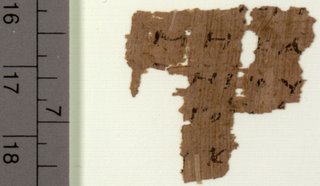
On this side we have clear traces of letters above the first clear line. None were visible on the other side which raised the question as to whether we had the upper margin. This evidence suggests that we don't have the upper margin. So we have an extra line on this side:
Line 1:
Not too much is visible here. The first visible ink looks like the bottom of a left-down diagonal and the second visible trace looks like a part of a lower horizontal line. The angles suggest that these must be parts of the same letter. Three or four basic possibilities for this combination: delta, alpha, lamda, chi. Does the horizontal line continue right across between the two traces? If so then probably a delta. But it doesn't seem to. No other examples of any of these letters on either side of the fragment except for alpha (of which we have many examples). Potentially alpha, although other letters can't be ruled out.
There is some kind of a dot/trace to the left of the tear between the lines. If this was ink it would have to be a long tail (psi, phi?), but I don't think it is the same colour as the ink. I think it is just a spot in the papyrus, we had a few of these on the other side.
The other traces are simply vertical lines. The first is reasonably close to the preceeding trace then there is a pretty long gap to the second vertical descender. These are compatible with loads of different letters so I don't think there is much to be gained from listing them all here. We could certainly exclude some letters, so the traces are relevant to the identification of the text, but we'll leave that open for now.
Line 1: ]. . . [ (this doesn't look like much yet does it?)
Line 2:
Ah, some clear letters. No real problems here: MU (with a big space to the left), HTA, KAPPA (this has lost a bit of the vertical line, but the angles of the diagonals and the general spacing are very similar to the two clear kappas, and there is nothing else it could be!), ALPHA.
In connection with the other side we raised the question as to whether the large space to the right of the existing letters meant we had the margin. The evidence of this side is tantalising. The space to the left of the MU is bigger than most/all of the spacings between letters elsewhere. So it could be the left-hand margin. On the other hand the space is not large enough to say definitely that we have the margin, especially since MH could be introducing a new clause and thus be given a punctuation-type space. Basic gut instinct suggests this is the left hand margin, but can that be proven?
Line 2: M H K A
Up-date begins here:
Line 3:
The first letter is missing, but the line above it (and the following two letters) is visible. So with NU (the downward slope of the horizontal line distinguishes this from the HTA in the line above, which would also nto make any sense as a NS) and IOTA abbreviated the only option is PNI, the nomen sacrum for PNEUMATI. The next two letters are also clear as OMICRON and UPSILON. The mark to the left of the omicron in this case does look ink-coloured and may be a punctuation mark. Hence:
Line 3: P] N I : O Y [ (unfortunately I can't put in the over-lines and the colon stands for a dot)
Line 4:
The first letter is a little unclear. First impression is that it is a GAMMA, closer inspection suggests that the horizontal line and the dot are not actually joined - in which case it would be an IOTA followed by a punctuation point. A problem here is that this dot, if it is punctuation; is different from the proposed punctuation point in the previous line (which was more like a short line than a dot). I'd like to look at these with some more magnification to compare them. Also it will be interesting to see how the punctuation may or may not work with the text once identified. For the moment I'll opt for IOTA dot. Then we have an OMICRON. The next letter has only some traces remaining and a mark above it. The trace of the letter is of small horizontal stroke followed by a vertical element. It is a little odd and doesn't really correspond to a standard shape. Fortunately we have already noted the unusual UPSILON with this feature on the other side.
Here is a picture. The additional trace, which is a r.h. upward diagonal also clearly fits with this model and thus an UPSILON is the best explanation. Above the UPSILON is a mark which looks like a breathing mark (and almost certainly is), the only question I have in my mind is whether the mark comes from the same scribe as the text as the ink looks a different colour.
As regards the next trace it looks like something in the interlinear area - it is spatially equivalent to the breathing mark rather than the top of a letter. Not too sure what this is.
So, line 4: ?] I : O Y [? (plus breathing and another interlinear mark).
Line 5: Well, the second letter is clearly a KAPPA, the first letter is less clear. It looks like we have part of a vertical upright stroke and a (rather short and thin) upper r.h. diagonal. The only obvious candidate is UPSILON, even though it is not the standard shape. But the other upsilons are similar enough to confirm this.
Hence:
line 5: ]Y K [
Overall:
Line 1: ]. . . [
Line 2: ]M H K A
Line 3: P] N I : O Y [ (with over-lines and the colon stands for a dot)
Line 4: ?] I : O Y [? (plus breathing and another interlinear mark)
line 5: ]Y K [
NB. I said previously that the nomen sacrum - PNEUMATI - was probably critical in the identification of the piece (at least as proposed) as from Romans. With no complete words I doubt if anyone would have bothered it it wasn't for this indication (both in form and content) that this was an early Christian text, possibly Scripture. Even so the fact that we have no complete words might encourage some caution as we explore whether this proposed identification is actually correct (more on this later in another post).
Up-dated: see below
Here is a picture:
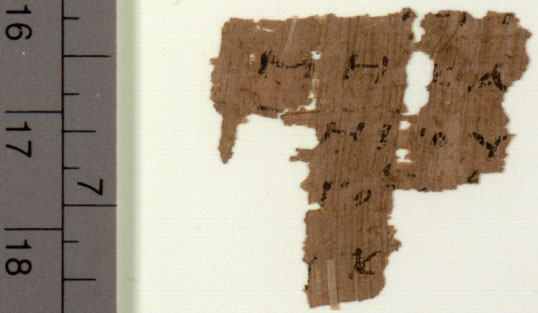
On this side we have clear traces of letters above the first clear line. None were visible on the other side which raised the question as to whether we had the upper margin. This evidence suggests that we don't have the upper margin. So we have an extra line on this side:
Line 1:
Not too much is visible here. The first visible ink looks like the bottom of a left-down diagonal and the second visible trace looks like a part of a lower horizontal line. The angles suggest that these must be parts of the same letter. Three or four basic possibilities for this combination: delta, alpha, lamda, chi. Does the horizontal line continue right across between the two traces? If so then probably a delta. But it doesn't seem to. No other examples of any of these letters on either side of the fragment except for alpha (of which we have many examples). Potentially alpha, although other letters can't be ruled out.
There is some kind of a dot/trace to the left of the tear between the lines. If this was ink it would have to be a long tail (psi, phi?), but I don't think it is the same colour as the ink. I think it is just a spot in the papyrus, we had a few of these on the other side.
The other traces are simply vertical lines. The first is reasonably close to the preceeding trace then there is a pretty long gap to the second vertical descender. These are compatible with loads of different letters so I don't think there is much to be gained from listing them all here. We could certainly exclude some letters, so the traces are relevant to the identification of the text, but we'll leave that open for now.
Line 1: ]. . . [ (this doesn't look like much yet does it?)
Line 2:
Ah, some clear letters. No real problems here: MU (with a big space to the left), HTA, KAPPA (this has lost a bit of the vertical line, but the angles of the diagonals and the general spacing are very similar to the two clear kappas, and there is nothing else it could be!), ALPHA.
In connection with the other side we raised the question as to whether the large space to the right of the existing letters meant we had the margin. The evidence of this side is tantalising. The space to the left of the MU is bigger than most/all of the spacings between letters elsewhere. So it could be the left-hand margin. On the other hand the space is not large enough to say definitely that we have the margin, especially since MH could be introducing a new clause and thus be given a punctuation-type space. Basic gut instinct suggests this is the left hand margin, but can that be proven?
Line 2: M H K A
Up-date begins here:
Line 3:
The first letter is missing, but the line above it (and the following two letters) is visible. So with NU (the downward slope of the horizontal line distinguishes this from the HTA in the line above, which would also nto make any sense as a NS) and IOTA abbreviated the only option is PNI, the nomen sacrum for PNEUMATI. The next two letters are also clear as OMICRON and UPSILON. The mark to the left of the omicron in this case does look ink-coloured and may be a punctuation mark. Hence:
Line 3: P] N I : O Y [ (unfortunately I can't put in the over-lines and the colon stands for a dot)
Line 4:
The first letter is a little unclear. First impression is that it is a GAMMA, closer inspection suggests that the horizontal line and the dot are not actually joined - in which case it would be an IOTA followed by a punctuation point. A problem here is that this dot, if it is punctuation; is different from the proposed punctuation point in the previous line (which was more like a short line than a dot). I'd like to look at these with some more magnification to compare them. Also it will be interesting to see how the punctuation may or may not work with the text once identified. For the moment I'll opt for IOTA dot. Then we have an OMICRON. The next letter has only some traces remaining and a mark above it. The trace of the letter is of small horizontal stroke followed by a vertical element. It is a little odd and doesn't really correspond to a standard shape. Fortunately we have already noted the unusual UPSILON with this feature on the other side.

Here is a picture. The additional trace, which is a r.h. upward diagonal also clearly fits with this model and thus an UPSILON is the best explanation. Above the UPSILON is a mark which looks like a breathing mark (and almost certainly is), the only question I have in my mind is whether the mark comes from the same scribe as the text as the ink looks a different colour.
As regards the next trace it looks like something in the interlinear area - it is spatially equivalent to the breathing mark rather than the top of a letter. Not too sure what this is.
So, line 4: ?] I : O Y [? (plus breathing and another interlinear mark).
Line 5: Well, the second letter is clearly a KAPPA, the first letter is less clear. It looks like we have part of a vertical upright stroke and a (rather short and thin) upper r.h. diagonal. The only obvious candidate is UPSILON, even though it is not the standard shape. But the other upsilons are similar enough to confirm this.
Hence:
line 5: ]Y K [
Overall:
Line 1: ]. . . [
Line 2: ]M H K A
Line 3: P] N I : O Y [ (with over-lines and the colon stands for a dot)
Line 4: ?] I : O Y [? (plus breathing and another interlinear mark)
line 5: ]Y K [
NB. I said previously that the nomen sacrum - PNEUMATI - was probably critical in the identification of the piece (at least as proposed) as from Romans. With no complete words I doubt if anyone would have bothered it it wasn't for this indication (both in form and content) that this was an early Christian text, possibly Scripture. Even so the fact that we have no complete words might encourage some caution as we explore whether this proposed identification is actually correct (more on this later in another post).
Subscribe to:
Posts
(
Atom
)