Monday, January 16, 2023

A Westminster Divine on Codex Alexandrinus

3

Back in November a man I’ve never met named Stephen Steele sent me an article he’d recently written. On Friday, I finally got around to reading it and commend it to you. Stephen is a minister in Scotland and has an MA on Presbyterian history from Queen’s University Belfast. The article looks at Thomas Goodwin’s engagement with textual criticism and his appeal to the newly known Codex Alexandrinus. Goodwin is especially important because he was a Westminster Divine. Here is the key takeaway:

So-called ‘Confessional Bibliologists’ claim to hold the position of the Westminster Divines. However they certainly do not hold the position of leading Westminster Divine Thomas Goodwin.

It has been said that in the century after Goodwin, ‘the Received Text was still treated with excessive veneration, and was not actually replaced in England until the nineteenth century. But events in the scholarly world had been gradually bringing about its decline, ever since the arrival of the Codex Alexandrinus (A) in 1627’.

For an example of a Reformed pastor who gratefully used readings from this newly discovered manuscript in preference to the TR, we can go all the way back to Westminster Divine Thomas Goodwin.

Do give the whole article a read.

Friday, January 06, 2023

Houghton: GA 239 & 304 Do Not Attest the Short Ending of Mark

9

In the latest issue of NTS, Hugh Houghton has a brief article looking at two catena manuscripts (GA 239 and 304) that both break off after Mark 16:8. The latter is even cited as evidence for the short ending in the ECM. But Houghton makes the case that neither provide evidence for the short ending since there are good reasons to conclude that both manuscripts originally had the longer ending. The evidence for this comes both from the catena and from the fact that neither manuscript has typical ending marks after 16:8, suggesting the text originally continued. Here’s the conclusion:

In sum, there are no known Greek minuscule manuscripts which only preserve the Short Ending of Mark. While the tenacity of the early textual variation at this point continues to be visible in such documents in the form of marginal asterisks, other scribal annotations, and comments from early Christian authors in catenae, claims that this ancient reading is attested by a Byzantine manuscript cannot be sustained unless they are supported by detailed investigation of the witness’s codicology, scribal practice, and textual tradition. The present study does not challenge the scholarly consensus on the earliest attainable form of the ending of Mark, but it does demonstrate the imperative to take full account of the context and nature of documents in which an unexpected reading appears before adducing them as evidence for an early form of text.

There are other interesting features about both manuscripts, but the case against citing these two minuscules to support the short ending is convincing to my mind. The article is open access and you can read it here. 

Mark 16:8 in GA 239

Wednesday, January 04, 2023

Robinson Reviews Stanojević’s Orthodox New Testament Textual Scholarship

4

In the latest issue of the Southeastern Theological Review, Maurice Robinson has a review of Jovan Stanojević’s recent book Orthodox New Testament Textual Scholarship: Antoniades, Lectionaries, and the Catholic Epistles, Texts and Studies (Third Series) 26 (Piscataway NJ: Gorgias Press, 2021). 

The review is interesting because Stanojević is Eastern Orthodox himself and argues for a revision to the Antoniades edition, the standard form of the Greek NT text in the Orthodox church, as I understand it. Robinson, of course, has coedited a Byzantine edition which is not the Orthodox standard. No one in this situation is apparently happy. The review is online (p. 97ff).

Tuesday, January 03, 2023

Hebrew Poetic and Prophetic Discourse Conference in Dallas

0

On October 18, 2023, Dallas International University is hosting an in-person and virtual conference on Macro Analysis of Hebrew Poetic and Prophetic Discourse. Registration opens in the Spring and submissions are open until April 28, 2023. You can learn more at hebrewdiscourse.com.


Monday, January 02, 2023

Two Recent Articles from Peter Rodgers

8

Peter Rodgers sends word that he has two new articles in Filología Neotestamentaria. I can’t seem to link to the specific issues or articles, but here are the titles and abstracts. (Update: I’ve added links to Peter’s Academia page where they’re uploaded.)

Mark’s longer ending

Among the theories as to how the Gospel of Mark ended is the proposal that a final page was lost early in its transmission. This article presents evidence to support that theory. Matthew appears to follow Mark closely until 16:8 when our authentic Mark ends abruptly. We may expect him to do so if he has access to Mark’s longer ending. Utilizing C. H. Turner’s article on Marcan usage, we explore several peculiarities of Mark’s style that appear in Matthew 28:9-20. These indicate that Matthew followed Mark as he reshaped the gospel in his own way, but distinctive traces of Mark survived.

The Origins of the Alexandrian Text of the New Testament

The Alexandrian text is generally regarded as the most reliable text form of the New Testament. However, there is reason to suspect that it did not originate in Alexandria. There is a total absence of references to Christians in the documentary papyri before the beginning of the third century. This article argues that the “Alexandrian” text actually originated in Ephesus, a major Christian center in Apostolic and sub-apostolic times. This proposal sheds further light on the text-critical issue at Eph. 1:1.

Thursday, December 22, 2022

Amalar of Metz on nomina sacra/orthography

11

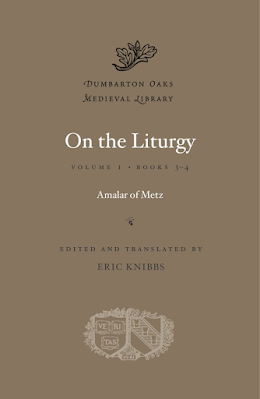
I was recently skimming through Amalar of Metz' On the Liturgy (specifically, volume 2) and came across an interesting couple of pages. Not only does Amalar write about the nomina sacra, he also gives a bit of precedent to questions about orthography reflected in the Tyndale House Greek New Testament.

Amalar wrote a letter "To his dearest father and most acute rhetorician, the prophet Jeremiah in our Jerusalem." The reference to Jerusalem threw me because at first, I was looking for a ninth-Jeremiah in Jerusalem, unsuccessfully. Eric Knibbs' notes on the text at the back of the volume identify this person as "Archbishop Jeremy of Sens (818–827)."

Amalar writes (Knibbs' translation, pp. 267–269):

Our countrymen write the name of our savior Jesus with the letter "H," and I am puzzled about the reason. I know that, if there is a reason that an "H" in Jesus's name is placed after the "I," it is not unknown to you. If you know, tell your son. If you do know, I am certain that it will be in the storeroom of your mind to pass the reason on to me. ... Now the Greeks write that name with the letters "I" and "C," and they read "Isus." Thus it seems to me—if it does not seem otherwise to you—that what we read as "Iesus" should be written with an "I" and an "H" and a "C" or an "S." I ask that you tell me with which letters I should write the stated name.

Jeremy of Sens responded and explained to Amalar that the letter was [and I am using lower-case here for clarity] not actually 'h' but 'η,' though they are written the same.

To be honest, I have wondered this too—why do we see IHS in the Latin tradition, which we still see today? I remember as a kid somebody in my rural southern church culture explained to me that he thought it meant "In His Service." I guess Jeremy's answer still doesn't really explain why we see the Greek eta in the Latin tradition, only that the 'H' is an eta. Has anyone come across any patristic/medieval discussions of why the Greek eta was used? If any of you, our readers, does know, I am certain that it will be in the storeroom of your mind to pass the reason on to me.