Wednesday, October 16, 2019

BREAKING: Andrew Stimer’s Pieces of P129 and P131 and Their Fake Provenance

11
Earlier this summer we reported on two new papyri which accidentally were made public on the webpage of he Institute for New Testament Textual Research. They turned out to be pieces of P129 (1 Cor) and P131 (Romans), respectively. It was the owner, Andrew Stimer, who had sent in documentation and requested that they be registered. With it, he also submitted documentation and a provenance story. In case our readers did not know it, the same Stimer sold a couple of fake Dead Sea Scrolls fragment to the Museum of the Bible (full list of un-provenanced post-2002 Dead Sea Scrolls-like fragments at the Lying Pen).

Just minutes ago, an announcement was made by Greg Paulson on the Institute for New Testament Textual Research (INTF) Blog, Münster, concerning P129 and P131. Note in particular the part in italics which is the provenance story that Andrew Stimer provided for his pieces (which is obviously fake, but who faked it? Stimer or the person who sold it to him – Obbink?):
There’s been a lot of discussion and speculation in the past few months about two new 2nd/3rd century papyrus fragments, first mentioned by Brent Nongbri as papyri being displayed by Scott Carroll in 2018. We were contacted earlier this year by Andrew Stimer, a private collector in California, who wanted to obtain G-A numbers for two papyrus fragments that he acquired in 2015. The fragments are of 1 Corinthians and Romans. Stimer provided us with unpublished scholar’s reports, which he received in 2016 and 2017: the report for 1 Corinthians was done by Dirk Obbink (who dates the fragment to mid-2nd cent.) and the report on Romans was done by Jeffery Fish (who dates the fragment to the first half of the 3rd cent.).

Through Nongbri’s blog, the INTF was already alerted to the possibility that the papyri in Stimer’s possession were parts of other papyri already registered in the Liste, P129 (1 Cor) and P131 (Romans), which are currently at the Museum of the Bible (MOTB). These numbers, P129 and P131, were assigned to the papyri at MOTB in 2015 so they could include this information in a planned publication with Brill, although this has not been published.

Over the past few months, we’ve been working to (a) verify the authenticity of Stimer’s fragments and (b) decide whether they belong to P129 and P131. The MOTB kindly provided us with images of P129 and P131 so we could make comparisons. We shared images of Stimer’s two fragments with Michael Holmes, and scholars at the Museum of the Bible Scholar’s Initiative were of the opinion that the fragments did indeed belong together. The pieces were analyzed by a number of INTF staff but we still had some lingering questions. We requested expert advice from papyrologist Panagiota Sarischouli at the University of Thessaloniki so we could get an external opinion.

A few weeks ago, Sarischouli graciously provided us with an extensive report confirming the authenticity of the fragments. She noted, “I can say that I have no reason to believe that Stimer’s fragments are fakes; if they are forgeries, they are masterly done!!!” Sarischouli stated, “There can be little doubt that the two fragments (Stimer’s 1 Cor. + P129) belong to the same codex page. Although there are some slight differences between the two handwritings, the hand is identical.” She also agreed with the dates proposed by Obbink and Fish. We are very grateful to her for providing such extensive information about these fragments.
We have now assigned Stimer’s 1 Corinthians fragment to the already registered P129, and have assigned his Romans fragment to the already registered P131 fragment. We can now update the contents of these papyri:

Stimer’s portion of P129 is: 1 Cor 7:32-37; 9:10-16
MOTB’s portion of P129 is: 1 Cor 8:10-9:3, 27-10:6
Stimer’s portion of P131 is: Rom 9:21-23; 10:3-4
MOTB’s portion of P131 is: Rom 9:18-21, 33-10:2

With regard to provenance, Stimer provided us with the following report for his pieces:
I acquired both of the manuscripts in the summer of 2015 from Mr. M. Elder of Dearborn, Michigan. He bought them the previous year, in April 2014, via a private treaty sale executed by Christie’s London. The fragments were part of a collection of texts that had been in the Pruitt family since the 1950s. Dr. Rodman Pruitt was an industrialist and inventor in southern Indiana who was known as a collector of manuscripts, books and artifacts of various kinds. He acquired his papyri from Harold Maker, a well-known dealer in manuscripts who was based in Irvington, New Jersey. I am told that the Trismegistos database lists numerous published papyri originally sold by Harold Maker. [Coincidentally, I have another manuscript in my collection that also came through Harold Maker, and with it are copies of sales materials he issued in the early 1950s.] I contacted Christie’s London to confirm that they had indeed conducted the private treaty sale of manuscripts that had passed by descent through the Pruitt family. I communicated with Dr. Eugenio Donadoni, Director of Medieval and Renaissance Manuscripts. He confirmed that the consignor of the collection that was sold in April 2014 was a relative of Dr. Rodman Pruitt, though he was of course restricted in the amount of information he was at liberty to provide to me. The sale included various papyri, in Coptic, Greek and Syriac. I was satisfied that the information I had been given at the time of the acquisition was correct.
We recently learned, however, that the two fragments belonging to the MOTB previously belonged to the Egypt Exploration Society (EES), see here and were sold without their permission. While many questions still remain regarding Stimer’s papyri, it seems highly probable that his pieces were also once part of the EES collection and were sold without their permission (see here). We have notified Stimer of this and updated the Liste entries in the NT.VMR (P129 and P131) to reflect this. We hope to upload images of Stimer’s papyri and the MOTB papyri on the NT.VMR for public viewing after the issue of provenance has been resolved.
In light of this problematic provenance and so many open questions, we have debated whether to register these two papyri. We are aware that the designation of a G-A number may have the unfortunate side effect of inflating the value of a manuscript on the antiquities market. However, our primary focus when deciding whether to include a new manuscript in the Kurzgefasste Liste has been verifying its authenticity and collecting key data so these manuscripts can be made known to the wider scholarly community. Our hope is that registering these manuscripts in the Liste, where all information is made publically available on the NT.VMR, will enable any unprovenanced manuscripts to be located (or re-located) as effectively as possible.
Update 1: More on “Mr. Elder” and his connection to Dirk Obbink over at Brent Nongbri’s blog here.

Update 2: Note Mike Holmes comments over at Brent Nongbri’s blog:
Re the following: “It seems almost certain, then, that these two fragments were also Oxyrhynchus Papyri taken from the Egypt Exploration Society and sold by Dirk Obbink to Christie’s, then bought from Christie’s by his business partner.”
  1. It is certain that these two fragments are Oxyrhynchus Papyri (EES documentation leaves no doubt in that regard).
  2. There is no evidence that these “Stimer fragments” were sold through Christie’s–only Stimer’s claim about a claim allegedly made by M. Elder. Why should these claims be given any more credence than the claims in the rest of the paragraph? They are likely additional “red herrings.” You have documented a connection between Stimer and Scott Carroll, who in turn is closely associated with Obbink, and there is also the Obbink-Elder connection. Rather than jumping to a conclusion re the alleged Christie’s sale, let’s wait for some evidence and see where it may lead.

Monday, October 14, 2019

News Statement: ‘Museum of the Bible Helps EES Recover Antiquities’

14
The MOTB has now made the following statement, click image to read (HT: Mike Holmes):

NEWSFLASH: ‘Professor Obbink and Missing EES Papyri’ – MOTB returns 13 Papyri to EES!

9
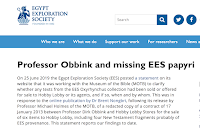
https://www.ees.ac.uk/news/professor-obbink-and-missing-ees-papyri)Just now at 3:30 p.m. (Oxford time) the EES posted the following statement (here):

Professor Obbink and missing EES papyri

On 25 June 2019 the Egypt Exploration Society (EES) posted a statement on its website that it was working with the Museum of the Bible (MOTB) to clarify whether any texts from the EES Oxyrhynchus collection had been sold or offered for sale to Hobby Lobby or its agents, and if so, when and by whom. This was in response to the online publication by Dr Brent Nongbri, following its release by Professor Michael Holmes of the MOTB, of a redacted copy of a contract of 17 January 2013 between Professor Dirk Obbink and Hobby Lobby Stores for the sale of six items to Hobby Lobby, including four New Testament fragments probably of EES provenance. This statement reports our findings to date.

With the help of photographs provided by the MOTB, the EES has so far identified thirteen texts from its collection, twelve on papyrus and one on parchment, all with biblical or related content, which are currently held by the MOTB (see the attached list). These texts were taken without authorisation from the EES, and in most of the thirteen cases the catalogue card and photograph are also missing. Fortunately, the EES has back-up records which enable us to identify missing unpublished texts. For clarity, we note that the four texts specified in the handwritten list made public alongside the 2013 contract, which are probably the texts of that contract, remain in the EES collection, and two have been published as P.Oxy. LXXXIII 5345 and 5346.

The Board of Trustees of the MOTB has accepted the EES claim to ownership of the thirteen pieces identified to date, and is arranging to return them to the EES. The EES is grateful to the MOTB for its co-operation, and has agreed that the research on these texts by scholars under the auspices of the MOTB will receive appropriate recognition when the texts are published in the Oxyrhynchus Papyri series.

The MOTB has informed the EES that 11 of these pieces came into its care after being sold to Hobby Lobby Stores by Professor Obbink, most of them in two batches in 2010. In August 2016 the EES did not re-appoint Professor Obbink as a General Editor of the Oxyrhynchus Papyri primarily because of unsatisfactory discharge of his editorial duties, but also because of concerns, which he did not allay, about his alleged involvement in the marketing of ancient texts, especially the Sappho text. In June 2019 the EES banned him from any access to its collection pending his satisfactory clarification of the 2013 contract. Oxford University is now investigating, with EES help, the removal from University premises and alleged sale of EES texts.

The EES is also pursuing identification and recovery of other texts, or parts of texts, which have or may have been illicitly removed from its collection. Systematic checking of the EES collection will be a long process because of its size. Meanwhile, our primary aim remains the authoritative publication for public benefit of the texts of all types in our collection.

We cannot comment here on any broader legal issues arising from these findings, except to note that they are under consideration by all the institutions concerned.

EES papyri being returned by the MOTB (MOTB inventory number in square brackets)

  1. Genesis 5:  P.Oxy. inv. 39 5B.119/C(4-7)b.  [PAP.000121]
  2. Genesis 17:  P.Oxy. inv. 20 3B.30/F(5-7)b.   [PAP.000463]
  3. Exodus 20-21:  P.Oxy. inv. 102/171(e).   [PAP.000446]
  4. Exodus 30.18-19:  P.Oxy. inv. 105/149(a).   [PAP.000388]
  5. Deuteronomy:  P.Oxy. inv. 93/Dec. 23/M.1.   [PAP.000427]
  6. Psalms 9.23-26:   P.Oxy. inv. 8 1B.188/D(1-3)a.   [PAP.000122]
  7. Sayings of Jesus:  P.Oxy. inv. 16 2B.48/C(a).   [PAP.000377]
  8. Romans 3:  .   [PAP.000467]
  9. Romans 9-10:  P.Oxy. inv. 29 4B.46/G(4-6)a.   [PAP.000425 one part]
  10. 1 Corinthians 7-10:  P.Oxy. inv. 106/116(d) + 106/116(c).   [PAP.000120 three small fragments]
  11. Quotation of Hebrews:  P.Oxy. inv. 105/188(c).   [PAP.000378]
  12. Scriptural homily:  P.Oxy. inv. 3 1B.78/B(1-3)a.   [PAP.000395]
  13. (parchment) Acts of Paul:  P.Oxy. inv. 8 1B.192/G(2)b.   [MS.000514]
Published:
See also the previous EES statement concerning “First-Century Mark” and Dirk Obbink here. And for our own extensive coverage of the First-Century Mark story, see here.
The statement from Museum of the Bible is here.

Tuesday, October 08, 2019

Corrections in P46

1
Jacob W. Peterson has a new article out on the corrections in P46, the very useful, ‘An Updated Correction List for Chester Beatty BP II & P. Mich. Inv. 6238 (Gregory-Aland Papyrus 46 [P46])’ BASP 56 (2019), 173-195.

Abstract:
This study offers an update to previous works on the scribal corrections in Papyrus 46 (P46) of the Pauline Epistles. These prior studies are introduced and used for comparison throughout. Using the latest digital images, I identify thirteen new corrections, show that four previously identified corrections are doubtful, and provide clarification for seven difficult to interpret correction events. An updated total is provided as well as the distribution of corrections by each hand and book.


Friday, October 04, 2019

An example of how older editions mislead us about patristic citations

2
Earlier this week, I was speaking to Dirk Jongkind about Luke 1:50. The THGNT adopts the phrase “εἰς γενεὰς καὶ γενεάς“ as the viable reading that cannot be attributed to harmonisation. Some variants include a form of the phrase that uses singulars instead of plurals, “εἰς γενεὰν καὶ γενεάν“ (ℵ01 Ψ044 f1 f13 [including 69] 892 1424) as well as the reading in the majority of manuscripts, “εἰς γενεὰς γενεῶν“ (A[nt; the odes have a different reading] C2 D1 K Δc Θ 33 Byz).

One point of reference that Dirk mentioned is that the there might be patristic citations of the phrase that show that the phrase itself, “εἰς γενεὰς καὶ γενεάς“ is not inherently unusual. Sure enough, the TLG turns up two instances that I want to point out here.

The first instance is Origen’s commentary on Psalm 119(118):90. Origen makes an exegetical point that the text is singular, not plural: the two generations are Israel and the Church, so it is specifically “from generation to generation”.
Origen at the TLG
In the second instance, Chrysostom quotes part of Daniel 4:37 (LXX) in one of his Letters to Olympia (10.9), and he uses the exact same phrase:
Chrysostom in the TLG

So, here we have two patristic sources attesting the phrase that is adopted in the THGNT at Luke 1:50. Admittedly, neither of these phrases is a citation of Luke 1:50, but the question we are considering is whether the phrase itself is particularly unusual, and if so, would that mean that it could be subject to variation that would normalise the phrase into something more common. From the look of it, the phrase “εἰς γενεὰς καὶ γενεάς“ is common enough that Origen and Chrysostom use it, which would be a mark against the rationale that the phrase would be normalised and changed away from “εἰς γενεὰς καὶ γενεάς“ to either “εἰς γενεὰν καὶ γενεάν“ or “εἰς γενεὰς γενεῶν“, which are both more commonly attested.

Wait, not so fast.

Trying to do the responsible thing, I went to the CUL to pull the critical editions. Both are in the Sources chrétiennes series (henceforth, SC). The citation of Origen comes from a catena on Psalm 119(118). The edition is Harl, Marguerite, ed. La chaîne palestinienne sur le Psaume 118 (Origène, Eusèbe, Didyme, Apollinaire, Athanase, Théodoret): Tome I. Introduction, texte grec critique et traduction. Sources chrétiennes 189. Paris: Cerf, 1972. When I turned to the relevant pages, I did not find εἰς γενεὰς καὶ γενεάς“ as the TLG reported for the text here. Instead, the author of the commentary attributed to Origen roughly quotes Psalm 119:90 in the form of the text attested by the Byzantine tradition at Luke 1:50 (there is an added οὖν, but otherwise it is the same):
Origen in the SC edition

Similarly, the TLG also disagrees with the edition of Chrysostom: Malingrey, Anne-Marie, ed. Jean Chrysostome: Lettres à Olympias. Sources chrétiennes 13. Paris: Cerf, 1947. Instead of the plural form of the phrase εἰς γενεὰς καὶ γενεάς“ that the TLG says is Chrysostom’s text, we find the singular form “εἰς γενεὰν καὶ γενεάν“:
Chrysostom in the SC edition
But wait, there’s more!

This edition was primarily a revision of an older edition rather than being a genuinely new edition, but there is a second edition of this work in the SC series for that. This second edition of Chrysostom, which is the source of the TLG text, does in fact have “εἰς γενεὰς καὶ γενεάς“, and notes two manuscripts (a: Vatican Library, Palatinus gr. 228, and M: Paris, BnF, gr. 657) that have “εἰς γενεὰν καὶ γενεάν“. Malingrey does note that previous editions used these manuscripts for Chrysostom’s text (“a” in Savile, 1612, and “M” in Fronton du Duc, 1614 and Montfaucon, 1821—this is assuming my memory of the relevant page is correct; the Classics library wouldn’t let me borrow the book, so I had to read and take photos of the text itself with my phone):
Chrysostom in SE 2nd edition

_____

What then is the point of this rather pedantic post? There are two points.

1. Pedantic details matter, because [2].

2. When we rely on older editions, we can be misled about the form of the text that a church father quotes. There even appears to be an error in the first edition of the SC edition for Chrysostom that was carried over from previous editions, so sometimes even critical editions don’t quite get it right. And they differ at a phrase for which there are textual variants when it occurs in Luke 1:50. More than that, Origen (or the author of the comment attributed to him) specifically makes an exegetical point about the precise wording of the text, and even there, the SC edition and the TLG disagree on what that precise wording is. TLG’s text of Origen here is based on J.B. Pitra, Analecta sacra spicilegio Solesmensi parata, vols. 2 and 3 (Paris: Tusculum, 1882). This is also an example why it is appropriate to take older literature with a grain of salt when it claims that certain patristic authors supported one reading against another. They might not have.

For more on why we might have problems citing Chrysostom for particular readings, see Peter Montoro’s guest post, here.

Tuesday, October 01, 2019

Colwell, Direct Copies, and Singular Readings in Dante

11
Paolo Trovato has alerted me to an interesting article just published in the latest Storie e linguaggi by one of his doctoral students, Federico Marchetti. The article grows out of his doctoral work and considers manuscripts of Dante that have known exemplars (Abschriften in NTTC terms). In the course of studying these, he addresses the use of singular readings as a way of determining scribal habits. This method has had its critics over the years (e.g., Strutwolf, Jongkind, myself, and now Hixson). Marchetti also criticizes it given his own results because it includes false data. Here is his conclusion:
If Po [the exemplar] had been lost, and if we had decided to investigate the scribal behaviour of Est [the copy] according to the Colwell method (that is, by calculating the percentage of textual agreement with the rest of the surviving manuscript tradition), we would necessarily have considered the scribe of Est responsible both for his own errors (which affect 0,06% of the verses) and for those that are ascribable to earlier stages of the tradition (which affect 17,6% of the verses). It is evident that such a diversity in approaches leads to a dramatic discrepancy in outcomes and their degree of reliability. Applying the Colwell method, we would certainly talk about a “scribal version” or “scribal revision” in this case, but – as we have just seen – the copyist of Est is in fact a very diligent scribe, careful about the formal features of his model as well as about its substance. In conclusion, the data collected bear out the necessity of making use of the genealogical-reconstructive method; more in general, they advocate the validity of the Neo-Lachmannian approach.
What I didn’t see in Marchetti’s article is a recognition that Royse, for example, fully recognizes this limitation or that Royse incorporates these false positives under his rubric of “the complex scribe.” But, as I have argued in my own work, the problem of deducing scribal habits from singular readings can’t simply be solved by appeal to the complex scribe since most scribally-created readings are not singular at all. I suspect part of the issue here for Marchetti is that he is after a different goal than determining principles of transcriptional probability (Colwell’s main goal). The NT, of course, is highly contaminated which is why Lachmannian approaches, whether neo- or not, have generally not been used.

In any case, my thanks to Paulo for alerting me to this essay. The entire issue will be of interest to our readers and can be found online here with abstracts.