

I've just been combing through Daniel Wallace's excellent review of Ehrman's Misquoting Jesus. One thing that struck me was the question of the evidence for χωρις θεου in Hebrews 2:9. In Wallace's footnote 36 he says:
'Ehrman says the reading “occurs in only two documents of the tenth century” (Misquoting Jesus, 145), by which he means only two Greek documents, 0243 (0121b) and 1739txt. These manuscripts are closely related and probably represent a common archetype. It is also found in 424cvid (thus, apparently a later correction in an eleventh century minuscule) as well as vgms syrpmss Origengr (vr), lat MSSaccording to Origen Theodore Nestorians according to Ps-Oecumenius Theodoret 1/2; lem Ambrose MSSaccording to Jerome Vigilius Fulgentius. Ehrman does note some of the patristic evidence, underscoring an important argument, viz., “Origen tells us that this was the reading of the majority of manuscripts in his own day” (ibid.)'
It is also claimed in Ehrman's Orthodox Corruption (p. 146) and in Metzger's Textual Commentary (2nd edn; p. 594) that Peshitta manuscripts support this reading. I'm wondering why Wallace, Ehrman and Metzger agree that this is the Peshitta's reading. In Barbara Aland and Andreas Juckel, Das Neue Testament in syrischer Überlieferung, II. Die Paulinischen Briefe, Teil 3: 1./2. Thessalonicherbrief, 1./2. Timotheusbrief, Titusbrief, Philemonbrief und Hebräerbrief (Berlin: De Gruyter, 2002, pp. 262-264) there is no record of any Peshitta ms with this reading.
There are, however, readings of Severus of Antioch, Theodore of Mopsuestia and Babai the Great that appear to support 'without God'.
Tuesday, May 09, 2006
Monday, May 08, 2006
Ehrman, Studies in the TC of the NT
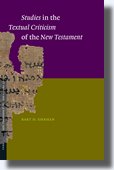 Thanks to the author of an anonymous comment, who pointed out that Brill is advertising a new book by Bart Ehman entitled Studies in the Textual Criticism of the New Testament. See here. Before we all go out and purchase a copy (at just 139 USD or 105 Euros) it might be worth calculating how much of it we each individually possess.
I paste below the Brill advertising with a comment by Eldon Jay Epp. Thereto I append my own comments.
'For the first time in one volume this book presents contributions to the textual criticism of the New Testament made over the past twenty years by Bart Ehrman, one of the premier textual scholars in North America. The collection includes fifteen previously published articles and six lectures (delivered at Duke University and Yale University) on a range of topics of central importance to the field. Following a general essay that gives an introduction to the field for beginners are several essays dealing with text-critical method, especially pertaining to the classification of the Greek manuscript witnesses. There then follow two articles on the history of the text, several articles on important specific textual problems, and three articles on the importance and use of patristic evidence for establishing the text and writing the history of its transmission. The volume concludes with six lectures designed to show the importance not only of reconstructing an allegedly “original” text but also of recognizing how that text was changed by scribes of the early Christian centuries.This book will be of vital interest to any scholar or advanced student of the New Testament and early Christianity. It will make an ideal companion volume for Bart Ehrman’s ground-breaking study, The Orthodox Corruption of Scripture: The Effects of Early Christological Controversies on the Text of the New Testament (Oxford, 1993) and the volume he co-edited with Michael Holmes, The Text of the New Testament in Contemporary Research: Essays on the [sic; lege Status Quaestionis] (Eerdmans, 1995).'
'Bart Ehrman, in merely two decades, has emerged as one of a handful of New Testament textual critics worldwide who work at the cutting edge. Most of the fascinating and meticulous articles in this volume formed the basis of or carry forward his influential work on The Orthodox Corruption of Scripture (1993), which displayed for us the socio-historical and theological contexts of textual variants, demonstrating effectively their dynamic, creative role in early Christianity. The essays are interestingly informative, remarkably insightful, and–in the best sense–genuinely provocative. Overall, the volume, which includes detailed methodological studies and treatments of individual texts, as well as the Kenneth Clark Lectures at Duke University (1997) and the Shaffer Lectures at Yale (2004), will be a stimulating challenge to biblical and patristic scholars and to early church historians.'
Eldon Jay Epp
From the Brill blurb and Epp's comments it is not at all clear whether there is any substantial new material in this volume. Moreover, according to the Brill website Ehrman and Metzger are still the series editors for the series New Testament Tools and Studies. Ehrman may therefore have used his editor's prerogative to commission some of his own essays for republishing. The Schaffer Lectures would cost $32 (here) but the Kenneth W. Clark lectures are freely available: Lecture 1; Lecture 2. What we need is a contents page so that we can identify the 15 previously published essays.
Thursday, May 04, 2006
A Hebrew Vorlage of Matthew
Eusebius refers via Papias twice to an original Hebrew autograph for St. Matthew's Gospel (Adv.Haer. 3.1.1; Hist.Eccl. 3.39). Is there any evidence for (or against) this in the sphere of textual-criticism?
The Schøyen Collection boasts that it has a Middle Egyptian copy of Matthew (MS 2560) which differs from the NA27 text and can be attributed to an alternate Greek Vorlage of Matthew. If you scroll down the page, you can find a picture here.
The Schøyen Collection boasts that it has a Middle Egyptian copy of Matthew (MS 2560) which differs from the NA27 text and can be attributed to an alternate Greek Vorlage of Matthew. If you scroll down the page, you can find a picture here.
Misquoting Jesus update
Given the continuing interest in it, it is time to renew the list of critical reviews of Bart Ehrman's Misquoting Jesus. Peter Rodger's should have a review out in Christian Century soon.
Craig Blomberg, Michael Kruger, Mark D. Roberts, Jim Snapp, Daniel Wallace (earlier), Daniel Wallace (later and longer), P.J. Williams
Darrell Bock (just on issue of variants to do with women)
Ivo Tamm's Master's thesis (in German; on subject of theological motivation for variants, interacting with Ehrman's Orthodox Corruption of Scripture)
Craig Blomberg, Michael Kruger, Mark D. Roberts, Jim Snapp, Daniel Wallace (earlier), Daniel Wallace (later and longer), P.J. Williams
Darrell Bock (just on issue of variants to do with women)
Ivo Tamm's Master's thesis (in German; on subject of theological motivation for variants, interacting with Ehrman's Orthodox Corruption of Scripture)
Wednesday, May 03, 2006
Daniel 7:13 OG
Daniel 7:13 in the Old Greek reads ως παλαιος ημερων παρην usually rendered 'like an ancient of days was present', which seems an unusual rendering of the Aramaic עד עתיק יומיא מטה 'unto the ancient of days arrived'. I reflected today that the Greek could be explained as a literal rendering of the Aramaic (with some misunderstanding) if it were allowed that the translator understood the word עד as meaning 'while', a sense that ως can easily bear. עד can mean 'while' in Syriac and CAL also mentions 'Palestinian Aramaic'. Learned colleagues, please inform me whether this proposal is likely.
Tuesday, May 02, 2006
JTS 57 (2006) reviews
There are a number of reviews of text-critical interest in the latest volume of the Journal of Theological Studies.
Here are the main ones:
pp. 177-179
Alison G. Salvesen reviews Joshua: Jesus Son of Naue in Codex Vaticanus. By A. GRAEME AULD. Pp. xxix + 236. (Septuagint Commentary Series.) Leiden and Boston: Brill, 2005.
The first vol. of the Septuagint Commentary Series to appear. It appears that Auld has adopted a usefully literal translation technique.
pp. 203-208
Jennifer Dines reviews The Open Book and the Sealed Book: Jeremiah 32 in its Hebrew and Greek Recensions. By ANDREW G. SHEAD. Pp. 316. (Journal for the Study of the Old Testament Supplement Series, 347; The Hebrew Bible and its Versions, 3.) London: Sheffield Academic Press (a Continuum imprint), 2002.
Thoroughly worthwhile summary and evaluation.
pp. 217-219
J. K. Elliott reviews Reading and Writing in the Time of Jesus. By ALAN MILLARD. Pp. 288. London: T & T Clark (A Continuum Imprint), 2004.
The new paperback edition is essentially unchanged from the edition of 2000.
pp. 235-246
J. Neville Birdsall reviews The Textual Tradition of the Gospels: Family 1 in Matthew. By AMY S. ANDERSON. Pp. x + 219. (New Testament Tools and Studies, 32.) Leiden: Brill, 2004.
‘I have little but applause for what it presents’ says the late Neville Birdsall. I wonder if this was one of the last things he wrote.
pp. 287-291
J. Lionel North reviews Biblical Greek Language and Lexicography: Essays in Honor of Frederick W. Danker. Edited by BERNARD A. TAYLOR, JOHN A. L. LEE, PETER R. BURTON, and RICHARD E. WHITAKER. Pp. xxii + 266. Grand Rapids, MI: William B. Eerdmans, 2004.
In this volume the rather polemic second attack by the Assyriologist Rykle Borger on the UBS GNT and NA26 makes an interesting read.
Here are the main ones:
pp. 177-179
Alison G. Salvesen reviews Joshua: Jesus Son of Naue in Codex Vaticanus. By A. GRAEME AULD. Pp. xxix + 236. (Septuagint Commentary Series.) Leiden and Boston: Brill, 2005.
The first vol. of the Septuagint Commentary Series to appear. It appears that Auld has adopted a usefully literal translation technique.
pp. 203-208
Jennifer Dines reviews The Open Book and the Sealed Book: Jeremiah 32 in its Hebrew and Greek Recensions. By ANDREW G. SHEAD. Pp. 316. (Journal for the Study of the Old Testament Supplement Series, 347; The Hebrew Bible and its Versions, 3.) London: Sheffield Academic Press (a Continuum imprint), 2002.
Thoroughly worthwhile summary and evaluation.
pp. 217-219
J. K. Elliott reviews Reading and Writing in the Time of Jesus. By ALAN MILLARD. Pp. 288. London: T & T Clark (A Continuum Imprint), 2004.
The new paperback edition is essentially unchanged from the edition of 2000.
pp. 235-246
J. Neville Birdsall reviews The Textual Tradition of the Gospels: Family 1 in Matthew. By AMY S. ANDERSON. Pp. x + 219. (New Testament Tools and Studies, 32.) Leiden: Brill, 2004.
‘I have little but applause for what it presents’ says the late Neville Birdsall. I wonder if this was one of the last things he wrote.
pp. 287-291
J. Lionel North reviews Biblical Greek Language and Lexicography: Essays in Honor of Frederick W. Danker. Edited by BERNARD A. TAYLOR, JOHN A. L. LEE, PETER R. BURTON, and RICHARD E. WHITAKER. Pp. xxii + 266. Grand Rapids, MI: William B. Eerdmans, 2004.
In this volume the rather polemic second attack by the Assyriologist Rykle Borger on the UBS GNT and NA26 makes an interesting read.
Subscribe to:
Posts
(
Atom
)