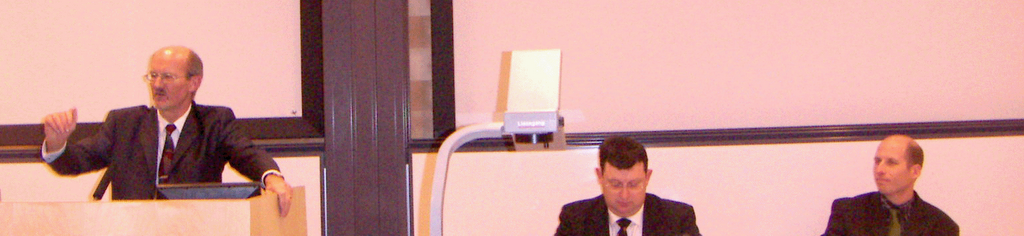
This is a guest-post in which Ryan Wettlaufer shares his personal thoughts about his recent thesis defence at the University of St. Michael’s College, University of Toronto, as described more formally in
a previous post. Be sure to read related posts with advices for PhD students,
"Where to do a PhD" and
"Theses in Textual Criticism", and other thesis defences
here and
here.
Thoughts on Defending a Thesis
In December I successfully defended my doctoral thesis "Conjectural Emendation in New Testament Textual Criticism with the Epistle of James as a Case Study" at the University of St. Michael’s College, University of Toronto, and Tommy has very kindly invited me to guest blog about the experience.
The set-up of the defence was interesting. As a young student you get all these wild images in your head of what the defence will look like, and most of them look something like the imposing set-up of a supreme court hearing or perhaps something out of a Masonic temple. In reality, it consisted of a very normal looking boardroom with a long table, water glasses, and an overly optimistic number of copies of my abstract for any guests. There were six professors in total, including John Kloppenborg – my supervisor – and Michael Holmes – my external examiner (who participated by speaker phone). It was interesting that the examiners, while all New Testament scholars, each had different areas of focus, such as patristics, philosophy, etc.
They began by asking me to leave the room while they discussed the agenda. Once I returned, they began the formal questioning, with each examiner being allotted 15 minutes. For the second round, each examiner was given another 5 minutes. When that was done, they again asked me to leave while, I assume, they discussed their thoughts and voted on the outcome. Or possibly they just flipped a coin. Either way, as my supervisor invited me back in he smiled and said “Congratulations.” When the committee chair complained that he had tipped their hand, I wanted to joke that he was referring to me finally getting a hair cut, but alas, the wit is never quick enough.
So what were my reactions? The first was actually disappointment. I was disappointed because it really felt like I had done a very poor job. In my memory, I had been a babbling fool, stuttering away, barely able to make a sentence. Sometimes after accomplishing something people try to downplay it with false humility, but this was not that: I really believed I had done poorly! It wasn’t till I talked with a colleague whose own defence had been just a month prior that I discovered this is a relatively common reaction. “I felt the exact same way” he explained, “I was sure I had sounded like some imbecile who could barely talk!” Fortunately, some of his colleagues had attended his defence and were able to verify that, contrary to whatever feelings he had, he had actually done a very good job. Since then, I’ve heard of many doctoral students who had this same reaction. There must be some interesting psychological phenomenon at work there, but I’ll let someone else tackle that.
My second reaction was surprise. Before the defence I had prepared by drawing up a list of all the points I thought were most important about my thesis, and made notes of all the facts that I thought needed to be discussed. Looking over that list afterwards, I was surprised that we had ended up discussing not a single one of them! Similarly, I had collected from various doctoral advice websites all over the internet several pages of common defence questions. As I looked over that list – you guessed it – not a single one of them had been asked. The questions that were asked were very surprising. A lot of them had to do with how my thesis related to their own area of focus. Some other questions poked at points that I thought were rather minor or unimportant. Other questions pointed out to me areas of the thesis that really could be improved, and I was thankful for that.
The most surprising questions, however, were the ones that demonstrated how equivocal this language really is. More than once an examiner asked a question that left me shaking my head in confusion, wondering whose thesis they could be talking about. Each time it would turn out that they had interpreted something I had written in a way completely different than I had intended. As I would review the section of my thesis in question, however, I would realise that the problem wasn’t that I had written it incorrectly, but it also wasn’t that they had read it incorrectly: the problem was that the language in question could legitimately support more than one meaning. It makes me wonder how we can ever hope to communicate here online, where our writing is usually less thought out and certainly less supported by body language or voice tone. It also made me realise how important it is to give people – especially people we disagree with – a sympathetic reading.
Finally, I was (eventually) happy! Not right away, mind you. Right away it was rather anti-climactic. I walked out of the defence and instead of feeling like I’d just accomplished something, it really felt like I had just finished a meeting. You imagine going out and having some crazy celebration, whooping and hollering with all your friends, but all I actually did was drive home, pour a cup of tea, read the ETC blog, and go to bed. Not much whooping there (some on that ETC blog, but only when they’re re-launching a journal!). After a good number of days though you suddenly realise what has happened. I think that realisation comes the first time your long-honed instinct nags you to go finish editing that draft of chapter 1, and then it dawns on you: you never have to revise chapter 1 again!
In closing, what advice do I have for those preparing for their defence? First, don’t be nervous. Really, don’t be: there’s just no need for it. For the rest of your life, at dinner parties or receptions, people will ask you what you studied and when you begin excitedly telling them about your dissertation you’ll only get to about the 30 second mark when you’ll see their eyes glaze over and you’ll realise that they were only asking to be polite! Your defence, on the other hand, will be the first and last time in your life that you will have a room full of people who both know what you’re talking about and want to hear you talk about it – for several hours at that! Enjoy this chance while you have it! Second, don’t be afraid to direct the conversation. This will be one of your best chances to get really thoughtful and in-depth critique, especially if, like me, you have the benefit of a high calibre external examiner. Unfortunately, the structure of the defence – rules about who can speak when or for how long – can really limit that critical discussion. If there’s something you really want to bring up or draw attention to, therefore, don’t be afraid to speak up and direct the discussion that way. Finally, no matter how many people you’ve had edit your dissertation, you will still get a page long list of typos and corrections from the committee. I got 5 pages! (Most of them were just errors in accenting though, so that doesn’t matter, right? [Little joke for P.J. Williams there!]). Start getting ready to accept that now, and then it won’t seem so bad when it happens.
That’s my thoughts! And much thanks again to Tommy Wasserman for this invitation, and this venue.
Ryan Wettlaufer