

David Lincicum, Hildegund Müller, and Jeremiah Coogan are running a working group at Notre Dame on Jewish and Christian Books. Jeremiah tells me the group is open to all comers and that if you RSVP soon enough, you may even get free lunch! What’s not to love? (Except the polar vortex sweeping Indy right now.) Here’s the info:
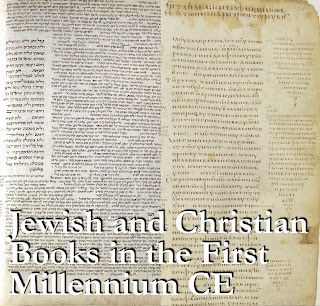 Books do more than contain texts. They are objects, always implicated in economic, ritual, and readerly matrices of production, collection, and use. We never encounter texts disembodied, apart from the material constraints and paratextual interventions that enable their physical existence. Nor do books read themselves. They are manipulated by reading communities with specific reading practices.
This working group seeks to develop an ongoing conversation about material texts and reading practices in Judaism and Christianity of the first millennium CE. Christian and Jewish communities have often oriented themselves around books and reading. Attention to material texts thus enriches our understanding of both traditions and their interactions with one another.
The group is organized by David Lincicum, Hildegund Müller, and Jeremiah Coogan. For further information or to be included on the working group mailing list, please contact Jeremiah Coogan (jcoogan2[at]nd.edu).
Overview
 Books do more than contain texts. They are objects, always implicated in economic, ritual, and readerly matrices of production, collection, and use. We never encounter texts disembodied, apart from the material constraints and paratextual interventions that enable their physical existence. Nor do books read themselves. They are manipulated by reading communities with specific reading practices.
This working group seeks to develop an ongoing conversation about material texts and reading practices in Judaism and Christianity of the first millennium CE. Christian and Jewish communities have often oriented themselves around books and reading. Attention to material texts thus enriches our understanding of both traditions and their interactions with one another.
The group is organized by David Lincicum, Hildegund Müller, and Jeremiah Coogan. For further information or to be included on the working group mailing list, please contact Jeremiah Coogan (jcoogan2[at]nd.edu).
Spring Schedule
- 25 January | Book Discussion: Brent Nongbri, God’s Library: The Archaeology of the Earliest Christian Manuscripts (New Haven: Yale University Press, 2018) | 12–1.30pm in 106 O’Shaughnessy
- 15 February | Andrew King (Notre Dame), “The Big Data of Intertextuality and the Book of Deuteronomy” | 12–1.30pm in 106 O’Shaughnessy
- 1 March | Hildegund Müller (Notre Dame), “The Early Transmission of Augustine’s Enarrationes in Psalmos” | 12– 1.30pm in 106 O’Shaughnessy
- 12 April | Paul Wheatley (Notre Dame), “Behind the Veil of Translation: Onomastics, Interpretation, and Revelation” | 12–1.30pm in 106 O’Shaughnessy
- 31 May | Conference: “The Material Gospel” (details forthcoming) Lunch will be provided for midday seminars; an opportunity to RSVP will be sent to the working group mailing list.


