Showing posts with label Westcott. Show all posts

Tuesday, November 29, 2016

Interesting Material from the Archives at Westcott House

1
Westcott House in the summer
This morning I spent some time going through a cabinet of material from B. F. Westcott kept at Westcott House in Cambridge (see here for details). Westcott founded the school in 1881 as Cambridge Clergy Training School and it took its current name only after his death.

The archives has a number of interesting things belonging to Westcott. There are about ten books that either he owned or that he gave to others. These include Hort’s copy of Tischendorf’s Greek Old Testament, H. B. Swete’s copy of Westcott and Hort’s Greek New Testament, and a copy of the Revised Version (NT) that Hort gave to Westcott.

The manuscript of Westcott’s
book on the history of the canon.
Speaking of Hort, there is this nice note to Westcott when the latter left Cambridge to become the Bishop of Durham: “… It does not often happen that two friends work together almost literally day by day for forty years; and now, in one sense, our end comes, and some words of farewell which are indeed God speed may well be spoken, & yet it is not the words themselves so much as the blessing of the presence.”

The archives also contain a number of Westcott’s original manuscripts from his published books including his History of the English Bible, History of the Canon of the New Testament, and his commentary on John.

But the most interesting item in the collection, as far as I’m concerned, is Westcott’s own copy of Eberhard Nestle’s first edition of the Novum Testamentum Graece (1898). This, of course, is the precursor to the Nestle-Aland edition we are all familiar with today. Westcott and Hort’s edition was one of the three that Nestle originally used to determine his own text. What makes the copy at Westcott House special is that it is the copy Nestle himself sent to Westcott as a thank you. Inside the front cover there is a short letter from Nestle.

Ulm, Germany
end of March
1898
Dear Sir

It is my pleasant duty, after I have finished the edition of the Greek Testament, which I have undertaken for the Bible Society of Wurttemberg, to renew to you the expression of our sincerest thanks, for the permission so graciously granted to us, to make use for it of the Greek Testament revised by yourself and Professor Hort. As you will see from the copy, which will be forwarded to you by same post, your text is the one constituent factor of the new edition, and I testify once more with the greatest pleasure, I never handled a book made up with so much care and thoughtfulness in the smallest details as your edition. The forthcoming number of the Expository Times (and that of May) will bring the small list of Errata or Inconsistencies, which I have detected, while I was collating your edition with Weymouth and Tischendorf. I shall recommend it to your kind attention and remain in lasting thankfulness.
yours
most faithfully
Eb. Nestle

Here’s a photo. (Sorry about the quality.)


Now, I can’t talk about Westcott House without mentioning my favorite feature: their tortoise named Hort. He literally gets put in a fridge for the winter to hibernate so I didn’t see him today. But during the warmer months, he can be seen trawling the courtyard for food. I’m told he used to have a friend named Lightfoot, but he lived up to his name and ran off!

“Hort” at Westcott House


Thursday, October 20, 2016

The Value of Knowing the Bible’s Transmission History (Westcott)

1
Westcott’s words to clergy-in-training from his Lessons from Work (1901):
2. The study [of the Bible] must be systematic, and again it must be thorough. Even the external history of the Sacred books illustrates the action of the Spirit in the Christian Society, and gives a personal reality to the past. It cannot be a matter of indifference to know how the New Testament — to limit myself to that — has come down to us; to look at the Manuscripts from which our fathers drew words of life, to trace the stirring history of the version through which the teaching of Apostles has been made accessible to men of other tongues. Almost every great Library has some touching memorial of biblical labour before which it is well for us to pause. Every Oxford man here has, I trust, looked with deep questionings of heart, on the very copy of the Acts which our own Bede read and quoted, turning from the familiar Latin to the original Greek, and so laying the foundation of biblical scholarship for his countrymen: every Cambridge man on the precious copy of the Gospels and Acts which Beza offered as his choicest gift to the University, and many, I hope, have read on the open page the memorable saying found only there, which seems to mark the distinction between popular tradition and apostolic record : every visitor to the British Museum, on the copy of the Latin Gospel, which was once carried about with Cuthbert’s body, and noticed its leaves, stained with sea water, a testimony to the perils which his followers endured in their wanderings. In such treasures the Diocese of Durham has a large share. We claim as our own three Manuscripts of the Vulgate of unsurpassed interest, the most authoritative copy of the whole Bible, written at Jarrow, under the direction of Bede’s Master, and sent as a present to the Pope, the most exquisite copy of a single Gospel, St John, which was placed in the coffin of Cuthbert when he was laid to rest; and the Lindisfarne Gospels, written in his honour, to which I have already referred, to which was added at Chester-le-Street, one of the first, if not the very first, translation of the Gospels into an English dialect. The three are strangely different in form, in writing, in ornament, yet alike in the general character of their text. We may then well be proud of these works of the leaders of our Northern Church; and for my own part, I delight to remember that our English Version is marked as no other version is marked, by a double and in some sense a fourfold seal of martyrdom. The great scholar who laid its sure foundations and the brave pastor who first brought the fragments together which completed its original structure died simply for their faith; and so too, though less purely, the statesman and the prelate who first procured its authoritative publication.  
Such details have, I think, far more than a literary interest. They help us to feel the value of our heritage. They make the past live again for us, live with the life which is truly life. 
So touched with a grateful sense of the care which our own fathers have lavished on the books which we have received, we approach their interpretation. And here I counsel you most earnestly to do two things habitually, to read the original Greek, and in reading the English version to strive to recall the Greek. In doing this question each word in the apostolic text, and in your imperfect recollection of it, till it has told its lesson: till each apostolic word has rendered its peculiar meaning: till each error in your own version has revealed the loss which it entailed. 

Friday, May 27, 2016

Fun Fact Friday

0
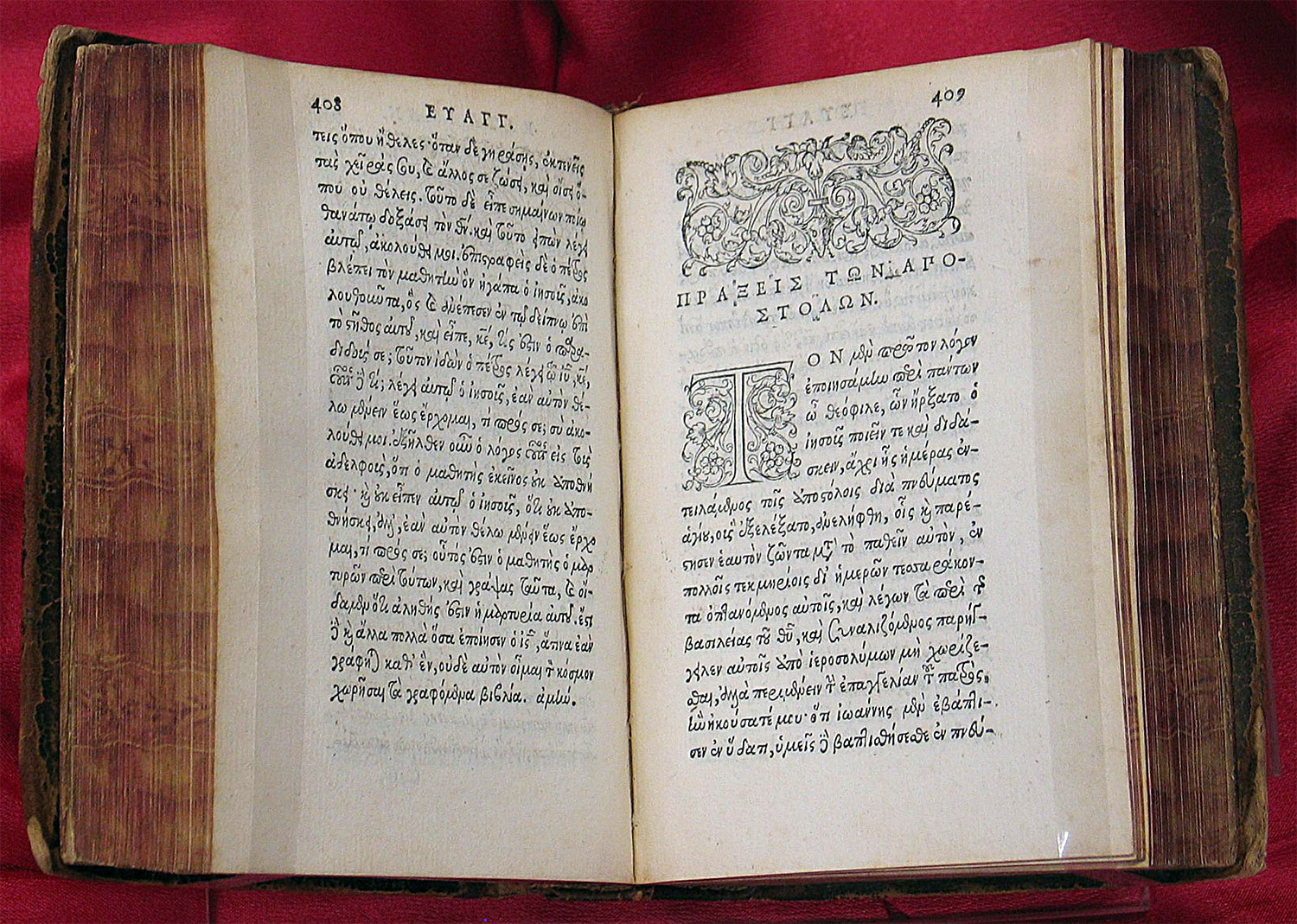
Tregelles’s 1549 Stephanus GNT
Dallas Theological Seminary’s Turpin Library owns a copy of Robert Stephanus’s 1549 Greek New Testament that was once own by Samuel P. Tregelles and was then given, by his wife, to B. F. Westcott. Stephanus, of course, is best known for adding versification to the NT in his 1551 edition.

The book was owned by DTS professor J. Dwight Pentecost who donated it to the library. Pentencost was still teaching classes when I graduated in 2012. He was then 93! We used to eat dinner with him fairly regularly because he lived in student housing. He was slowing down by then, but his mind was still sharp.

One night I got to talking to him about my text critical interests and I learned that he regularly used a form of the textus receptus for his own study. Apparently Tregelles and Westcott had not worn off on him.

If you’re in Dallas, stop by the Turpin Library and check out their nice collection of rare Bibles.