Showing posts with label Latin. Show all posts

Thursday, December 22, 2022

Amalar of Metz on nomina sacra/orthography

11

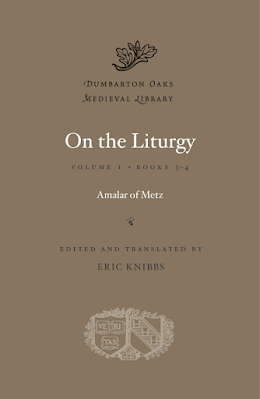
I was recently skimming through Amalar of Metz' On the Liturgy (specifically, volume 2) and came across an interesting couple of pages. Not only does Amalar write about the nomina sacra, he also gives a bit of precedent to questions about orthography reflected in the Tyndale House Greek New Testament.

Amalar wrote a letter "To his dearest father and most acute rhetorician, the prophet Jeremiah in our Jerusalem." The reference to Jerusalem threw me because at first, I was looking for a ninth-Jeremiah in Jerusalem, unsuccessfully. Eric Knibbs' notes on the text at the back of the volume identify this person as "Archbishop Jeremy of Sens (818–827)."

Amalar writes (Knibbs' translation, pp. 267–269):

Our countrymen write the name of our savior Jesus with the letter "H," and I am puzzled about the reason. I know that, if there is a reason that an "H" in Jesus's name is placed after the "I," it is not unknown to you. If you know, tell your son. If you do know, I am certain that it will be in the storeroom of your mind to pass the reason on to me. ... Now the Greeks write that name with the letters "I" and "C," and they read "Isus." Thus it seems to me—if it does not seem otherwise to you—that what we read as "Iesus" should be written with an "I" and an "H" and a "C" or an "S." I ask that you tell me with which letters I should write the stated name.

Jeremy of Sens responded and explained to Amalar that the letter was [and I am using lower-case here for clarity] not actually 'h' but 'η,' though they are written the same.

To be honest, I have wondered this too—why do we see IHS in the Latin tradition, which we still see today? I remember as a kid somebody in my rural southern church culture explained to me that he thought it meant "In His Service." I guess Jeremy's answer still doesn't really explain why we see the Greek eta in the Latin tradition, only that the 'H' is an eta. Has anyone come across any patristic/medieval discussions of why the Greek eta was used? If any of you, our readers, does know, I am certain that it will be in the storeroom of your mind to pass the reason on to me.

Thursday, August 24, 2017

The earliest Latin commentary on the Gospels published

4
Exciting news out of Birmingham (UK) today. De Gruyter has just published the long-lost fourth century commentary on the Gospels by Fortunatianus of Aquileia. Hugh Houghton explains:
The earliest Latin commentary on the Gospels, lost for more than 1,500 years, has been rediscovered and made available in English for the first time. The extraordinary find, a work written by a bishop in northern Italy, Fortunatianus of Aquileia, dates back to the middle of the fourth century.

The biblical text of the manuscript is of particular significance, as it predates the standard Latin version known as the Vulgate and provides new evidence about the earliest form of the Gospels in Latin.

Despite references to this commentary in other ancient works, no copy was known to survive until Dr Lukas Dorfbauer, a researcher from the University of Salzburg, identified Fortunatianus’ text in an anonymous manuscript copied around the year 800 and held in Cologne Cathedral Library. The manuscripts of Cologne Cathedral Library were made available online in 2002.

Scholars had previously been interested in this ninth-century manuscript as the sole witness to a short letter which claimed to be from the Jewish high priest Annas to the Roman philosopher Seneca. They had dismissed the 100-page anonymous Gospel commentary as one of numerous similar works composed in the court of Charlemagne. But when he visited the library in 2012, Dorfbauer, a specialist in such writings, could see that the commentary was much older than the manuscript itself.

In fact, it was none other than the earliest Latin commentary on the Gospels.
Dr. Houghton has published the (free) English translation of the Latin text edited by Lukas J. Dorfbauer. I do wish these had been published as a diglot rather than separate volumes. But well done to all involved! These kind of discoveries are what make textual criticism and the study of manuscripts so exciting. There is always the chance of new finds.

Thursday, February 18, 2016

ETC Interview with Hugh Houghton: Part 1

0
It is a real pleasure to continue our ETC Blog interview series with someone who is no stranger to our regular readers. Dr. Hugh Houghton is Reader in New Testament Textual Scholarship at the University of Birmingham (UK) and Deputy Director of the Institute for Textual Scholarship and Electronic Editing (ITSEE) there. He is currently working on the volume of John as part of the IGNTP/ECM collaboration as well as the letters of Paul. This month he has a new book out on the Latin NT which we’re giving away thanks to OUP. Without further ado, here’s Hugh.


PG: First things first. Can you tell us how to pronounce your name? Is it HOW-ton or HOE-ton?

HH: Thank you for asking. It’s HOW-ton, although HOR-ton is a very common pronunciation too in the UK, and I sometimes also hear HUFF-ton. As this is a blog on textual criticism, we could explore the relationship of the different pronunciations to textual variation: when my surname is misspelt – which is fairly common – is that because the copyist voiced it in their head and substituted a different spelling for the text of their exemplar? Is it just replacement by a simpler or more common form? Were they copying to dictation? And then what about the visual or orthographic influence of my first name, with the potential for interference, haplography...? You’d better ask the next question or we’ll never finish this interview!

Can you tell us about what led to your current interests in the text of the New Testament and specifically the Latin and Patristic evidence for it?

I’ve always enjoyed languages, particularly the historical relationship between them. I was fortunate to study both Latin and Ancient Greek at school, and then read Classics at university. In my final year, my courses included Medieval Latin, when I first visited the university library to see a manuscript (the Cambridge Songs), and the history of the Greek language up to the fall of Byzantium. I wrote an undergraduate dissertation on the Acts of the Christian Martyrs as linguistic documents.

My Master’s degree, although still in Classical Linguistics, involved studies of Tertullian’s language and the Greek Apocryphal Acts of the Apostles. A few years later, I took a second undergraduate degree in Theology as part of my ministerial training, which included a module on the Gospel according to Mark with Keith Elliott. So when Philip Burton (who had taught me as an undergraduate, while he was completing his doctorate) and David Parker contacted me to see if I would be interested in joining them to work on the Vetus Latina Iohannes (an edition of the Old Latin versions of John’s Gospel), I jumped at the opportunity.

Win a Copy of Hugh Houghton's The Latin New Testament (OUP)

33
To celebrate the release of his book next week, Oxford University Press has kindly agreed to give away a copy of Hugh Houghton’s The Latin New Testament: A Guide to its Early History, Texts, and Manuscripts.

You can enter to win in any of the ways listed below. The contest closes at midnight (EST) on February 24th. We’ll announce the randomly-chosen winner in part 2 of our interview with Hugh.

Update: congrats to Drew Longacre who was the randomly-chosen winner!

a Rafflecopter giveaway

Thursday, February 11, 2010

Stupid History

7
I have a desk calendar called "Stupid History" that gives you daily facts on funny and ironic events of history. Today's stupid history describes how in 1716, the Oxford University Press, printed 500 copies of a book titled Translation of the New Testament from Coptic into Latin by David Wilkins. It took 191 years to sell all 500 copies. On the upside, I'm sure Wilkins' book made a huge impact on Oxford University's RAE submission in that year.