Does Hebrew pointing matter? This may seem a strange question from someone who spent the good part of five years of his life teaching students to point Hebrew (see my exasperated
The Great Pointing Crisis). However, I am asking it more as a theological question and in relation to evangelical doctrines of scripture.
Most are probably familiar with the story of how Elias Levita (1469-1549) called into question the antiquity of the Masoretic pointing and how the question of the antiquity and inspiration of the vowels became a matter of special controversy in the seventeenth century. Key elements included the bringing to Europe of the first copy of a Samaritan Pentateuch by Pietro della Valle in 1616, with a script that was (rightly) judged archaic and that lacked pointing. Johannes Buxtorf (snr) attempted to refute Elias Levita’s contention that the vowels were late, and this contention was continued by his son, Johannes Buxtoft (jnr), who particularly strove with Louis Cappel. Very much connected with this is John Owen’s controversy with the London Polyglot of 1657[1658].
Even towards the end of the seventeenth century the Helvetic Consensus Formula (1675) said that:
‘... The Hebrew original of the OT which we have received and to this day do retain as handed down by the Hebrew Church, “who had been given the oracles of God” (Rom 3:2), is, not only in its consonants, but in its vowels either the vowel points themselves, or at least the power of the points not only in its matter, but in its words, inspired by God.’ (Canon II, Klauber’s translation)
Subsequent opinion has concluded that those who argued for the antiquity or inspiration of the vowels were wrong.
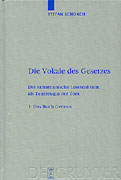
Some will also be aware that there has been some movement towards re-establishing the antiquity of the vowels—not arguing that they were ancient written entities, but rather affirming the antiquity of the reading tradition. Many who work within Masoretic studies find this plausible, and my Doktorvater, the great Semitist Geoffrey Khan, always used to say that the vowels were as old as the consonants. Even the Samaritans have their own oral system of pointing (with occasional marks in manuscripts) and this has been studied by Stefan Schorch (
Die Vokale des Gesetzes: Die samaritanische Lesetradition als Textzeugin der Tora 1. Band 1: Das Buch Genesis [Beihefte zur Zeitschrift fur die alttestamentliche Wissenschaft 339; Walter de Gruyter, 2004]). It both agrees and disagrees with the Masoretic system.
I should like to distinguish between (
a) the pointing as a source of information to us about ancient Hebrew and (
b) the pointing as a necessary guide in the identification of lexemes and grammatical forms in particular instances.
It seems to me that the pointing is very important in giving us a knowledge of the language and in moving us closer to the position that a native speaker would be in (function
a), but is relatively unimportant in actually identifying the lexical or grammatical forms being used (function
b). I read through Jeremiah 36 and Genesis 1 last night in Hebrew with this in mind and came to the conclusion that with competence in the language (based on a knowledge of pointing) it was possible to identify the lexemes and grammatical forms in all words in these texts. I wonder how much this is the case across the Hebrew Bible.
Often when people have sought to disregard pointing, they have disregarded it in both functions
a and
b. Such was the case with Dahood. I wonder, however, what people think about the following as a possible evangelical approach:
To accept that pointing is a reliable guide to ancient Hebrew, to its repertory of lexemes and grammatical structures, but to argue that it is not necessary for the identification of lexemes and grammatical structures in particular cases. This would seem to me to have the advantage of being able to maintain that the ancient written text (consonants comprising words with clear lexical identity and in specific grammatical forms) is self-sufficient provided one has (from somewhere) expertise in the language.
Whether the object marker is pointed with
sere or
seghol is not relevant for grammatical function or lexical identification. Neither is the question of whether a form is in pause or not (though unit division itself can be sematically important).
The
Helvetic Consensus Formula was IMHO wrong in attributing ‘inspiration’ to the vowels. However, I would like to think they were particularly striving to be able to maintain that words in the text had particular grammatical forms and lexical identities. If so, they would not have been so much in error.
Thoughts?


