

Dan Wallace and Bart Ehrman have had another debate. Dan blogs about his arguments and strategy here (including news about mysteriously unknowable new manuscripts including the autograph of Mark). Andreas Ko/estenberger was there too and didn’t like Dan’s approach, he blogs about it here (Dan answers Andreas’ critique in a long and interesting comment). I don’t know what Bart thought about it all.
Showing posts with label Debates. Show all posts
Showing posts with label Debates. Show all posts
Monday, February 06, 2012
Wednesday, January 25, 2012
An Inconvenient Quiz

The cover of the DVD containing last Fall’s Wallace-Ehrman Debate, “Can we Trust the Text of the New Testament” (mentioned on this blog on 11 Nov 2011) features a manuscript containing a Greek minuscule text, written in quite a neat hand.
The only problem is that — in relation to the title of the debate — the MS pictured is not to be trusted for the purpose stated. I pointed this out to Dan, and he assured me that he had nothing to do with the packaging of the DVD (nor, I presume, with the selection of the same manuscript pages for flyer and poster promotion of the debate).
So, as an interesting challenge, what text is actually displayed in the photograph? I know, and Dan knows, but do you?
If you need a larger version of the photo, see the flyer at:
http://www.friendsofcsntm.com/smudebate/smu_debate_flyer_4.25x11.pdf
Friday, November 11, 2011
DVD Available of Ehrman vs. Wallace Debate
Latest news from the Center for the Study of New Testament Manuscripts:

For my own thoughts on this debate, see here.

On October 1, 2011 Dr. Bart D. Ehrman and CSNTM's Executive Director, Dr. Daniel B. Wallace, debated the reliability of the text of the New Testament at Southern Methodist University. This was the largest debate over the text of the New Testament in history. A professional film crew recorded the debate, which is now available to you. In this exciting dialogue you have the opportunity to listen to two leading scholars talk about this issue from opposing viewpoints. Can we trust the text of the New Testament? You decide.There is a video trailer about the debate, which is a bit too melodramatic for my taste, but here it is:
The DVD is priced at only $15.50 plus shipping and handling. Currently only the USA format (NTSC) is available. Pick yours up today.
The DVD is copyrighted by CSNTM; please do not replicate or distribute it.
Click here to purchase DVDs
For my own thoughts on this debate, see here.
Monday, July 05, 2010
Chrys Caragounis' Review of Samuelsson on Crucifixion
In a blogpost on 14 June I mentioned a review of Gunnar Samuelsson's thesis "Crucifixion in Antiquity" written by Chrys Caragounis. The review, found here, was very negative (to use mild words). Towards the end he writes:
When a reader of our blog, "Z," had read Caragounis' review he made this comment:
Apparently Caragounis reads this blog, at least occasionally, and that is something I take pride in. However, he was not pleased with this comment, and, thus, he posted a two pages long reply to my blogcomment, "Tommy Wasserman and Crucifixion" on his website.
I offer here some comments to Caragounis' comments. Perhaps it is not the best timing since I will be on holiday for some time without good internet access, but nevertheless, here it is:
First, C. says I have assumed the role of Samuelsson's advocate. Let me clarify that I would prefer it if Samuelsson's thesis is wrong! (Not for Samuelsson's sake of course.) However, I feel that I owe it to Samuelsson to listen to his reply, he has after all devoted many years to the study of crucifixion, although he has now been criticized sharply by a very competent scholar like C. (which of course makes me worried for Samuelsson's sake).
C. asks this question: "With what right does Wasserman assume that 'Caragounis has not read Samuelsson's interpretation of those texts'? How does he know that?"
I do not know that. What I say is that something *implies* that C. has not read the (whole) book, but that it *seems* he has browsed the book (see further below). Only C. (and God) really knows the truth. However, *I* assumed it because I had spoken to a rather depressed author the day before, and he had that very impression. Now the author of the book of course would know better than me, because I had only read the conclusion, and browsed other parts.
By the way, C. later goes on to ask why, if he has followed such a procedure – browsing the book, searching texts on one's own and responding – would invalidate what he as a reviewer has to say about the dissertation ... Well, the point, if I understand Samuelsson, is that C. is basically reproducing the traditional understanding of those texts, a traditional understanding which Samuelsson criticizes with his new thesis (which may or may not be groundbreaking). It seems to me the question of method becomes rather important. (Again, I am not saying that Samuelsson's method is good but I would have liked to see Caragounis discuss the question of how to select the texts.)
C. asks:
I agree with C., that we need to understand what the texts are saying, and I assume that is what Samuelsson also claims. Here C. mentions "10.000 texts till the XVIth century," and in his review of Samuelsson he similarly says: "Samuelsson treats a smaller number of occurrences, but even these should have been sufficient to clarify the meaning of crucifixion" (p. 2), and, further, "The evidence for crucifixion is altogether too overwhelming to cite here. The examples are innumerable. I shall here content myself with presenting just a few brief texts" (p. 5).
Why does Samuelsson treat "a smaller number of occurences"? Is it a sloppy omission or does it rather have to do with his method? Has C. noted that Samuelsson has searched *all* accessible texts within the defined time span of the investigation, from Homer to the turn of the 1st century? Samuelsson's very method is to not treat later texts. Why? Because Samuelsson thinks they might have been influenced by the death of Jesus. As the title of the thesis implies, Samuelsson studies the *background* to the NT terminology: "Crucifixion in Antiquity. An Inquiry into the Background of the New Testament Terminology of Crucifixion."
And, yet, in his review C. cites later texts as evidence for crucifixion using a different methodology (again, I am not saying C. is wrong, but it seems to me he, as a reviewer, is not sensible to Samuelsson's work at this point). It would indeed have been interesting to hear what Caragounis says about Samuelsson's method on this point, but that is not what he does in the review (although he does make other very relevant methodological points on p. 3ff.). Instead C. presents "a few brief texts" as evidence for crucifixion. When one reads those texts (and the rest of the review) and has not read Samuelsson's thesis in any detail, one probably reacts as the reader "Z" – Samuelsson "must have forgotten about lots of ancient texts which describe crucifixion."
This very comment (that preceded my comment) made me suspect that the review, in this regard, may not represent Samuelsson's work very well, because, as I have pointed out, Samuelsson actually discusses in detail *all* those texts except those outside the time span for the investigation, and he comes to a different conclusion. Samuelsson's point is that the Greek words under discussion are used in a wider sense than previously assumed (in the time span of the investigation).
Note that Samuelsson is *not* arguing against the major event - that Jesus was executed on Calvary - I think on this point Samuelsson is being constantly misunderstood, especially in the media.
C. further writes in his review of Samuelsson (p. 2):
Does Samulesson really draw this conclusion, “that Jesus most probably was not crucified” or has C. misunderstood him? Is he not saying that the texts are so vague that one cannot say on the basis of them how Jesus was executed, or to conclude that what happened to Jesus cohere altogether with modern definitions of "crucifixion." Samuelsson therefore chooses to use a wider designation, "suspension" (which, in the case of Jesus' execution, may or may not have been what we think today of as "crucifixion").
C. further says:
I certainly do not doubt C.'s superior knowledge and command of the Greek language. In fact, I have consulted him a number of times on various issues (the last time on Atticism). However, I think Samuelsson's point is that the Greek terms relating to crucifixion have been affected much by what happened to Jesus (it is a major historical event). Again, a methodological question.
Further, C. cites me saying that his “critique [against Samuelsson] is serious and many points are probably relevant” and C. finds it troublesome that I use a “probably” here, implying an uncertainty on my part. Then he makes a further remark:
Okay, I am not so competent in Greek as I would wish (sorry Riesenfeld, but you, if anyone, would probably have been very happy with my textual criticism), but when I said "probably relevant" I was only trying to be humble, because (1) I had not read the entire book; and (2) I had not heard Samuelsson's reply.
Finally, I find it very strange that a "dilettantish investigation" (to use C.'s words) would leave Gothenburg University, which has a long and good tradition of Greek studies. What about the joint seminaries where linguists have read Samuelsson's material? What about the examining board? What about the opponent Erkki Koskenniemi (Åbo Akademi). Were they all, in contrast to Caragounis (p. 10), "fooled by this caricature presentation of the Greek evidence on the question of anci[ent] crucifixion in general and of Jesus’ crucifixion in particular"?, since this dissertation has passed their scrutiny (of course not without criticism, but far from the level expressed in Caragounis' review).
Update (12/7): C. has posted a new reply here. In the comments to this blogpost Christian Askeland captures well what would be my re-response:
Sadly, it is the view of the present Reviewer that Samuelsson’s book does not meet the standards of stringent scientific inquiry into Greek linguistic problems. Through the use of the Thesaurus Linguae Graecae, he may have amassed a long list of texts, which at first sight may look impressive to the uninitiated, but a specialist in Greek linguistics and philology is not fooled by this caricature presentation of the Greek evidence on the question of ancinet crucifixion in general and of Jesus’ crucifixion in particular. The evidence stands clear and cannot be falsified by such dilettantish investigations.
When a reader of our blog, "Z," had read Caragounis' review he made this comment:
Still haven't read the work of Gunnar Samuelsson, but the review confirms my suspicion: He must have forgotten about lots of ancient texts which describe crucifixion.To which I replied:
I wait to see Samuelsson's reply. The thing is that almost all those texts that Caragounis cites are included in Samuelsson's treatment, which implies that Caragounis has not read Samuelsson's interpretation of those texts. It seems Caragounis has browsed the work, made his own searches and then responded.
Nevertheless, the critique is serious and many points are probably relevant, but I'd like to hear Samuelsson's response. In fact, he now will have time to revise his dissertation on some points before publication (hopefully in the WUNT series).
Apparently Caragounis reads this blog, at least occasionally, and that is something I take pride in. However, he was not pleased with this comment, and, thus, he posted a two pages long reply to my blogcomment, "Tommy Wasserman and Crucifixion" on his website.
I offer here some comments to Caragounis' comments. Perhaps it is not the best timing since I will be on holiday for some time without good internet access, but nevertheless, here it is:
First, C. says I have assumed the role of Samuelsson's advocate. Let me clarify that I would prefer it if Samuelsson's thesis is wrong! (Not for Samuelsson's sake of course.) However, I feel that I owe it to Samuelsson to listen to his reply, he has after all devoted many years to the study of crucifixion, although he has now been criticized sharply by a very competent scholar like C. (which of course makes me worried for Samuelsson's sake).
C. asks this question: "With what right does Wasserman assume that 'Caragounis has not read Samuelsson's interpretation of those texts'? How does he know that?"
I do not know that. What I say is that something *implies* that C. has not read the (whole) book, but that it *seems* he has browsed the book (see further below). Only C. (and God) really knows the truth. However, *I* assumed it because I had spoken to a rather depressed author the day before, and he had that very impression. Now the author of the book of course would know better than me, because I had only read the conclusion, and browsed other parts.
By the way, C. later goes on to ask why, if he has followed such a procedure – browsing the book, searching texts on one's own and responding – would invalidate what he as a reviewer has to say about the dissertation ... Well, the point, if I understand Samuelsson, is that C. is basically reproducing the traditional understanding of those texts, a traditional understanding which Samuelsson criticizes with his new thesis (which may or may not be groundbreaking). It seems to me the question of method becomes rather important. (Again, I am not saying that Samuelsson's method is good but I would have liked to see Caragounis discuss the question of how to select the texts.)
C. asks:
In which way does my citation of a number of texts that Samuelsson treats prove that I have not read what he wrote? ... Here it is not a case that we need more texts about crucifixion (there are about 10.000 texts till the XVIth century and many more till the present day!), but that we need to understand what the texts are saying.
I agree with C., that we need to understand what the texts are saying, and I assume that is what Samuelsson also claims. Here C. mentions "10.000 texts till the XVIth century," and in his review of Samuelsson he similarly says: "Samuelsson treats a smaller number of occurrences, but even these should have been sufficient to clarify the meaning of crucifixion" (p. 2), and, further, "The evidence for crucifixion is altogether too overwhelming to cite here. The examples are innumerable. I shall here content myself with presenting just a few brief texts" (p. 5).
Why does Samuelsson treat "a smaller number of occurences"? Is it a sloppy omission or does it rather have to do with his method? Has C. noted that Samuelsson has searched *all* accessible texts within the defined time span of the investigation, from Homer to the turn of the 1st century? Samuelsson's very method is to not treat later texts. Why? Because Samuelsson thinks they might have been influenced by the death of Jesus. As the title of the thesis implies, Samuelsson studies the *background* to the NT terminology: "Crucifixion in Antiquity. An Inquiry into the Background of the New Testament Terminology of Crucifixion."
And, yet, in his review C. cites later texts as evidence for crucifixion using a different methodology (again, I am not saying C. is wrong, but it seems to me he, as a reviewer, is not sensible to Samuelsson's work at this point). It would indeed have been interesting to hear what Caragounis says about Samuelsson's method on this point, but that is not what he does in the review (although he does make other very relevant methodological points on p. 3ff.). Instead C. presents "a few brief texts" as evidence for crucifixion. When one reads those texts (and the rest of the review) and has not read Samuelsson's thesis in any detail, one probably reacts as the reader "Z" – Samuelsson "must have forgotten about lots of ancient texts which describe crucifixion."
This very comment (that preceded my comment) made me suspect that the review, in this regard, may not represent Samuelsson's work very well, because, as I have pointed out, Samuelsson actually discusses in detail *all* those texts except those outside the time span for the investigation, and he comes to a different conclusion. Samuelsson's point is that the Greek words under discussion are used in a wider sense than previously assumed (in the time span of the investigation).
Note that Samuelsson is *not* arguing against the major event - that Jesus was executed on Calvary - I think on this point Samuelsson is being constantly misunderstood, especially in the media.
C. further writes in his review of Samuelsson (p. 2):
Such an astonishing claim makes it incumbent on me ... to look critically into the kind of evidence that has led the author to such an extraordinary conclusion, namely, that Jesus most probably was not crucified, but died in some other way. e.g. through some kind of 'suspension' (e.g. p. 372).
Does Samulesson really draw this conclusion, “that Jesus most probably was not crucified” or has C. misunderstood him? Is he not saying that the texts are so vague that one cannot say on the basis of them how Jesus was executed, or to conclude that what happened to Jesus cohere altogether with modern definitions of "crucifixion." Samuelsson therefore chooses to use a wider designation, "suspension" (which, in the case of Jesus' execution, may or may not have been what we think today of as "crucifixion").
C. further says:
Wasserman does not seem to appreciate that I write both as a scholar of Greek and as a Greek user of Greek. I have mentioned, for example, that the words in question have been used in the Greek language continuously till the present day. If some non-Greek students of Greek are uncertain about what Greek words mean, we, at least, who have Greek as our mother tongue, consider that we do know what we mean with the words of our language!
I certainly do not doubt C.'s superior knowledge and command of the Greek language. In fact, I have consulted him a number of times on various issues (the last time on Atticism). However, I think Samuelsson's point is that the Greek terms relating to crucifixion have been affected much by what happened to Jesus (it is a major historical event). Again, a methodological question.
Further, C. cites me saying that his “critique [against Samuelsson] is serious and many points are probably relevant” and C. finds it troublesome that I use a “probably” here, implying an uncertainty on my part. Then he makes a further remark:
[P]erhaps old Riesenfeld was not so wrong after all, when he deplored that with the developments taking place in his time, the day would soon come in Sweden when it would be difficult to find a competent scholar of Greek within the field of the NT.
Okay, I am not so competent in Greek as I would wish (sorry Riesenfeld, but you, if anyone, would probably have been very happy with my textual criticism), but when I said "probably relevant" I was only trying to be humble, because (1) I had not read the entire book; and (2) I had not heard Samuelsson's reply.
Finally, I find it very strange that a "dilettantish investigation" (to use C.'s words) would leave Gothenburg University, which has a long and good tradition of Greek studies. What about the joint seminaries where linguists have read Samuelsson's material? What about the examining board? What about the opponent Erkki Koskenniemi (Åbo Akademi). Were they all, in contrast to Caragounis (p. 10), "fooled by this caricature presentation of the Greek evidence on the question of anci[ent] crucifixion in general and of Jesus’ crucifixion in particular"?, since this dissertation has passed their scrutiny (of course not without criticism, but far from the level expressed in Caragounis' review).
Update (12/7): C. has posted a new reply here. In the comments to this blogpost Christian Askeland captures well what would be my re-response:
Caragounis does not seem to understand Wasserman's basic challenge concerning Samuelsson's method. In point 5, he admits that he did not discuss Samuelsson's minimalist method in his review. One would assume that either (1) he had accepted the method (which he obviously did not) or (2) that he was unaware of it (the assumption of Samuelsson via Tommy Wasserman).
Wednesday, June 23, 2010
Has SBL Said Farewell to Reason?
Ronald S. Hendel, Professor of Hebrew Bible and Jewish Studies in the Department of Near Eastern Studies at the University of California, Berkeley, has recently published an opinion piece in the current Biblical Archaeology Review, “Farewell to SBL: Faith and Reason in Biblical Studies”, (available online here). According to Hendel, SBL "has changed its position on the relationship between faith and reason in the study of the Bible."
Here is an excerpt:
Hendel concludes with his personal "farewell to the SBL" – he has let his membership lapse.
Subsequently SBL has published an official reply to Hendel on the SBL website, "Discussing Faith and Reason in Biblical Studies," specifically offering clarifications on four of Hendel's claims (as SBL understands them):
1) The SBL has diluted its standards of critical scholarship, as evidenced in the 2004 change to the Society mission statement.
2) ASOR and AAR stopped meeting with the SBL “due to petty disputes among the leaders of these groups.”
3) Since the AAR decision to discontinue joint meetings, the SBL has loosened its standards as to the types of organizations that can be included at the SBL Annual Meeting.
4) The current SBL environment, which includes instances of proselytizing activity as well as veiled theological denunciations of certain individuals or groups, is hostile to a critical approach to biblical studies.
Finally, SBL invite members to respond to the issues to this e-mail address suggesting the following type of issues for discussion:
Joseph Kelly (kolhaadam) sums up the story providing a lot of links to other bloggers' responses (Jim West, John Loftus, Doug Magnum, Jim Davila, John Hobbins, Michael Bird, Carl Sweatman, Stephen Carlson, Robert Cargill and Chris Brady). Apparently, there is now also a Facebookgroup urging that the SBL should put the word "critical" back into their purpose statement.
Here is an excerpt:
The problem is that the SBL has loosened its own definition of Biblical scholarship, such that partisan attacks of this type are now entirely valid. When I learned of the new move to include fundamentalist groups within the SBL, I wrote to the director and cited the mission statement in the SBL’s official history: “The object of the Society is to stimulate the critical investigation of the classical biblical literatures.”3 The director informed me that in 2004 the SBL revised its mission statement and removed the phrase “critical investigation” from its official standards. Now the mission statement is simply to “foster biblical scholarship.” So critical inquiry—that is to say, reason—has been deliberately deleted as a criterion for the SBL. The views of creationists, snake-handlers and faith-healers now count among the kinds of Biblical scholarship that the society seeks to foster.
Hendel concludes with his personal "farewell to the SBL" – he has let his membership lapse.
Subsequently SBL has published an official reply to Hendel on the SBL website, "Discussing Faith and Reason in Biblical Studies," specifically offering clarifications on four of Hendel's claims (as SBL understands them):
1) The SBL has diluted its standards of critical scholarship, as evidenced in the 2004 change to the Society mission statement.
2) ASOR and AAR stopped meeting with the SBL “due to petty disputes among the leaders of these groups.”
3) Since the AAR decision to discontinue joint meetings, the SBL has loosened its standards as to the types of organizations that can be included at the SBL Annual Meeting.
4) The current SBL environment, which includes instances of proselytizing activity as well as veiled theological denunciations of certain individuals or groups, is hostile to a critical approach to biblical studies.
Finally, SBL invite members to respond to the issues to this e-mail address suggesting the following type of issues for discussion:
* To what extent do you believe that the Society successfully balances its commitment to scholarly integrity while maintaining an atmosphere in which all voices may be heard (specific, first-hand examples are encouraged)?
* Should the Society establish a standards-based approach to membership? That is, should there be a set of minimum standards, qualifications, or achievements for SBL membership?
* If you favor a standards-based approach, what specific standards would you advocate for SBL membership?
Joseph Kelly (kolhaadam) sums up the story providing a lot of links to other bloggers' responses (Jim West, John Loftus, Doug Magnum, Jim Davila, John Hobbins, Michael Bird, Carl Sweatman, Stephen Carlson, Robert Cargill and Chris Brady). Apparently, there is now also a Facebookgroup urging that the SBL should put the word "critical" back into their purpose statement.
Wednesday, April 14, 2010
Craig Evans Debates Bart Ehrman

 About two weeks ago (yes, we're slow sometimes), there was a live debate hosted by First Family Church, Overland Park, KS, between Craig Evans, Payzant Distinguished Professor of New Testament at Acadia Divinity College of Acadia University, in Wolfville, Nova Scotia, Canada and Bart Ehrman, the James A. Gray Distinguished Professor and Chair of the Department of Religious Studies at the University of North Carolina at Chapel Hill.
 The debate evolved around seven questions:
1: Are the gospels historically reliable?
2: Do the gospels accurately preserve the teachings of Jesus Christ?
3: Do the gospels accurately preserve the activities of Jesus Christ?
4: Do the gospels contain eyewitness tradition?
5: Do archaeologists and historians use the gospels as sources?
6: Have the gospels been accurately preserved done through the centuries
7: Do scribal errors and textual variants significantly impact any teaching of Jesus or any important Christian teaching?
See a video of the debate here.
Or, listen to an audio recording here.
If you don't have time, you can read a (tendentious and humorous) summary of the arguments here.
Finally, a reflection: a local church hosting a debate between two New testament scholars would be something very unusual in Sweden. Local churches here seem to pay little attention to what the academy does (they should since it will affect them).
Monday, April 07, 2008
Ehrman/Wallace Debate II
Unfortunately, I haven't been able to attend the Greer-Heard lectures which we have announced on this blog several times. However, summaries, analyses and photo's are available at the blog "if i were a bell, i'd ring".
I have indexed most of them here:
I have indexed most of them here:
- "Rules of the Game"
- Ehrman's presentation
- Wallace's presentation
- Ehrman's response
- Wallace's response
- Ehrman's second response
- Wallace's second response
- "Final Friday thoughts"
- Michael Holmes' session
- More thoughts on Holmes' session
- Dale Martin's session
- More thoughts
- Parker's session
- More thoughts
- Bill Warren's session
- Concluding statements
- Greer-Heard: Final thoughts
Friday, April 04, 2008
Ehrman/Wallace Debate
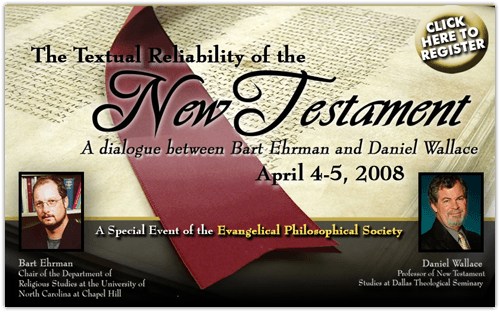
Daniel Wallace will be debating Bart Ehrman on The Textual Reliability of the New Testament. The debate is part of the Greer-Heard Point-Counterpoint Forum, a ministry of New Orleans Baptist Theological Seminary.
Here's the announcement from DTS:
Here's the announcement from DTS:
On April 4-5, 2008, Dr. Dan Wallace, professor of New Testament Studies at Dallas, will participate in a debate with Dr. Bart Ehrman, chair of the department of religious studies at University of North Carolina Chapel Hill, over the textual reliability of the New Testament.For more information, please visit http://www.greer-heard.com/.
HT: Phil Gons
Subscribe to:
Posts
(
Atom
)