

A followup example for the text and canon question raised in a diferent post.
What would it mean to accept the MT as a canon?
I have a nice example for illustration. Most might follow the LXX in this example and would not think that the MT would need a footnote, even when going against the MT.
Isaiah 53:5 has an interesting reading in the MT uvaHavurato
ובחֲבֻרתוׂ 'and in his joining, in his group'.
Translations and even Hb lexica (!) will list this as "bruise, weal, wound, 'stripe'". However, in Hebrew that word would be uvaHabburato
ובחַבּרתו
I read the MT as distinct and different from the "wound" reading. Of course, the LXX and 1Pet read according to a "wound"-tradition: τω μωλωπι.
If I were reading an unvocalized text here, I would go with the "bruise, wound" reading, Habbura, like the LXX and 1 Peter.
However, I do not believe that that is the MT reading. If I were going to present the MT reading, I might translate as "we are healed in association with him".
I would happily footnote, even "demand" a footnote, along the lines of "we are healed by his wound, according to old Greek and a different vocalization of the Hebrew."
The point here in this post is that the MT is a distinct textual entity and should be respected on its own right. In addition, one may argue that this is a canon. It is certainly a canon within the synagogue.
blessings
Randall
Saturday, July 08, 2006
Text and Canon, or, Do we really want an eclectic Hebrew Bible?
Shalom Hevre, χαιρειν
שלום חברה
This is a first post to the ETC and hopefully will appear in full if I don’t push the wrong buttons along the way.
There is a theoretical textual question that might be nice to discuss with this group. It is visible with the Hebrew Bible. Most Bible translations and many a commentary assume an unpublished, eclectic Hebrew text (whether they realize it or not) when translating/explaining the Hebrew Bible.
Do we want a new, 21st century eclectic text for the Hebrew Bible?
As a Bible translator I had assumed that a translator’s job included establishing a Hebrew text. It’s what everyone does and what most training directs and presupposes. It is the practice of every published Bible if there are footnotes along the lines of “according to LXX, Hebrew unclear”, or “according to different vocalization, Hebrew reads ‘xxxxx’”.
Some time ago [OK, 15 years already :-) ] I came to the conclusion that we don’t have enough background to produce a definitive pre-massoretic text of the Hebrew Bible. This is not a counsel of despair, but a recognition that the MT is in many respects a very conservative eclectic text with roots to the first century CE. If we accept it as a canon, we can translate it, and footnote our speculations and comparisons with other traditions. (Or, conversely, someone might use an LXX as their canon, and footnote MT differences and speculations outside the text.) Again, without realizing it, this is scholarly practice, where Leningrad is published in the BHS and everything else is footnoted.
Why don’t we acknowledge this and produce translations accordingly? It would mean defining the canon as the MT (or perhaps an LXX for some groups) and relegating all textual questions to “extra-canonical” footnotes.
I’ll give an example in another post on Is53 5 uvaHavurato ובחברתו.
blessings
Randall
שלום חברה
This is a first post to the ETC and hopefully will appear in full if I don’t push the wrong buttons along the way.
There is a theoretical textual question that might be nice to discuss with this group. It is visible with the Hebrew Bible. Most Bible translations and many a commentary assume an unpublished, eclectic Hebrew text (whether they realize it or not) when translating/explaining the Hebrew Bible.
Do we want a new, 21st century eclectic text for the Hebrew Bible?
As a Bible translator I had assumed that a translator’s job included establishing a Hebrew text. It’s what everyone does and what most training directs and presupposes. It is the practice of every published Bible if there are footnotes along the lines of “according to LXX, Hebrew unclear”, or “according to different vocalization, Hebrew reads ‘xxxxx’”.
Some time ago [OK, 15 years already :-) ] I came to the conclusion that we don’t have enough background to produce a definitive pre-massoretic text of the Hebrew Bible. This is not a counsel of despair, but a recognition that the MT is in many respects a very conservative eclectic text with roots to the first century CE. If we accept it as a canon, we can translate it, and footnote our speculations and comparisons with other traditions. (Or, conversely, someone might use an LXX as their canon, and footnote MT differences and speculations outside the text.) Again, without realizing it, this is scholarly practice, where Leningrad is published in the BHS and everything else is footnoted.
Why don’t we acknowledge this and produce translations accordingly? It would mean defining the canon as the MT (or perhaps an LXX for some groups) and relegating all textual questions to “extra-canonical” footnotes.
I’ll give an example in another post on Is53 5 uvaHavurato ובחברתו.
blessings
Randall
Tuesday, July 04, 2006
A Manuscript Witness to a Marcionite edition of Luke?
In a recent article Claire Clivaz has *suggested* that P69 (P. Oxy 2383) should be regarded 'as a witness to a Marcionite edition of Luke's Gospel' (C. Clivaz, 'The Angel and the Sweat Like "Drops of Blood" (Lk 22:43-44): P69 and f13' HTR 98 (2005), 419-440, citation from p. 420).
If this could be substantiated it would be a major discovery, since hitherto we have no actual manuscripts of any of Marcion's works. The contents of Marcion's canon has to be (re-) constructed from the comments of his polemical opponents (esp. Tertullian and Epiphanius, but also others). [For some kind of introduction to Marcion's Gospel see my article on Marcion]
Clivaz makes the following points:
If this could be substantiated it would be a major discovery, since hitherto we have no actual manuscripts of any of Marcion's works. The contents of Marcion's canon has to be (re-) constructed from the comments of his polemical opponents (esp. Tertullian and Epiphanius, but also others). [For some kind of introduction to Marcion's Gospel see my article on Marcion]
Clivaz makes the following points:
- P69 lacks Luke 22.42-45a
- This reflects a 'conscious omission' since 22.42-45a is a logical narrative unit
- Jesus' request that the cup pass from him (v42) was the most shocking element in the Gethsemane story (for ancient readers, as seen in Celsus; Porphyry, Origen)
- Celsus argued that some Christians had corrupted the text of the Gospels in order to evade the criticisms of opponents (Contra Celsum II.27 with specific reference to this passage)
- This could mean that scribes were omitting material from the Gethsemane account.
- 'This strategy of "negating the objections" by omission would be practical only in a type of Christianity that preserved a single gospel, as did Marcion.' (p. 429).
- Nothing of Luke 22.42-44 is attested in Marcion's Euaggelion (an argument from the silence of Tertullian and Epiphanius, with the authoritative support of Harnack)
- The omission of v42 is congruent with Marcionite Christology
- At Luke 22.61 in P69 Peter (not Jesus) is looking. This avoids any suggestion that Jesus is paying attention to Peter and is coherent with Marcion's avoidance of anything that could magnify Peter's status.
It is an interesting proposal. But can it stand up to critical scrutiny?
Monday, July 03, 2006
Glasgow, MS Gen 1026/13.
Last Friday, during a visit to Glasgow (primarily for a spot of external examining at the International Christian College), I managed a quick visit to the twelfth floor of the University Library to take a look at Glasgow MS Gen 1026/13 (a.k.a. P. Oxy 1228; a.k.a. P22).
It is important as being one of very few early NT mss written in roll format (rather than codex). The larger piece has a rather badly preserved text for the most part, so I shall have to return next year for a closer look at the blanks!
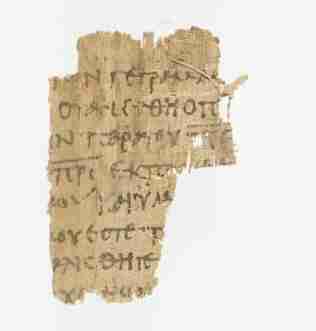
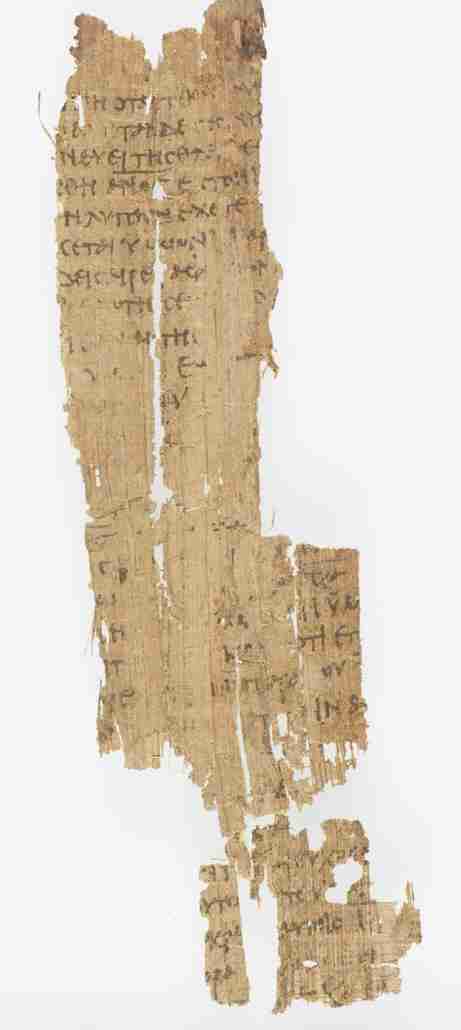
Here are some pictures (Glasgow University Library has images of all their Oxyrhycnhus Papyri available here).

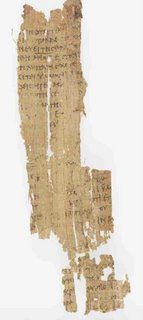
It is important as being one of very few early NT mss written in roll format (rather than codex). The larger piece has a rather badly preserved text for the most part, so I shall have to return next year for a closer look at the blanks!
Here are some pictures (Glasgow University Library has images of all their Oxyrhycnhus Papyri available here).

When did the Psalm titles get smaller?
In most modern English Bibles the titles of the Psalms are printed slightly smaller than the rest of the text. This is the case despite the alleged independence of translations such as the NIV, NLT, and NRSV, and will be familiar to many from the KJV.
I'm wondering when exactly this practice began. I've seen it in the facsimile edition of the Geneva Bible (1560), but presume it goes back before then.
What precedents there are for this in the manuscript tradition and in early printed editions (English, Latin, etc.)? I would guess that, while there might be a few analogies for this within mss, manuscripts would more generally have other ways of marking titles (e.g. colour of ink) since a slight change of character size is hard to achieve in a ms.
It seems to me that to use another font, character shape, colour or italics for the titles can usefully separate them from the rest of the text, but that if you print them in a smaller size it will almost inevitably be seen as giving them a lower status.
A few translations, of course, do not give the titles at all (e.g. NEB). Was Coverdale also thus (modern spelling edition here)?
I'm wondering when exactly this practice began. I've seen it in the facsimile edition of the Geneva Bible (1560), but presume it goes back before then.
What precedents there are for this in the manuscript tradition and in early printed editions (English, Latin, etc.)? I would guess that, while there might be a few analogies for this within mss, manuscripts would more generally have other ways of marking titles (e.g. colour of ink) since a slight change of character size is hard to achieve in a ms.
It seems to me that to use another font, character shape, colour or italics for the titles can usefully separate them from the rest of the text, but that if you print them in a smaller size it will almost inevitably be seen as giving them a lower status.
A few translations, of course, do not give the titles at all (e.g. NEB). Was Coverdale also thus (modern spelling edition here)?
Saturday, July 01, 2006
Meditations on defeat
Scotland is a happy country tonight after England's defeat. As an exile in the North I comforted myself with the thought that each word in the Bible is far more important than the World Cup. I'd also like to think that the same would apply to moveable nus in the NT, but I guess not all my compatriots would agree.
Subscribe to:
Posts
(
Atom
)