

It might be tempting to suppose that, because MT ascribes 73 psalms to David and the LXX 84, there was a tendency to add ascriptions to David to the psalms.
I would like to speculate about a contrary tendency to remove authorship ascriptions. The particular piece of evidence I would adduce for this comes from the ‘Psalms of Ascents’.
In MT these psalms share the title שיר המעלות 'song of the ascents', except Ps. 121, which reads שיר למעלות 'song to/for the ascents', by the simple change of one letter. Further ascriptions of authorship to David (122, 124, 131, 133) have been arranged more or less symmetrically either side of the central psalm 127, which is ascribed to Solomon. On either side of Ps. 127 the tetragrammaton occurs 24 times (I think this observation goes back to Hengstenberg).
However, this careful arrangement may have been produced by removing ascriptions to authors. The unusual structure שיר למעלות in Ps. 121 is the clue. In the Qumran text 11Qpsa we have a lacuna just at the beginning of Ps. 123 followed by דויד למעלות 'David to/for the ascents'. The lacuna is most naturally filled by the word שיר 'song'. Thus the whole title would read שיר דויד למעלות 'song of David for the ascents'. The use of the preposition lamedh 'to/for' is clearly necessitated by the fact that the construct-genitive relationship cannot be used here: 'song of David of the ascents' is not possible.
Thus it seems that MT's 'song for the ascents' in the title of Ps. 121 is a structure that can best be explained by the existence of an earlier authorship ascription. Of course, it is not possible to know what name may have been there previously. As often, MT suggests a previous history, but does not allow us to identify what that history is.
This, alongside the obscurity of information within the titles, would be another argument for some antiquity to traditions of information that formed the titles.
Wednesday, May 31, 2006
TC volume going mega-cheaply

D. G. K. Taylor, ed. Studies in the Early Text of the Gospels and Acts. Texts and Studies, third series, vol. 1. Birmingham, U.K.: University of Birmingham Press, 1999. Pp. xiii + 283. Normally: GBP £18.99/ US $55.00. ISBN: 1-902459-03-2.
For those interested this volume is now on sale from Continuum for only £5.
A review of the book can be found here.
To order:
Web - Continuum
Phone - (UK) 01202 665432
Tuesday, May 30, 2006
Septuagint lectionaries
Does anyone know of any good sources of information about lectionary texts of the Septuagint?
Monday, May 29, 2006
Tomas Bokedal, ThD thesis at Lund
[I am grateful to the author for receipt of the following abstract of a doctorate in systematic theology with considerable interaction with text-critical issues. It is good to see that the material aspects of manuscripts are beginning to be noticed by systematicians.]
Bokedal, Tomas, The Scriptures and the Lord: Formation and Significance of the Christian Biblical Canon. A Study in Text, Ritual and Interpretation, 374 pp. (ISBN: 91-628-6607-9). Thesis for the degree of Doctor of Theology, ThD, Lund University, 2005.
This study explores the emergence of the Christian biblical canon and its significance for the early as well as for the contemporary church. Some major challenges to previous research on the biblical canon are presented.
The apostolic formula "the Scriptures and the Lord" is defended as a good summary of the Christian canon, its formation and significance. It is argued that the canon was formed in a process with its own particular intention, history and direction. Seeking to bridge the early canon with its future orientation and reception, history and theology, past and present are considered alongside each other. The ongoing preservation and actualization of the canon is crucial also for today's church.
As part of the investigation, a set of signifiers for the different dimensions of the concept of canon is elaborated. Furthermore, the trinitarian textual markers of the so called nomina sacra are treated. The nomina sacra were consistently used in the Bible manuscripts until modern times, and their reintroduction in contemporary Bibles is proposed. Particularly highlighted are also the codex format, oral and written text, the textuality of the canon, canonical shape, the Liturgy of the Word, the Rule of Faith and the logic of the Christian canon.
The results of this investigation suggest that three recent views on the canon formation should be revised: 1) The significance of canonizing as an act of cataloguing of a definite list of Scriptures, commonly ascribed to the late fourth century. 2) The insignificance often associated with the first and second century concepts of a Christian biblical canon. And 3) The idea that the act of canonizing Scripture is just past history, while numerous examples of the act of preserving, actualizing and restructuring the Scriptures as canon may be enlisted in the midst of ongoing canon debates.In order to grasp the complex phenomenon of the Christian canon, applying a semiotic approach, the study is divided in four major parts, each signifying different aspects of the canonical structuring of the Christian Scriptures. These are: 1) linguistic and effective-historical, 2) material and textual, 3) performative, and 4) ideational aspects. The hermeneutics of tradition developed by Hans-Georg Gadamer is central to the study.
Bokedal, Tomas, The Scriptures and the Lord: Formation and Significance of the Christian Biblical Canon. A Study in Text, Ritual and Interpretation, 374 pp. (ISBN: 91-628-6607-9). Thesis for the degree of Doctor of Theology, ThD, Lund University, 2005.
This study explores the emergence of the Christian biblical canon and its significance for the early as well as for the contemporary church. Some major challenges to previous research on the biblical canon are presented.
The apostolic formula "the Scriptures and the Lord" is defended as a good summary of the Christian canon, its formation and significance. It is argued that the canon was formed in a process with its own particular intention, history and direction. Seeking to bridge the early canon with its future orientation and reception, history and theology, past and present are considered alongside each other. The ongoing preservation and actualization of the canon is crucial also for today's church.
As part of the investigation, a set of signifiers for the different dimensions of the concept of canon is elaborated. Furthermore, the trinitarian textual markers of the so called nomina sacra are treated. The nomina sacra were consistently used in the Bible manuscripts until modern times, and their reintroduction in contemporary Bibles is proposed. Particularly highlighted are also the codex format, oral and written text, the textuality of the canon, canonical shape, the Liturgy of the Word, the Rule of Faith and the logic of the Christian canon.
The results of this investigation suggest that three recent views on the canon formation should be revised: 1) The significance of canonizing as an act of cataloguing of a definite list of Scriptures, commonly ascribed to the late fourth century. 2) The insignificance often associated with the first and second century concepts of a Christian biblical canon. And 3) The idea that the act of canonizing Scripture is just past history, while numerous examples of the act of preserving, actualizing and restructuring the Scriptures as canon may be enlisted in the midst of ongoing canon debates.In order to grasp the complex phenomenon of the Christian canon, applying a semiotic approach, the study is divided in four major parts, each signifying different aspects of the canonical structuring of the Christian Scriptures. These are: 1) linguistic and effective-historical, 2) material and textual, 3) performative, and 4) ideational aspects. The hermeneutics of tradition developed by Hans-Georg Gadamer is central to the study.
The case against reduction of large numbers
Here I am going to present some arguments to the effect that the large numbers of Israelites in current texts (MT, LXX, etc.) of the exodus narrative, especially in the book of Numbers, should not be reduced.
Outline
1. Large numbers as a biblical theme
Numbers of humans are a significant element of the biblical narrative right from Genesis 1:28 when the humans are told to ‘be fruitful and multiply and fill the earth’. Such language is echoed in Genesis 6:1, but human sin provokes the Flood, whereafter God reissues his multiplication command in Genesis 9:1. After his election Abra(ha)m is given specific promises of a large number of offspring and it is said that they will in fact be unable to be counted (Gen. 15:5).
We then follow the Genesis narrative carefully as, despite multiple barrenness, the patriarchs begin to multiply. A key point is Genesis 46 when Jacob and family are about to enter Egypt. Here the narrative goes into slow motion as it carefully counts the small number of those who enter Egypt. Jacob has already emphasised the smallness of his family (34:30), saying literally that he consists of ‘men of number’ (i.e. not an uncountable group).
Exodus picks up where Genesis left off. It begins by listing Jacob’s sons and mentioning that, as in Genesis 46, there were only 70 (LXX 75). We then read Exodus 1:7:
‘Now the children of Israel were fruitful, and swarmed, and multiplied, and became very, very strong, and the land was filled with them.’
But let us not forget that ‘land’ and ‘earth’ are the same word in Hebrew. Thus the large number of Israelites is linked back to the command first given to humanity (Gen. 1:28) and the promises to Abraham. It is in fact a central theme in the narrative.
Pharaoh gets seriously worried. He proclaims, rightly or wrongly, that the Israelites are in fact a stronger nation than his own, or possibly ‘too strong’ for him (Exod. 1:9), but even after this point the narrative reports tw0 further expansions of the Israelites (Exodus 1:12, 20).
The large number of Israelites is mentioned in Exodus 38:26 to be 603,550 men, and this number is confirmed by the quantity of tax in the context.
This number is, moreover, given at great length over the course of Numbers 1-2, and confirmed by multiple totalling. A similar census appears later in Numbers 26. The length of text devoted to this subject in Numbers suggests that the census is extremely important. One source of importance could be the narrative’s stress on the fact that only two men of the exodus generation made it to the promised land. However, it is also naturally linked with the theme of the patriarchal promises of multiple offspring and the emphasis on multiplication among the Israelites. Abraham had been promised so many children that they could not be counted. In these passages we have the many, but they can still be counted.
Numbers also shows us that, broadly speaking, multiplication is suspended during the wilderness period.
In case we had any doubt that the number of Israelites was really huge we have the narrative in Numbers 11, where their numbers are emphasised: ‘all this people’ (11:13, 15). God says that he will provide meat for the people for a whole month (11:20), which Moses views as impossible because there are 600,000 men on foot (11:21-22)—Moses’ objection does not work so well with a smaller number. Moses’ disbelief in God’s ability to provide meat is answered by God’s provision of quail for one day’s journey either side of the camp (let’s say conservatively that this means quail for 15 miles in each direction) and 3 feet deep (11:31). This provision suits the large size of camp.
The next point which emphasises the large number of Israelites is the Balaam narrative (Numbers 22-24). Balak takes Balaam to various points from which he can catch a view of some, but not all, of the Israelite camp (22:41). He emphasises their number (23:10).
The large number of Israelites is again confirmed by the counting of spoil in Numbers 31.
The number of Israelites is thus confirmed by four different means of reckoning (Exodus 38, Numbers, 1, 2, 31) and by the narrative structure of Genesis-Numbers. It is not only the most carefully given number in the Bible, but probably the most carefully given number in antiquity.
If the numbers have been changed then this has occurred in a number of passages in at least two books of the Bible.
2. Two internal objections
Two objections to a literal understanding of the text might be:
a) the number of the bekor, traditionally rendered ‘first born’, is too low (Num. 3:43)
b) the number of people in the land is even greater than the number of Israelites (Deut. 9:1)
a) rests on assumptions about the meaning of the term bekor, which is a term about which we do not know enough. In particular we are not sure of the extent to which this was a fixed status. There is some biblical evidence that it was not (Gen. 25:33; 1 Chron. 5:1). Was one still called bekor after one came to majority, when one had received one’s inheritance or after one’s father had died? Was there a bekor in families where the oldest child was female, or was is only males who ‘opened the womb’ (peter rehem)? Is there anything in the idea that the bekor was at first the first born of the mother and that the term was then applied to the first born of the father? Was there flexibility? Was there an exact parallel between the term when used of animals and when used of humans? What is the relationship between those who were bekor and the age range 20-50? If Pharaoh was ‘first born’ in our sense, why was he not killed in the 10th plague? This requires some sort of study. But quite aside from these questions those who want to use the number of firstborn as an objection to the figure of 600,000 men need to disprove Keil and Delitzsch’s detailed argument that the number refers specifically to the firstborn since the exodus (opening section of their commentary on Numbers).
b) requires us to find out whether it is when the nations are taken singly or together that they are greater than Israel, and whether their ‘greatness’ is entirely numerical.
Thus, objections to taking the large numbers literally are not yet sustained.
3. How an evangelical can shoot themselves in the foot
Here I wish to point out to evangelicals interested in the subject why it would be unwise to try to scale down the numbers at the exodus.
a) When evangelicals assert that, despite multiple totalling, thematic links and textual agreement across all the versions, the text of the Bible is corrupt in regard to the number of Israelites, they make it rather attractive not to be evangelical. After all, the vast majority of scholars from other groups are quite happy for the text to stand as it is. The most significant thing in attracting evangelicals to abandon classic evangelical views of scripture is when they become convinced that other views show a greater loyalty to the scriptures.
b) The external (mss) evidence for the text is overwhelming. Those who posit that the text is corrupt are positing that large swathes of the biblical text have been systematically corrupted. However, the quantity of text and quality of its thematic coherence on the subject of large numbers easily surpasses the quantity and quality of text needed to establish a whole number of core evangelical beliefs, both doctrinal and ethical. The scribe(s) who systematically changed all the numbers has/have about as much evidence for their existence as scribes who inserted trinitarian verses into the NT, or put anti-homosexual practice texts in the Bible. If you’re going to say that the large number of Israelites is textually corrupt, it would surely be easier to argue that John 3:16 is an interpolation.
c) Corruptions common to MT and LXX as well as other versions would have to have taken place considerably prior to the time of the NT. Those who argue that the text is corrupt are likely to have to conclude that the truth about the exodus had been lost before the time of the NT.
4. External objections
There are, of course, massive objections to a narrative with 600,000 Israelite men, but these are entirely historical in nature. Strictly speaking the text-critical decision about the textual integrity of the narrative can be made without regard to the question of whether the narrative is historical and whether it was composed in the fifteenth or the third century BC. It is therefore unnecessary to answer historical objections to the narrative in order to be able to establish that the large numbers should stand.
However, it is necessary for someone who accepts the large numbers and espouses an evangelical position on scripture that says that the narrative is true to explain how that belief could be rational. This is really a topic for another forum and for someone with different expertise from myself. My conclusion from textual criticism is that evangelicals do indeed have a problem, but that this problem is to be solved by historical research (on topics like ancient population estimates, and the archaeology of the exodus and conquest) not by text-critical conjecture.
Outline
- Large numbers as a biblical theme
- Two internal objections
- How an evangelical can shoot themselves in the foot
- External objections
1. Large numbers as a biblical theme
Numbers of humans are a significant element of the biblical narrative right from Genesis 1:28 when the humans are told to ‘be fruitful and multiply and fill the earth’. Such language is echoed in Genesis 6:1, but human sin provokes the Flood, whereafter God reissues his multiplication command in Genesis 9:1. After his election Abra(ha)m is given specific promises of a large number of offspring and it is said that they will in fact be unable to be counted (Gen. 15:5).
We then follow the Genesis narrative carefully as, despite multiple barrenness, the patriarchs begin to multiply. A key point is Genesis 46 when Jacob and family are about to enter Egypt. Here the narrative goes into slow motion as it carefully counts the small number of those who enter Egypt. Jacob has already emphasised the smallness of his family (34:30), saying literally that he consists of ‘men of number’ (i.e. not an uncountable group).
Exodus picks up where Genesis left off. It begins by listing Jacob’s sons and mentioning that, as in Genesis 46, there were only 70 (LXX 75). We then read Exodus 1:7:
‘Now the children of Israel were fruitful, and swarmed, and multiplied, and became very, very strong, and the land was filled with them.’
But let us not forget that ‘land’ and ‘earth’ are the same word in Hebrew. Thus the large number of Israelites is linked back to the command first given to humanity (Gen. 1:28) and the promises to Abraham. It is in fact a central theme in the narrative.
Pharaoh gets seriously worried. He proclaims, rightly or wrongly, that the Israelites are in fact a stronger nation than his own, or possibly ‘too strong’ for him (Exod. 1:9), but even after this point the narrative reports tw0 further expansions of the Israelites (Exodus 1:12, 20).
The large number of Israelites is mentioned in Exodus 38:26 to be 603,550 men, and this number is confirmed by the quantity of tax in the context.
This number is, moreover, given at great length over the course of Numbers 1-2, and confirmed by multiple totalling. A similar census appears later in Numbers 26. The length of text devoted to this subject in Numbers suggests that the census is extremely important. One source of importance could be the narrative’s stress on the fact that only two men of the exodus generation made it to the promised land. However, it is also naturally linked with the theme of the patriarchal promises of multiple offspring and the emphasis on multiplication among the Israelites. Abraham had been promised so many children that they could not be counted. In these passages we have the many, but they can still be counted.
Numbers also shows us that, broadly speaking, multiplication is suspended during the wilderness period.
In case we had any doubt that the number of Israelites was really huge we have the narrative in Numbers 11, where their numbers are emphasised: ‘all this people’ (11:13, 15). God says that he will provide meat for the people for a whole month (11:20), which Moses views as impossible because there are 600,000 men on foot (11:21-22)—Moses’ objection does not work so well with a smaller number. Moses’ disbelief in God’s ability to provide meat is answered by God’s provision of quail for one day’s journey either side of the camp (let’s say conservatively that this means quail for 15 miles in each direction) and 3 feet deep (11:31). This provision suits the large size of camp.
The next point which emphasises the large number of Israelites is the Balaam narrative (Numbers 22-24). Balak takes Balaam to various points from which he can catch a view of some, but not all, of the Israelite camp (22:41). He emphasises their number (23:10).
The large number of Israelites is again confirmed by the counting of spoil in Numbers 31.
The number of Israelites is thus confirmed by four different means of reckoning (Exodus 38, Numbers, 1, 2, 31) and by the narrative structure of Genesis-Numbers. It is not only the most carefully given number in the Bible, but probably the most carefully given number in antiquity.
If the numbers have been changed then this has occurred in a number of passages in at least two books of the Bible.
2. Two internal objections
Two objections to a literal understanding of the text might be:
a) the number of the bekor, traditionally rendered ‘first born’, is too low (Num. 3:43)
b) the number of people in the land is even greater than the number of Israelites (Deut. 9:1)
a) rests on assumptions about the meaning of the term bekor, which is a term about which we do not know enough. In particular we are not sure of the extent to which this was a fixed status. There is some biblical evidence that it was not (Gen. 25:33; 1 Chron. 5:1). Was one still called bekor after one came to majority, when one had received one’s inheritance or after one’s father had died? Was there a bekor in families where the oldest child was female, or was is only males who ‘opened the womb’ (peter rehem)? Is there anything in the idea that the bekor was at first the first born of the mother and that the term was then applied to the first born of the father? Was there flexibility? Was there an exact parallel between the term when used of animals and when used of humans? What is the relationship between those who were bekor and the age range 20-50? If Pharaoh was ‘first born’ in our sense, why was he not killed in the 10th plague? This requires some sort of study. But quite aside from these questions those who want to use the number of firstborn as an objection to the figure of 600,000 men need to disprove Keil and Delitzsch’s detailed argument that the number refers specifically to the firstborn since the exodus (opening section of their commentary on Numbers).
b) requires us to find out whether it is when the nations are taken singly or together that they are greater than Israel, and whether their ‘greatness’ is entirely numerical.
Thus, objections to taking the large numbers literally are not yet sustained.
3. How an evangelical can shoot themselves in the foot
Here I wish to point out to evangelicals interested in the subject why it would be unwise to try to scale down the numbers at the exodus.
a) When evangelicals assert that, despite multiple totalling, thematic links and textual agreement across all the versions, the text of the Bible is corrupt in regard to the number of Israelites, they make it rather attractive not to be evangelical. After all, the vast majority of scholars from other groups are quite happy for the text to stand as it is. The most significant thing in attracting evangelicals to abandon classic evangelical views of scripture is when they become convinced that other views show a greater loyalty to the scriptures.
b) The external (mss) evidence for the text is overwhelming. Those who posit that the text is corrupt are positing that large swathes of the biblical text have been systematically corrupted. However, the quantity of text and quality of its thematic coherence on the subject of large numbers easily surpasses the quantity and quality of text needed to establish a whole number of core evangelical beliefs, both doctrinal and ethical. The scribe(s) who systematically changed all the numbers has/have about as much evidence for their existence as scribes who inserted trinitarian verses into the NT, or put anti-homosexual practice texts in the Bible. If you’re going to say that the large number of Israelites is textually corrupt, it would surely be easier to argue that John 3:16 is an interpolation.
c) Corruptions common to MT and LXX as well as other versions would have to have taken place considerably prior to the time of the NT. Those who argue that the text is corrupt are likely to have to conclude that the truth about the exodus had been lost before the time of the NT.
4. External objections
There are, of course, massive objections to a narrative with 600,000 Israelite men, but these are entirely historical in nature. Strictly speaking the text-critical decision about the textual integrity of the narrative can be made without regard to the question of whether the narrative is historical and whether it was composed in the fifteenth or the third century BC. It is therefore unnecessary to answer historical objections to the narrative in order to be able to establish that the large numbers should stand.
However, it is necessary for someone who accepts the large numbers and espouses an evangelical position on scripture that says that the narrative is true to explain how that belief could be rational. This is really a topic for another forum and for someone with different expertise from myself. My conclusion from textual criticism is that evangelicals do indeed have a problem, but that this problem is to be solved by historical research (on topics like ancient population estimates, and the archaeology of the exodus and conquest) not by text-critical conjecture.
Saturday, May 27, 2006
Septuagint Research
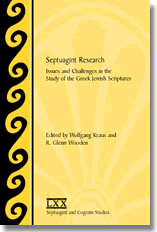 Wolfgang Kraus and R. Glenn Wooden, eds, Septuagint Research: Issues and Challenges in the Study of the Greek Jewish Scriptures (Septuagint and Cognate Studies 53; Atlanta: Society of Biblical Literature, 2006), pp. xvi + 414. ISBN 1589832043. $49.95.
Publication blurb:
The past few decades have witnessed a renewed scholarly interest in the Septuagint, especially with regard to its importance for the fields of theology, Jewish studies, classics, philosophy, history of religions, linguistics, and history of literature. To provide students and scholars alike with ready access to the most recent developments, this collection of essays presents a comprehensive and representative picture of septuagintal research today. Specifically, this volume surveys methodological issues, provides thematic and book-centered studies focused on the Old Greek-Septuagint translations, explores the use of these translations in the New Testament, and issues a call for the exploration of the theologies of the Septuagint as a bridge between the theologies of the Hebrew Bible and those of the New Testament. It brings together a variety of perspectives, from emerging voices to seasoned scholars, both English-speaking scholars working on the New English Translation of the Septuagint project and German-speaking scholars working on the Septuaginta Deutsch project.
Subscribe to:
Posts
(
Atom
)