Tuesday, March 10, 2015

Radiometric Dating of the Gospel of Judas

3
Peter Kirby has put together an excellent survey of information on the 14C dating of the Gospel of Judas, here.  The whole issue is complicated, particularly for those without a firm grounding in the application of radiometric dating, but I can summarize the conundrum by saying that a National Geographic publication by Herbert Krosney suggested that the GJudas codex material could be assigned to 280 CE ±60 years, but then represented the results as all falling in the third century.  (Both are statements are problematic, but especially the second.)  This was unfortunate and created a great deal of confusion and speculation.  The Tchacos Codex would then be the earliest Coptic manuscript currently known!

Peter Kirby offers a number of learned insights, but in particular points out an important gross error on the part of Krosney.  Krosney did not understand how radiocarbon results should be “calibrated” against known radiocarbon evidence (tree rings), and instead simply subtracted his BP (“Before Present”) numbers from the year in which the results were produced (2005) to erroneously produce a series of numbers dating to the the third century.

The National Geographic Society granted the Arizona AMS laboratory permission to send me the actual results, and I am publishing an update on the dating of the Tchacos Codex based on the findings.  Again, it’s complicated, and I offer here only a summary.  Krosney made a number of errors, including simple typos.  This is a shame, because generally his two Judas books are well-executed.  In my forthcoming book chapter, I advance the theory of Peter Head, including the actual results from the reports, suggesting that the way in which the results were averaged is not codicologically optimal.  (The lab had six test results, and by averaging results one can reduce the deviation number which consequently reduces the date range from periods of greater than two centuries to periods of less than two centuries.)  Head has argued that instead of excluding one of the results from the leaves and averaging the remaining five, there should be two averages: one average of all three leaves and one average of the three binding elements.

My estimation following Peter Head’s thesis leaves a radiometric result in the late third through the end of the fourth century.  One should be aware that fourth century manuscripts will typically have calibrated dates ranging back into the third century.  The issues is that the amount of 14C carbon in the atmosphere dipped in the fourth century, and thus fourth century manuscripts generally look like third century manuscripts.  Notably, one of the individual calibrations of the papyri leaves offered a date range into the sixth century!

Seeing the Codex Vercellensis in a New Light: Multispectral Imaging and the Old Latin Bible

9
I’m pleased to be able to post here a report of some important new research from Gregory Heyworth and Roger Easton which will doubtless be of broader interest:


Dating to the first half of the 4th century, the Codex Vercellensis or Codex A is the earliest manuscript of the Gospels in Latin. As such, it is perhaps the closest witness to the text of the Christian Bible in the West in the age of Constantine and the Council of Nicaea. Housed in the Capitulary Library of Vercelli since the time of St. Eusebius of Vercelli under whose auspices it was written, the manuscript now contains 317 folios, many of which are badly damaged by mold and decay to the point of illegibility. In fact, the last edition of Codex A to be made from an original reading of the manuscript was in the mid 18th century when it was considerably more legible than it is today.
          To stabilize the crumbling manuscript, Franz Ehrle, head conservator at the Vatican in the early 20th century, disbound it and encased each bifolium in thin sheets of gelatin. While effective in preventing further decay, the gelatin also inhibits ultraviolet light which scholars have traditionally used to enhance reading through fluorescence. In an effort return Codex A to the attention of scholars, the curator of the Capitulary Library and Museum of the Dome, Timoty Leonardi, contacted the Lazarus Project for assistance in recovering text from the manuscript.
          In March 2013, a team from the Lazarus Project (http://www.lazarusprojectimaging.com/) traveled to Vercelli to collect spectral images of sample leaves from the codex. In July 2014 they returned to image the entire manuscript, this time with help from the Early Manuscripts Electronic Library (http://emel-library.org/).
          Spectral imaging involves two distinct phases. First, imagers photograph the manuscript with a 50-megapixel camera fitted with a specially calibrated quartz lens and a dual filter wheel. 

 Specially designed LED light units illuminate each folio both from above (reflectively) and below (transmissively) in twelve different wavelengths of light between the ultraviolet (365nm) and the infrared (940nm). Fluorescence from the manuscript provoked by ultraviolet and blue light is separated and captured with the help of a dual filter wheel that sits in front of the lens. All told, as many as thirty-three individual images of each page are captured by the computer-driven system, totaling in this case over 20,000 photos in a ten day period and over 4 terabytes of data.
          In the image processing phase, combinations of these bands are computed digitally using a hypersectral software called ENVI that is traditionally used for processing geospatial images from satellites. The goal is to enhance the contrast of the text to the background. The image “cubes” are then further refined using statistical processing known as Principle Component Analysis (PCA) and Independent Component Analysis (ICA). In this example, pseudocolor images with different combinations of spectral bands were animated to show how the text looks before and after image processing.
          The key to the effectiveness of a spectral imaging project lies in the interdisciplinarity of the team. Led by Dr. Gregory Heyworth, a medievalist and codicologist trained in textual editing, the Lazarus Project team is comprised of imaging scientists Drs. Keith Knox and Roger Easton, both of whom are known for their pioneering work on the Archimedes Palimpsest among many other major recovery intitiatives. They were joined by Michael Phelps, Executive Director of EMEL, a biblical scholar by training, who directs the Sinai palimpsest project at St. Catherine’s monastery, and by Ken Boydston of MegaVision Corporation, who constructed the camera system and designed the lens, and who is known, among other things, for his work imaging the Dead Sea Scrolls multispectrally. The team was rounded out by a number of undergraduate students from the University of Mississippi and the Rochester Institute of Technology who are learning the interdisciplinary skills of textual science necessary to broaden the awareness of this esoteric field for the next generation.
          The result of the first imaging is shown in the animation video. Much of the text that is unreadable to the unaided eye reveals itself in the spectral images. Processing of images of the entire manuscript is now ongoing. Additional results are expected by the end of summer 2015, to be followed by a new edition by Heyworth under the auspices of the Vetus Latina Institute.


Monday, March 09, 2015

Helpful Website on English Translations of the Bible

9
I recently came across a website called the Internet Bible Catalog. Notwithstanding that mis-spelling of “catalogue” I found this a useful resource in tracking down both a particular edition of an English translation of the NT, and also earlier and later editions of the same. It is run mostly by and for collectors, rather than scholars (so better on translations than Hebrew and Greek editions). Here is what they say about themselves:
The Internet Bible Catalog is a web-based catalog of printed editions of the Bible. Its primary focus is on English language translations, but it has many entries for Bibles in the original languages and in non-English versions. The Catalog welcomes participation from the larger community of Bible Collectors. Members are encouraged to add and correct entries.
The Internet Bible Catalog is different from printed catalogs in that it includes images of the Bibles. For almost all entries, the title page is included and many entries include covers, jackets, or representative pages. Another unique feature is the inclusion of sample verses; a representative sample of verses from a given version.
For example, have a look at the impressive list of different English translations

Friday, March 06, 2015

Greek Lectionaries: An Introduction

14
I was getting together a handout for a seminar on Monday on the topic of Greek Lectionary manuscripts of the New Testament. But it is an area in which I readily confess my ignorance (and usually don’t even get to in courses I have taught), so I thought I would offer it here for correction and suggestions. Most of the material is from Osburn (2012), with a bit of Jordan (2009). Suggestions of helpful reading (and an ideal online manuscript) would be especially welcome.


Greek Lectionaries: an introduction

Around 40% of all NT manuscripts (over 2,400 listed) (mostly minuscule, with a few earlier majuscule manuscripts of a lectionary type). Relatively neglected – e.g. no critical edition (often commented on, from Westcott & Hort through to Osburn & Karavidopoulos).[1] Generally close to Byzantine text: ‘lectionaries have text-critical value primarily for the later history of the NT textual tradition’ (Osburn, 108).

Different types of lectionary (eklogadion):
Mostly (over two-thirds): euaggelion or euaggelistarion (separate gospel manuscripts become known as tetraeuaggelion)
Others (a quarter): apostolos or praxapostolos (lessons from Acts and epistles: la)
Others: apostoloeuangelion (readings from Gospels, Acts and Epistles; #75: l+a)

Complete Lectionary system has two parts: synaxarion – follows ecclesiastical calendar, from Easter Sunday to Holy Saturday (moving with the date of Easter); and the menologion – follows the civil calendar, from Sept 1 to Aug 31. See Scrivener, Introduction, 80-89 for a plan (or Gregory, Textkritik, 344-386). [Plans can be added to cont. text mss, e.g. 892, BL Add 33277]

Synaxarion
Easter to Pentecost – readings from John and Acts
Pentecost to Holy Cross day – 16 weeks – readings from Matthew supplemented from Mark; Romans, 1 & 2 Cor, texts from Eph and Hebrews.
Holy Cross day to Lent – readings from Luke (and some Mark)
Lent – Sat & Sun readings from Mark, John, Hebrews; weekday readings OT
Holy Week – numerous longer readings (Gospels, Romans, 1 Corinthians)
After Holy Week – eleven resurrection readings from Sunday morning.

Menologion
developed in the tenth century by Symeon Metaphrastes (Høgel)
Includes readings for special occasions and celebrations of lives of saints etc., incorporating hagiographical, homiletical and biblical material (with differences for local practice).

On date of origin of system and lectionary text:
Metzger: ‘the lectionary system current today in the Orthodox church had its origin sometime during the fourth century’ (1972, 495-6) [evidence from Chrysostom that he comments on the lesson for the day, e.g. Hom. 7 ad Antioch; Hom. 63.47 in Act)
Aland: none of the pre-eighth century lectionary manuscripts have the later system (e.g. l1604 (IV), l1043 (V), l1276 (VI), l1347 (VI), l1354 (VI) etc.); reading notes added to continuous text manuscripts (arche, telos) only from the eighth century onwards. Junack: general lectionary system comes from late seventh or early eighth century (same time as Byzantine calendar; hence also Byzantine text)
For earlier systems (e.g. Jerusalem based readings) need to compare Syriac, CPA, Armenian and other versional evidence. And the earlier majuscule lectionary manuscripts (mentioned earlier), as well as patristic practice.
History of Study (Jordan, Osburn, Karavidopoulos)
Mill (1707) used 8 gospel lectionaries and 1 apostolos
Wettstein (1751f) – 24 euaggelion, 4 apostolos
Matthaei (1782-1788) – 57 euaggelion, 20 apostolos
Scholz (1830-1836) – 178 euaggelion, 58 apostolos
Not much role/use in Tischendorf, Westcott & Hort, von Soden (deliberately not)
Gregory (1900-1909): counts and describes 1,599 lectionaries
1904/1912: V./B. Antoniades, h9 kainh\ diaqh/kh e0gkri/sei th=j Mega/lhj tou= Xristou=  0Ekklhsi/aj (Constantinople: Ek tou Patriarchikou Typographeiou [Patriarchal Press], 1904, 1912 [corrected]; Athens: Apostoliki Diakonia, 1993 reprint): first continuous comprehensive Greek text of NT in Orthodox world; continuous text based on text of 116 lectionaries (Contantinople, Mount Athos, Athens, Jerusalem); aimed for ‘the best reconstruction of the most ancient text of ecclesiastical tradition and, more specifically, of the Church of Constantinople’. (Karavidopoulos)
Chicago Lectionary Project under Ernest C. Colwell - 1930s-60s (Wikgren)
NA/UBS: Generally cited together: Byz. Lect. or singly by the letter l in italics and their number. But: ‘Nothing approaching a systematic presentation of lectionary readings occurs in any currently printed Greek Testament.’ (Osburn, 100).

Approaching a Lectionary Manuscript
Euaggelion - organized into separate readings, with the day set for each passage written at the start of the periscope or in the upper margin. Sometimes with an indication of which liturgical service is meant.
l339 = British Library, Egerton 2163: good example of complete lectionary (syn. & men.), Byz text (http://www.bl.uk/manuscripts/FullDisplay.aspx?ref=Egerton_MS_2163)
Liste       le = e9bdoma/dej – contains readings for each day of the week (except in Lent, when there are only Sat/Sun readings)
                    lesk = e9bdoma/dej/sabbatokuriakai/ - contains readings for each day between Easter Sunday and Pentecost, Sat/Sun readings to Palm Sunday and daily readings in Holy Week until Holy Saturday.
                    lsk = sabbatokuriakai/ - contains readings for Sat/Sundays only
                    lsel = contains readings for selected days
                    lK = kuriakai/ - contains readings for Sundays

Bibliography

C.R. Gregory, Textkritik des Neuen Testamentes (Leipzig: J.C. Hinrichs, 1900-09).
C. Höeg & G. Zuntz, ‘Remarks on the Prophetologion’ in Quantulacumque: Studies Presented to Kirsopp Lake (ed R.P. Casey, S. Lake & A.K. Lake; London: Christophers, 1937), 189-226.
C. Høgel, Symeon Metaphrastes. Rewriting and Canonization (Copenhagen: Museum Tusculanum Press, University of Copenhagen, 2002).
C.R.D. Jordan, ‘The  Textual Tradition of the Gospel of John in Greek Gospel Lectionaries from the Middle Byzantine Period (8th-11th Century)’ (PhD; Birmingham, 2009).
K. Junack, ‘Zu den griechischen Lektionaren und ihrer Überlieferung der katholischen Briefe’ Die alten Übersetzungen des Neuen Testaments, die Kirchenväterzitate und Lektionaire (ed. K. Aland; ANTF 5; Berlin: de Gruyter, 1972), 498-591.
I.D. Karavidopoulos, ‘The Ecumenical Patriarchate’s 1904 New Testament Edition and Future Perspectives’ Sacra Scriptura X (2012), 7-14.
B.M. Metzger, ‘Greek Lectionaries and a Critical Edition of the Greek New Testament’ in Die alten Übersetzungen des Neuen Testaments, die Kirchenväterzitate und Lektionaire (ed. K. Aland; ANTF 5; Berlin: de Gruyter, 1972), 479-497.
C. Osburn, ‘The Greek Lectionaries of the New Testament’ in Ehrman, B.D. & Holmes, M.W. (edd.), The Text of the New Testament in Contemporary Research: Essays on the Status Quaestionis. Second Edition (NTTSD 42; Leiden: E.J. Brill, 2012), 93-113.
D. Patras, ‘The Gospel Lectionary in the Byzantine Church’ StVladThQ 41 (1997), 113-140.
D. W. Riddle, ‘The Use of Lectionaries in Critical Editions and Studies of the New Testament Text’ in Prolegomena to the Study of the Lectionary text of the Gospels. Studies in the Lectionary Text of the Greek New Testament, vol. 1, ed. E. C. Colwell and D. W. Riddle (Chicago: The University of Chicago Press, 1933), 67-77.
F.H.A. Scrivener, A Plain Introduction to the Criticism of the New Testament for the use of Biblical Students (London: George Bell & Sons, 1894; 4th edition ed. E. Miller)
B. F. Westcott and F. J. Hort, The New Testament in the Original Greek. Introduction and Appendix (London: MacMillan and Co., 1881).
A. P. Wikgren, ‘Chicago Studies in the Greek Lectionary of the New Testament’ in Biblical and Patristic Studies in Memory of Robert Pierce Casey (ed J.N. Birdsall & R.W. Thomson; Freiburg: Herder, 1963), 96-121.


[1] Westcott & Hort, Introduction, 76-77: ‘an almost unexplored region of textual history...’; Osburn, 93: ‘seriously neglected in the search for the earliest forms of the NT text’.


Thursday, March 05, 2015

Vatican Library: Online Images (NT Greek)

3
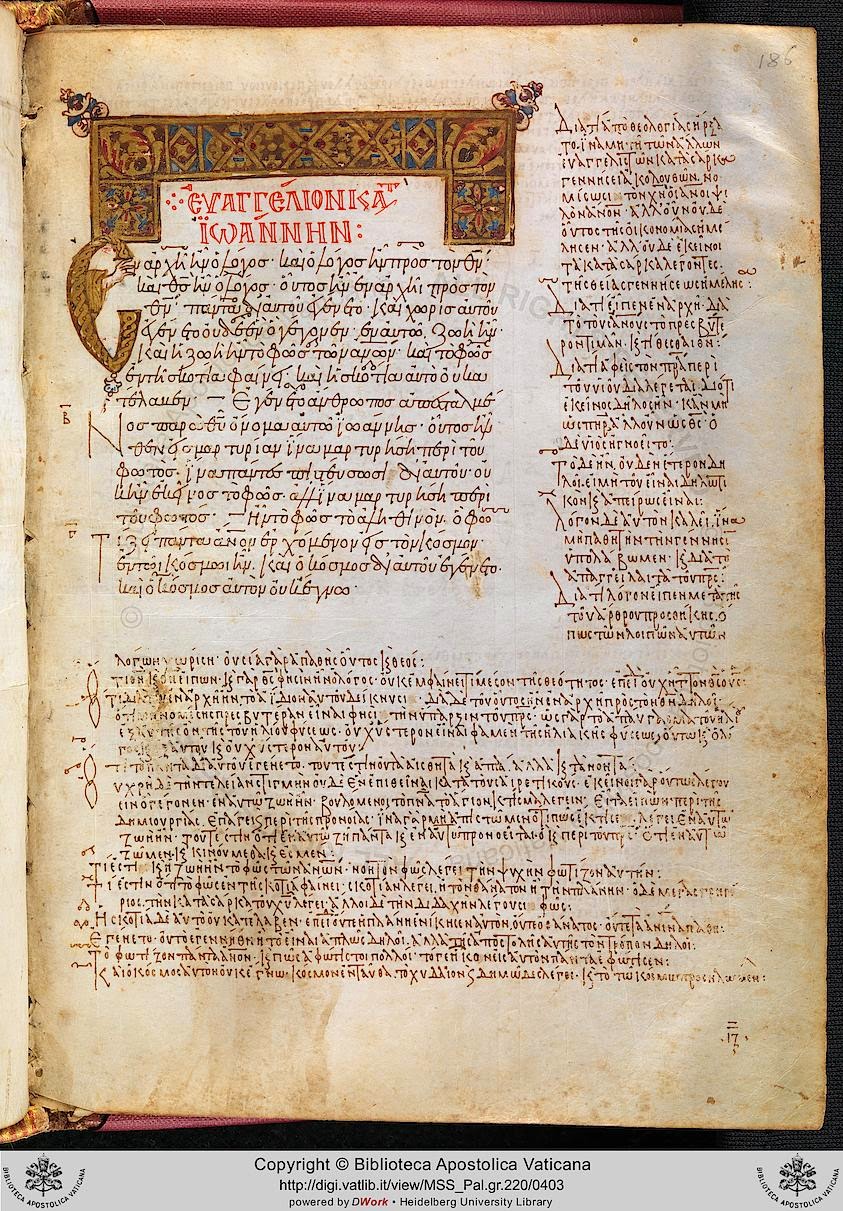
I don’t think that it will be possible to post regular up-dates for online images of the Vatican Library. They are aiming to get all 80,000 manuscripts photographed and on-line (1690 so far). Among those 80,000 are around 346 NT Greek manuscripts (the number of results in the online Liste), and (I presume) extensive holdings in LXX manuscripts and other ancient languages. But as a first installment, and a reminder that it may well be worth checking whether a particular manuscript has appeared on-line (if you want a particular manuscript to appear on line you should request it), the general page you want to start at is here.

Several of these include text and commentary (illustrating some of the major types discussed recently by Dan Wallace here).

So far the following are online:

NT 150 (Vatican, Pal. Gr. 189) [11th cent. Gospels] (Mark 1.1 again)


NT 151 (Vatican, Pal. Gr. 220) [10th cent. Gospels with Commentary] (nice style)


NT 388 (Vatican, Ottob. Gr. 212) [13th cent. Gospels] (John 1)


NT 850 (Vatican, Barb. Gr. 504) [12th cent.; John 1-10 with Commentary] (guess where)


NT 1843 (Vatican, Vat. Gr. 1208) [13th cent. Acts, CE, Paul] (James)


NT 1946  (Vatican, Ottob. Gr.31) [11th cent. Paul (lacking Romans) with Commentary] (neat!)


NT 1957 (Vatican, Vat. Gr. 1209) [15th cent.; end of Heb & Rev. [i.e. end of B]] (umlauts!)


NT 2032 (Vatican, Vat.Gr. 1904, II) [11th cent; portions of Rev with Commentary] (scrappy)


NT 2195 (Vatican, Ross. 135-138) [11th cent Gospels] (never forget the Great Commission)


 NT  l 130  (Vatican, Ottob. Gr. 2) [10th cent.; Uncial] (cool hand John)


Monday, March 02, 2015

Scheide Library stays in Princeton

1
The William Schiede collection, which contains copies of the first six printed editions of the Bible, including a practically complete Gutenberg Bible (1455), as well as a host of other early printed books and manuscripts (including the NT manuscripts: 1357, 1693, lect. 1231; lect. 2305), has been donated to Princeton University (having been housed there since 1959).