Showing posts with label Harklean Syriac. Show all posts

Saturday, February 16, 2019

New Critical Edition of the Harklean Syriac of Revelation

2
Because it appears in a volume of essays, it might have gone unnoticed that Martin Heide has published his critical edition of Revelation in the Harklean Syriac. I haven’t had time to work through it, but I thought I should at least note it here for others. I did look it over in pre-pub form several years ago and I remember being impressed. It should go along nicely with Ian Beacham’s Birmingham PhD on the Harklean Syriac version of Revelation. As I’ve written before, the Harklean Syriac is fertile soil for understanding the transmission history of the New Testament text.

By my reckoning, it’s about time we put together all the work that’s been done on the Harklean Syriac into a complete Harklean New Testament. It would employ the materials from Barbara Aland and Andreas Juckel on Paul and the large Catholic Letters, the material collated for Acts and the small Catholics for the ECM, Kiraz’s work on the Comparative edition of the Syriac Gospels (with an assist from Yohanna’s edition in Mark), and now Heide’s work on Revelation. Who wants to make this happen?

Monday, March 13, 2017

On the Origin of the Pericope Adulterae in the Syriac NT

8
Here is an interesting detail about the origin of John 7.53-8.11 in the Syriac tradition. Apparently, in the excellent Mingana collection at the University of Birmingham, there is a “handsome and sumptuous” manuscript containing the New Testament and a number of other treatises. So says A. Mingana in his Catalogue (vol. 1, col. 863). One important feature of this manuscript that Mingana reports is this:

The Syriac can be translated as follows:
This story (ܣܘܢܬܟܣܝܣ = σύνταξις) is not found in all manuscripts. But Abba Mar Paule found it in one of the Alexandrian manuscripts and translated it into Syriac as written here from the Gospel of John.
From this, J. de Zwaan, writing in 1958, draws this conclusion:
Paul of Tella, who was the leading spirit in the translation of the Hexaplaric O.T. by order of Athanasius I, and under whose auspices Thomas of Harkel laboured on the N.T. at the same time and the same place, viz. the Enaton-monastery near Alexandria (615-617), is, therefore, responsible for the introduction of John vii.53-viii.11 in MSS. of the Syriac N.T.

This is interesting as it confirms the hypothesis that on Paul’s initiative the Harklean enterprise (whatever it has been: translation, revision, collation or mere annotating) was completed.

And this is important as it adds probability to the surmise that Thomas’ work should be considered as analogous to the O.T. enterprise. For textual criticism e.g. the question, whether ‘Western’ copies could be present in the viith century in Alexandria and be still valued there by experts as authoritative, this point is very important.
We know that in most of the NT, Thomas actually used a nearly Byzantine text and in the Catholic Epistles he used something more distinctive, a possible precursor to the Byzantine text (so K. Wachtel). Where Thomas gave “Western” readings, so far as I understand it, is primarily in the margin in Acts.

So I’m not convinced with Zwaan that this remark in Mingana Syr 480 shows that the “Western” text was valued in the 7th century in Alexandria. But it is still significant if Zwaan is right that this confirms Paul of Tella’s involvement in both the Syro-hexapla and the Harklean NT and that he is somehow responsible for the inclusion of the Pericope Adulterae in the latter.

You can find this and more discussed in Chris Keith’s excellent book on the Pericope Adulterae. For more on the manuscript sources, see Gwynn.

* * *

For more on the PA in Syriac and Arabic, see Adam McCollum’s blog post on a 17th cent. Garshuni lectionary which has the following note pictured below:
Know, dear reader, that this pericope [pāsoqā] is lacking in our Syriac copy [lit. the copy of us Syriac people], but we have seen it among the Latins [r(h)omāyē], and we have translated it into our Syriac language and into Arabic. Pray for the poor scribe!
Marginal note in CCM 64, f. 79r, (17th cent.) explaining the origin of the Pericope Adulterae.

Friday, August 05, 2016

Three Interesting Variants at Rev. 2.13 Not in Nestle

7
While doing some sermon prep last week I came across some interesting variants in Rev. 2.13. The NA28 reads:
οἶδα ποῦ κατοικεῖς, ὅπου ὁ θρόνος τοῦ σατανᾶ, καὶ κρατεῖς τὸ ὄνομά μου καὶ οὐκ ἠρνήσω τὴν πίστιν μου καὶ ἐν ταῖς ἡμέραις Ἀντιπᾶς ὁ μάρτυς μου ὁ πιστός μου, ὃς ἀπεκτάνθη παρʼ ὑμῖν, ὅπου ὁ σατανᾶς κατοικεῖ. 
I know where you dwell, where Satan’s throne is. Yet you hold fast my name, and you did not deny my faith even in the days of Antipas my faithful witness, who was killed among you, where Satan dwells. (ESV)
The trickiest part here is grammatical—what should we do with the nominative after ἐν ταῖς ἡμέραις when we expect genitives? The commentators will tell you that scribes tried to smooth this by adding αἷς before Ἀντιπᾶς and that’s what we find in the Byzantine text. The syntax still isn’t great since we’re left with a verbless clause, but some have suggested that it is implied.

Others have followed Lachmann’s conjecture of Ἀντιπᾶ (the “proper” genitive of the name) suggesting that the sigma arose from dittography involving the article: αντιπα ο μαρτυϲ → αντιπαο ο μαρτυϲ → αντιπαϲ ο μαρτυϲ. That is one too many steps for my liking though.

Where things get more interesting is in the Syriac. Here is what we find in the British and Foreign Bible Society (BFBS) edition which is also the basis for the recent Gorgias edition. I’ve highlighted the main differences with the Greek:
ܝܳܕ݂ܰܥ ܐ̱ܢܳܐ ܐܱܝܟܴ݁ܐ ܥܳܡܰܪܬ݁ ܂ ܐܱܬ݂ܱܪ ܕ݁ܟ݂ܽܘܪܣܝܶܗ ܕ݁ܣܳܛܴܢܳܐ ܂ ܘܰܐܚܺܝܕ݂ ܐܱܢ̄ܬ݁ ܒ݁ܫܶܡܝ ܂ ܘܰܒ݂ܗܰܝܡܳܢܽܘܬ݂ܝ ܠܴܐ ܟ݁ܦ݂ܰܪܬ݁ ܂ ܘܰܒ݂ܝܱ̈ܘܡܳܬ݂ܴܐ ܐܷܬ݂ܚܪܻܝܬ݁ ܘܣܳܗܕܴ݁ܐ ܕܻ݁ܝܠܝ ܂ ܡܗܰܝܡܢܳܐ ܂ ܡܶܛܾܠ ܕ݁ܟ݂ܽܠ ܣܳܗܕܴ݁ܐ ܕܻ݁ܝܠܝ ܡܗܰܝܡܢܳܐ ܂ ܐܱܝܢܳܐ ܕ݁ܡܶܢܟ݂ܽܘܢ ܐܷܬ݂ܩܛܷܠ ܂
I know where you dwell, the place of Satan’s throne, and you hold fast my name, and you did not deny my faith even in the days when you contended, even my faithful witness, because every witness of mine is faithful, the one who was killed among you [omit].
So we have (1) the verb “you contended” substituted for the name “Antipas,” (2) the long addition of the phrase “because every witness of mine is faithful,” and (3) the omission of the final clause “where Satan dwells”—none of which you will find in the NA/UBS editions. You have to go all the way to Hoskier (or at least a footnote in Beale) to find the addition.

The first variant has a good explanation in that Ἀντιπᾶς is sometimes spelled αντειπας and this could be read as an Aorist form of ἀντιλέγω. Hence we get ܚܪܐ in Syriac which means “resist, dispute, contend,” etc. in the ethpeal. Tischendorf tries to explain the Syriac as a translator’s failed attempt to render the name. But explaining it as a different way to read the Greek is much more viable especially because Hoskier lists several Greek minuscules that seem to accent it as the verb (ἀντεἶπας rather than ἀντειπᾶς).

The third variant, the omission of the last phrase, is a bit easier to explain in Syriac than in Greek. In Syriac, it looks like a case of homoioteleuton involving ܐܠܐ at the beginning of v. 14. The phrase is included in the Harklean Syriac manuscripts, so, apparently, it didn’t last long. It’s only attested by two minuscules in Greek perhaps just by accident.

The second variant, the addition, is the most surprising of the three. It is also not unique to the Syriac, being found in over a dozen Greek minuscules. This suggests that the Syriac is not innovating but rather reflecting its Greek Vorlage. In his edition, Gwynn argues the same but still calls the longer reading an “interpolation.” What he doesn’t mention but should have is that its omission has an obvious explanation by way of homoioteleution, the scribe’s eye jumping from πιστός to πιστός (cf. GA 2028).
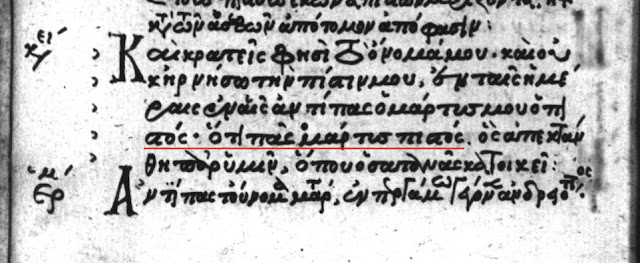
Rev 2.13 in GA 2028 (15th cent.) showing the longer reading.
What’s important is that the Syriac shows that this reading has much earlier support than the Greek evidence alone would suggest. It goes back at least to AD 616 when the Harklean Syriac was completed and probably earlier since the Crawford MS (the basis for the BFBS and Gorgias editions) likely predates the Harklean. This is thus a good example of late Greek manuscripts preserving much earlier readings. It also illustrates the benefit of keeping an eye on the versions.

None of this made it into the sermon, you’ll be relieved to know. But I wonder if some of these readings shouldn’t make it into the Nestle apparatus. The longer reading in particular belongs there not only for its exegetical significance, but because, at least transcriptionally, it can explain the shorter reading.

Monday, October 19, 2015

Rescued by Water and Salt?

9
There are a number of puzzles to resolve in 1 Peter 3.20 but I’ve come across a new one, at least with its transmission and reception. The Harklean Syriac of 1 Peter 3.20 tells of “eight souls rescued by (byadܒܝܕ) water.” Notably, the Syriac translates the debatable δι’ ὕδατος as unambiguously instrumental. But this is not what’s odd. What’s odd is the marginal reading.

1 Peter 3.20 in New College 333 showing the marginal reading after ܡ̈ܝܐ (“water”)
Marked after the word “water,” the margin has kad metmalhān ܟܕ ܡܬܡܠܚܢ which is something like “when they [the souls] were salted.” In his 1799 edition, Joseph White admits ignorance as to what was meant by this, suggesting that maybe it should be read as kad metmalāyēn ܟܕ ܡܬܡܠܝܝܢ (“when they were filled”) instead.

It looks to me (and B. Aland) like the first reading is correct which leaves me to explain the presence of “when they were salted.” Typically, the marginal readings in the Harklean text provide an alternate reading for Thomas’s main text, but here this doesn’t appear to be the case since there isn’t anything which it would naturally replace, certainly not “by the water.” And there is nothing in the ECM that would show this to be a known reading in the rest of the textual tradition; it seems to be unique to the Harklean margin.

Elsewhere Thomas does use his margin for short interpretive comments and that seems to be the best way to understand it here. But if so, how does “being salted” explain “being rescued by water”?

The only parallel to “being salted” I can think of is Mark 9.49 where the Harklean has the longer reading: “every person will be salted with fire and every sacrifice will be salted with salt.” Like the water in 1 Peter 3.20, there is debate as to whether the salt in Mark 9 is a means of judgment or a means salvation (or perhaps both). I’m wondering whether there is any history of connecting the the imagery of the flood, the salting in Mark, and possibly baptism in the Syriac tradition that Thomas might be reflecting. Or maybe I am missing some simpler explanation. It is certainly curious.

Monday, July 27, 2015

Book Review: The Gospel of Mark in the Syriac Harklean Version (2015)

8
Samer Soreshow Yohanna. The Gospel of Mark in the Syriac Harklean Version: An Edition Based upon the Earliest Witnesses. Biblica et Orientalia 52. Rome: Gregorian & Biblical Press, 2015. xi + 196. €48 (hardback); £5.75 (e-book)
“No other branch of the church has given so much effort to spread and to accurately transmit the Gospel. From the hills of Lebanon and Kurdistan, from the Mesopotamian plains and the coast of Malabar, even from faraway China, Syriac manuscripts that are valuable for textual criticism have come to the European libraries.” —Eberhard Nestle

1. Background

The Syriac speaking church has left us one of the richest traditions of Biblical translation. The translation of the New Testament starts with the Gospels as early as the second and third centuries with Tatian’s Diatessaron and the Old Syriac Gospels. The Peshitta came next and was to become the most prominent of all the Syriac translations. Even so, the heat of theological controversy led to a number of more exacting translations which were intended to help settle matters of exegetical dispute. The Philoxenian was completed in 508 and was the first to include the small Catholic Epistles and possibly Revelation, the former being all that survives to us today. The last of the major translations and the most literal was that of Thomas of Harkel who finished his work in 616, shortly after Paul of Tella’s completion of the Syro-hexepla.

Even with native Aramaic, Thomas gives
the Greek (e.g., μαραναθα in 1 Cor 16.22)
Although the youngest of the Syriac translations, the Harklean has proven to be one of the most fruitful for textual criticism. This is due to Thomas’s innovation as a translator. His colophon tells us that he based his work on the Philoxenian but revised it with the help of what he considered to be “well proven and accurate” (ܣܓܝ ܒܚܝܪܝܢ ܘܚܬܬܝܬܝܢ) Greek manuscripts. These he represents with an exacting translation style designed to give the Syriac reader as much access to the Greek as possible. To this end he adopted the text critical symbols made famous by Origen (the asterisk, metobelus, and obelus) to mark words not found in his Greek manuscripts but either required by Syriac idiom or found in his Philoxenian predecessor. In the margin he adds more detail, supplying textual variants, translation notes, word meanings, and often simply giving the Greek word itself. In short, Thomas holds the distinction of producing the very first critical edition of the Syriac New Testament.

Friday, March 10, 2006

Foundations for Syriac Lexicography I

3
A. Dean Forbes and David G.K. Taylor, eds, have just brought out the volume Foundations for Syriac Lexicography I: Colloquia of the International Syriac Language Project (Piscataway: Gorgias Press, 2005). It contains much that is of interest to Syriasts and lexicographers with contibutors such as Terry Falla, Alison Salvesen, George Kiraz, Dean Forbes, Janet Dyk, Andreas Juckel and Sebastian Brock. Perhaps I may be forgiven for drawing attention to my own contribution, which is probably the one most relevant to textual criticism. It is: 'On Matching Syriac Words with Their Greek Vorlage' (pp. 157-166). Andreas Juckel, Syriac expert at the INTF in Münster, writes on 'Should the Harklean Version Be Included in a Future Lexicon of the Syriac New Testament' (pp. 167-194), which, despite the title, also includes material of text-critical interest.